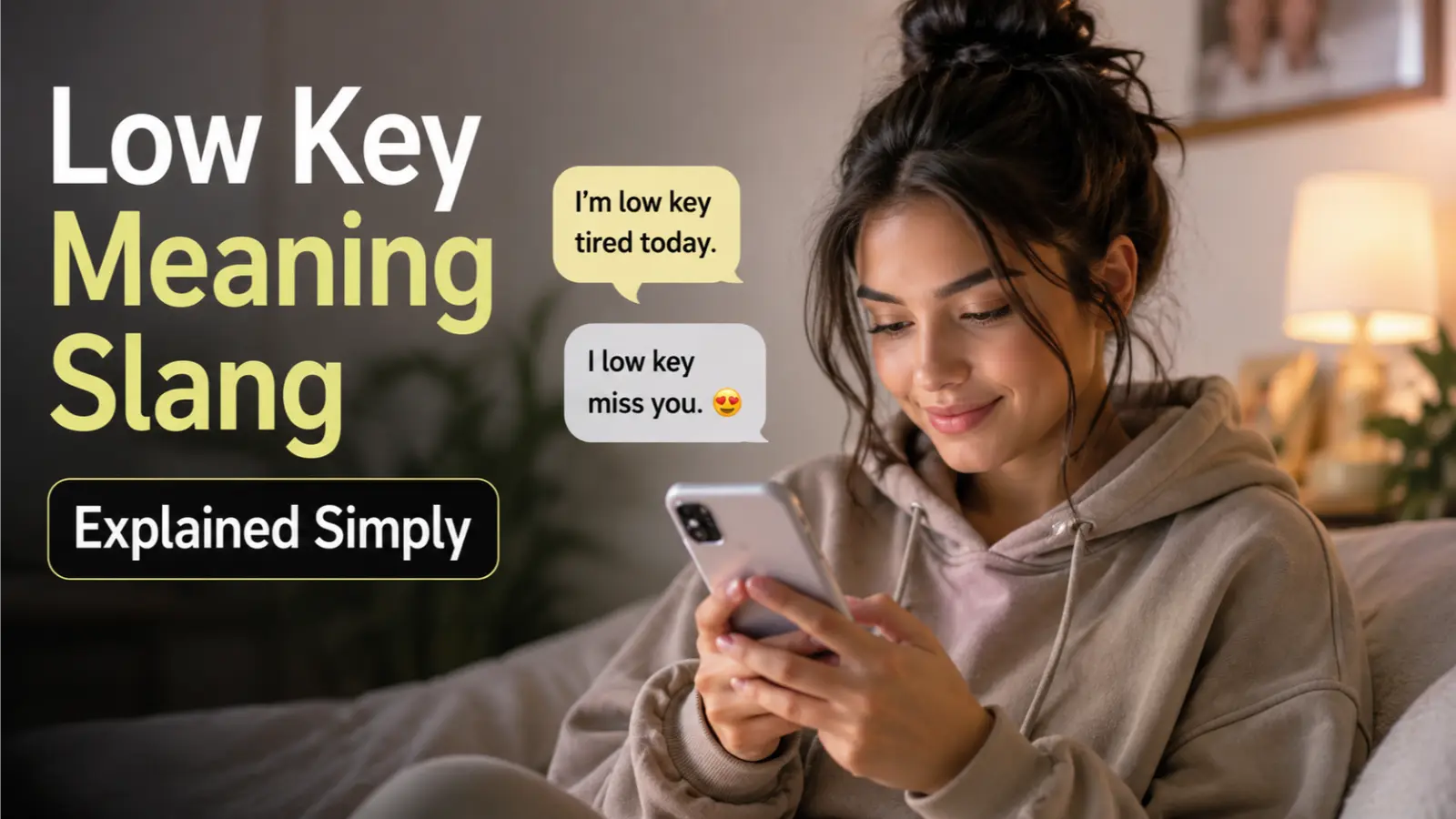
Low key meaning slang is one of the most searched internet expressions because people often see it in text messages, TikTok videos, Instagram captions, X (formerly Twitter), and online chats.
If someone says, “I’m low key excited,” or “I low key want pizza,” you may wonder whether they are trying to hide their feelings or simply speaking casually.
The phrase low key has become a popular slang expression that helps people express emotions in a subtle, relaxed, or understated way. Instead of making a strong statement, it softens what someone is saying while still revealing their true feelings.
Understanding this slang can help you communicate naturally online and avoid misunderstanding what others mean.
Quick Answer
Low key is a slang term that means slightly, secretly, quietly, or honestly feeling something without making a big deal about it. It is usually friendly, casual, and not considered offensive.
What Does Low Key Mean in Text?
In texting and online conversations, low key means that someone feels a certain way but doesn’t want to sound dramatic or overly emotional.
It often suggests that the speaker is:
- Quietly admitting something
- Secretly liking something
- Feeling something without exaggerating it
- Being honest in a relaxed way
Example
“I’m low key nervous about tomorrow.”
Meaning:
“I’m a little nervous, but I’m not making a big deal out of it.”
Low Key Full Form
Many people search for low key full form, but the truth is that low key is not an acronym.
It does not stand for separate words.
Instead, it is an English expression that originally described something quiet or understated before becoming modern internet slang.
Low Key Meaning in Different Contexts
In Text Messages
People use low key to express hidden thoughts or mild emotions.
Example:
“I low key miss school.”
Meaning:
The person secretly or quietly misses school.
On Social Media
Influencers and everyday users often use the phrase in captions.
Example:
“Low key proud of myself.”
It means they feel proud but don’t want to appear boastful.
Among Friends
Friends commonly use it during casual conversations.
Example:
“I low key want to stay home tonight.”
This means they quietly prefer staying home instead of going out.
In Dating
The phrase often hints at hidden attraction.
Example:
“He’s low key cute.”
Meaning:
The speaker thinks the person is attractive but says it casually.
Is Low Key Rude, Offensive, or Neutral?
Low key is generally considered neutral and polite.
It is:
- ✅ Casual
- ✅ Friendly
- ✅ Social media safe
- ✅ Appropriate with friends
It is not a rude or offensive expression.
However, because it is informal slang, it may not be suitable for:
- Academic writing
- Business emails
- Professional reports
- Formal presentations
Where Is Low Key Commonly Used?
You’ll often see this slang on:
- Text messages
- TikTok
- Snapchat
- X (Twitter)
- Discord
- Online gaming chats
Young adults and teenagers use it frequently, but many adults have adopted it as well.
Real-Life Conversation Examples
Friendly
Emma: Want to watch a movie?
Jake: I low key do.
Meaning:
Jake quietly wants to watch one.
Casual
“I low key love rainy days.”
Meaning:
The speaker enjoys rainy weather without making a dramatic statement.
Argumentative
“You low key ignored my messages.”
Meaning:
The speaker believes the other person quietly or subtly ignored them.
School
“I’m low key worried about the exam.”
Meaning:
The student feels nervous but isn’t panicking.
Workplace
“I’m low key excited about the new project.”
Meaning:
The employee feels positive while staying modest.
Emotional and Psychological Meaning
Using low key often reflects how people manage emotions.
Instead of expressing feelings strongly, they soften their words.
People use it to:
- Avoid sounding dramatic
- Reduce embarrassment
- Express honesty comfortably
- Sound relaxed
- Protect themselves emotionally
It makes conversations feel more natural and less intense.
Origin and Background of Low Key
The phrase low key originally described things that were quiet, subtle, or not very noticeable.
For example:
- Low-key lighting in photography
- A low-key event with few guests
Over time, younger generations transformed the expression into internet slang.
Today it usually means:
- Secretly
- Slightly
- Quietly
- Honestly
without attracting too much attention.
Low Key vs Similar Slang
| Slang | Meaning | Tone | Example |
|---|---|---|---|
| Low key | Quietly or secretly feel something | Mild | “I low key like this song.” |
| High key | Openly or strongly feel something | Strong | “I high key love this movie.” |
| Honestly | Truthfully | Neutral | “Honestly, I agree.” |
| Kind of | Somewhat | Soft | “I’m kind of tired.” |
| Secretly | Without telling others | Direct | “I secretly wanted to win.” |
When to Use Low Key
Use it when:
- Talking with friends
- Posting on social media
- Sending casual text messages
- Making relaxed conversation
- Sharing small emotions
Examples:
- “I’m low key hungry.”
- “I low key enjoyed the show.”
- “I’m low key excited.”
When to Avoid Using It
Avoid using low key in formal situations like:
- Job applications
- Business emails
- Academic essays
- Legal documents
- Professional presentations
Instead, choose standard English.
Example:
Instead of:
“I’m low key interested.”
Say:
“I’m genuinely interested.”
Polite Alternatives
If you want a more formal expression, try:
- Somewhat
- Slightly
- Quietly
- Honestly
- Genuinely
- Personally
- In my opinion
- Secretly
These alternatives work well in professional communication.
Why People Use This Slang
People enjoy using low key because it sounds:
- Relaxed
- Friendly
- Honest
- Modern
- Less dramatic
It allows someone to admit feelings without sounding overly emotional.
For example:
“I’m low key proud of myself.”
This feels softer than saying:
“I’m extremely proud of myself.”
Impact of Using Slang in Communication
Slang like low key makes conversations feel natural and relatable.
Benefits include:
- Building friendships
- Creating casual conversations
- Showing personality
- Making messages sound less formal
However, using too much slang in professional settings can make communication seem less polished.
Balance is important.
Is Low Key Safe for Social Media?
Yes.
Low key is considered safe across most social media platforms.
It contains:
- No offensive language
- No profanity
- No hate speech
- No inappropriate meaning
It is widely accepted in online communities.
Common Misunderstandings
Some people mistakenly think low key always means secret.
Not exactly.
Depending on context, it can also mean:
- Slightly
- Quietly
- Honestly
- Without exaggeration
Example:
“I’m low key tired.”
This usually means:
“I’m a little tired.”
It doesn’t necessarily mean the person is hiding it.
Variations and Types
You may see these common variations:
- Low key excited
- Low key obsessed
- Low key funny
- Low key cute
- Low key mad
- Low key jealous
- Low key happy
- Low key scared
All follow the same basic meaning—expressing feelings in a subtle or understated way.
How to Respond When Someone Uses Low Key
Here are some natural responses.
If someone says:
“I’m low key nervous.”
You could reply:
- “You’ll do great!”
- “I understand.”
- “You’ve got this.”
If someone says:
“I low key love this song.”
You might answer:
- “Me too!”
- “Same here.”
- “It’s really good.”
Regional and Cultural Usage
Although low key began in English-speaking communities, it is now widely used around the world.
It is especially popular in:
- United States
- Canada
- United Kingdom
- Australia
- New Zealand
Many non-native English speakers also use it because of social media, movies, music, and online gaming.
Frequently Asked Questions
What does low key mean in slang?
It means quietly, secretly, or slightly feeling something without making a big deal about it.
What does low key stand for?
It does not stand for anything. It is a regular English expression, not an abbreviation.
Is low key a compliment?
Sometimes. Saying someone is “low key funny” or “low key amazing” is usually meant as a compliment.
Is low key offensive?
No. It is generally considered neutral, polite, and safe for casual conversations.
What is the opposite of low key?
The opposite is high key, which means openly, strongly, or obviously expressing something.
Can adults use low key?
Yes. Although younger people use it more often, adults also use it in casual conversations and online communication.
Conclusion
The low key meaning slang is simple once you understand its purpose. It describes expressing thoughts or emotions in a quiet, subtle, or understated way. Whether someone says they are low key excited, low key nervous, or low key happy, they are usually sharing a genuine feeling without sounding overly dramatic.
Because low key is friendly, neutral, and widely understood, it works well in text messages, social media posts, and everyday conversations. Just remember to avoid it in formal writing or professional communication where standard English is more appropriate. Knowing how and when to use this popular slang will help you communicate more naturally and confidently online.