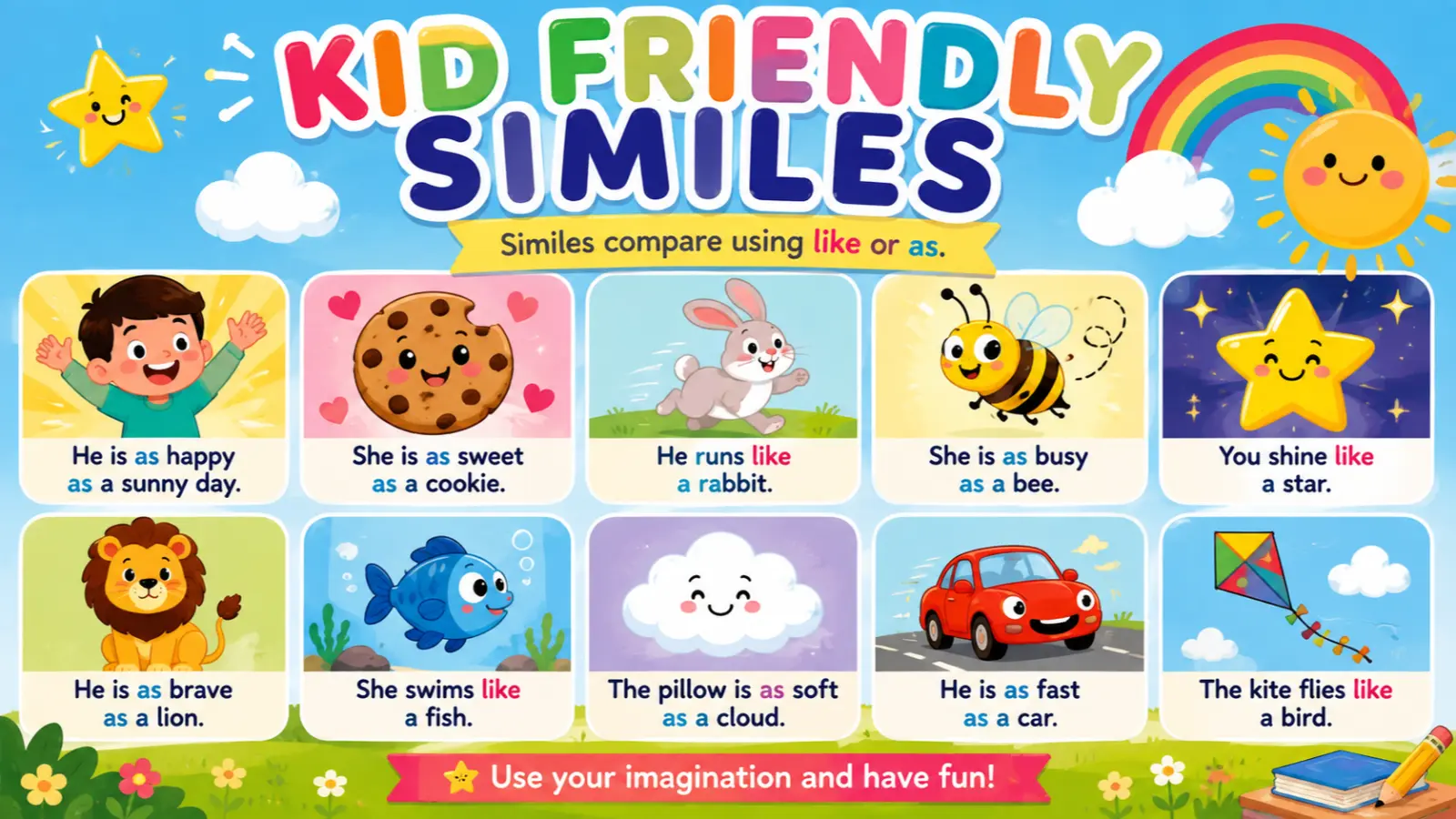
Kid Friendly Similes make ordinary writing more colorful by comparing one thing to another using words such as like or as. Instead of saying “the puppy was excited,” a writer might say, “The puppy bounced like a spring.”
For children, similes are especially useful because they turn abstract feelings, sounds, movements, and descriptions into pictures readers can imagine. Kid Friendly Similes can use them in stories, poems, school assignments, conversations, songs, and creative writing.
This guide focuses on kid friendly similes that are easy to understand but still imaginative. Along the way, you’ll learn why each comparison works, how to use it naturally, and how to create original similes of your own.
What Is a Simile for Kids?
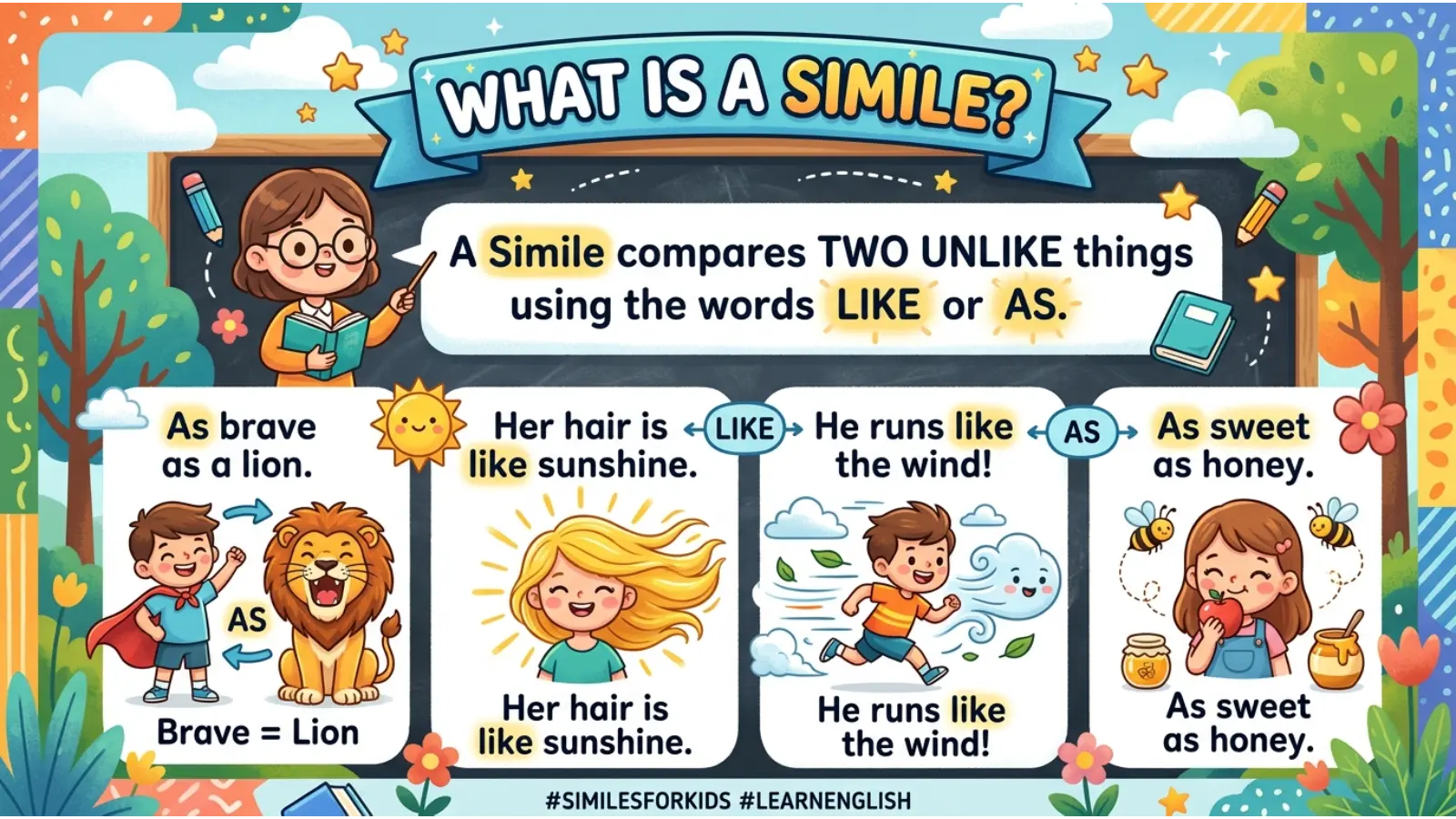
A Kid Friendly Similes is a comparison between two different things, usually using like or as.
For example:
The little boat rocked like a cradle.
The boat isn’t actually a cradle. The comparison helps readers imagine its gentle movement.
Another example is:
Her Kid Friendly Similes was as bright as a window in the morning.
The comparison gives the reader a clearer image than simply saying that she smiled brightly.
Why Do Kids Use Similes?
Kid Friendly Similes can help young writers:
- Make descriptions more interesting
- Show emotions without simply naming them
- Create stronger pictures in a reader’s mind
- Add personality to stories
- Make poems more memorable
- Describe characters, animals, weather, and places
- Have fun experimenting with language
The strongest Kid Friendly Similes don’t just decorate a sentence. They give the reader something useful to imagine.
30 Kid Friendly Similes Young Writers Can Use
1. As Bouncy as a Rubber Ball
Meaning: Extremely energetic and full of movement.
Example:
Mia was as bouncy as a rubber ball after hearing the good news.
This works because a rubber ball instantly suggests quick, lively movement.
Best context: Happy characters, exciting moments, playground scenes, and children’s stories.
Writing tip: Use movement-based comparisons when you want a character’s energy to feel visible.
2. Like a Lantern in the Dark
Meaning: Something that brings comfort, hope, or brightness.
Example:
Grandpa’s kind words were like a lantern in the dark.
This simile can describe a person, idea, smile, or helpful action.
Emotional effect: Warm and reassuring.
Best context: Stories about friendship, family, encouragement, or solving problems.
3. As Quiet as a Snowy Morning
Meaning: Very peaceful and quiet.
Example:
The classroom was as quiet as a snowy morning while everyone read.
Rather than simply saying “quiet,” the comparison creates an atmosphere.
Writing tip: Choose a familiar scene that carries the feeling you want.
4. Like a Kite Chasing the Wind
Meaning: Moving freely, playfully, or unpredictably.
Example:
The red scarf danced like a kite chasing the wind.
The unusual comparison adds movement to an otherwise simple scene.
Best context: Outdoor descriptions, poems, and imaginative stories.
5. As Warm as a Blanket from the Dryer
Meaning: Comfortingly warm.
Example:
The puppy felt as warm as a blanket from the dryer in Lily’s arms.
This works particularly well because children can easily recognize the sensation.
Writing tip: Everyday experiences often make the most understandable similes for young readers.
6. Like Popcorn in a Pan
Meaning: Jumping, moving, or appearing quickly in many places.
Example:
The children scattered like popcorn in a pan when the bell rang.
Why it works: Popcorn gives the reader a strong sense of sudden, energetic movement.
Best context: Funny scenes and fast-paced stories.
7. As Curious as a Cat at a New Window
Meaning: Very interested in discovering something unfamiliar.
Example:
Noah was as curious as a cat at a new window when he saw the mysterious box.
This is useful when a character wants to investigate something.
8. Like a Pencil Dancing Across Paper
Meaning: Writing quickly, smoothly, or enthusiastically.
Example:
Her pencil moved like it was dancing across the paper.
Best context: School stories, poems, journals, and descriptions of creative work.
9. As Slippery as a Soap Bubble
Meaning: Difficult to hold onto or control.
Example:
The wet ball was as slippery as a soap bubble.
The comparison is playful while still communicating the physical quality.
10. Like a Firefly in a Field
Meaning: Small but noticeable or beautiful.
Example:
The yellow flower stood out like a firefly in a field.
Emotional effect: Gentle, magical, and peaceful.
Best context: Nature writing and children’s poetry.
11. As Proud as a Rooster at Sunrise
Meaning: Feeling very proud of an accomplishment.
Example:
After finishing his first model airplane, Ben stood as proud as a rooster at sunrise.
This gives the character a humorous visual quality.
12. Like Marbles Rolling Down Stairs
Meaning: Moving quickly, noisily, and unpredictably.
Example:
The kids’ laughter bounced through the hallway like marbles rolling down stairs.
Writing purpose: This is especially useful for describing sound and movement together.
13. As Soft as a Feather Pillow
Meaning: Extremely soft and comfortable.
Example:
The kitten’s fur felt as soft as a feather pillow.
This is a straightforward comparison that works well for younger readers.
14. Like a Secret Waiting to Be Opened
Meaning: Mysterious, exciting, or full of possibility.
Example:
The old wooden door stood like a secret waiting to be opened.
Best context: Adventure stories, mysteries, and imaginative fiction.
This comparison gives an ordinary object a sense of mystery.
15. As Quick as a Raindrop on Glass
Meaning: Moving very quickly.
Example:
The little lizard was as quick as a raindrop on glass.
Instead of using the common “quick as lightning,” this comparison gives the sentence a fresher image.
16. Like a Drumbeat in My Chest
Meaning: A feeling that is strong, noticeable, or exciting.
Example:
Excitement thumped like a drumbeat in my chest before the race.
Emotional effect: Energetic and suspenseful.
Writing tip: Comparing emotions to physical sensations can make feelings easier for readers to experience.
17. As Bright as a Window Full of Morning
Meaning: Cheerful, glowing, or full of light.
Example:
Her room looked as bright as a window full of morning.
This works particularly well in descriptive and poetic writing.
18. Like Leaves Playing Tag
Meaning: Moving around playfully in the wind.
Example:
The leaves spun across the yard like children playing tag.
Best context: Autumn scenes, outdoor stories, and poems.
The comparison gives nature a playful quality without requiring a complicated description.
19. As Hungry as a Bear After a Hike
Meaning: Very hungry.
Example:
After the long walk, we were as hungry as bears after a hike.
The familiar animal comparison makes the meaning immediately clear.
20. Like a Drumroll Before a Surprise
Meaning: Creating anticipation or excitement.
Example:
The silence felt like a drumroll before a surprise.
Best context: Birthday stories, competitions, mysteries, and dramatic moments.
21. As Gentle as Rain on a Roof
Meaning: Soft, calm, and soothing.
Example:
Her voice was as gentle as rain on a roof.
This comparison uses sound to communicate personality.
Writing tip: You don’t always need to compare appearance. Sounds, smells, textures, and feelings can all inspire similes.
22. Like a Rocket with No Snooze Button
Meaning: Extremely energetic and difficult to slow down.
Example:
My little brother was like a rocket with no snooze button all morning.
This is intentionally humorous.
Best context: Funny stories, family writing, and informal descriptions.
23. As Nervous as a Bird Before Its First Flight
Meaning: Very nervous about something new.
Example:
I felt as nervous as a bird before its first flight before walking onto the stage.
The comparison works because it connects nervousness with an important first experience.
24. Like Chocolate Melting in the Sun
Meaning: Becoming softer, calmer, or less tense.
Example:
His angry expression disappeared like chocolate melting in the sun after his friend apologized.
Best context: Stories involving changing emotions.
This is particularly useful because the comparison shows a change rather than simply naming it.
25. As Steady as a Clock’s Tick
Meaning: Consistent and dependable.
Example:
Her footsteps were as steady as a clock’s tick as she walked toward the finish line.
Writing purpose: Good for showing determination, rhythm, and persistence.
26. Like a Book with a Missing Ending
Meaning: Unfinished, mysterious, or leaving questions unanswered.
Example:
The strange message felt like a book with a missing ending.
Best context: Mysteries and stories involving unanswered questions.
27. As Cheerful as a Bird on a Spring Morning
Meaning: Very happy and lively.
Example:
Ella arrived at school as cheerful as a bird on a spring morning.
The comparison creates an immediately positive mood.
28. Like Stars Practicing Their Sparkle
Meaning: Small lights appearing or flickering beautifully.
Example:
The city lights twinkled like stars practicing their sparkle.
Best context: Nighttime descriptions and children’s poetry.
29. As Stubborn as a Backpack Full of Rocks
Meaning: Extremely difficult to move or change.
Example:
The stuck door was as stubborn as a backpack full of rocks.
This playful comparison can make a frustrating situation funny.
30. Like a Rainbow After a Long Storm
Meaning: A welcome moment of happiness or hope after difficulty.
Example:
Seeing her friends again felt like a rainbow after a long storm.
Emotional effect: Hopeful and uplifting.
Best context: Stories about overcoming problems, friendship, and positive change.
How to Make a Simile More Vivid
A weak simile usually compares something with an idea that is too general.
For example:
The boy was happy like a happy person.
The comparison adds almost nothing.
A stronger version might be:
The boy was as excited as a kite suddenly catching the wind.
The second sentence gives readers movement and energy.
Choose Comparisons That Add Information
Before using a simile, ask:
What does this comparison help my reader see, hear, feel, or understand?
If the answer is “nothing new,” replace it.
Compare:
The rain was like water.
with:
The rain tapped against the window like tiny fingers asking to come inside.
The second comparison adds sound, movement, and personality.
Use Familiar Things for Younger Readers
Kid-friendly writing works best when the comparison is easy to picture.
Good sources include:
- Toys
- Animals
- Food
- Sports
- School
- Weather
- Nature
- Family life
- Games
- Everyday objects
You can become more imaginative without making the comparison confusing.
How Kids Can Create Their Own Similes
Creating a simile is easier when you start with the quality you want to describe.
Step 1: Pick the subject
Choose something simple:
A puppy
Step 2: Identify its quality
Ask what you want to show:
The puppy is energetic.
Step 3: Think of something with the same quality
Maybe:
A bouncing ball
Step 4: Connect the ideas
The puppy bounced like a rubber ball.
Step 5: Make the image more personal
Now try another comparison:
The puppy raced around the room like a tiny athlete who had forgotten the finish line.
The second version creates more personality.
A Simple Simile Exercise for Kids
Choose one word from each column and combine the ideas.
| Thing to Describe | Quality | Possible Comparison |
|---|---|---|
| A dog | Excited | A bouncing ball |
| A classroom | Quiet | A snowy morning |
| A runner | Fast | A darting bird |
| A friend | Kind | A warm blanket |
| Rain | Gentle | Fingers tapping glass |
| A mystery | Strange | A locked treasure chest |
Then write your own sentence.
For example:
The classroom was as quiet as a snowy morning.
Try creating three different comparisons for the same subject. This teaches an important writing lesson: there is rarely only one possible simile.
How to Avoid Boring or Overused Similes
Some comparisons are so common that readers barely notice them.
Examples include familiar phrases such as:
- As busy as a bee
- As cold as ice
- As fast as lightning
- As quiet as a mouse
These aren’t wrong. They can be useful when clarity matters. But young writers should also practice inventing fresh comparisons.
Instead of:
The runner was as fast as lightning.
Try:
The runner shot forward like a shoelace suddenly coming untied.
The second image is stranger and more surprising, which can give the sentence personality.
The goal isn’t to avoid every familiar simile. The goal is to know when a familiar comparison feels appropriate and when an original one would be stronger.
Similes Can Show Emotions
One of the most useful skills for a young writer is learning to show emotions instead of repeatedly naming them.
Instead of:
Sam was nervous.
Try:
Sam’s thoughts jumped around like popcorn in a pan.
Instead of:
Maya was very happy.
Try:
Maya’s excitement rose like a kite catching a strong breeze.
Instead of:
He was angry.
Try:
His anger felt like a kettle beginning to whistle.
The comparison gives readers something to experience rather than simply telling them the character’s emotional label.
Similes in Stories
Similes can help describe characters, settings, action, and mood.
Consider this plain sentence:
The storm arrived.
A more vivid version might be:
The storm rolled across the sky like a giant curtain being pulled shut.
The second sentence changes the way readers picture the event.
Don’t Put a Simile in Every Sentence
Too many comparisons can make writing feel crowded.
A useful rule for young writers is to let your strongest images stand out. If every sentence contains a simile, none of them feels especially important.
Use a simile when it adds something worth noticing.
Similes in Poetry
Poetry often uses similes because comparisons can compress a large idea into a few words.
For example:
The moon hung above the trees
like a silver button on the night.
The comparison gives the moon a shape, position, and visual quality.
When writing a poem, experiment with comparisons involving:
- Light
- Sound
- Movement
- Nature
- Memories
- Feelings
- Colors
- Seasons
A good poetic simile doesn’t need to be complicated. It needs to create an image that feels meaningful.
Simile, Metaphor, and Other Literary Devices
Similes are closely related to several other writing techniques, but they aren’t identical.
Simile vs. Metaphor
A simile makes a direct comparison using words such as like or as:
The moon was like a silver coin.
A metaphor makes the comparison directly:
The moon was a silver coin in the sky.
Both create imagery, but they do it differently.
Simile and Personification
Personification gives human qualities to nonhuman things.
The wind whispered through the trees.
A simile could describe that same wind differently:
The wind sounded like someone whispering a secret.
The first gives the wind a human action. The second compares its sound to something familiar.
Simile and Hyperbole
Hyperbole uses deliberate exaggeration.
I’ve told you a million times.
A simile compares two things:
His backpack felt as heavy as a mountain.
A sentence can sometimes use both techniques, but they serve different purposes.
Simile and Imagery
Imagery is the broader technique of creating sensory pictures through language. Similes are one tool writers can use to create that imagery.
Common Simile Mistakes Kids Should Avoid
The Comparison Doesn’t Make Sense
The teacher was as quiet as a loud trumpet.
The two ideas contradict each other.
Ask whether the qualities of both sides actually connect.
The Simile Is Too Complicated
A comparison with five different ideas can confuse readers.
Keep the central image clear.
The Simile Is Forced
If a comparison sounds strange only because you’re trying to include one, remove it.
A plain sentence is better than an awkward simile.
The Writer Mixes Images
Be careful when combining unrelated comparisons:
The idea flew like a heavy mountain climbing through a sea of pencils.
The reader doesn’t know what image to focus on.
Choose one strong picture instead.
The Comparison Repeats the Same Meaning
She was happy like a happy girl.
A simile should add a new image or quality.
The Simile Is Used When It Isn’t Needed
Not every sentence needs figurative language.
Sometimes:
The dog ran across the yard.
is stronger than a complicated comparison.
Good writers know when to use imagery—and when to keep things simple.
Fun Ways to Practice Similes
The Five-Senses Challenge
Choose an ordinary object, such as an apple.
Describe it using comparisons involving:
- Sight
- Sound
- Smell
- Taste
- Touch
For example:
The red skin shone like a tiny polished ornament.
This exercise teaches writers to look beyond obvious visual comparisons.
The Three-Comparison Challenge
Choose one subject and create three different similes.
For rain, you might compare it to:
- Fingers tapping on glass
- Beads sliding down a window
- A curtain falling from the clouds
Then choose the comparison that best matches the mood of your scene.
Make a Boring Sentence Better
Start with:
The playground was busy.
Now add an image:
The playground buzzed like a box of excited bees.
Then try to invent something more original:
The playground sounded like a hundred sneakers racing toward recess.
The exercise shows how revision can make writing more specific.
How Professional Writers Choose Better Comparisons
Experienced writers don’t simply ask, “What is this like?”
They ask more specific questions:
What does it move like?
A does it sound like?
A texture does it suggest?
What memory does it bring to mind?
A emotion should the reader feel?
What unexpected object shares this quality?
That last question can lead to especially memorable writing.
Suppose you’re describing a nervous character. Instead of immediately choosing “butterflies,” look around for other things that tremble, bounce, shake, race, or hesitate.
A fresh comparison often begins with a fresh question.
FAQ About Kid Friendly Similes
What is a simple simile for kids?
A simple simile compares two things using like or as. For example: “The puppy was as playful as a bouncing ball.”
What are some fun similes for children?
Fun similes can compare everyday things with animals, toys, food, weather, sports, or nature. For example: “The children scattered like popcorn in a pan.”
How do you teach a child to write a simile?
Start with one object, identify a quality it has, and then find another familiar object with the same quality. Connect them with like or as.
Can a simile start with “like”?
Yes. For example: “Like a kite chasing the wind, the scarf danced above the fence.” A simile can also appear after the subject: “The scarf danced like a kite chasing the wind.”
What is the difference between a simile and a metaphor for kids?
A simile usually uses like or as to compare things. A metaphor makes the comparison directly. “The moon is like a coin” is a simile, while “The moon is a coin” is a metaphor.
Should every sentence in a children’s story have a simile?
No. Too many comparisons can make writing feel crowded. Use similes when they make an important description clearer, more vivid, funnier, or more emotional.
How can kids make original similes?
Start with an ordinary subject, identify its most important quality, and brainstorm unusual objects that share that quality. Then choose the comparison that creates the clearest picture.
Are common similes bad for children’s writing?
Not at all. Familiar similes can be clear and useful. However, practicing original comparisons helps children develop stronger descriptive writing and a more individual voice.
Conclusion
Kid friendly similes give young writers a simple way to make ordinary sentences more vivid. A puppy can become a bouncing ball, a quiet room can resemble a snowy morning, and nervous thoughts can move like popcorn in a pan. The real skill isn’t memorizing dozens of comparisons. It’s learning why a comparison works and knowing how to invent one that fits the moment. When you write your next story, poem, or school assignment, choose one ordinary sentence and ask yourself: What could this be like? Then look beyond the first answer. The most memorable simile may be hiding somewhere unexpected.
I am Helena Frost, a writer captivated by the beauty of language and the art of comparison. Through my words, I explore the world by turning ordinary moments into vivid similes and reflections. I enjoy crafting phrases that spark imagination, evoke emotion, and linger in the mind. My writing celebrates the subtle connections between people, nature, and the stories we live. For me, every sentence is an opportunity to reveal the extraordinary in the everyday.