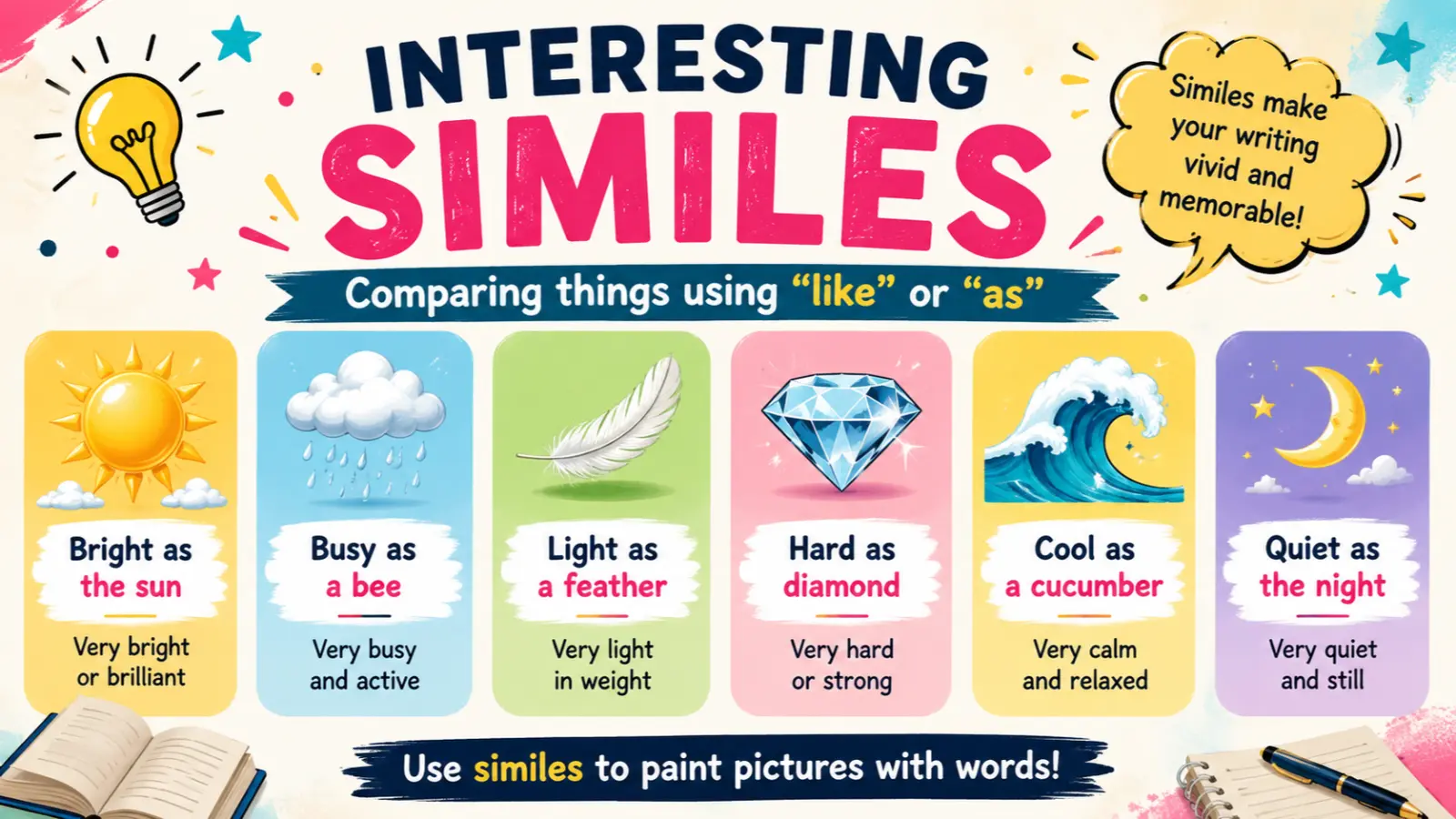
Interesting Similes s make ordinary descriptions more expressive by comparing one thing to another using words such as like or as. Instead of saying that a room was quiet, a writer might say it was as quiet as a library after closing time. The comparison gives the reader something concrete to imagine.
Interesting similes are especially useful when a familiar description feels flat. They can add humor, emotion, atmosphere, personality, and rhythm to stories, poems, essays, speeches, and everyday conversation.
The strongest similes do more than decorate a sentence. They Interesting Similes reveal something about the subject and guide the reader toward a particular feeling or image. This collection offers fresh examples while showing how you can build your own.
What Makes a Simile Interesting?
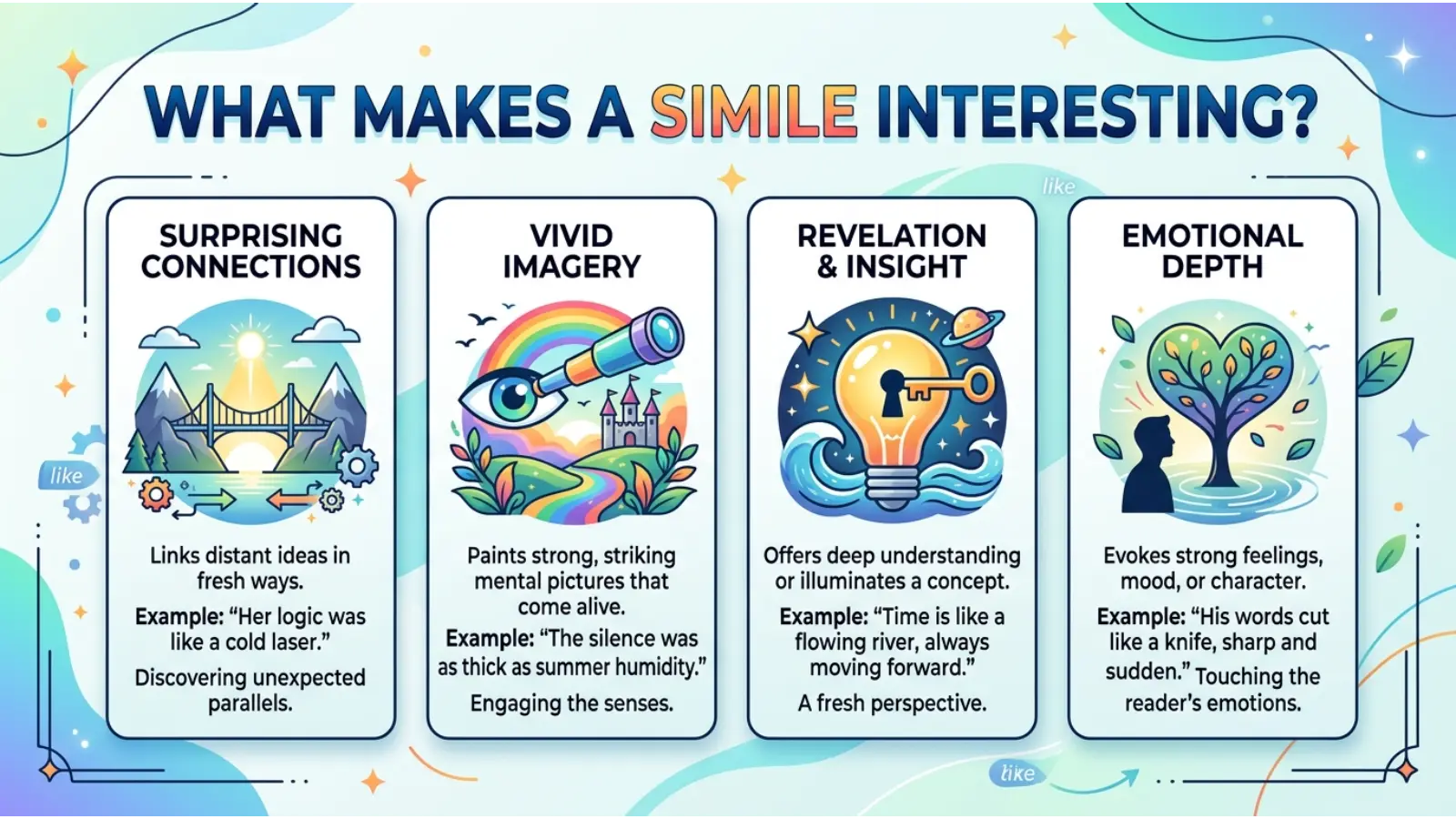
An interesting simile creates a connection the reader can understand but may not have expected.
Compare these two sentences:
The street was busy.
The street buzzed like a beehive that had forgotten where it parked its car.
The Interesting Similes second version is more playful and specific. It gives the scene movement and personality.
A useful Interesting Similes usually has three qualities:
- Clarity: The reader can understand the comparison.
- Specificity: The image contains meaningful details.
- Purpose: The comparison adds emotion, atmosphere, humor, or insight.
A Interesting Similes surprising comparison is not automatically a good one. If the connection feels random, the reader may stop thinking about the scene and start wondering what the writer meant.
30 Interesting Similes for Creative Writing
1. As restless as a clock that refuses to tick
Meaning: Extremely impatient or unable to settle down.
Example:
Mia was as restless as a clock that refuses to tick while she waited for the results.
This comparison works because a clock normally represents steady movement through time. Removing that movement creates a feeling of frustrating anticipation.
Best context: Suspense, waiting, nervousness, and impatient characters.
Writing tip: Use objects associated with a particular behavior, then imagine what would happen if that behavior suddenly stopped.
2. Like sunlight spilling through an open window
Meaning: Warm, welcome, or gradually uplifting.
Example:
Her laughter entered the room like sunlight spilling through an open window.
This Interesting Similes connects laughter with warmth and brightness without simply calling it “happy.”
Best context: Positive emotions, character descriptions, poetry, and reflective writing.
Writing tip: When describing an emotion, consider comparing it with something readers can physically experience.
3. As sharp as a question nobody wanted to answer
Meaning: Uncomfortably direct or piercing.
Example:
His final remark was as sharp as a question nobody wanted to answer.
The comparison gives an abstract quality—sharpness—to an uncomfortable social moment.
Best context: Dialogue, essays, dramatic scenes, and character interactions.
4. Like a paper boat carrying a stone
Meaning: Trying to handle something far beyond one’s ability or resources.
Example:
Taking on three major projects at once felt like a paper boat carrying a stone.
The image suggests fragility and an impossible burden.
Best context: Personal essays, storytelling, and descriptions of difficult situations.
5. As bright as a secret finally told
Meaning: Filled with sudden relief, excitement, or emotional openness.
Example:
Her face became as bright as a secret finally told.
The simile connects brightness with the emotional release that comes from no longer hiding something.
Best context: Character development and emotional writing.
6. Like footsteps disappearing in fresh snow
Meaning: Something that quickly fades or becomes difficult to remember.
Example:
The argument seemed important that night, but its details vanished like footsteps disappearing in fresh snow.
The image communicates disappearance without simply saying that the memory faded.
Best context: Reflective writing, memories, endings, and nostalgia.
7. As crowded as thoughts before an important decision
Meaning: Extremely busy or full.
Example:
The station was as crowded as thoughts before an important decision.
This comparison works particularly well because it combines a physical scene with an internal experience.
Best context: Travel scenes, emotional essays, and storytelling.
8. Like a match trying to outshine the sun
Meaning: Attempting something impressive but hopelessly beyond one’s power.
Example:
Arguing with her was like a match trying to outshine the sun.
The contrast between a tiny flame and the sun creates a clear sense of imbalance.
Best context: Humor, conflict, competition, and character descriptions.
9. As patient as a tree waiting for spring
Meaning: Calmly waiting for change.
Example:
He remained as patient as a tree waiting for spring.
The comparison uses nature to communicate patience without making the description abstract.
Best context: Inspirational writing, poetry, and stories about perseverance.
10. Like a sentence with its most important word missing
Meaning: Incomplete or strangely unsatisfying.
Example:
The unfinished painting looked like a sentence with its most important word missing.
This simile is useful because readers immediately understand what it feels like when something essential is absent.
Best context: Art, unfinished work, relationships, and reflective writing.
11. As awkward as a penguin at a dance lesson
Meaning: Extremely uncomfortable or clumsy in a social situation.
Example:
I felt as awkward as a penguin at a dance lesson during my first presentation.
The unexpected image gives the sentence a humorous tone.
Best context: Funny stories, personal writing, and informal conversation.
12. Like thunder trapped inside a teacup
Meaning: Powerful emotion contained in a small or controlled setting.
Example:
His anger sounded like thunder trapped inside a teacup.
The contrast between thunder and a tiny teacup creates tension.
Best context: Dialogue, emotional scenes, and poetry.
13. As fragile as a promise written in pencil
Meaning: Easily broken, changed, or forgotten.
Example:
Their agreement felt as fragile as a promise written in pencil.
The simile suggests uncertainty without explicitly explaining it.
Best context: Relationships, trust, agreements, and serious storytelling.
14. Like a radio searching for one clear station
Meaning: Confused, distracted, or unable to focus.
Example:
My thoughts were like a radio searching for one clear station.
The comparison turns mental confusion into something readers can visualize.
Best context: School writing, personal essays, creative nonfiction, and dialogue.
15. As heavy as a backpack filled with unfinished decisions
Meaning: Emotionally burdensome.
Example:
The choice felt as heavy as a backpack filled with unfinished decisions.
The physical weight of a backpack helps communicate an invisible emotional burden.
Best context: Character development and reflective writing.
16. Like a candle arguing with the wind
Meaning: Trying to maintain something fragile against strong opposition.
Example:
His confidence was like a candle arguing with the wind.
The image suggests vulnerability while still showing determination.
Best context: Conflict, perseverance, and emotional storytelling.
17. As quick as a rumor in a small town
Meaning: Spreading or moving extremely fast.
Example:
News of the surprise party traveled as quick as a rumor in a small town.
This comparison works because it connects speed with a familiar social experience.
Best context: Humor, dialogue, and storytelling.
18. Like an old photograph waking up
Meaning: A memory or scene suddenly becoming vivid again.
Example:
When she returned to the neighborhood, childhood memories came alive like an old photograph waking up.
The simile gives a static photograph an unexpected sense of life.
Best context: Nostalgia, memoir-style writing, and emotional scenes.
19. As stubborn as a door that has forgotten its hinges
Meaning: Extremely difficult to move, change, or persuade.
Example:
The old gate was as stubborn as a door that had forgotten its hinges.
The unusual comparison adds humor to an ordinary object.
Best context: Descriptive writing and lighthearted storytelling.
20. Like a puzzle missing the piece in the middle
Meaning: Confusing or incomplete.
Example:
His explanation was like a puzzle missing the piece in the middle.
It tells readers that something essential is absent while keeping the description simple.
Best context: Essays, dialogue, mysteries, and explanations.
21. As nervous as a bird inside a library
Meaning: Extremely uncomfortable in an unfamiliar environment.
Example:
I was as nervous as a bird inside a library before the audition.
The quiet setting and restless animal create an amusing contrast.
Best context: Personal narratives and humorous writing.
22. Like rain tapping on a window with a secret
Meaning: Gentle, mysterious, and slightly suspenseful.
Example:
The sound of the rain was like rain tapping on a window with a secret.
The comparison turns an ordinary sound into a mysterious presence.
Best context: Poetry, atmospheric fiction, and reflective scenes.
23. As curious as a key looking for a lock
Meaning: Eager to discover where something belongs or how it works.
Example:
The young detective was as curious as a key looking for a lock.
The comparison gives curiosity a sense of direction and purpose.
Best context: Children’s stories, mysteries, and character descriptions.
24. Like a shadow wearing bright clothes
Meaning: Something that appears cheerful while hiding sadness or darkness.
Example:
His cheerful jokes were like a shadow wearing bright clothes.
The contrast makes the reader suspect that the character’s happiness may not be genuine.
Best context: Characterization and emotionally complex stories.
25. As calm as a lake holding the moon
Meaning: Completely peaceful and still.
Example:
The garden became as calm as a lake holding the moon.
The image combines stillness with a quiet nighttime atmosphere.
Best context: Poetry, nature writing, and peaceful scenes.
26. Like a question knocking softly on the mind
Meaning: An idea or doubt that continues to demand attention.
Example:
One thought remained like a question knocking softly on the mind.
This gives an abstract thought a gentle physical presence.
Best context: Essays, introspection, and literary fiction.
27. As loud as a drawer full of spoons falling down the stairs
Meaning: Extremely noisy in a chaotic way.
Example:
The kitchen became as loud as a drawer full of spoons falling down the stairs.
The exaggerated image makes the sentence playful and energetic.
Best context: Humor, children’s writing, and lively scenes.
28. Like a map drawn by someone who had never traveled
Meaning: Unreliable, confusing, or disconnected from reality.
Example:
His plan was like a map drawn by someone who had never traveled.
The comparison criticizes the plan without simply calling it “bad.”
Best context: Essays, arguments, storytelling, and satire.
29. As warm as a chair beside a winter window
Meaning: Comforting and inviting.
Example:
The little café felt as warm as a chair beside a winter window.
The reader can almost feel the physical comfort behind the comparison.
Best context: Setting descriptions and cozy scenes.
30. Like a door opening inside a wall you thought was solid
Meaning: A surprising opportunity or discovery.
Example:
Finding that scholarship was like a door opening inside a wall I thought was solid.
This simile communicates surprise and possibility at the same time.
Best context: Personal essays, inspirational writing, and stories about change.
How to Make Your Similes More Vivid
A weak simile often compares two things simply because they share one obvious quality.
For example:
The runner was fast like a cheetah.
The comparison is understandable, but it is familiar enough to feel predictable.
Try looking beyond the obvious quality. Ask what experience, movement, sound, texture, or behavior communicates the same idea.
Instead of asking:
“What is fast?”
Ask:
“What feels impossible to catch?”
That question opens the door to more original images.
Give the Comparison a Specific Detail
Specific details make images easier to visualize.
Compare:
Her voice was like music.
with:
Her voice moved through the room like a melody drifting from a half-open apartment window.
The second comparison creates a location, movement, and atmosphere.
Match the Simile to the Emotion
The same subject can produce very different similes depending on the intended mood.
A storm might be:
- like a restless orchestra for excitement,
- like a locked room shaking in the dark for fear,
- like a tired giant dragging its feet for sadness.
The comparison should support the emotional direction of the scene.
Use Contrast to Create Surprise
Some of the most memorable similes bring together things that seem opposite.
For example:
His anger was like thunder trapped inside a teacup.
Thunder suggests enormous power. A teacup suggests delicacy and smallness. That tension makes the image interesting.
How Professional Writers Build Fresh Comparisons
Strong writers often begin with observation rather than a search for a clever phrase.
Suppose you want to describe someone who is nervous. Instead of immediately writing “as nervous as a…” observe the character:
- Do they keep checking the door?
- Are they tapping their fingers?
- Do they avoid eye contact?
- Are they talking too quickly?
- Do they keep changing their mind?
Then look for another object or situation that behaves similarly.
This method produces similes based on behavior, not just adjectives.
That distinction matters. A simile becomes more powerful when the comparison reveals how something behaves.
Simile vs. Metaphor: What’s the Difference?
A simile makes a comparison using words such as like or as.
The hallway was like a tunnel.
A metaphor makes the comparison directly.
The hallway was a tunnel.
Both can create imagery, but they produce slightly different effects. A simile reminds readers that the writer is comparing two things, while a metaphor presents the comparison more directly.
Neither is automatically better. Choose the form that fits your sentence and tone.
Other Literary Devices That Work With Similes
Imagery
Imagery uses sensory details to help readers see, hear, feel, smell, or taste a scene. A strong simile often strengthens imagery.
The soup was hot like a stone left in the afternoon sun.
The comparison gives the reader a physical sensation.
Personification
Personification gives human qualities to nonhuman things.
The wind whispered through the trees.
You can combine it with a simile:
The wind whispered through the trees like a neighbor sharing a secret.
Hyperbole
Hyperbole deliberately exaggerates something for emphasis.
I have a mountain of homework.
A simile can add an imaginative comparison to exaggeration:
My homework pile looked like a mountain built by someone who hated weekends.
How to Create Your Own Interesting Similes
Try this five-step process.
1. Choose the quality
Start with what you want readers to understand.
Examples:
- nervous
- peaceful
- confusing
- energetic
- lonely
- stubborn
- exciting
2. List unexpected objects
For “nervous,” don’t immediately choose a rabbit or a frightened animal. Think about:
- a phone waiting for a message,
- a spoon balanced on a glass,
- a balloon near a thorn,
- an elevator stuck between floors.
3. Find the shared behavior
Ask what connects your subject and the object.
A nervous person and a phone waiting for a message both involve anticipation.
4. Add one precise detail
Details make the image personal.
Instead of:
He was nervous like a phone.
Try:
He was nervous like a phone waiting for a message that could change everything.
5. Read it aloud
If the simile sounds forced when spoken, revise it. Good creative writing usually feels natural even when the image itself is unusual.
Creative Exercises for Better Similes
Exercise 1: Make the Ordinary Strange
Choose an ordinary object such as a cup, shoe, window, or pencil.
Describe it using a simile that has nothing to do with its usual purpose.
For example:
The pencil lay on the desk like a tiny bridge waiting for someone to cross.
Exercise 2: Replace an Emotion
Choose an emotion without naming it.
Instead of writing:
She was lonely.
Create an image that makes loneliness visible.
She sat at the table like the only chair left in an empty restaurant.
Exercise 3: Write Three Moods
Describe the same rain in three ways:
- joyful,
- frightening,
- peaceful.
This teaches you that a simile does not merely describe an object. It controls the reader’s emotional response to that object.
Common Simile Mistakes to Avoid
Using Too Many Clichés
Comparisons such as busy as a bee or strong as an ox are easy to understand, but they have been used so often that they may add little personality.
Clichés are not always grammatically wrong. The problem is that they often stop readers from seeing anything new.
Forcing a Clever Comparison
An unusual simile should still make sense.
If the connection requires several sentences of explanation, it may not belong in the passage.
Mixing Images
Avoid combining unrelated comparisons in the same sentence.
For example, moving from a storm to a machine to a musical instrument can make an image difficult to follow.
Choose one central picture and develop it clearly.
Explaining Too Much
A strong simile often speaks for itself.
Instead of writing:
Her smile was like sunlight, which means she made everyone feel happy and comfortable.
Simply let the image work:
Her smile spread through the room like sunlight through an open window.
Trust the reader to make the connection.
Confusing Similes With Metaphors
If you write:
The classroom was a zoo.
that is a metaphor.
If you write:
The classroom was like a zoo.
that is a simile.
Understanding the distinction helps you choose the right literary technique.
Frequently Asked Questions
What is an interesting simile?
An interesting simile is a fresh comparison that makes an idea, emotion, person, object, or scene easier to imagine. It often combines familiar experiences in an unexpected way.
How can I make a simile more creative?
Start with the quality you want to describe, then brainstorm objects or situations that share the same behavior. Specific details and unexpected comparisons usually make similes more memorable.
What are some examples of interesting similes?
Examples include “like thunder trapped inside a teacup,” “as fragile as a promise written in pencil,” and “like a door opening inside a wall you thought was solid.”
Can similes be funny?
Yes. Humor often comes from an unexpected contrast. A comparison such as “as awkward as a penguin at a dance lesson” creates a playful mental picture.
Are similes used in poetry?
Absolutely. Poets use similes to create imagery, communicate emotions, establish rhythm, and give abstract ideas a concrete form.
What is the difference between a simile and a metaphor?
A simile explicitly compares two things, usually with like or as. A metaphor makes the comparison directly without those comparison words.
Should I avoid common similes?
Not always. Common similes can be useful when clarity matters more than originality. However, creative writing usually becomes more distinctive when you choose comparisons that fit the specific scene and voice.
Conclusion
Interesting similes give writers a way to turn ordinary observations into memorable images. The goal is not to make every comparison strange or complicated. The goal is to find an image that reveals something meaningful about what you are describing. Start with observation. Identify the quality or emotion you want readers to feel, search beyond the obvious comparison, and choose a specific image that supports your purpose. The best similes do not merely tell readers what something is like. They give readers a new way to see it.

I am Helena Frost, a writer captivated by the beauty of language and the art of comparison. Through my words, I explore the world by turning ordinary moments into vivid similes and reflections. I enjoy crafting phrases that spark imagination, evoke emotion, and linger in the mind. My writing celebrates the subtle connections between people, nature, and the stories we live. For me, every sentence is an opportunity to reveal the extraordinary in the everyday.