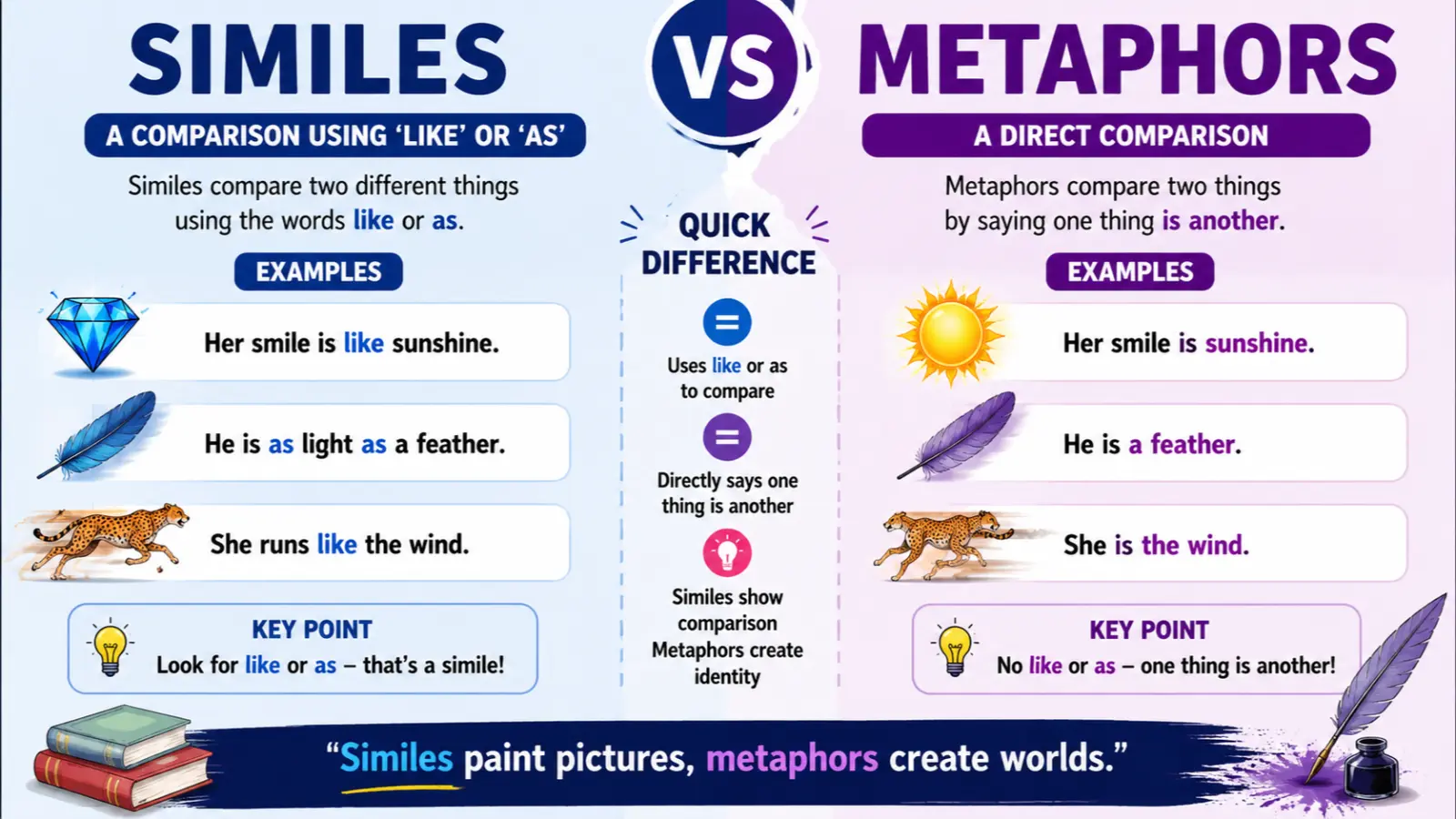
A Similes vs Metaphors compares two different things using words such as “like” or “as.” A Similes vs Metaphors makes a direct comparison by saying one thing is another. Both literary devices create imagery, but they produce different effects.
For example:
- Simile: Her laughter was like bells drifting through an open window.
- Metaphor: Her laughter was a trail of bells through the room.
The Similes vs Metaphors signals the comparison clearly. The metaphor makes the image feel more direct and imaginative.
What Is a Simile?
A Similes vs Metaphors is a figure of speech that compares two unlike things, usually with like or as, to create a clearer mental picture.
Instead of saying:
The classroom was very quiet.
A writer might say:
The classroom was as quiet as a room waiting for its first word.
The second sentence gives readers something to imagine. They can almost feel the unusual stillness.
Similes vs Metaphors appear everywhere: fiction, poetry, speeches, advertising, everyday conversation, music, essays, and storytelling.
A strong simile does more than decorate a sentence. It gives an abstract idea a physical shape.
What Is a Metaphor?
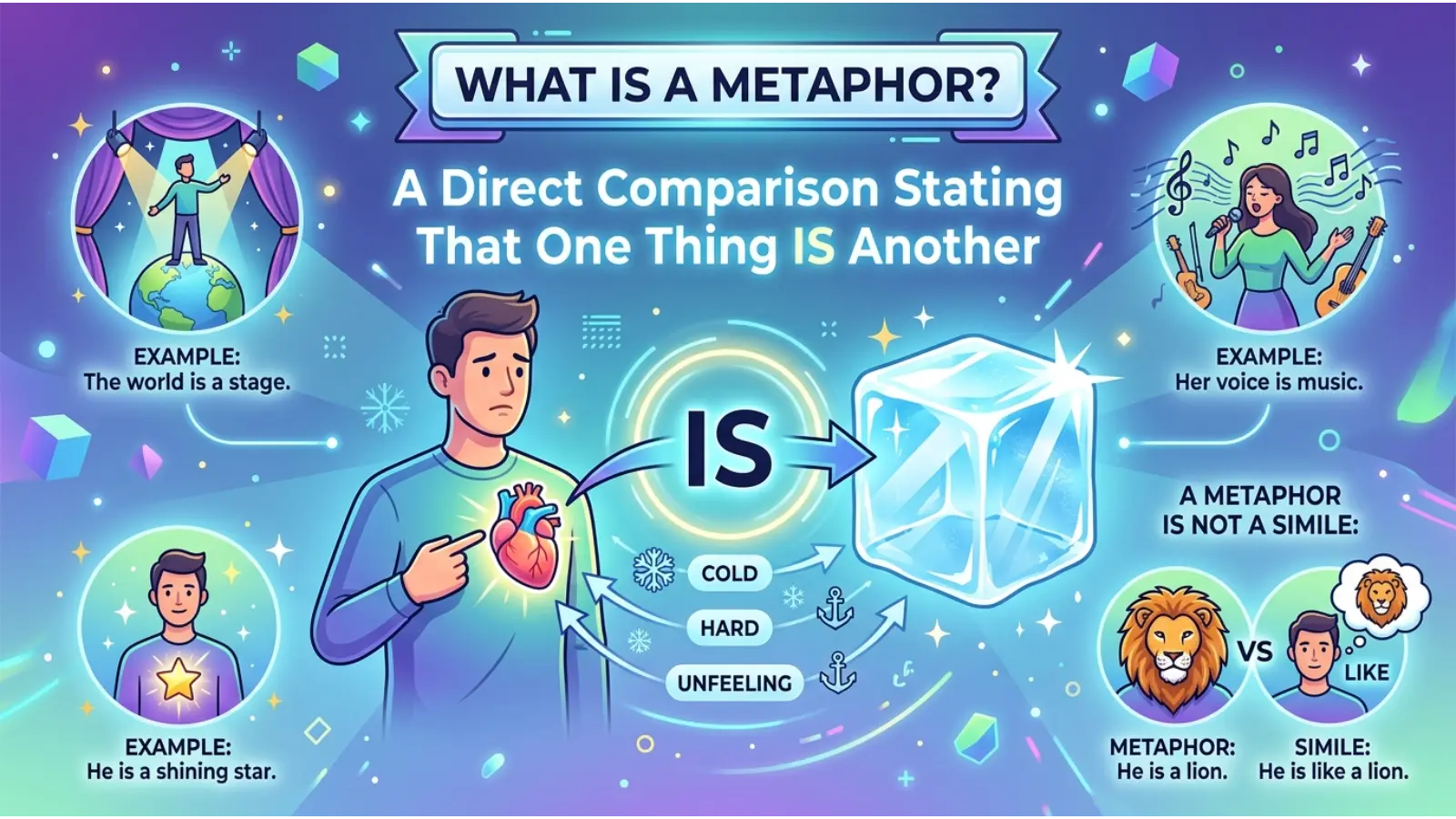
A Similes vs Metaphors makes a comparison directly rather than using like or as.
For example:
The classroom was a sealed jar of silence.
The classroom is not literally a jar. The metaphor invites the reader to imagine silence as something contained and almost tangible.
Similes vs Metaphors can make writing feel bold, compressed, and emotionally powerful.
Consider the difference:
Simile:
His worry followed him like a shadow.
Metaphor:
His worry was a shadow.
The simile emphasizes the resemblance. The Similes vs Metaphors turns the comparison into the central image.
Similes vs Metaphors: The Main Difference
The simplest distinction is grammatical, but the creative difference matters just as much.
| Feature | Simile | Metaphor |
|---|---|---|
| Comparison | Explicit | Direct |
| Common markers | Like, as, than | Usually none |
| Effect | Clear and accessible | Stronger and more immediate |
| Example | The road curled like a ribbon. | The road was a ribbon. |
| Best use | Explaining or illustrating an idea | Creating a striking image |
Neither device is automatically better.
A writer chooses based on the feeling and level of intensity the sentence needs.
When a Simile Works Better
Use a simile when you want readers to notice the comparison without losing sight of the original subject.
For example:
The old house leaned like a tired traveler.
The house remains the focus, while the traveler gives it personality and visual meaning.
When a Metaphor Works Better
Use a Similes vs Metaphors when the comparison should dominate the sentence.
The old house was a tired traveler.
This version feels more imaginative because the house temporarily becomes the traveler.
That small grammatical change can alter the entire tone.
Why Writers Use Similes
A good simile can perform several jobs at once.
It can:
- clarify an unfamiliar idea
- make an emotion easier to understand
- create visual imagery
- establish mood
- reveal personality
- make a scene memorable
- add rhythm to prose
- help readers connect abstract ideas with familiar experiences
The important question is not simply, “Can I add a simile here?”
Ask instead:
“What does this comparison help the reader see, feel, or understand?”
If the answer is nothing, the comparison may not be necessary.
20 Original Similes to Strengthen Creative Writing
The following examples are designed to show how different comparisons can create different moods and purposes.
1. Her Happiness Sparkled Like Sunlight on Moving Water
Meaning: Her happiness feels bright, active, and impossible to keep still.
Example:
Her happiness sparkled like sunlight on moving water when she heard the good news.
Writing purpose: This works well for joyful scenes because moving water suggests energy rather than simple brightness.
Writing tip: When writing about happiness, avoid relying only on words such as bright, beautiful, or wonderful. Give the emotion movement.
2. His Friendship Was Like a Lantern on an Unfamiliar Road
Meaning: His friendship provided guidance and comfort during uncertainty.
Example:
His friendship was like a lantern on an unfamiliar road; I always knew where to turn.
Best context: Personal essays, stories about loyalty, and reflective writing.
The comparison works because a lantern does not remove the road. It simply makes the next part easier to see. That creates a more nuanced image of friendship.
3. The Rain Tapped the Roof Like Fingertips Testing a Door
Meaning: The rain sounds gentle but curious.
Example:
Rain tapped the roof like fingertips testing a door before knocking.
This simile turns sound into a small action. It would fit naturally into a quiet evening scene.
4. Her Love Grew Like a Garden No One Could See
Meaning: Her affection developed gradually and privately.
Example:
Her love grew like a garden no one could see, quietly filling the spaces between ordinary days.
Emotional effect: Tender and reflective.
This comparison is useful when you want love to feel gradual rather than dramatic.
5. His Anger Rose Like Heat From Pavement
Meaning: His anger built gradually and intensely.
Example:
His anger rose like heat from pavement after a long afternoon.
This works because heat can be sensed before it becomes overwhelming.
Writing tip: Comparisons are often stronger when the image has a recognizable physical process.
6. The Empty Playground Looked Like a Story After the Final Page
Meaning: The playground feels abandoned and strangely finished.
Example:
By sunset, the empty playground looked like a story after the final page.
This is especially effective in reflective or nostalgic writing.
7. Her Voice Moved Through the Crowd Like a Thread Through Cloth
Meaning: Her voice was able to pass clearly through a busy environment.
Example:
Her voice moved through the crowd like a thread through cloth.
The comparison is unusual enough to attract attention without becoming difficult to understand.
8. The News Hit Him Like a Door Opening in the Middle of Sleep
Meaning: The news arrived suddenly and disrupted his sense of security.
Example:
The announcement hit him like a door opening in the middle of sleep.
Best context: Fiction, suspense, emotional essays.
Rather than simply saying he was shocked, the comparison shows the sudden disruption.
9. The City Glowed Like a Circuit Board After Dark
Meaning: Lights made the city appear connected, energetic, and technological.
Example:
From the hill, the city glowed like a circuit board after dark.
This is useful for modern urban descriptions.
10. Her Idea Was Like a Small Window in a Crowded Room
Meaning: Her idea offered a new perspective or possibility.
Example:
Her suggestion was like a small window in a crowded room.
The image makes an intellectual idea feel physical and accessible.
11. The River Curved Like a Question Mark Across the Valley
Meaning: The river’s shape creates a sense of mystery or curiosity.
Example:
The river curved like a question mark across the valley.
This is a strong example of visual simile because the shape of the object supports the comparison.
12. His Confidence Was Like a Shoe That Finally Fit
Meaning: He had discovered a comfortable sense of certainty.
Example:
Speaking in front of the audience felt strange at first, but by the final minute, his confidence was like a shoe that finally fit.
This comparison works because confidence is abstract while a well-fitting shoe is immediately understandable.
13. The Morning Air Felt Like a Freshly Opened Notebook
Meaning: The morning feels clean, new, and full of possibility.
Example:
The morning air felt like a freshly opened notebook.
Best context: Beginnings, school stories, personal reflections, and inspirational writing.
14. Her Memory Flickered Like a Porch Light in a Storm
Meaning: She could remember something only briefly or uncertainly.
Example:
The memory flickered like a porch light in a storm, appearing clearly and then disappearing again.
This simile is useful for uncertain memories because the light naturally suggests instability.
15. The Old Photograph Felt Like a Locked Room
Meaning: The photograph contained memories that could not be completely accessed.
Example:
That old photograph felt like a locked room with someone still inside.
Writing purpose: This can add mystery and emotional depth to reflective writing.
16. The Crowd Swelled Like Water Behind a Dam
Meaning: More and more people gathered, creating increasing pressure.
Example:
The crowd swelled like water behind a dam as the gates prepared to open.
The comparison communicates both size and tension.
17. His Excitement Bounced Like a Ball in an Empty Hall
Meaning: His excitement was energetic and difficult to contain.
Example:
His excitement bounced like a ball in an empty hall.
The image creates a playful rhythm and works especially well for younger characters.
18. The Silence Settled Like Dust on Unused Furniture
Meaning: Silence remained for a long time and made the place feel neglected.
Example:
After everyone left, silence settled like dust on unused furniture.
This is more than a description of quiet. It gives silence a sense of age and weight.
19. Her Words Fell Like Pebbles Into Still Water
Meaning: Her words created emotional consequences that spread outward.
Example:
Her words fell like pebbles into still water, and nobody spoke for several seconds.
The image suggests that even small words can create large ripples.
20. The Opportunity Stood Before Him Like an Unlocked Gate
Meaning: A chance was available, but he still had to choose whether to move forward.
Example:
The opportunity stood before him like an unlocked gate.
This comparison works especially well in motivational or decision-making scenes.
How to Make a Simile More Vivid
A weak simile often compares something with an image that is too predictable.
For example:
She was as busy as a bee.
Readers understand it immediately, but they have encountered the comparison many times.
A more specific comparison might be:
She moved between tasks like a stagehand changing scenes before the audience noticed.
The second version creates a situation rather than simply naming a familiar comparison.
Use Specific Images
Instead of:
The room was messy like a disaster.
Try:
The room looked like three unfinished projects had collided overnight.
Specific details give readers something to picture.
Compare Actions, Not Just Objects
You can compare:
- movement
- sound
- texture
- temperature
- emotional changes
- shapes
- patterns
- behavior
For example:
His thoughts scattered like birds startled from a wire.
The comparison describes movement rather than simply attaching a label to an emotion.
Similes for Happiness: Show More Than a Smile
Happiness can be quiet, explosive, nervous, peaceful, or playful.
Compare:
She was happy.
with:
Her excitement skipped through the afternoon like music coming from another room.
The second sentence gives happiness a direction and sound.
When writing joyful scenes, consider what happiness does to the character:
- Does the person move faster?
- Do they notice small details?
- Does their voice change?
- Do ordinary objects suddenly seem different?
- Does the emotion spread to other people?
A useful simile should support one of those observations.
Similes for Friendship: Focus on What Friendship Provides
The strongest friendship comparisons often describe support, trust, familiarity, or shared history.
For example:
Their friendship was like a path worn smooth by years of footsteps.
The path represents something used repeatedly and trusted.
Another possibility:
Her advice was like a handrail on a steep staircase.
This focuses on support rather than simply saying the friend was “great.”
When creating your own friendship similes, ask:
What does this person actually do for the other person?
That question usually produces stronger imagery than simply searching for a synonym for good friend.
Similes for Rain: Use Sound, Movement, and Mood
Rain is particularly useful for figurative language because it has several recognizable qualities.
It can:
- whisper
- drum
- streak
- blur
- surround
- refresh
- isolate
- interrupt
- soothe
Instead of repeatedly describing rain as like tears, experiment with other sensory qualities.
For example:
Rain stitched silver lines across the window.
Although this is technically closer to metaphorical imagery than a conventional simile, it demonstrates an important writing principle: look at what the subject does before deciding what to compare it with.
A rainy scene does not always need to feel sad. Rain can create excitement, comfort, mystery, romance, tension, or peacefulness depending on the surrounding details.
Similes for Love: Avoid Generic Comparisons
Love is one of the easiest subjects to write about badly because familiar comparisons appear everywhere.
Rather than saying:
Their love was like a rose.
Ask what makes the relationship distinctive.
Maybe:
Their affection was like a song they had learned without realizing they were singing together.
This focuses on shared familiarity.
For romantic or emotional writing, specific memories often produce better comparisons than grand declarations.
Think about:
- shared routines
- private jokes
- waiting
- trust
- patience
- distance
- reunion
- small acts of care
A quiet comparison can sometimes communicate more than an exaggerated one.
Similes for Anger: Show How It Develops
Anger changes over time.
It may begin as irritation, become frustration, and eventually turn into something difficult to control.
A useful comparison can show that progression:
His frustration gathered like thunder beyond the hills.
The reader understands that the emotional storm has not fully arrived yet.
For a different effect:
Her anger flashed like a match struck in a dark room.
This suggests something sudden rather than gradual.
The key lesson is simple: choose an image that matches the stage of the emotion.
Funny Similes: Surprise the Reader
Humor often comes from an unexpected comparison.
For example:
He entered the kitchen like a detective who had forgotten what crime he was investigating.
The humor comes from the mismatch between the serious image and the ordinary action.
Funny similes often work because they:
- establish a familiar situation,
- introduce an unexpected comparison,
- exaggerate one recognizable feature.
Try not to make every funny simile wildly absurd. A small twist can be enough.
Common Similes and Why They Still Work
Some comparisons have become familiar because they are clear and memorable.
Examples include:
- as quiet as a mouse
- as busy as a bee
- as cold as ice
- like a fish out of water
- like a needle in a haystack
These are often called clichéd similes when they are used so frequently that they no longer create a fresh image.
That does not mean every familiar simile is forbidden.
In casual conversation, a common comparison may be exactly right.
In literary writing, however, you may want something more specific.
A Useful Test
Ask yourself:
“Could hundreds of other writers have written this exact comparison?”
If yes, consider changing it.
Simile vs Metaphor vs Imagery
These terms overlap, but they are not interchangeable.
Simile
A comparison using an explicit marker such as like or as.
The clouds moved like ships.
Metaphor
A direct comparison.
The clouds were ships.
Imagery
Language that helps readers experience something through the senses.
Gray clouds crowded the sky while cold drops tapped against the window.
Imagery does not require a simile or metaphor.
A skilled writer often combines these techniques rather than choosing only one.
Simile vs Metaphor vs Personification
Personification gives human qualities to something nonhuman.
For example:
The wind argued with the shutters.
This is personification because the wind is given a human action.
A simile would be:
The wind rattled the shutters like an impatient visitor.
Both create imagery, but they do it differently.
Knowing the distinction gives you more control over your descriptions.
Simile vs Metaphor vs Hyperbole
Hyperbole is deliberate exaggeration.
For example:
I waited a thousand years for the bus.
That statement is not meant literally.
A simile might say:
The wait felt like a thousand years.
The second sentence uses a comparison, while the exaggeration makes the wait feel dramatically long.
Writers sometimes combine devices, but each should have a clear purpose.
How Professional Writers Build Better Comparisons
Strong figurative language usually begins with observation.
Suppose you want to describe nervousness.
Instead of immediately writing:
He was nervous like a scared animal.
Pause and examine nervousness.
What happens physically?
Perhaps:
- his fingers move constantly,
- his mouth becomes dry,
- he checks the clock,
- he forgets simple words,
- he cannot sit still.
Now search for an image that behaves similarly.
You might write:
His thoughts fluttered like receipts caught in a station breeze.
The comparison feels fresher because it grows from an observed quality: restless movement.
Start With the Quality
Ask:
What exactly am I comparing?
Is it:
- speed?
- shape?
- sound?
- pressure?
- brightness?
- instability?
- softness?
- loneliness?
- repetition?
Once you identify the quality, finding an effective comparison becomes easier.
How to Create Your Own Similes Step by Step
1. Choose the Subject
Start with something ordinary:
The child was nervous.
2. Identify Its Strongest Quality
Perhaps the nervousness is restless and unpredictable.
3. Brainstorm Physical Images
Think of things that move restlessly:
- a trapped moth
- loose paper
- a bouncing ball
- a flickering sign
- a needle on a broken gauge
4. Choose the Most Specific Image
Avoid the first cliché that appears.
5. Add the Comparison
His nervous thoughts fluttered like loose paper beneath a fan.
6. Read It Aloud
If the sentence sounds awkward, simplify it.
7. Check the Purpose
Ask whether the comparison makes the character, setting, emotion, or action clearer.
If it does not, remove it.
Good writing is not about maximizing figurative language. It is about choosing the right image at the right moment.
Three Creative Exercises for Better Similes
Exercise 1: Replace the Abstract
Take five simple statements:
- She was happy.
- He was angry.
- The room was quiet.
- The road was crowded.
- The morning was beautiful.
Rewrite each one using a different physical comparison.
Do not use the first comparison that comes to mind.
Exercise 2: Build From the Senses
Choose one emotion.
Describe it through:
- sound
- movement
- texture
- temperature
- light
Then turn one of those observations into a simile.
For example, if anxiety feels physically restless, you might compare it with something that cannot stay still.
This exercise helps prevent vague comparisons.
Exercise 3: Turn a Simile Into a Metaphor
Start with:
The hallway was like a tunnel.
Now remove the comparison marker:
The hallway was a tunnel.
Then experiment:
The hallway became a tunnel of fluorescent light.
Notice how changing the structure changes the intensity of the image.
Common Mistakes Writers Make With Similes
Using Too Many Similes
A paragraph packed with comparisons can become exhausting.
If every sentence contains a figurative image, none of them receives enough attention.
Choose your strongest comparison and let it breathe.
Mixing Images
Avoid combining unrelated comparisons:
His anger was a boiling storm that raced like a train through a volcano.
The reader has too many images competing at once.
Pick one central image and develop it.
Choosing a Comparison That Does Not Match
A comparison should share a meaningful quality with the subject.
If the connection is unclear, the reader may stop to figure out what you meant.
Explaining the Simile Too Much
If you write:
Her voice was like a warm blanket, meaning it made everyone feel comfortable and safe.
The explanation may weaken the image.
Often, the comparison should be allowed to do the work itself.
Confusing Similes With Metaphors
Remember:
His voice was like thunder. — simile
His voice was thunder. — metaphor
Both are comparisons, but their structures and effects differ.
Using a Simile Only Because It Sounds Poetic
Figurative language should serve the writing.
If removing a simile makes the sentence clearer and loses nothing important, removing it may be the better choice.
When Should You Use a Simile Instead of a Metaphor?
Choose a simile when clarity matters or when you want to gently guide the reader toward an image.
Choose a metaphor when you want the comparison to feel immediate, bold, or central to the idea.
For example:
Simile:
The memory was like a photograph fading in sunlight.
Metaphor:
The memory was a photograph fading in sunlight.
The simile keeps the original idea at the front. The metaphor makes the image feel more deeply connected to the idea.
Neither is automatically stronger. The surrounding sentence determines which works best.
How Similes Work in Music and Poetry
Similes are especially useful in lyrical and poetic writing because comparisons can communicate emotions quickly.
A songwriter or poet may need to express a complicated feeling without explaining it directly.
Instead of:
I feel lonely.
A writer could create an image of isolation:
I felt like the only window still lit in an empty building.
The comparison gives loneliness a visual form.
In poetry, sound matters too. A simile should fit the rhythm of the surrounding lines rather than interrupt it.
When writing lyrical language, read the sentence aloud. If the comparison sounds forced, revise the wording until the image feels natural.
A Simple Rule for Choosing Between Simile and Metaphor
Think of the difference this way:
Simile says:
“Notice how these two things are similar.”
Metaphor says:
“Imagine these two things as one.”
That distinction is small but powerful.
A simile can create distance and clarity. A metaphor can create identification and intensity.
Good writers use both deliberately.
Frequently Asked Questions
What is the easiest way to tell a simile from a metaphor?
Look for an explicit comparison. If the sentence uses like, as, or another comparison structure, it may be a simile. A metaphor usually makes the comparison directly.
Is “as” always a sign of a simile?
No. The word as can have other grammatical functions.
For example:
She works as a teacher.
This is not a simile because no comparison is being made.
Which is better, a simile or a metaphor?
Neither is universally better. A simile is often useful when you want a clear comparison, while a metaphor can make an image feel more direct and powerful.
Can a sentence contain both a simile and a metaphor?
Yes. Writers can combine literary devices, although they should avoid overcrowding the sentence with unrelated images.
Why do writers use similes?
Writers use similes to make ideas more vivid, explain unfamiliar concepts, communicate emotions, create atmosphere, and give readers memorable images.
What makes a simile effective?
An effective simile usually has a clear connection between the subject and comparison. It should add meaning rather than simply sound decorative.
How can I stop using cliché similes?
Start with observation. Identify the specific quality you want to describe, then brainstorm less predictable images that share that quality.
Can similes be used in formal writing?
Yes. A carefully chosen comparison can make an explanation clearer and more memorable. However, formal writing usually benefits from precise, relevant figurative language rather than excessive decoration.
Conclusion
Understanding similes vs metaphors is not simply a matter of memorizing two definitions. The real skill is learning how comparison changes the way readers experience an idea. A simile can open a door to an image by saying one thing is like another. A metaphor can push that image further by treating the two as one. When you write, start with observation. Find the exact quality you want readers to notice, choose an image that genuinely shares that quality, and make the comparison earn its place. The best figurative language does not make writing complicated. It makes an idea easier to see. Experiment with both similes and metaphors, read your sentences aloud, replace familiar comparisons with specific ones, and keep only the images that make the writing clearer, sharper, or more memorable.
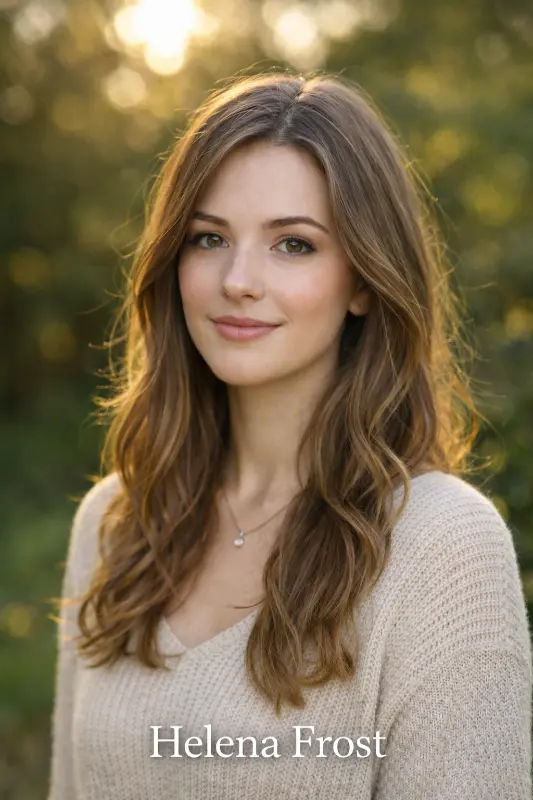
I am Helena Frost, a writer captivated by the beauty of language and the art of comparison. Through my words, I explore the world by turning ordinary moments into vivid similes and reflections. I enjoy crafting phrases that spark imagination, evoke emotion, and linger in the mind. My writing celebrates the subtle connections between people, nature, and the stories we live. For me, every sentence is an opportunity to reveal the extraordinary in the everyday.