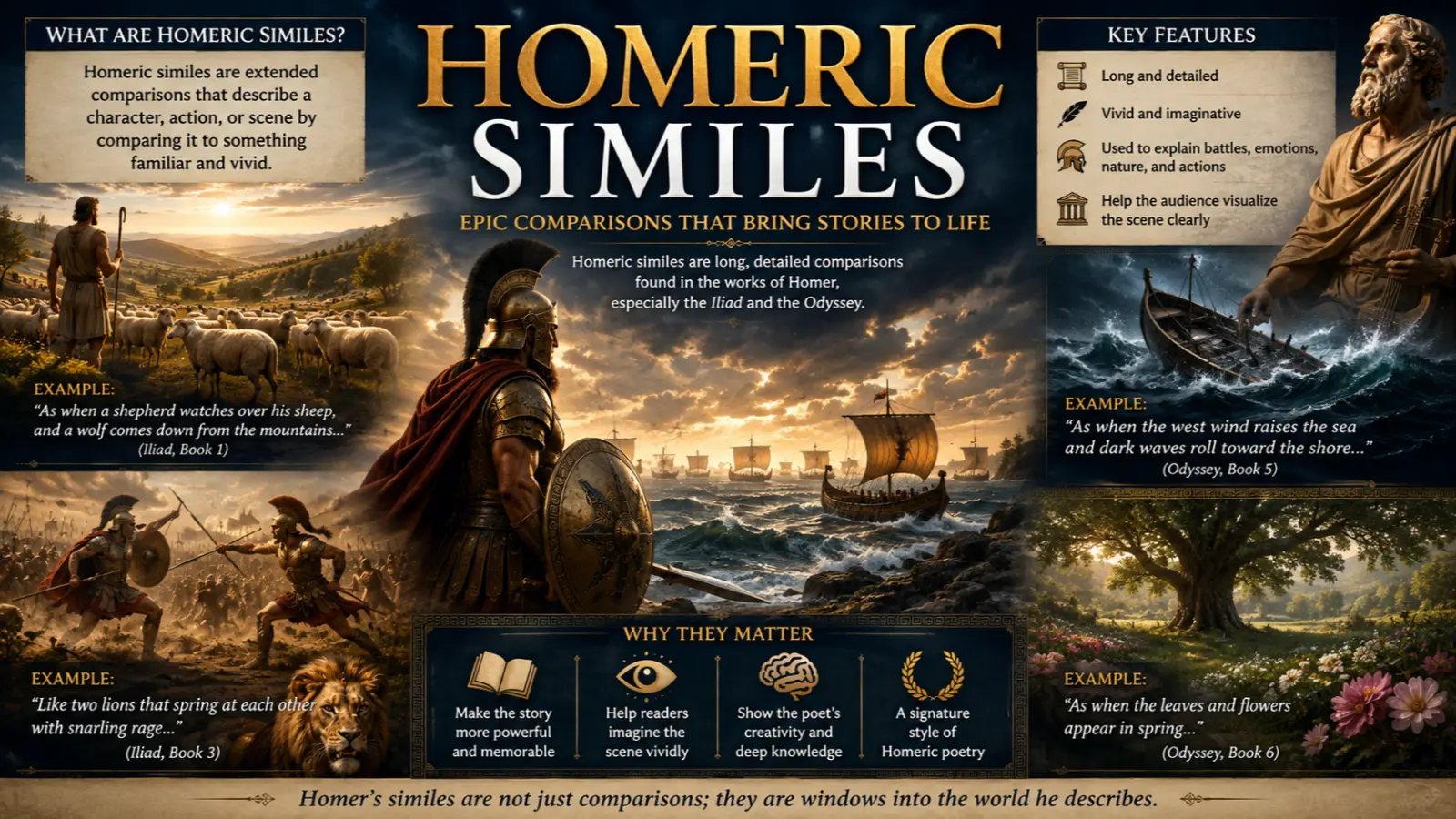
Homeric similes are among the most powerful tools in storytelling. Unlike a short comparison, they expand an image into a vivid scene that helps readers picture emotions, actions, and ideas in remarkable detail. They first became famous through the epic poems traditionally attributed to Homer, where battles, journeys, and everyday life were connected through long, imaginative comparisons. Today, writers, students, poets, and storytellers still use Homeric similes to make scenes richer and more memorable. Whether you’re studying literature or writing your own stories, learning how these extended comparisons work can instantly improve your descriptive writing. This guide explains what Homeric similes are, how they differ from ordinary similes, when to use them, and how to write your own. You’ll also find a collection of fresh, original Homeric similes with practical examples.
What Is a Homeric Simile?
A Homeric simile—also called an epic simile—is an extended comparison that uses words such as like or as while developing the comparison across several lines or sentences.
Instead of saying:
“The army moved like a river.”
A Homeric simile expands the picture:
“The army moved like a river after heavy spring rain, carrying fallen branches, smoothing rough stones, and steadily finding its path toward the sea despite every obstacle.”
The longer comparison creates stronger imagery and deeper emotion.
Why Writers Use Homeric Similes
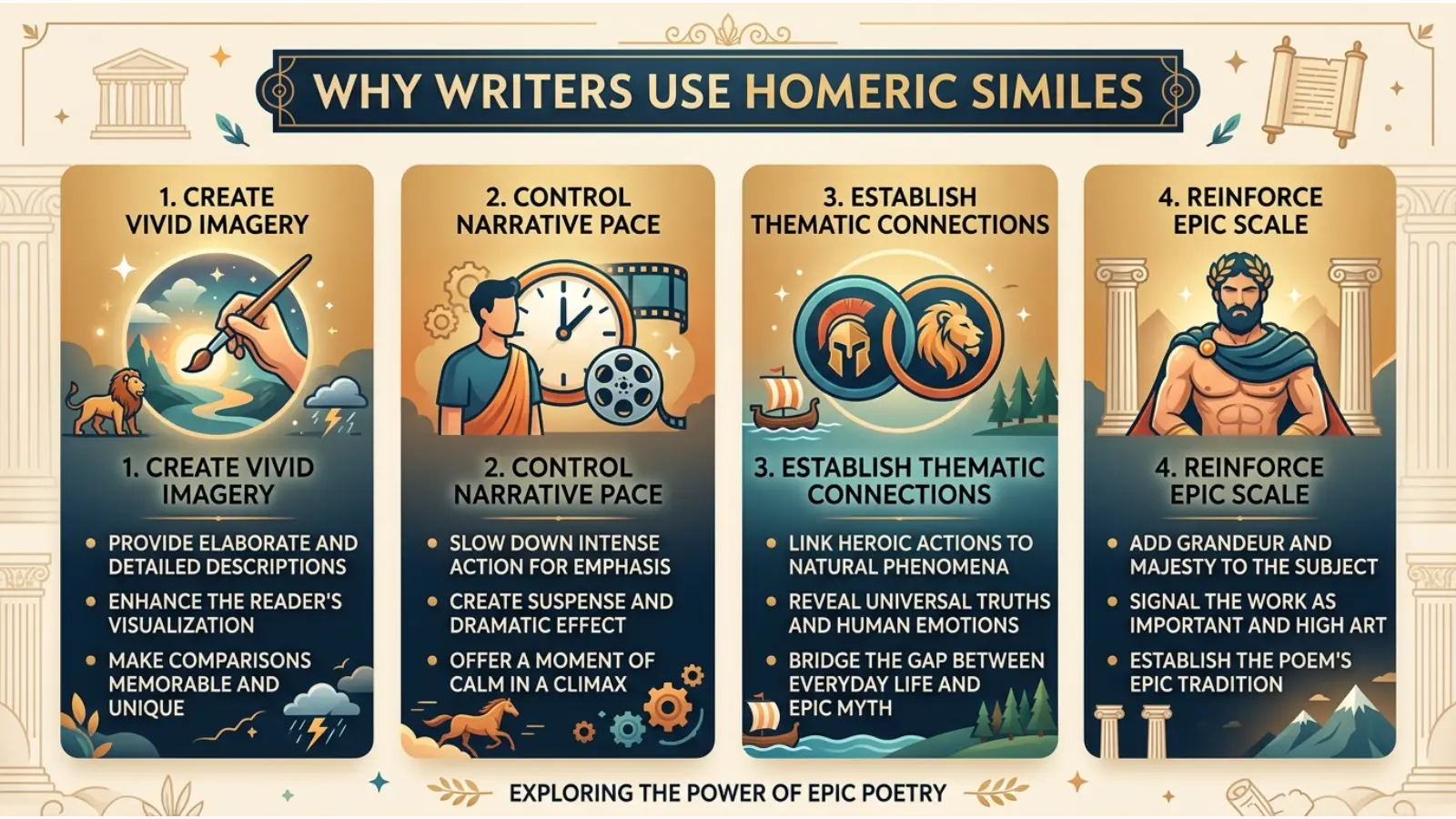
Homeric similes do much more than decorate sentences.
They help readers:
- Visualize complex scenes.
- Slow down important moments.
- Build suspense.
- Reveal emotions indirectly.
- Connect unfamiliar events with familiar experiences.
- Make stories feel cinematic.
Rather than simply describing an action, the writer invites readers to experience it.
How Homeric Similes Differ from Regular Similes
| Regular Simile | Homeric Simile |
|---|---|
| Usually one sentence | Several lines or more |
| Quick comparison | Detailed comparison |
| Focuses on one image | Develops an entire scene |
| Creates brief imagery | Builds atmosphere and emotion |
| Common in everyday writing | Common in epic storytelling and literary fiction |
Original Homeric Similes with Examples
1. Courage Like a Lighthouse During a Storm
Simile
His courage stood like a lighthouse during a violent storm, battered by towering waves, wrapped in rain, yet sending its steady beam across the darkness until every lost traveler found direction.
Meaning
True courage remains steady despite danger.
Example Sentences
- Her confidence inspired everyone during the crisis.
- The firefighter refused to retreat.
Writing Effect
Creates admiration and hope.
Best For
Epic adventures, leadership stories, historical fiction.
2. Hope Like Dawn Climbing the Mountains
Simile
Hope rose like dawn climbing mountain peaks, touching one silent ridge after another until every valley slowly awakened beneath warm light.
Meaning
Hope spreads gradually.
Conversation Example
“After hearing the good news, hope spread through the family.”
Poetry Example
Hope walked over the hills like patient sunlight.
Writing Tip
Use gradual natural events to represent emotional change.
3. Anger Like a Forest Fire Finding Dry Leaves
Simile
His anger spread like a forest fire discovering dry leaves, beginning with a single spark before racing through every forgotten branch until nothing remained untouched.
Meaning
Unchecked anger grows rapidly.
Storytelling Use
Perfect during arguments or battles.
4. Wisdom Like an Old Oak
Simile
Her wisdom stood like an ancient oak whose roots had quietly held the hillside through countless storms while younger trees bent and disappeared.
Meaning
Experience creates lasting strength.
5. Fear Like Birds Leaving the Marsh
Simile
Fear scattered through the soldiers like birds lifting from a quiet marsh, each wingbeat stirring another until the entire sky filled with restless motion.
Emotion
Panic spreading through a group.
6. Determination Like a River Carving Stone
Simile
His determination moved like a river carving stone, never rushing, never stopping, shaping even the hardest surface through patient persistence.
Best Context
Personal growth and achievement.
7. Joy Like Wildflowers After Rain
Simile
Their laughter bloomed like wildflowers after spring rain, filling forgotten fields with unexpected color where silence had lived for months.
8. Loneliness Like Winter Fog
Simile
Loneliness settled around her like winter fog covering empty roads, softening every familiar landmark until even home felt distant.
9. Curiosity Like a Cat Exploring Ruins
Simile
His curiosity wandered like a cat exploring ancient ruins, pausing at every broken doorway before quietly disappearing into another mystery.
10. Friendship Like Intertwined Vines
Simile
Their friendship grew like climbing vines wrapping around the same old wall, each season strengthening what time had already joined.
11. Grief Like the Falling Tide
Simile
Grief withdrew like the falling tide, slowly revealing hidden shells, broken memories, and quiet strength beneath the retreating waves.
12. Determination Like Snow Melting into Rivers
Simile
Her determination resembled mountain snow becoming rivers, beginning as silent drops before gathering enough force to reshape entire landscapes.
13. Curiosity Like Wind Through Open Windows
Simile
Curiosity entered his thoughts like wind flowing through open windows, lifting forgotten pages and uncovering ideas long left untouched.
14. Victory Like Eagles Returning Home
Simile
Victory arrived like eagles returning to familiar cliffs after crossing endless skies, tired yet proud, carrying the certainty of survival.
15. Kindness Like Rain on Dry Earth
Simile
Her kindness spread like gentle rain across thirsty ground, sinking quietly beneath the surface before bringing life where none seemed possible.
16. Patience Like Moss Covering Stone
Simile
His patience grew like moss across old stone, almost invisible each day yet transforming the landscape over many seasons.
17. Ambition Like the Rising Tide
Simile
Ambition advanced like the rising tide, reaching farther with every passing hour until even distant shores felt its influence.
18. Memory Like Autumn Leaves
Simile
Old memories drifted through his thoughts like autumn leaves circling a quiet lake before settling where they truly belonged.
19. Unity Like Threads Becoming a Tapestry
Simile
The villagers came together like separate threads woven into a tapestry, each color keeping its identity while creating something stronger as one.
20. Resilience Like Bamboo After the Wind
Simile
Their resilience resembled bamboo after fierce winds, bending with every storm yet standing upright again once the sky became calm.
Why Homeric Similes Work So Well
A successful Homeric simile does more than compare two things.
It tells a miniature story inside the larger story.
Readers don’t simply imagine an object—they experience movement, sound, weather, emotion, and consequence. That added layer creates richer imagery and makes important scenes unforgettable.
The comparison often reflects the emotional state of the character as much as the physical action.
How to Write Your Own Homeric Similes
Creating an effective Homeric simile becomes easier when you follow a clear process.
Step 1: Choose the Main Subject
Decide what you want readers to understand.
Examples:
- Fear
- Courage
- Love
- Storm
- Journey
Step 2: Find a Rich Comparison
Look for something readers already understand.
Nature works especially well:
- Rivers
- Trees
- Seasons
- Animals
- Oceans
- Mountains
Step 3: Expand the Scene
Instead of ending the comparison immediately, continue describing it.
Ask:
- What happens next?
- What changes?
- What details stand out?
- How does the scene end?
Step 4: Connect Back to the Story
Make sure every detail reinforces the original emotion or action rather than distracting from it.
Practical Writing Exercises
Expand a Simple Simile
Start with:
“The city glowed like stars.”
Turn it into an extended comparison by describing:
- The lights
- The streets
- The people
- The mood
- The changing night
Observe Nature
Spend five minutes watching:
- Rain
- Clouds
- Birds
- Trees
- Rivers
Write how each could represent a human emotion.
Tell Two Stories at Once
Write a character’s emotional moment while comparing it to a complete natural event.
This is the heart of a strong Homeric simile.
Related Literary Devices
Metaphor
A metaphor makes a direct comparison without using “like” or “as.”
Example:
“The city was a sleeping giant.”
Imagery
Imagery appeals to the senses through descriptive language. Homeric similes rely heavily on vivid imagery to immerse readers in the scene.
Personification
Giving human qualities to nature can strengthen an extended comparison.
Example:
“The wind searched every corner of the valley.”
Hyperbole
Writers sometimes combine Homeric similes with gentle exaggeration to emphasize grandeur, but the comparison should still feel believable within the story.
Symbolism
Objects inside the comparison—such as rivers, mountains, or storms—can symbolize growth, struggle, hope, or change, adding deeper meaning.
Common Mistakes to Avoid
Making the Comparison Too Long
Every detail should support the main image. Remove descriptions that don’t strengthen the comparison.
Using Mixed Imagery
Avoid combining unrelated images.
Poor:
“The warrior was like a lion sailing through thunder.”
Keep imagery consistent.
Relying on Overused Comparisons
Fresh observations create stronger writing than familiar expressions.
Confusing Metaphors and Similes
Remember that Homeric similes always use comparison words like like or as while extending the image over multiple lines.
Forgetting the Story
The comparison should deepen the narrative, not interrupt it. If readers forget the original scene, the simile has become too distracting.
Frequently Asked Questions
What is a Homeric simile?
A Homeric simile is an extended comparison that uses “like” or “as” while developing the image across several lines to create vivid, memorable descriptions.
Why are Homeric similes called epic similes?
They’re often called epic similes because they are commonly used in epic poetry to enhance important moments with detailed, imaginative comparisons.
Are Homeric similes only found in ancient literature?
No. Modern novels, fantasy, historical fiction, and narrative poetry also use extended similes to create immersive storytelling.
How long should a Homeric simile be?
There is no fixed length. It should be long enough to develop a meaningful comparison without distracting from the main narrative.
Can beginners use Homeric similes?
Yes. Start with a simple comparison, then expand it by describing the comparison scene in greater detail while keeping it connected to your main idea.
What makes a Homeric simile effective?
Strong imagery, a clear emotional purpose, logical development, and a meaningful connection to the story all contribute to an effective Homeric simile.
Conclusion
Homeric similes transform ordinary descriptions into vivid experiences. By expanding a comparison into a complete scene, they invite readers to see, hear, and feel the moment rather than simply read about it. Whether you’re writing fiction, poetry, essays, or classroom assignments, mastering this technique will make your storytelling more engaging and memorable. Practice observing the world around you, experiment with fresh comparisons, and don’t be afraid to let your similes unfold naturally. The most memorable Homeric similes don’t just compare—they tell a story within the story.

I am Helena Frost, a writer captivated by the beauty of language and the art of comparison. Through my words, I explore the world by turning ordinary moments into vivid similes and reflections. I enjoy crafting phrases that spark imagination, evoke emotion, and linger in the mind. My writing celebrates the subtle connections between people, nature, and the stories we live. For me, every sentence is an opportunity to reveal the extraordinary in the everyday.