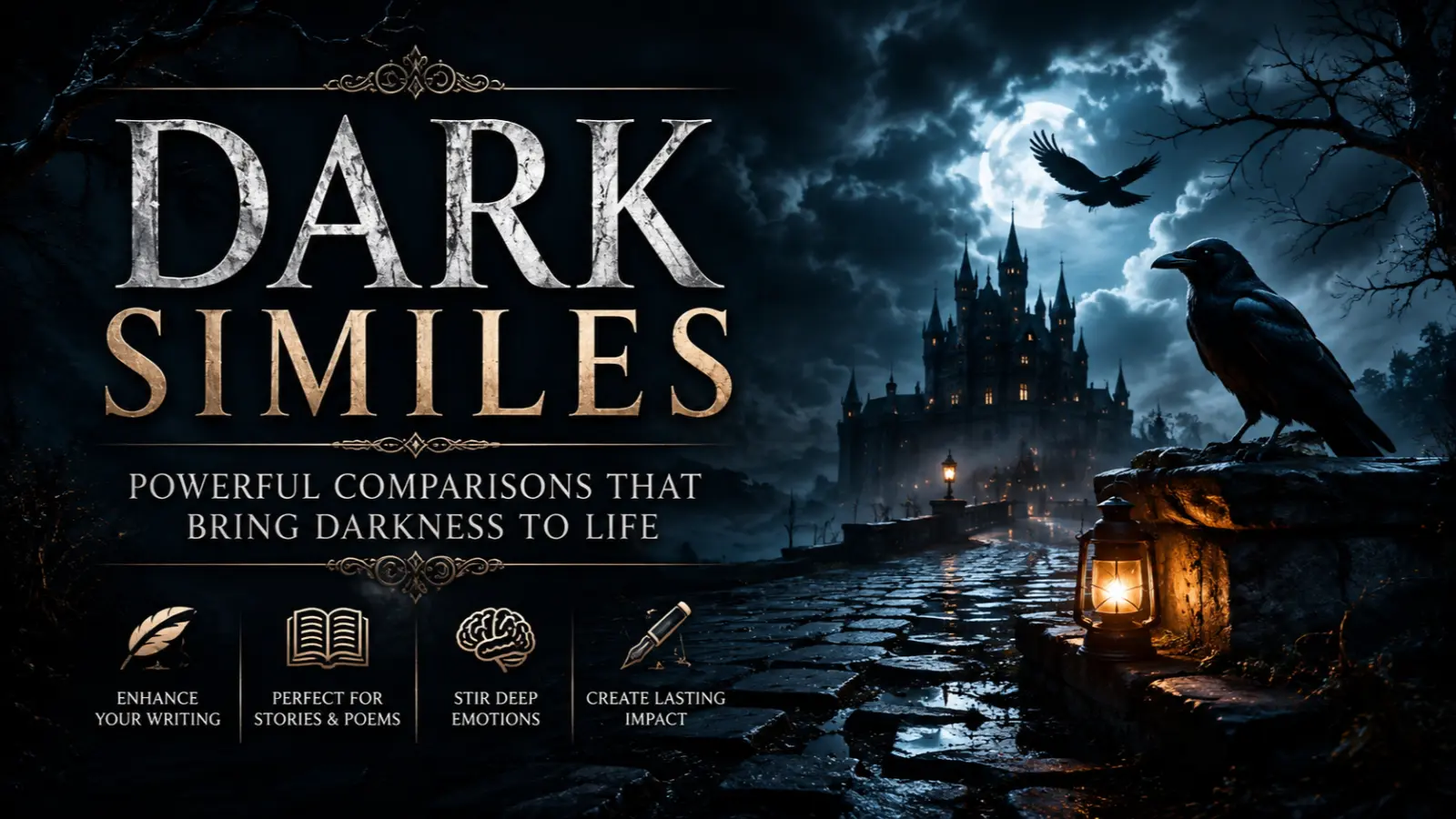
Dark Similes has fascinated writers for centuries because it can represent mystery, fear, sadness, danger, peace, or the unknown. One of the best ways to describe darkness without sounding repetitive is through similes.
A simile compares two different things using words such as like or as. A strong simile paints a clear picture in the reader’s mind and adds emotional depth to a sentence.
Dark similes appear in novels, poems, speeches, songs, horror stories, fantasy worlds, mysteries, and everyday conversations. Whether you are writing fiction or simply improving your descriptive skills, learning how to build original comparisons will make your writing more memorable.
This guide introduces fresh dark similes, explains why they work, and shows you how to create your own with confidence.
What Are Dark Similes?
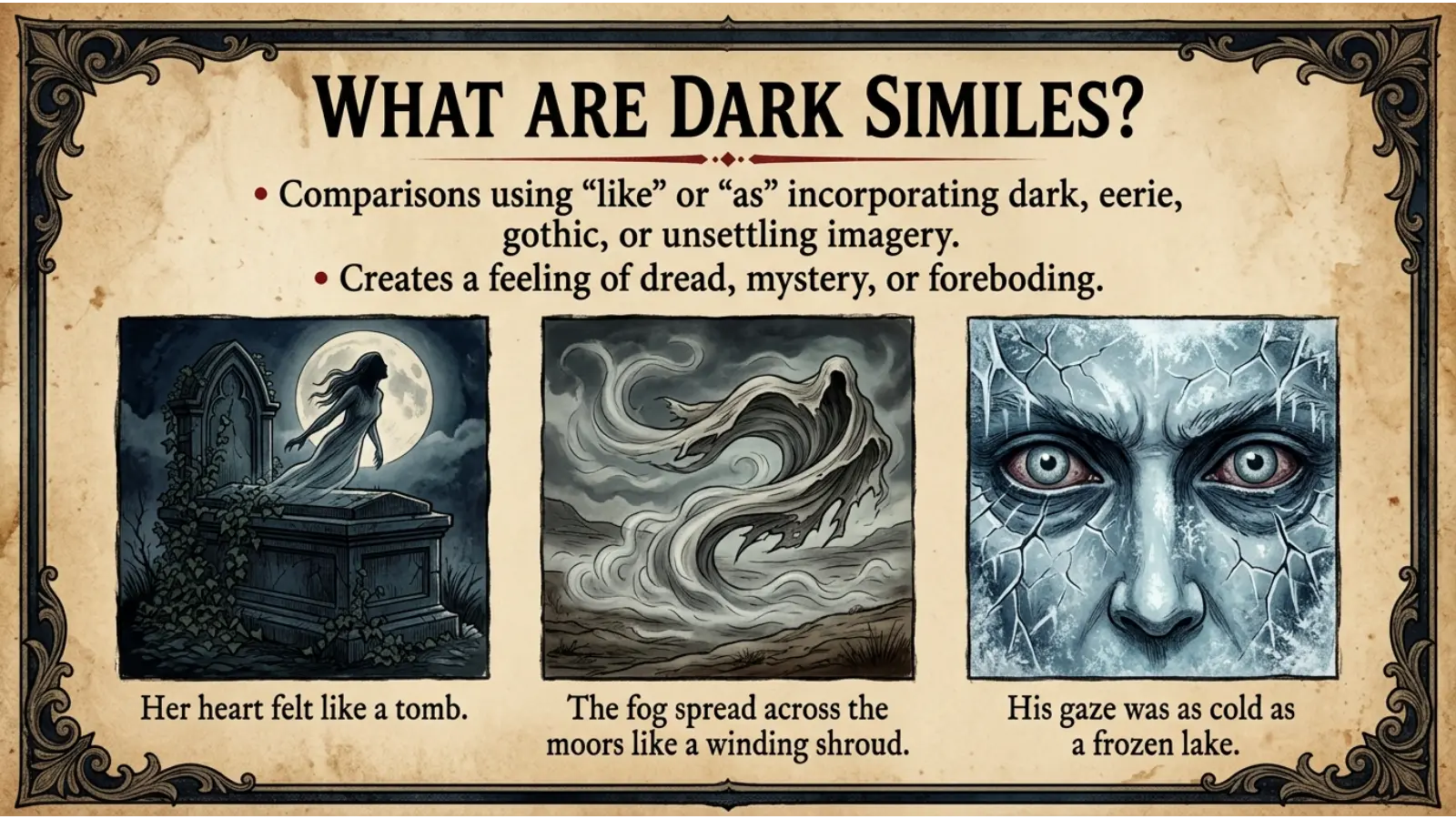
Dark similes compare darkness or something emotionally dark to another image using like or as.
They can describe:
- Night
- Fear
- Shadows
- Evil
- Sadness
- Mystery
- Silence
- Hidden emotions
- Dangerous places
- Uncertainty
A good dark simile doesn’t simply say something is black. Instead, it creates atmosphere and helps readers experience the scene.
Original Dark Similes
As dark as forgotten ink beneath the sea
Meaning
Suggests a darkness so deep that even memories seem buried.
Example Sentences
- The cave was as dark as forgotten ink beneath the sea.
- His thoughts became as dark as forgotten ink beneath the sea after the terrible news.
Emotional Effect
Creates mystery and emotional depth.
Best For
Fantasy, mystery, emotional fiction.
Writing Tip
Use this simile when describing places or emotions that feel hidden from the world.
Like a moon wrapped in smoke
Meaning
Describes light struggling to escape darkness.
Examples
- The lantern glowed like a moon wrapped in smoke.
- Hope appeared like a moon wrapped in smoke.
Storytelling Example
The old lighthouse flickered like a moon wrapped in smoke, barely guiding ships home.
As dark as a room where laughter disappeared
Meaning
Suggests emotional emptiness rather than physical darkness.
Examples
- The abandoned house felt as dark as a room where laughter disappeared.
- Her silence became as dark as a room where laughter disappeared.
Best Context
Emotional scenes.
Like paint spilled across the stars
Meaning
Describes night covering the sky.
Examples
- Evening spread like paint spilled across the stars.
- Clouds rolled in like paint spilled across the stars.
Poetry Example
Night arrived like paint spilled across the stars, softening every edge.
As dark as a secret never spoken
Meaning
Represents mystery and hidden truth.
Examples
- His expression was as dark as a secret never spoken.
- The forest felt as dark as a secret never spoken.
Like a curtain stitched from shadows
Meaning
Darkness covering everything.
Examples
- Fog settled like a curtain stitched from shadows.
- Silence fell like a curtain stitched from shadows.
As dark as forgotten dreams
Meaning
Expresses sadness and lost hope.
Examples
- Her memories felt as dark as forgotten dreams.
- The empty theater stood as dark as forgotten dreams.
Like cold velvet over the earth
Meaning
Night arriving softly.
Examples
- Darkness spread like cold velvet over the earth.
- Evening settled like cold velvet over the hills.
As dark as an unopened letter
Meaning
Represents uncertainty.
Examples
- The future looked as dark as an unopened letter.
- His expression became as dark as an unopened letter.
Like smoke hiding the mountains
Meaning
Suggests uncertainty and concealment.
Examples
- Fear drifted through the village like smoke hiding the mountains.
- Doubt spread like smoke hiding the mountains.
As dark as rain before thunder
Meaning
A warning that something serious is coming.
Examples
- The mood became as dark as rain before thunder.
- Her voice sounded as dark as rain before thunder.
Like footsteps fading underground
Meaning
Suggests mystery and disappearance.
Examples
- His memories vanished like footsteps fading underground.
- The whisper echoed like footsteps fading underground.
As dark as a candle after the flame dies
Meaning
Represents sudden loss.
Examples
- The room felt as dark as a candle after the flame dies.
- His smile disappeared, leaving his face as dark as a candle after the flame dies.
Like the last page of a forgotten diary
Meaning
Suggests unanswered questions.
Examples
- The ending felt like the last page of a forgotten diary.
- The silence lingered like the last page of a forgotten diary.
As dark as a silent eclipse
Meaning
Describes overwhelming shadow.
Examples
- Fear covered him as dark as a silent eclipse.
- The valley became as dark as a silent eclipse.
Like winter hiding beneath autumn leaves
Meaning
Darkness waiting quietly.
Examples
- Danger rested like winter hiding beneath autumn leaves.
- Anger remained like winter hiding beneath autumn leaves.
As dark as the space between heartbeats
Meaning
Captures suspense.
Examples
- The hallway became as dark as the space between heartbeats.
- Time slowed as dark as the space between heartbeats.
Like a locked doorway at midnight
Meaning
Represents uncertainty and fear.
Examples
- The future seemed like a locked doorway at midnight.
- His expression remained like a locked doorway at midnight.
As dark as forgotten footsteps
Meaning
Represents abandoned places.
Examples
- The castle stood as dark as forgotten footsteps.
- The hallway stretched as dark as forgotten footsteps.
Like ashes floating through silence
Meaning
Quiet sorrow.
Examples
- Memories drifted like ashes floating through silence.
- Regret settled like ashes floating through silence.
As dark as a starless horizon
Meaning
Complete absence of hope or light.
Examples
- The sea became as dark as a starless horizon.
- His mood felt as dark as a starless horizon.
Like fog swallowing a bell tower
Meaning
Darkness hiding familiar things.
Examples
- Fear arrived like fog swallowing a bell tower.
- Night settled like fog swallowing a bell tower.
As dark as forgotten hallways
Meaning
Represents abandonment.
Examples
- The mansion remained as dark as forgotten hallways.
- His memories became as dark as forgotten hallways.
Like broken mirrors beneath clouds
Meaning
Suggests emotional confusion.
Examples
- His thoughts scattered like broken mirrors beneath clouds.
- Shadows stretched like broken mirrors beneath clouds.
As dark as buried echoes
Meaning
Describes silence with mystery.
Examples
- The cave felt as dark as buried echoes.
- Their friendship ended as dark as buried echoes.
Like the wings of a sleeping raven
Meaning
Soft but powerful darkness.
Examples
- Night settled like the wings of a sleeping raven.
- Her cloak moved like the wings of a sleeping raven.
As dark as frozen midnight
Meaning
Intense, lifeless darkness.
Examples
- The forest was as dark as frozen midnight.
- His expression turned as dark as frozen midnight.
Like a shadow drinking sunlight
Meaning
Darkness overpowering brightness.
Examples
- Fear spread like a shadow drinking sunlight.
- Smoke rose like a shadow drinking sunlight.
As dark as the bottom of an empty well
Meaning
Deep loneliness.
Examples
- His heart felt as dark as the bottom of an empty well.
- The tunnel remained as dark as the bottom of an empty well.
Like silence locked inside stone
Meaning
Heavy, motionless darkness.
Examples
- The ruins stood like silence locked inside stone.
- Grief rested like silence locked inside stone.
Why These Similes Work
The strongest similes connect a physical image with an emotional experience. Instead of saying “it was very dark,” they invite readers to imagine texture, movement, memory, or feeling.
Professional writers often ask:
- What does the darkness hide?
- How does it make the character feel?
- What unexpected image captures that feeling?
Answering these questions leads to original comparisons instead of familiar clichés.
Make Your Dark Similes More Vivid
Choose images readers can easily imagine. Concrete objects such as velvet, smoke, stone, or winter create stronger mental pictures than vague descriptions.
Mix emotion with setting. A forest may be dark physically, but comparing it to “a room where laughter disappeared” also communicates loneliness.
Keep comparisons believable. Even imaginative similes should make emotional sense.
Read your sentence aloud. If the comparison feels forced or confusing, simplify it.
Related Literary Devices
Metaphor
A metaphor says something is another thing rather than comparing it with like or as.
- Simile: The sky was like black velvet.
- Metaphor: The sky was black velvet.
Imagery
Imagery appeals to the senses. Dark similes often strengthen visual imagery while also suggesting sounds, textures, or emotions.
Personification
Giving darkness human qualities can increase tension.
Example:
“The darkness reached for every corner.”
Symbolism
Darkness frequently symbolizes grief, uncertainty, danger, secrecy, or transformation. The exact meaning depends on the story and culture.
Create Your Own Dark Similes
Follow these simple steps:
- Decide what kind of darkness you want to describe.
- Think about the emotion behind it.
- List three objects, places, or memories with that same feeling.
- Compare them using like or as.
- Read the sentence aloud and remove unnecessary words.
Creative Exercise
Describe each of these using your own dark simile:
- An abandoned house
- A lonely road
- A stormy night
- A mysterious stranger
- A character hiding a secret
Try to avoid comparing everything to coal, ink, or pitch black. Fresh imagery is usually more memorable.
Common Mistakes
Overused Comparisons
Expressions such as “as black as coal” are familiar but rarely surprising. Look for new images that better fit your scene.
Mixed Imagery
Don’t combine unrelated ideas.
Weak:
“The room was as dark as velvet swimming through thunder.”
Choose one clear image instead.
Forced Similes
If the comparison needs a long explanation, readers may lose interest. Simplicity is often stronger.
Confusing Similes and Metaphors
Remember that similes use like or as. Metaphors do not.
Weak Descriptions
A simile should deepen the meaning, not repeat it. Instead of comparing darkness to another dark object, think about the feeling it creates.
Frequently Asked Questions
What is a dark simile?
A dark simile compares darkness, mystery, fear, sadness, or another gloomy idea to something else using like or as.
Are dark similes only used in horror stories?
No. They also appear in poetry, fantasy, historical fiction, thrillers, literary fiction, and emotional writing.
Can dark similes describe emotions?
Yes. They can express grief, loneliness, anxiety, uncertainty, or emotional distance just as effectively as physical darkness.
How can I avoid clichés?
Look beyond common comparisons. Draw inspiration from nature, memories, architecture, weather, music, or everyday objects that match the mood.
Should every dark scene include a simile?
No. A well-placed simile has more impact than using one in every paragraph.
Can dark similes be poetic?
Absolutely. Many poets use carefully chosen similes to create atmosphere without overwhelming the reader.
Conclusion
Dark similes do much more than describe the absence of light. They shape mood, reveal emotion, and help readers experience a scene instead of simply observing it. The most memorable comparisons are specific, meaningful, and unexpected. As you practice, focus on matching the image to the feeling you want to convey. Over time, you’ll develop a style that is vivid, original, and unmistakably your own.

I am Helena Frost, a writer captivated by the beauty of language and the art of comparison. Through my words, I explore the world by turning ordinary moments into vivid similes and reflections. I enjoy crafting phrases that spark imagination, evoke emotion, and linger in the mind. My writing celebrates the subtle connections between people, nature, and the stories we live. For me, every sentence is an opportunity to reveal the extraordinary in the everyday.