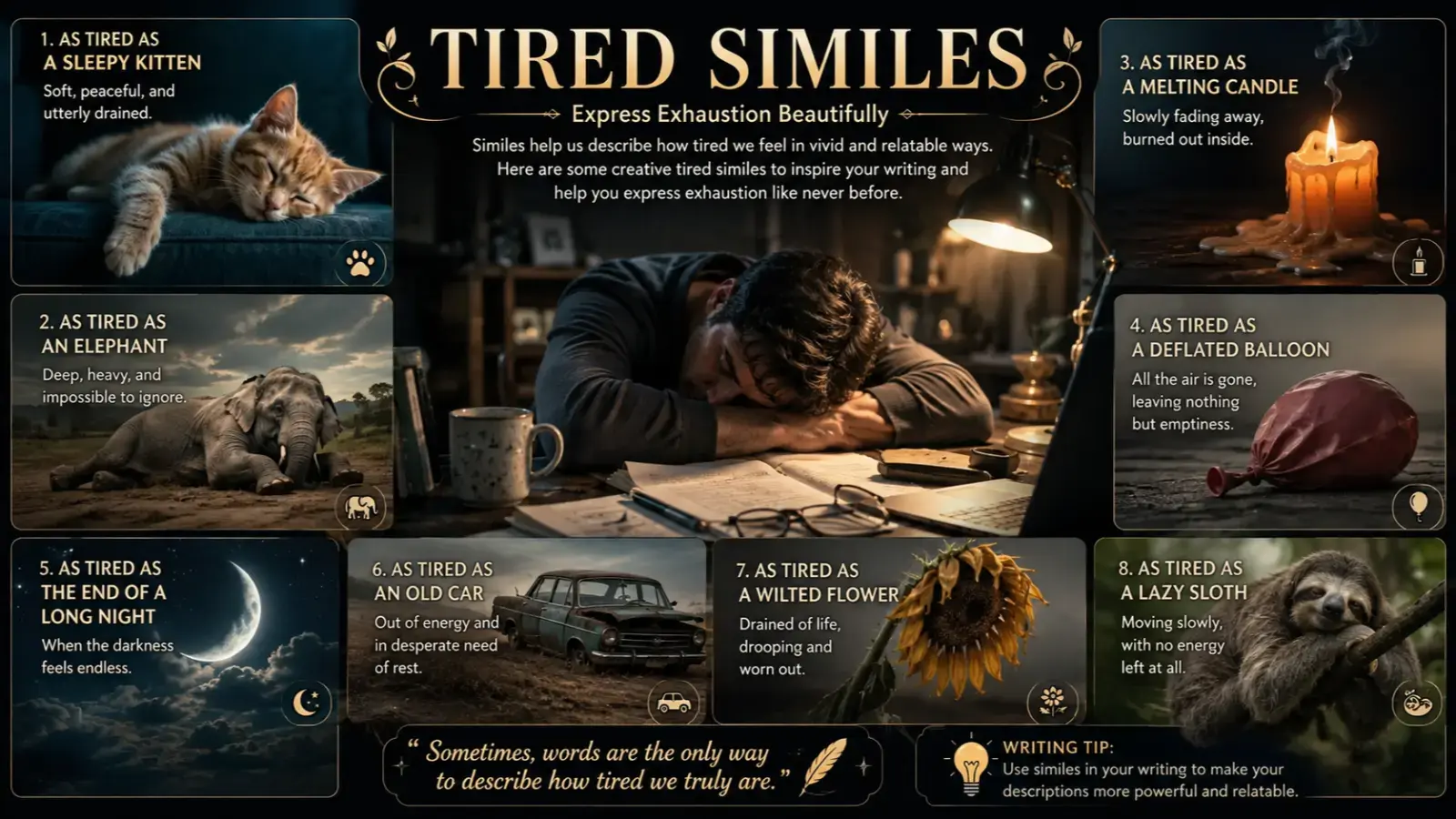
Feeling tired is something everyone experiences, but describing it in writing can be surprisingly difficult. That’s where tired similes become useful. A well-crafted simile transforms an ordinary sentence into a vivid image that readers can instantly picture and feel.
A simile compares two different things using words like “as” or “like.” Writers use similes in novels, poems, speeches, classroom assignments, blog posts, and everyday conversations because they make descriptions more memorable.
This guide explores original tired similes that go beyond familiar comparisons. You’ll learn what each simile suggests, when to use it, and how to create your own fresh comparisons that bring characters and scenes to life.
What Are Tired Similes?
Tired similes compare exhaustion to another object, creature, or experience to help readers understand the physical or emotional state more clearly.
Instead of writing:
She was very tired.
You could write:
She drifted through the room like the last ember of a fading fire.
The second sentence paints a stronger mental picture and creates a richer emotional response.
Why Writers Use Similes for Tiredness
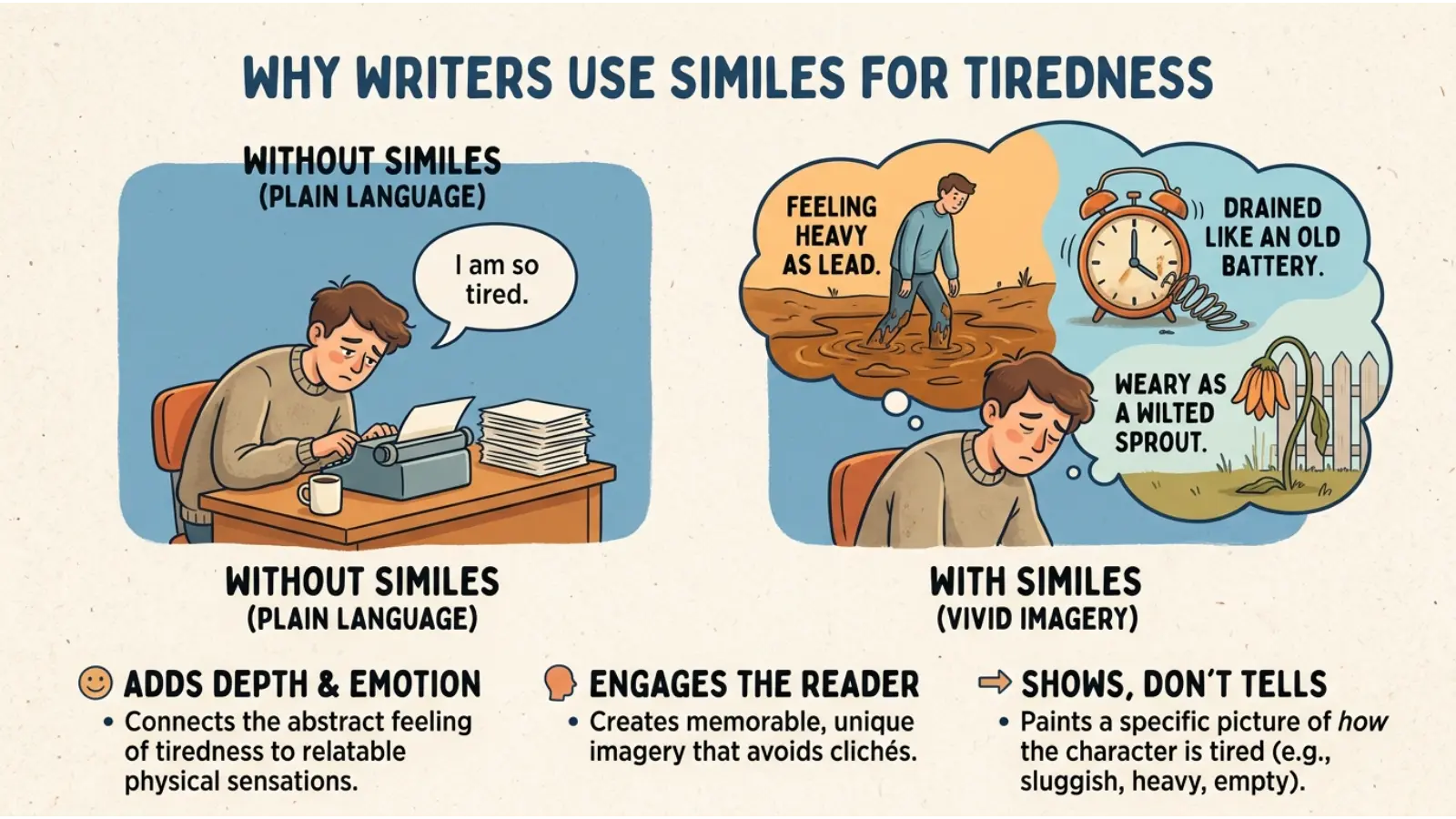
Good tired similes help readers:
- Picture physical exhaustion.
- Feel emotional burnout.
- Understand a character’s mood instantly.
- Add rhythm to poetry.
- Make dialogue sound more natural.
- Avoid repeating words like tired, sleepy, and exhausted.
30 Original Tired Similes
1. Like a candle burning its final inch
Meaning: Nearly out of energy.
Examples
- She walked home like a candle burning its final inch.
- By midnight, he felt like a candle burning its final inch.
Writing Effect
Suggests quiet exhaustion rather than dramatic collapse.
Best For
Stories, reflective essays, emotional scenes.
Writing Tip
Works especially well after a long emotional journey.
2. As slow as snow melting in spring
Meaning
Moving with very little energy.
Examples
- He answered as slow as snow melting in spring.
- The hikers became as slow as snow melting in spring.
Conversation
“I need coffee. I’m as slow as snow melting in spring.”
3. Like an old clock losing its rhythm
Meaning
Fatigue causing reduced performance.
Examples
- My thoughts moved like an old clock losing its rhythm.
- She typed like an old clock losing its rhythm.
Poetry
Perfect for reflective poems about aging or burnout.
4. Like a bird flying against heavy wind
Meaning
Every task feels difficult.
Examples
- He climbed the stairs like a bird flying against heavy wind.
- She smiled like a bird flying against heavy wind.
Writing Purpose
Creates determination alongside exhaustion.
5. As faded as yesterday’s sunset
Meaning
Energy has almost disappeared.
Examples
- His voice sounded as faded as yesterday’s sunset.
- I felt as faded as yesterday’s sunset.
6. Like a backpack filled with wet sand
Meaning
Every movement feels heavy.
Examples
- She walked like a backpack filled with wet sand.
- My legs felt like a backpack filled with wet sand.
Best Context
Adventure stories and travel writing.
7. As quiet as a phone with a dead battery
Meaning
Mentally and physically drained.
Examples
- He became as quiet as a phone with a dead battery.
- After the exam, everyone was as quiet as a phone with a dead battery.
8. Like a wave losing its strength on the shore
Meaning
Gradually running out of energy.
Examples
- She spoke like a wave losing its strength on the shore.
- His excitement faded like a wave losing its strength.
9. As droopy as a rain-soaked flower
Meaning
Physically exhausted.
Examples
- She looked as droopy as a rain-soaked flower.
- The team appeared as droopy as rain-soaked flowers.
10. Like a train running on its last drop of fuel
Meaning
Continuing despite exhaustion.
Examples
- He worked like a train running on its last drop of fuel.
- We finished the project like a train running on its last drop of fuel.
11. As dim as a lantern before dawn
Meaning
Almost completely exhausted.
Examples
- Her eyes looked as dim as a lantern before dawn.
- My focus became as dim as a lantern before dawn.
12. Like leaves hanging after a summer storm
Meaning
Drained and worn out.
Examples
- The players looked like leaves hanging after a summer storm.
- I felt like leaves hanging after a summer storm.
13. As heavy as rain-filled boots
Meaning
Every step requires effort.
Examples
- My feet were as heavy as rain-filled boots.
- She climbed as heavy as rain-filled boots.
14. Like a river running through a drought
Meaning
Running low on strength.
Examples
- His patience flowed like a river running through a drought.
- She worked like a river running through a drought.
15. As thin as the last thread of daylight
Meaning
Almost no energy remains.
Examples
- My motivation was as thin as the last thread of daylight.
- His voice became as thin as the last thread of daylight.
16. Like a kite without wind
Meaning
Unable to keep moving with energy.
Examples
- She wandered like a kite without wind.
- I studied like a kite without wind.
17. As worn as a library book read a thousand times
Meaning
Completely used up.
Examples
- He felt as worn as a library book read a thousand times.
- After the trip, everyone looked as worn as a library book read a thousand times.
18. Like fog settling over a valley
Meaning
Sleepiness slowly taking over.
Examples
- Tiredness spread like fog settling over a valley.
- Sleep arrived like fog settling over a valley.
19. As hollow as an empty drum
Meaning
Emotionally exhausted.
Examples
- She felt as hollow as an empty drum.
- He smiled while feeling as hollow as an empty drum.
20. Like a painter using the last brushstroke
Meaning
Giving the final bit of energy.
Examples
- She crossed the finish line like a painter using the last brushstroke.
- He answered like a painter using the last brushstroke.
21. As soft as a pillow forgotten in the attic
Meaning
Gentle, sleepy, and worn down.
Examples
- Her voice was as soft as a pillow forgotten in the attic.
- He laughed as soft as a pillow forgotten in the attic.
22. Like a lantern flickering in the wind
Meaning
Barely staying awake.
Examples
- His attention flickered like a lantern in the wind.
- She stayed awake like a lantern flickering in the wind.
23. As distant as the last star before sunrise
Meaning
Mentally exhausted and unfocused.
Examples
- My thoughts felt as distant as the last star before sunrise.
- He stared ahead as distant as the last star before sunrise.
24. Like paper folding under rain
Meaning
Giving in to exhaustion.
Examples
- She collapsed like paper folding under rain.
- His determination bent like paper folding under rain.
25. As quiet as an empty train station at midnight
Meaning
Silent from exhaustion.
Examples
- The office became as quiet as an empty train station at midnight.
- We sat as quiet as an empty train station at midnight.
26. Like a fading echo
Meaning
Energy disappearing little by little.
Examples
- My excitement faded like a fading echo.
- His voice sounded like a fading echo.
27. As pale as morning mist
Meaning
Looking exhausted.
Examples
- She appeared as pale as morning mist.
- He looked as pale as morning mist after the marathon.
28. Like a notebook with its final blank page
Meaning
Almost nothing left to give.
Examples
- I worked like a notebook with its final blank page.
- She smiled like a notebook with its final blank page.
29. As fragile as ice at sunset
Meaning
Physically and emotionally drained.
Examples
- He felt as fragile as ice at sunset.
- Her confidence became as fragile as ice at sunset.
30. Like the final note of a lullaby
Meaning
Peaceful exhaustion before sleep.
Examples
- She drifted toward bed like the final note of a lullaby.
- The baby yawned like the final note of a lullaby.
Best Context
Poetry, bedtime stories, reflective writing.
How to Make Tired Similes More Vivid
Strong similes come from observation rather than habit.
Instead of comparing tiredness to something everyone has already heard, think about how exhaustion feels in the body. Is it heavy, slow, quiet, blurry, or empty? Then compare that feeling to an object or moment that naturally shares the same quality.
For example, a fading lantern suggests dwindling energy, while wet sand suggests physical heaviness. The comparison works because the shared characteristic is clear.
How Professional Writers Create Memorable Imagery
Experienced writers usually avoid stacking several similes together. One carefully chosen comparison often creates a stronger impression than three average ones.
They also match the simile to the mood of the scene.
- Gentle comparisons suit reflective moments.
- Heavy comparisons fit physical exhaustion.
- Delicate comparisons work well in poetry.
- Practical comparisons make dialogue believable.
The goal is not to sound clever—it is to help readers experience the scene.
Related Literary Devices
Metaphor
A metaphor makes a direct comparison without using like or as.
Simile: She moved like a fading candle.
Metaphor: She was a fading candle.
Imagery
Imagery appeals to the senses. Pairing vivid sensory details with a simile creates stronger writing.
Hyperbole
Hyperbole exaggerates for effect.
Example:
“I was so tired I could sleep for a year.”
Unlike a simile, it relies on intentional exaggeration.
Personification
Personification gives human qualities to nonhuman things.
Example:
“Sleep called my name from across the room.”
It can work alongside similes to deepen description.
Symbolism
Objects such as fading light, empty roads, or autumn leaves often symbolize exhaustion, endings, or emotional weariness.
Create Your Own Tired Similes
Creating original similes becomes easier with practice.
Step 1
Choose the kind of tiredness.
- Physical
- Mental
- Emotional
- Sleepy
- Burned out
Step 2
Think of something that naturally shares that feeling.
Examples include:
- Nature
- Machines
- Animals
- Weather
- Everyday objects
Step 3
Find one shared quality.
Ask yourself:
- Is it slow?
- Heavy?
- Weak?
- Quiet?
- Fading?
Step 4
Write the comparison.
Example:
“Her thoughts drifted like leaves floating across a still pond.”
Creative Exercise
Write five sentences describing the end of a long day. Avoid using the words tired, sleepy, or exhausted. Instead, rely on original similes that show readers how the characters feel.
Common Mistakes When Writing Tired Similes
Relying on Overused Comparisons
Readers quickly recognize clichés. Look for fresh images from everyday life or nature instead.
Mixing Different Images
Avoid combining unrelated comparisons in one sentence. A character should not be “like a heavy mountain floating like a feather.”
Making Comparisons Too Complicated
If readers have to stop and decode the comparison, the simile is probably too complex.
Confusing Similes with Metaphors
Remember that similes use like or as, while metaphors make direct comparisons.
Forgetting the Story’s Tone
A humorous simile may feel out of place in a serious scene. Match your comparison to the mood.
Frequently Asked Questions
What is a tired simile?
A tired simile compares exhaustion to another object, experience, or image using like or as to make the description more vivid.
Why should writers use similes instead of simply saying “tired”?
Similes help readers picture and emotionally experience a character’s condition instead of merely being told about it.
Can tired similes be used in everyday conversation?
Yes. Simple comparisons can make casual conversations more expressive and memorable.
Are tired similes useful in poetry?
Absolutely. They create imagery, rhythm, and emotional depth, making poems more engaging.
How do I avoid cliché tired similes?
Observe real experiences, focus on one shared quality, and compare it to something unexpected yet believable.
Should every description of exhaustion include a simile?
No. Similes have the greatest impact when used selectively. Mixing them with straightforward descriptions keeps your writing balanced.
Conclusion
The best tired similes do more than describe low energy—they reveal emotion, atmosphere, and personality. By choosing comparisons that feel fresh and believable, you can turn ordinary descriptions into memorable moments that stay with readers. Practice observing the world around you, experiment with unexpected comparisons, and revise until each simile feels natural. Over time, you’ll develop a unique style that makes your writing more vivid, engaging, and expressive.
I am Helena Frost, a writer captivated by the beauty of language and the art of comparison. Through my words, I explore the world by turning ordinary moments into vivid similes and reflections. I enjoy crafting phrases that spark imagination, evoke emotion, and linger in the mind. My writing celebrates the subtle connections between people, nature, and the stories we live. For me, every sentence is an opportunity to reveal the extraordinary in the everyday.