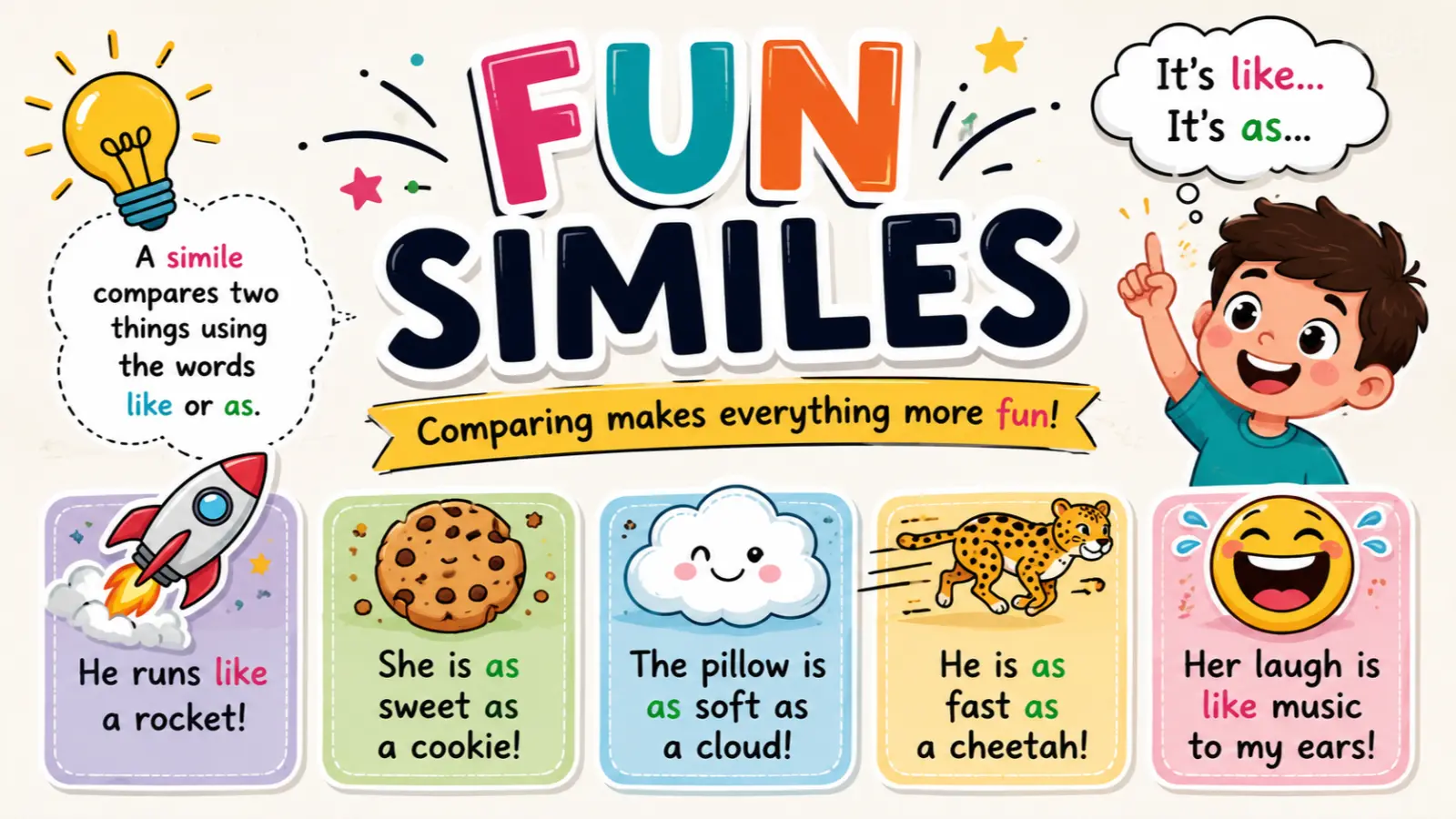
Fun similes bring writing to life by comparing one thing to another using the words “like” or “as.” They add humor, personality, and vivid imagery that help readers picture exactly what you mean. Whether you’re writing a story, poem, school assignment, speech, or even a social media caption, fun similes make ordinary sentences memorable. They help readers smile while making descriptions clearer and more engaging.
In this guide, you’ll discover original fun similes, learn why they work, and pick up practical techniques for creating your own imaginative comparisons.
What Are Fun Similes?
A fun simile is a playful comparison between two different things using like or as. Instead of simply describing something, a fun simile paints a colorful picture that sparks the reader’s imagination.
For example:
His excitement bounced around like popcorn in a hot pan.
This comparison doesn’t just tell readers someone is excited—it lets them almost see the energy.
Why Writers Love Fun Similes
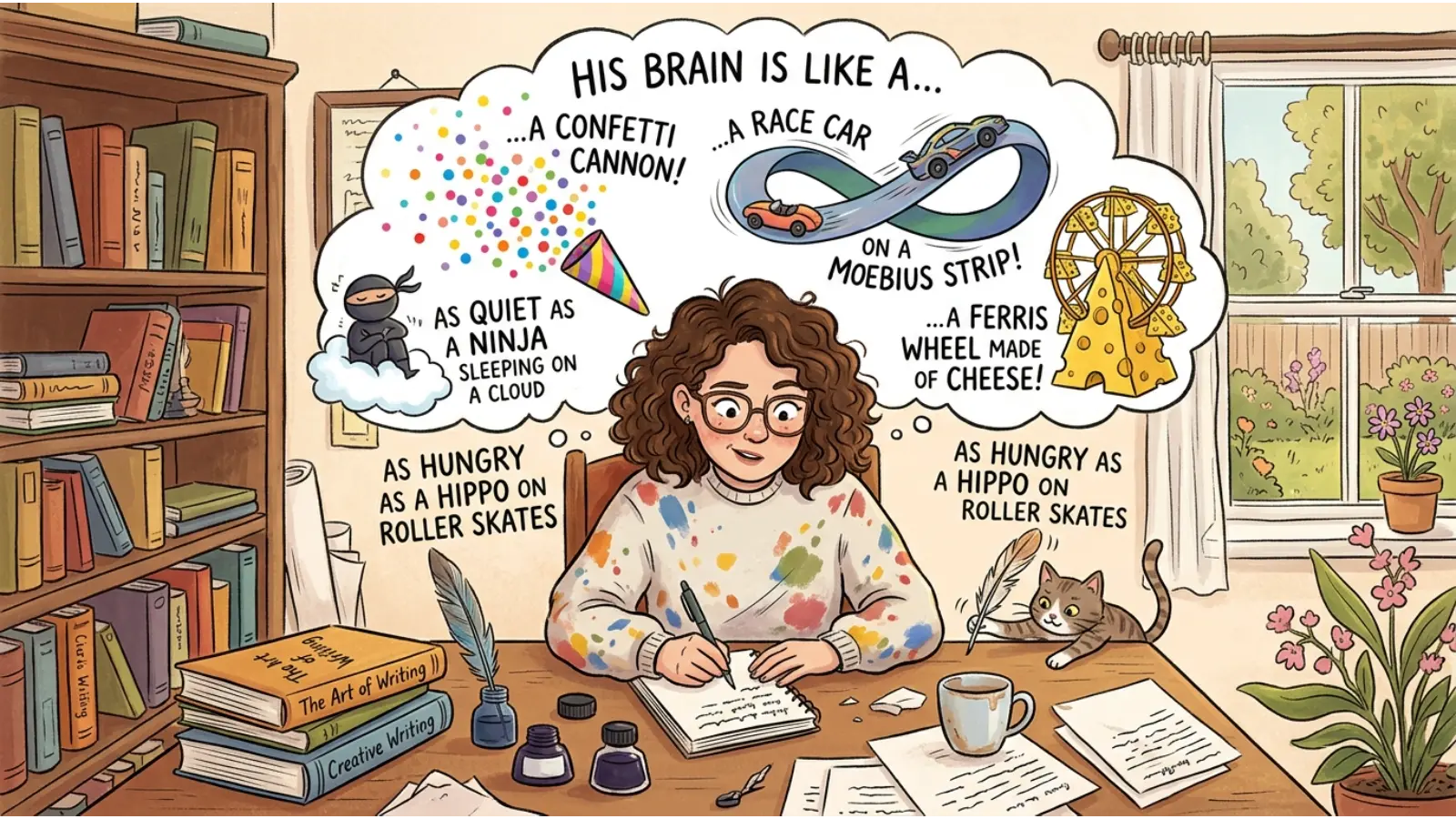
Fun similes can:
- Make descriptions more memorable.
- Add humor without telling jokes.
- Help readers visualize scenes.
- Improve stories, poems, and speeches.
- Make classroom writing more enjoyable.
- Create stronger emotional connections.
The best fun similes surprise readers while still making perfect sense.
30 Original Fun Similes
1. As cheerful as a kite dancing in spring wind
Meaning: Extremely happy and energetic.
Example 1: She walked into class as cheerful as a kite dancing in spring wind.
Example 2: The puppy looked as cheerful as a kite dancing in spring wind.
Writing Tip: Great for joyful characters.
2. Like pancakes flipping on a busy griddle
Meaning: Constantly changing direction.
Example 1: His ideas flipped like pancakes on a busy griddle.
Example 2: The conversation turned like pancakes on a busy griddle.
Best Context: Stories with fast-paced dialogue.
3. As colorful as a box of fresh crayons
Meaning: Bright and full of life.
Example 1: Her artwork was as colorful as a box of fresh crayons.
Example 2: The festival looked as colorful as a box of fresh crayons.
4. Like bubbles chasing each other
Meaning: Light, playful movement.
Conversation Example:
“The kids were running around like bubbles chasing each other.”
Storytelling Tip: Works well in children’s stories.
5. As playful as squirrels inventing new games
Meaning: Full of energy and curiosity.
Formal Example: The young campers remained as playful as squirrels inventing new games throughout the afternoon.
6. Like confetti caught in a breeze
Meaning: Scattered with joyful energy.
Example: Her laughter floated through the room like confetti caught in a breeze.
7. As busy as a pencil during exam week
Meaning: Extremely occupied.
Example: Mom was as busy as a pencil during exam week.
8. Like marshmallows floating in hot chocolate
Meaning: Comfortable and relaxed.
Example: He settled into the couch like marshmallows floating in hot chocolate.
9. As curious as a cat exploring a cardboard castle
Meaning: Eager to discover new things.
Writing Purpose: Perfect for adventurous characters.
10. Like fireworks hiding inside a smile
Meaning: Quiet excitement waiting to burst out.
Example: She looked like fireworks hiding inside a smile.
11. As light as a feather riding a breeze
Meaning: Effortless or graceful.
12. Like a cookie disappearing at a party
Meaning: Gone very quickly.
13. As quick as a squirrel spotting snacks
Meaning: Extremely fast.
14. Like music skipping through sunshine
Meaning: Bright and joyful.
15. As lively as popcorn at movie night
Meaning: Full of excitement.
16. Like a rainbow stretching after rain
Meaning: Hopeful and beautiful.
17. As bright as a room full of birthday candles
Meaning: Radiating happiness.
18. Like ice cubes dancing in lemonade
Meaning: Refreshing and lively.
19. As fearless as a child chasing butterflies
Meaning: Brave without overthinking.
20. Like puzzle pieces finally clicking together
Meaning: Everything suddenly makes sense.
21. As silly as socks on a rooster
Meaning: Wonderfully ridiculous.
Conversation Example: That’s as silly as socks on a rooster!
22. Like balloons escaping into blue skies
Meaning: Free and carefree.
23. As gentle as moonlight on fresh snow
Meaning: Calm and peaceful.
24. Like a train full of giggles
Meaning: Loud, joyful excitement.
25. As sweet as fresh berries after rain
Meaning: Kind and pleasant.
26. Like stars learning to dance
Meaning: Magical and graceful.
27. As surprising as finding treasure in your backpack
Meaning: Unexpected in a delightful way.
28. Like sunshine peeking through curtains
Meaning: Gradually becoming happier.
29. As smooth as melted butter on warm toast
Meaning: Effortless and easy.
30. Like a merry-go-round full of laughter
Meaning: Constant fun and happiness.
How to Write Better Fun Similes
The strongest similes connect two things that share a clear quality without being obvious.
Instead of writing:
Happy as the sun.
Try:
Happy as a puppy discovering its favorite toy.
Specific details make comparisons feel fresh.
Ask yourself:
- What does it look like?
- What emotion does it create?
- Can readers picture it immediately?
If the answer is yes, your simile is probably working.
Avoid Common Simile Mistakes
Using Overused Comparisons
Readers have seen comparisons like “busy as a bee” countless times. Original images are usually more memorable.
Mixing Images
Avoid combining unrelated comparisons.
Example:
She floated like a feather while roaring like thunder.
Unless you’re aiming for a surreal effect, mixed imagery can confuse readers.
Comparing Unrelated Ideas
Every comparison should highlight one clear shared quality.
Forgetting the Purpose
A funny simile should support your writing—not distract from it.
Fun Similes vs. Other Literary Devices
Simile
Makes a comparison using like or as.
The playground buzzed like a beehive.
Metaphor
States that one thing is another.
The playground was a beehive.
Imagery
Uses descriptive language to appeal to the senses.
Hyperbole
Uses intentional exaggeration.
I laughed for a thousand years.
Combining these techniques thoughtfully can make your writing more engaging.
Create Your Own Fun Similes
You don’t need to wait for inspiration. Try this simple method:
Step 1
Choose something you want to describe.
Example:
A happy child.
Step 2
Think about what it reminds you of.
Maybe:
- A bouncing ball
- A spinning pinwheel
- A puppy greeting its owner
Step 3
Connect them using like or as.
Example:
The child bounced like a pinball finding every bumper.
Creative Exercise
Write similes for these words:
- Curious
- Sleepy
- Noisy
- Friendly
- Excited
Try creating at least three different comparisons for each word. The more you practice, the more natural your writing will become.
Frequently Asked Questions
What is a fun simile?
A fun simile is a playful comparison using like or as to make descriptions more interesting and memorable.
Why should I use fun similes?
They make writing more vivid, engaging, and enjoyable for readers.
Can students use fun similes in school assignments?
Yes. They improve creative writing, descriptive paragraphs, poems, and stories.
What’s the difference between a simile and a metaphor?
A simile uses like or as, while a metaphor makes a direct comparison without those words.
How can I make my similes more original?
Focus on specific details, avoid common comparisons, and think about everyday experiences from a fresh perspective.
Are fun similes only for children’s writing?
No. Writers of all ages use playful similes to add personality and imagery to stories, speeches, blogs, and even professional presentations.
How many similes should I use in one piece of writing?
Use them where they strengthen the description. Too many can overwhelm readers, while a few well-chosen similes often have the greatest impact.
Conclusion
Fun similes do much more than decorate your writing—they create images readers remember. A well-crafted comparison can add humor, emotion, or clarity in just a few words. Instead of relying on familiar expressions, experiment with fresh ideas inspired by everyday life, nature, food, games, and imagination. The more original your comparisons become, the more your unique writing voice will shine. Practice often, observe the world closely, and don’t be afraid to invent playful images that surprise your readers while still feeling believable.
I am Helena Frost, a writer captivated by the beauty of language and the art of comparison. Through my words, I explore the world by turning ordinary moments into vivid similes and reflections. I enjoy crafting phrases that spark imagination, evoke emotion, and linger in the mind. My writing celebrates the subtle connections between people, nature, and the stories we live. For me, every sentence is an opportunity to reveal the extraordinary in the everyday.