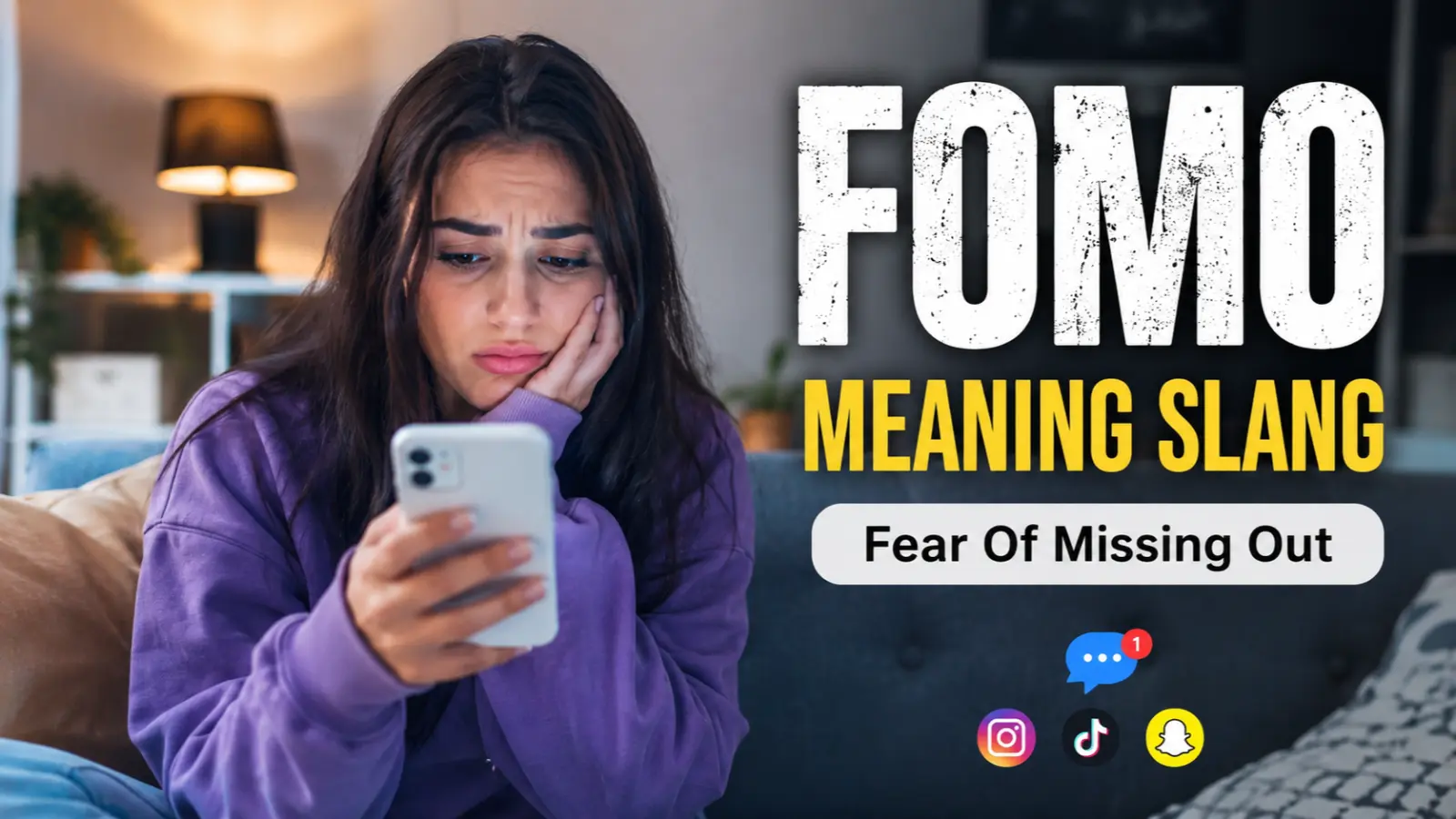
FOMO meaning slang is one of the most searched internet terms because people often see it on social media, in text messages, online chats, and even in everyday conversations.
If you’re scrolling through Instagram, reading comments on TikTok, or chatting with friends, you’ve probably come across someone saying, “I’ve got serious FOMO.”
The slang has become a common way to describe the feeling of missing out on exciting events, experiences, or opportunities. It is widely used by teenagers, young adults, influencers, marketers, and even professionals.
Understanding what FOMO means helps you better understand modern online culture and communicate more naturally.
In this guide, you’ll learn the full meaning of FOMO, where it came from, how people use it, conversation examples, emotional meaning, and when it’s appropriate to use.
Quick Answer
FOMO stands for Fear Of Missing Out. It describes the anxious feeling that other people are enjoying something exciting without you, making you wish you were included.
What Does FOMO Mean in Text?
In texting and online conversations, FOMO means Fear Of Missing Out.
People use it when they feel they might miss an event, opportunity, trend, or experience that others are enjoying.
For example:
“Everyone is going to the concert tonight. I’ve got major FOMO.”
The phrase isn’t always serious. Many people use it humorously when talking about parties, vacations, shopping deals, or trending topics.
FOMO Full Form
The FOMO full form is:
F – Fear
O – Of
M – Missing
O – Out
It refers to the emotional worry that you’re missing something fun, important, or valuable happening elsewhere.
Related searches include:
- FOMO meaning slang
- FOMO full form
- What does FOMO stand for?
- FOMO meaning in text
- FOMO meaning on social media
Meaning of FOMO in Different Contexts
In Text Messages
Friends use FOMO when discussing plans or events.
Example:
“You all went without me? Now I’ve got FOMO.”
On Social Media
People often use FOMO after seeing vacation photos, party pictures, or exciting experiences online.
Example:
“These beach pictures are giving me FOMO.”
At School or College
Students may use it when they miss social events, trips, or campus activities.
Example:
“I skipped the festival and now I’m feeling FOMO.”
At Work
Professionals sometimes use FOMO when talking about networking events or career opportunities.
Example:
“Everyone attended the conference except me. Serious FOMO.”
In Marketing
Businesses create FOMO to encourage customers to buy quickly.
Examples include:
- Limited-time offers
- Flash sales
- Countdown timers
- Exclusive memberships
Is FOMO Rude, Offensive, or Neutral?
FOMO is considered neutral slang.
It is:
- ✅ Not offensive
- ✅ Safe for casual conversations
- ✅ Appropriate on social media
- ✅ Common among all age groups
However, it’s better to avoid using slang in highly formal writing, business reports, or academic papers.
Where Is FOMO Commonly Used?
You’ll often see FOMO on:
- TikTok
- Snapchat
- X (Twitter)
- Discord
- Group chats
- Online gaming communities
It has become part of everyday internet language.
Emotional and Psychological Meaning of FOMO
FOMO isn’t just internet slang.
Psychologists describe it as the anxiety that others may be having rewarding experiences without you.
People experiencing FOMO often:
- Check social media frequently.
- Compare themselves to others.
- Feel left out.
- Worry about missing opportunities.
- Have difficulty making decisions.
While mild FOMO is common, excessive FOMO can affect mental well-being and increase stress.
Origin and Background of FOMO
Although the feeling has existed for centuries, the acronym FOMO became popular during the early 2000s.
Its popularity exploded with the rise of:
- Snapchat
- TikTok
- Influencer culture
As people shared more of their lives online, others increasingly compared themselves to those curated highlights, making FOMO a widely recognized term.
Today, it appears in:
- Psychology articles
- Marketing campaigns
- News reports
- Social media posts
- Everyday conversations
Why People Use FOMO Slang
People use FOMO because it’s:
- Short
- Easy to understand
- Emotionally expressive
- Popular online
- Relatable
Instead of saying,
“I’m worried I’m missing something fun.”
they simply say,
“I’ve got FOMO.”
Real-Life Conversation Examples
Friendly Conversation
Sarah: We’re going hiking tomorrow.
Emma: Don’t post too many pictures or I’ll get FOMO!
Casual Conversation
Alex: Everyone watched the new series.
Jake: Now I’ve got FOMO.
Argumentative Conversation
Person A: Why are you suddenly joining?
Person B: Because everyone else is going, and honestly, I have FOMO.
Shopping Example
Friend: The sale ends tonight.
You: You’re giving me FOMO. Maybe I should buy it.
Travel Example
Friend: We’re visiting Japan next month.
You: Those travel plans are giving me serious FOMO.
Common Misunderstandings About FOMO
Some people believe FOMO always refers to social media.
Actually, it can relate to:
- Career opportunities
- Friend gatherings
- Sports events
- Family celebrations
- Investment opportunities
- Shopping deals
- Educational events
Another misunderstanding is that FOMO is always negative.
Many people use it jokingly without feeling genuine anxiety.
Variations and Related Slang
Common variations include:
- Major FOMO
- Serious FOMO
- Weekend FOMO
- Vacation FOMO
- Travel FOMO
- Shopping FOMO
- Event FOMO
Related internet slang includes:
- YOLO
- JOMO
- IMO
- TBH
- ICYMI
Comparison Table
| Slang | Full Form | Meaning | Tone |
|---|---|---|---|
| FOMO | Fear Of Missing Out | Feeling left out | Neutral |
| JOMO | Joy Of Missing Out | Enjoying staying away | Positive |
| YOLO | You Only Live Once | Take opportunities | Encouraging |
| ICYMI | In Case You Missed It | Sharing missed information | Informative |
| TBH | To Be Honest | Expressing honesty | Casual |
How to Respond When Someone Uses FOMO
If someone says:
“I’ve got FOMO.”
You could reply:
- “Come with us next time!”
- “Don’t worry—you didn’t miss much.”
- “We’ll invite you next time.”
- “You can still join us.”
- “There will be another chance.”
When to Use FOMO
Use FOMO when:
- Talking with friends
- Posting on social media
- Casual texting
- Online chats
- Discussing events
- Talking about trends
When to Avoid Using FOMO
Avoid using it in:
- Academic essays
- Legal documents
- Professional reports
- Formal business emails
- Official presentations
In formal situations, it’s better to say:
- Concern about missing opportunities
- Feeling excluded
- Fear of being left out
Polite Alternatives
Instead of saying FOMO, you can say:
- I don’t want to miss out.
- I wish I could join.
- I feel left out.
- I’d love to be included.
- I hope I can come next time.
These alternatives sound more formal and professional.
Impact of Using Slang in Communication
Using FOMO can make conversations:
- More relatable
- More expressive
- More modern
- Easier to understand among younger audiences
However, using too much slang in formal settings may reduce professionalism.
Always consider your audience before using internet slang.
Is FOMO Safe for Social Media?
Yes.
FOMO is considered one of the safest internet slang terms because it:
- Has no offensive meaning.
- Doesn’t contain profanity.
- Is widely understood.
- Is acceptable on most social media platforms.
It is commonly used in captions, comments, stories, and posts.
Regional and Cultural Usage
Although FOMO originated in English-speaking countries, it is now used worldwide.
You’ll find it in conversations across:
- United States
- United Kingdom
- Canada
- Australia
- India
- Pakistan
- Europe
- Southeast Asia
Many non-native English speakers also use FOMO because of its popularity on social media.
Frequently Asked Questions
What does FOMO stand for?
FOMO stands for Fear Of Missing Out.
Is FOMO a bad thing?
Not necessarily. Small amounts of FOMO are normal, but constant FOMO may increase stress or anxiety.
Is FOMO internet slang?
Yes. FOMO is a widely used internet slang term in texting, social media, and online conversations.
Can adults use FOMO?
Absolutely. People of all ages use FOMO in casual conversations.
What is the opposite of FOMO?
The opposite is JOMO, which stands for Joy Of Missing Out, meaning you’re happy staying home or skipping events.
Is FOMO appropriate in professional settings?
It can be used casually among coworkers, but in formal business communication, it’s better to use phrases like “concern about missing opportunities.”
Conclusion
Understanding the FOMO meaning slang helps you communicate more confidently in today’s digital world. FOMO, which stands for Fear Of Missing Out, describes the feeling that others are enjoying experiences or opportunities without you. It’s a common, neutral expression used in texting, social media, workplaces, and everyday conversations.
While FOMO is generally safe and widely accepted, it’s best reserved for informal communication. In professional or academic settings, more formal alternatives are usually a better choice. By understanding what FOMO stands for, where it comes from, and how to use it naturally, you’ll be better prepared to recognize and use this popular slang in the right context.