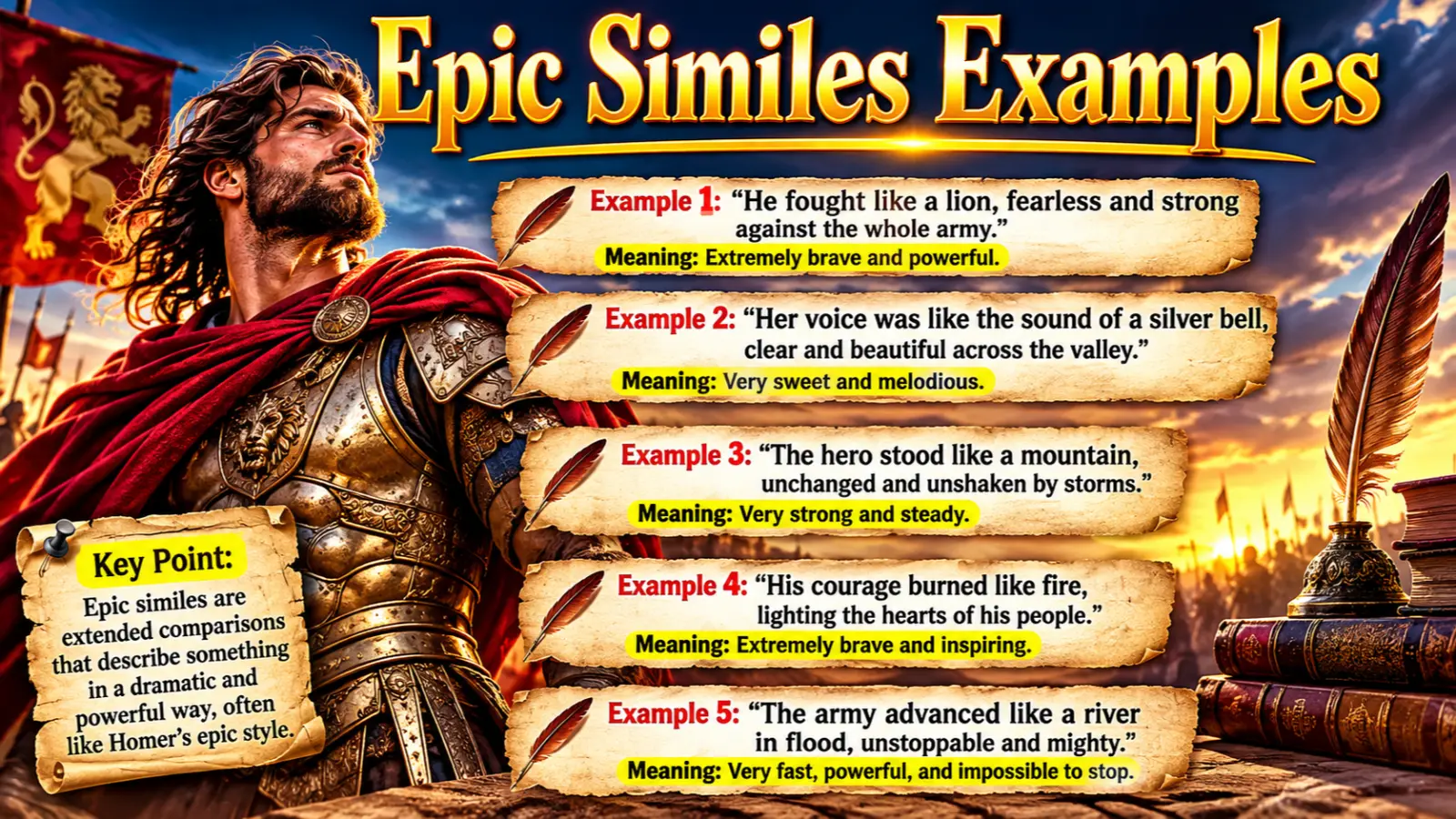
Epic Similes Examples are extended comparisons that do more than describe one thing. They slow the reader down, build a vivid scene, and connect an idea to a larger image or experience. Unlike a short simile such as “the warrior was brave like a lion,” an epic simile can unfold across several lines or sentences.
You can find Epic Similes Examples in poetry, novels, myths, storytelling, speeches, and creative writing. They are especially useful when an ordinary description needs greater scale, emotion, movement, or atmosphere.
This collection of epic similes examples explains how extended comparisons work, why they are effective, and how you can create your own without making your writing feel exaggerated or forced.
What Is an Epic Simile?
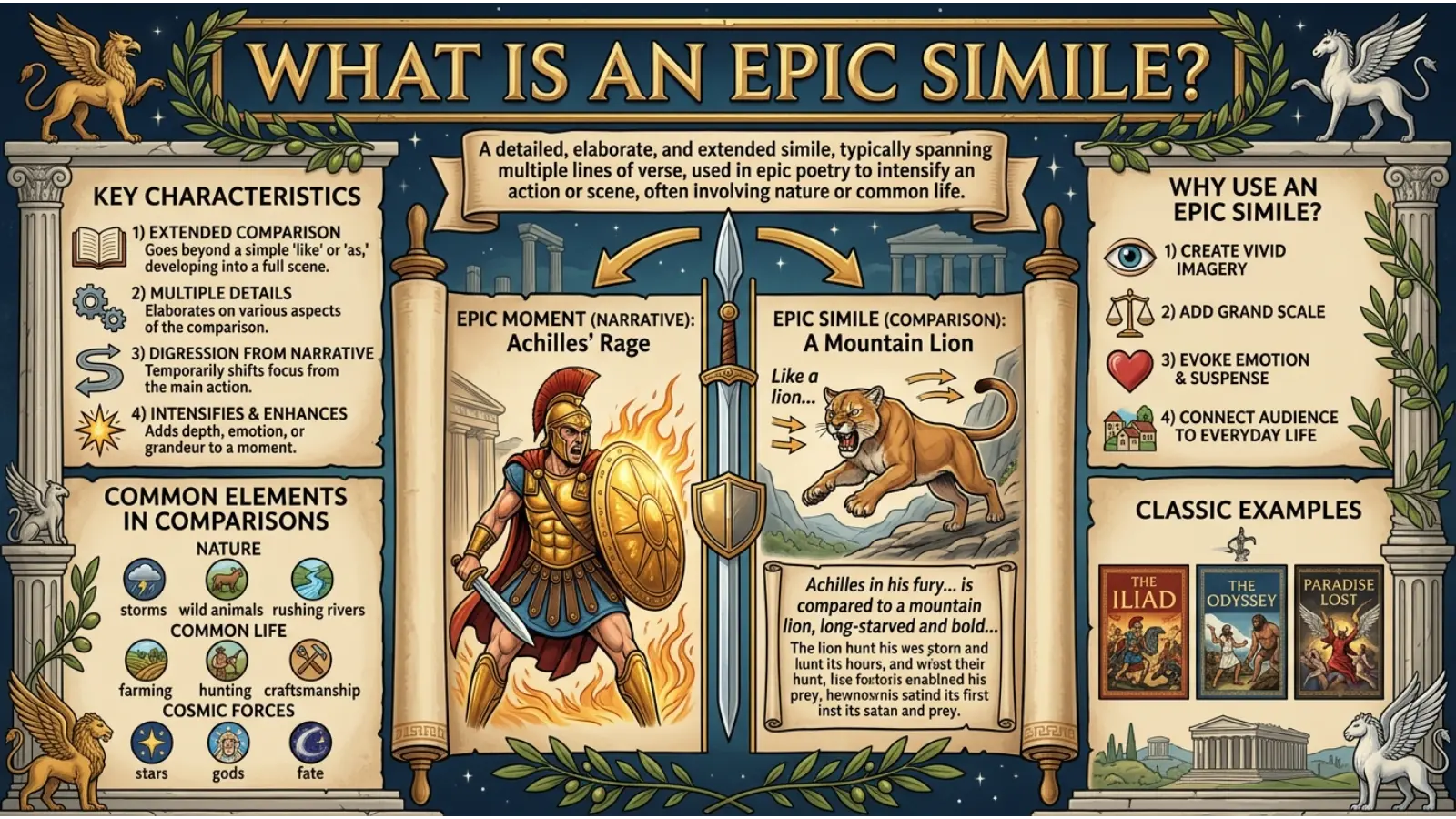
An Epic Similes Examples is a detailed comparison that uses words such as like or as to connect one subject with another. The comparison is extended through additional details rather than ending after a single phrase.
A simple simile might say:
The ship moved like a bird.
An Epic Similes Examples develops the image:
The ship moved like a sea bird searching for land, rising over the waves, dipping into the wind, and returning again to the horizon whenever the crew thought they had finally found their way home.
The Epic Similes Examples second comparison gives the reader movement, setting, mood, and a clearer mental picture.
Why Are Epic Similes So Powerful?
A well-written epic simile can:
- Make an unfamiliar subject easier to imagine
- Turn an ordinary moment into a memorable scene
- Create emotional depth
- Establish atmosphere
- Slow down an important moment
- Reveal something about a character
- Give poetry and storytelling a larger sense of scale
The Epic Similes Examples key is not length alone. An extended comparison should add meaning rather than simply add words.
20 Epic Similes Examples for Creative Writing
1. The Warrior and the Storm
Simile:
The warrior stood like a lone tree on a mountain during a storm, bending beneath the wind but refusing to surrender its roots.
Meaning:
This comparison presents courage as quiet endurance rather than aggression.
Example:
He stood at the gate like a tree in a mountain storm, battered by every gust yet holding firmly to the earth.
Writing purpose:
Use this when you want to show resilience under pressure.
2. A City Awakening
Simile:
The city woke like a giant slowly opening its eyes, first stirring in distant windows, then stretching through traffic until every street hummed with movement.
Why it works:
The city becomes almost human, allowing the reader to experience its gradual transformation from silence to activity.
Best context:
Urban stories, travel writing, introductions, and descriptive essays.
3. Fear in the Dark
Simile:
Her fear spread like ink dropped into clear water, beginning as one small thought before darkening every corner of her mind.
Emotional effect:
The image shows fear growing gradually until it becomes difficult to escape.
Writing tip:
When writing about an emotion, compare it to something that changes over time. This makes the feeling dynamic.
4. A Runner Near the Finish
Simile:
He raced like a spark carried across dry grass, moving from one step to the next with such urgency that stopping seemed impossible.
Meaning:
The comparison emphasizes speed and unstoppable momentum.
Best context:
Sports writing, action scenes, and motivational storytelling.
5. A Quiet Lake
Simile:
The lake rested like a sheet of glass beneath the morning sky, holding the mountains in its surface as carefully as a mirror holds a face.
Why it works:
The comparison combines stillness with reflection, giving the setting a peaceful quality.
Poetry example:
The lake lay like glass beneath the pale morning, keeping the mountains safely inside its silver surface.
6. Friendship
Simile:
Their friendship grew like a trail through a forest, beginning as a narrow path between strangers and becoming wider with every shared journey.
Meaning:
Friendship is presented as something built through repeated experiences.
Best context:
Personal essays, stories about relationships, and reflective writing.
7. Happiness
Simile:
Her happiness rose like sunlight entering a dark room, touching one forgotten corner after another until even the smallest things seemed bright.
Emotional effect:
The image suggests that happiness can gradually transform how someone sees the world.
Writing tip:
For positive emotions, natural images such as sunlight, birds, gardens, and warm weather can work well—but choose details that fit your specific scene rather than relying on familiar clichés.
8. Rain on a Summer Afternoon
Simile:
The rain arrived like a sudden orchestra, beginning with a few quiet notes against the roof before building into a full rhythm that filled the streets.
Why it works:
Sound becomes the bridge between rain and music.
Best context:
Atmospheric fiction, poetry, and sensory description.
9. Anger
Simile:
His anger grew like a furnace being fed from below, each new insult adding another piece of fuel until his calm expression could no longer contain the heat.
Meaning:
The comparison presents anger as something that builds rather than appears instantly.
Writing purpose:
Useful when showing emotional escalation.
10. Love
Simile:
Their love developed like a garden cared for through changing seasons, needing patience in winter, attention in spring, and steady care when summer became harsh.
Why it works:
The garden represents growth, maintenance, patience, and change.
Best context:
Reflective prose, poetry, and relationship-centered storytelling.
11. A Teacher’s Voice
Simile:
Her voice moved through the classroom like a lantern carried down a dark hallway, illuminating one difficult idea after another until confusion began to disappear.
Meaning:
The comparison portrays teaching as guidance.
Writing tip:
Extended similes work particularly well when the comparison has several related details that support the same central idea.
12. A Child’s Imagination
Simile:
His imagination raced like a small boat released onto a wild river, turning every ordinary object into a doorway to another adventure.
Emotional effect:
The image creates curiosity and playfulness.
Best context:
Children’s literature, character descriptions, and nostalgic writing.
13. An Old Photograph
Simile:
The photograph sat in the drawer like a forgotten window into another world, its faded faces still carrying the expressions of people who had long since left the room.
Why it works:
The photograph becomes more than an object; it becomes a connection to the past.
Best context:
Historical fiction, memoir, family stories, and reflective essays.
14. A Difficult Journey
Simile:
The journey unfolded like a mountain trail hidden by fog, revealing only a few steps at a time while every bend promised another climb.
Meaning:
The comparison communicates uncertainty without explaining every difficulty directly.
Writing purpose:
Use this approach when you want readers to experience uncertainty alongside a character.
15. A Crowd Before a Concert
Simile:
The crowd gathered like waves pushed toward the shore, growing larger and louder until the entire entrance seemed to move as one restless body.
Why it works:
The comparison captures both size and collective movement.
Best context:
Concerts, festivals, sporting events, and public celebrations.
16. A Memory
Simile:
The memory returned like a song heard from another room, faint at first, then clearer with every passing second until the past seemed close enough to touch.
Emotional effect:
It creates nostalgia and gradual recognition.
Writing tip:
When writing about memory, sensory comparisons are often stronger than abstract statements such as “he remembered the past.”
17. A Powerful Speech
Simile:
His words moved through the audience like a current through water, reaching people who had arrived with different opinions and leaving many of them thinking in a new direction.
Meaning:
The comparison focuses on influence rather than volume.
Best context:
Speeches, political fiction, historical scenes, and leadership narratives.
18. Snow at Night
Simile:
Snow covered the town like a fresh page laid across an old story, softening rooftops, hiding footprints, and making familiar streets seem newly invented.
Why it works:
The fresh page represents both silence and possibility.
Best context:
Winter fiction, poetry, fantasy, and atmospheric description.
19. A Difficult Decision
Simile:
The decision waited before her like a locked door in an unfamiliar house, offering no clear answer while every possible key seemed to fit a different future.
Meaning:
The comparison expresses uncertainty and consequence.
Writing purpose:
Use an extended simile to externalize an internal conflict.
20. Hope
Simile:
Hope remained like a small candle in a house without electricity, too weak to illuminate every room but bright enough to prove that darkness had not won.
Emotional effect:
The image creates quiet optimism without pretending that the problem has disappeared.
Best context:
Inspirational writing, literary fiction, poetry, and reflective essays.
How Epic Similes Differ From Ordinary Similes
A regular simile usually makes a quick comparison:
The moon was like a silver coin.
An epic simile stays with the comparison and develops it:
The moon hung above the rooftops like a silver coin left on a dark table, bright enough to catch the eye but too distant for anyone below to claim.
The difference is not simply the number of words. An epic simile develops an image.
A useful test is this: if you remove the extra details and the sentence loses an important layer of meaning, the comparison is probably doing meaningful extended work.
How to Write a Strong Epic Simile
Start With the Feeling or Idea
Before choosing an image, decide what you want the reader to feel.
Do you want the moment to feel:
- Peaceful?
- Threatening?
- Exciting?
- Lonely?
- Hopeful?
- Confusing?
- Joyful?
The emotional goal should guide the comparison.
Choose an Image With Room to Grow
Some images naturally offer several related details.
A storm can provide wind, rain, thunder, darkness, movement, and pressure.
A garden can provide roots, seasons, growth, neglect, flowers, and decay.
A river can provide direction, speed, obstacles, depth, and change.
These images give you material for extending a comparison without forcing unrelated details into it.
Keep the Details Connected
A common mistake is starting with one comparison and suddenly switching to another.
Weak:
Her thoughts were like a river, burning through the darkness like a frightened bird.
The imagery conflicts.
Stronger:
Her thoughts moved like a river after heavy rain, rushing faster than she could control and carrying every unfinished question downstream.
The details belong to the same image system.
What Makes an Epic Simile Memorable?
Specific Details
Compare:
The room was like a jungle.
with:
The room felt like a jungle after rainfall, with damp clothes hanging from chairs, books stacked like fallen branches, and narrow paths disappearing between piles of unfinished work.
The second version gives readers something concrete to visualize.
Emotional Connection
A beautiful image is not automatically a useful image.
Ask:
What does this comparison reveal about the character or situation?
If the answer is nothing, the simile may be decorative rather than meaningful.
Controlled Length
An epic simile does not need to become an entire paragraph.
If three details communicate the idea clearly, stop there. Extra imagery can weaken the original comparison.
Epic Similes in Poetry and Storytelling
Epic similes have a long history in literature, particularly in epic poetry. Classical and later poets used extended comparisons to give battles, journeys, heroes, landscapes, and emotional moments greater scale.
In modern writing, you do not need to imitate an ancient poetic style. You can use the same underlying technique in contemporary fiction, essays, poems, screenwriting, and personal narratives.
The principle remains simple:
Compare something familiar or vivid to something you want readers to understand more deeply, then develop that comparison with purposeful details.
Epic Simile vs. Metaphor
A simile normally signals comparison with like or as.
The road was like a ribbon through the valley.
A metaphor makes the comparison more directly:
The road was a ribbon through the valley.
An epic simile can therefore be thought of as an extended comparison, while an extended metaphor develops an identity between two things.
Both can create strong imagery. The choice depends on the voice and effect you want.
Other Literary Devices That Work With Epic Similes
Imagery
Imagery gives readers sensory information. Epic similes become stronger when they appeal to sight, sound, touch, smell, or movement.
Personification
You can combine an epic simile with personification:
The old house stood like a tired guardian, watching the road through cracked windows as though it still expected someone to return.
Hyperbole
Hyperbole deliberately exaggerates. It can appear alongside a simile, but make sure the exaggeration suits the tone.
Symbolism
A comparison can carry symbolic meaning. A locked door might represent uncertainty, while a growing tree might suggest resilience or maturity.
Common Mistakes When Writing Epic Similes
Using a Cliché
Comparisons such as “busy as a bee” are familiar because they have been used so often.
Familiar expressions are not automatically wrong, but original writing usually becomes more memorable when the image fits the specific scene.
Adding Too Many Details
An extended simile can become exhausting if every possible feature of the comparison is included.
Choose the two or three details that matter most.
Mixing Images
Do not begin with a river and suddenly introduce unrelated fire imagery unless the transition is deliberate.
Keep the comparison coherent.
Explaining the Simile Too Much
Trust the image.
Instead of writing:
She was like a candle because she gave everyone hope and was a source of light and made people feel better.
Try:
She was like a candle left burning in an empty room, small but impossible to ignore.
The image does more of the work.
Choosing an Image That Does Not Fit the Character
A comparison should feel natural for the speaker, character, setting, or subject.
A scientific character might notice machinery and patterns. A child might notice games, animals, colors, or adventures. A sailor might naturally think in terms of tides and weather.
The best similes often reveal the person making the comparison.
Create Your Own Epic Similes With This Exercise
Try this five-step method.
Step 1: Pick a subject
Choose something ordinary:
A tired student.
Step 2: Identify its strongest quality
Maybe the student feels exhausted, distracted, or determined.
Step 3: Find an image with the same quality
For exhaustion, consider a machine running out of power.
Step 4: Extend the image
Add details that belong to that image:
The student moved like an old machine nearing the end of its power, completing one task after another with slower movements, dimmer attention, and just enough energy to keep going.
Step 5: Remove anything unnecessary
Read the comparison aloud. If a detail does not strengthen the central image, cut it.
A Simple Epic Simile Writing Exercise
Choose one subject from each column:
| Subject | Possible comparison |
|---|---|
| A lonely character | An empty station |
| A celebration | A rising tide |
| A difficult exam | A locked gate |
| A new friendship | A growing path |
| A dangerous journey | A storm |
| A peaceful morning | A quiet garden |
Now write three sentences.
- Introduce the comparison.
- Add two specific details.
- Connect the image back to the original subject.
This exercise teaches you to develop an image rather than simply attach a comparison to a noun.
How to Make Your Similes More Original
Instead of asking, “What is this like?” ask a more specific question:
What is this like in this exact moment?
A character’s sadness may not always be “like rain.” Perhaps it is like finding a familiar chair missing from a room. A busy street may not always be “like an ocean.” Perhaps it moves like a conveyor belt that has forgotten how to stop.
Specificity creates originality.
Another useful technique is to borrow images from the character’s surroundings. A baker, mechanic, gardener, musician, athlete, or student will naturally notice different things. Let their experiences influence the comparison.
FAQ About Epic Similes
What is an example of an epic simile?
An epic simile might compare a person’s determination to a tree surviving a storm and then develop the comparison through details about wind, roots, branches, and endurance. The comparison extends beyond a single phrase to create a fuller image.
How long should an epic simile be?
There is no fixed length. It can be a sentence or several lines of poetry. The important feature is that the comparison is developed meaningfully rather than simply being a longer sentence.
What is the difference between a simile and an epic simile?
A normal simile makes a direct comparison, usually briefly. An epic simile extends that comparison with additional imagery, action, or description.
Are epic similes only used in poetry?
No. They can appear in poetry, fiction, essays, speeches, creative nonfiction, and other forms of descriptive writing.
Do epic similes have to use “like” or “as”?
Traditional similes generally use explicit comparison words such as “like” or “as.” If the comparison does not use those signals, it may function more like a metaphor.
Why do writers use epic similes?
Writers use them to create vivid imagery, slow down important moments, express emotion, reveal character, and help readers understand unfamiliar or abstract ideas through concrete images.
Can an epic simile be funny?
Yes. Humor can come from an unexpected but believable comparison. The key is to choose an image that creates surprise without becoming confusing.
How can I avoid making an epic simile sound forced?
Start with the emotion or idea you want to communicate, choose an image that naturally shares that quality, and use only details that strengthen the comparison.
Conclusion
Epic similes give writers a way to turn simple descriptions into experiences readers can picture and feel. The strongest examples do not use complicated vocabulary simply to sound impressive. They choose a clear image, develop it carefully, and make the comparison matter. When creating your own, focus first on the emotion, quality, or action you want to communicate. Then find an image that naturally shares that quality. Add a few precise details, keep the imagery consistent, and stop before the comparison becomes overloaded. A great epic simile does not merely decorate a sentence. It gives the reader a new way to see it.
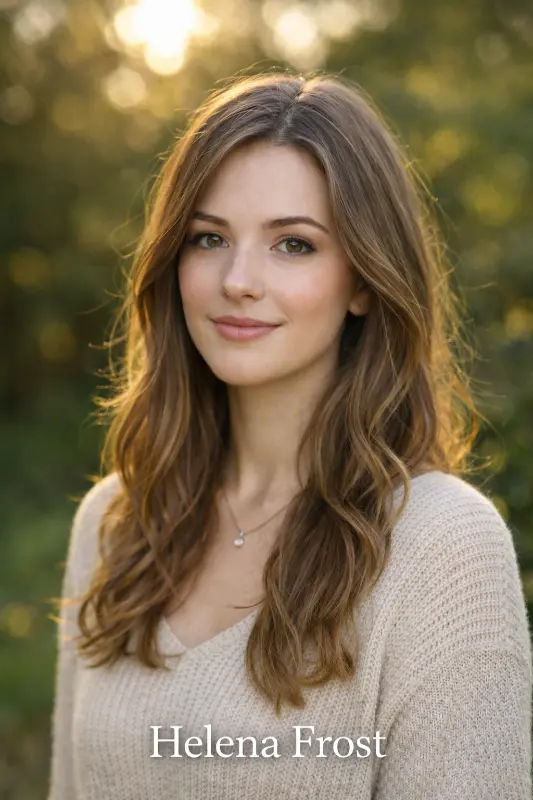
I am Helena Frost, a writer captivated by the beauty of language and the art of comparison. Through my words, I explore the world by turning ordinary moments into vivid similes and reflections. I enjoy crafting phrases that spark imagination, evoke emotion, and linger in the mind. My writing celebrates the subtle connections between people, nature, and the stories we live. For me, every sentence is an opportunity to reveal the extraordinary in the everyday.