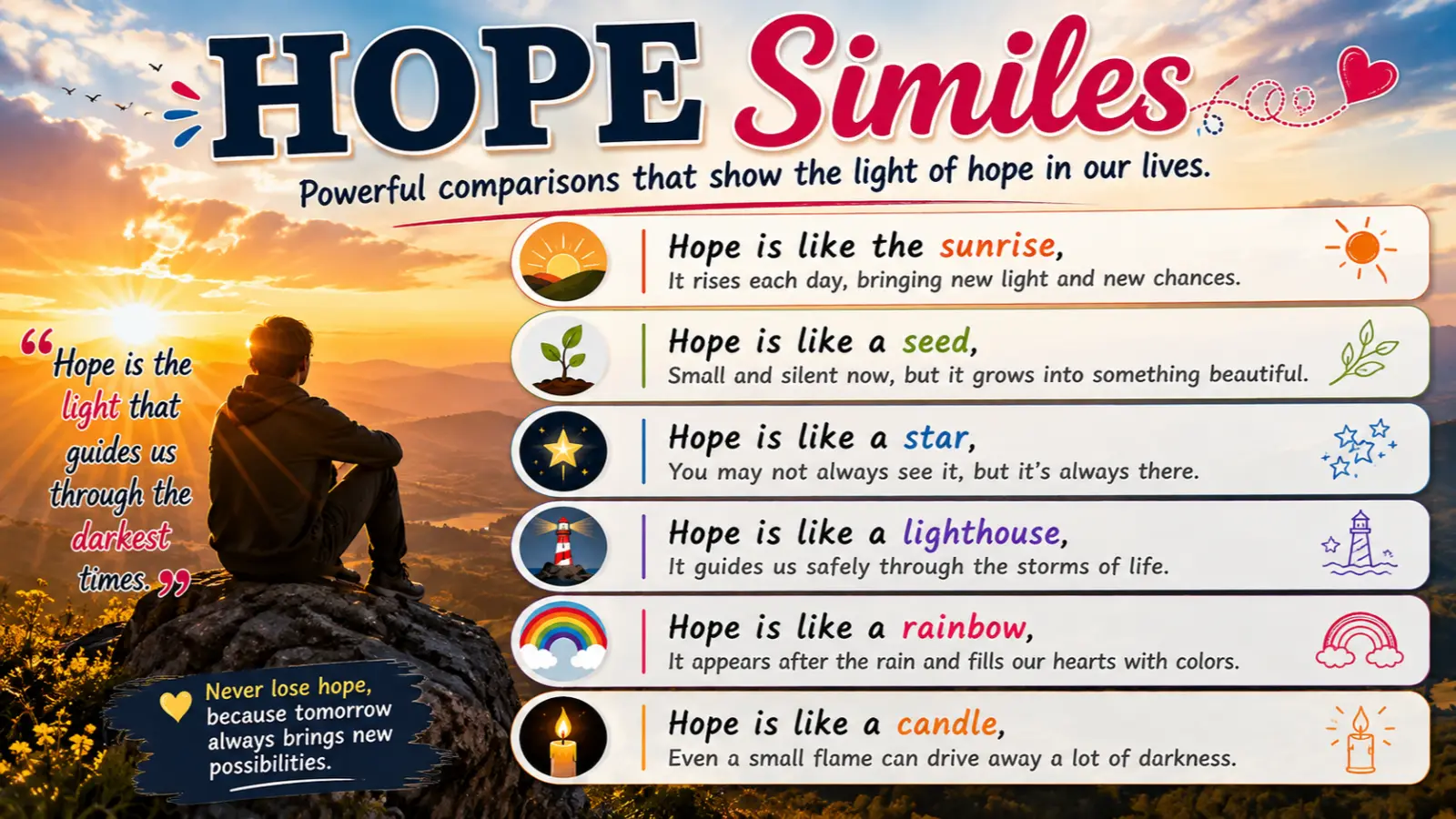
Hope Similes is one of those emotions that can be difficult to describe directly. It may feel quiet, fragile, powerful, or surprisingly persistent. A good simile gives that feeling a concrete image readers can see and understand.
A simile compares two different things using words such as “like” or “as.” For example, saying “Hope was like a small lamp in a dark hallway” turns an abstract emotion into something visual.
People use hope similes in poems, novels, speeches, personal writing, songs, conversations, and inspirational messages. This collection of hope similes offers fresh comparisons while showing how to use them effectively.
What Is a Simile for Hope?
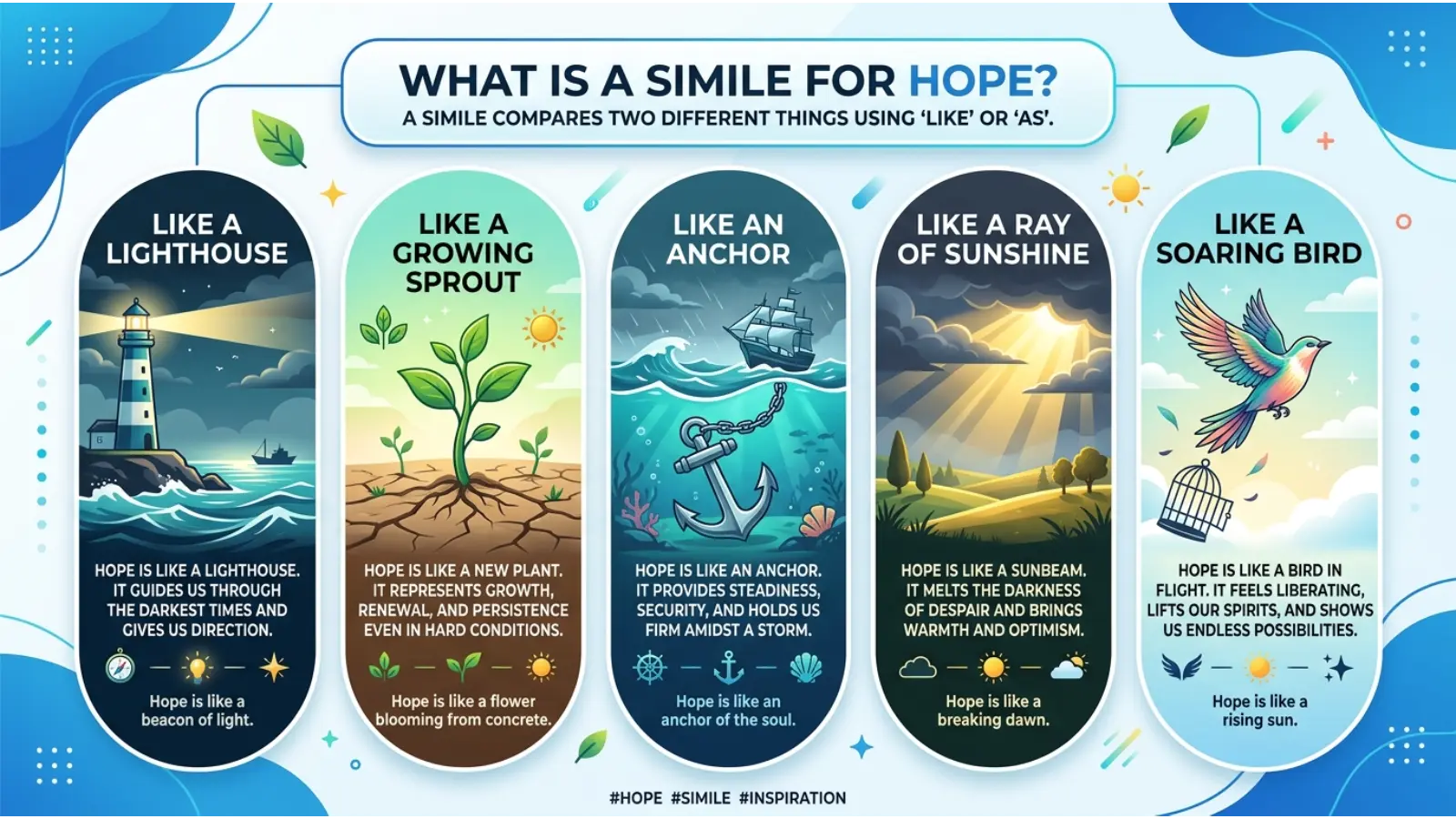
A hope simile compares hope to something that shares one of its qualities, such as light, persistence, warmth, growth, direction, or possibility.
For example:
Hope was like a window opening after a long storm.
The comparison suggests that hope brings relief and a sense of possibility after difficulty.
The strongest hope similes do more than say that hope is “good.” They show what hope feels like, what it does, or how it changes a person.
30 Original Hope Similes for Creative Writing
1. Hope was like a small lamp in an empty hallway.
Meaning: Hope provides guidance when the future feels uncertain.
Example:
After hearing the disappointing news, hope was like a small lamp in an empty hallway.
This works because the lamp gives the reader a simple visual image of something small but useful. It is especially effective in reflective writing and storytelling.
Writing tip: Use this comparison when you want hope to feel quiet rather than overwhelming.
2. Hope grew like grass between cracks in the pavement.
Meaning: Hope can survive even in difficult circumstances.
Example sentences:
- Her hope grew like grass between cracks in the pavement.
- Even after months of setbacks, his confidence returned like grass finding space through broken concrete.
The comparison emphasizes resilience. The important detail is not that grass is beautiful; it is that it keeps growing where growth seems unlikely.
Best context: Personal essays, stories about perseverance, and inspirational writing.
3. Hope was like a window opening after a storm.
Meaning: Hope can create a feeling of relief after hardship.
Example:
When the results finally arrived, hope was like a window opening after a storm.
This simile creates movement. Instead of treating hope as an object, it shows hope changing the atmosphere.
4. Her hope flickered like a candle beside an open window.
Meaning: Her hope was fragile and easily threatened.
Example:
Her hope flickered like a candle beside an open window, but she refused to let it go out.
The comparison is useful because it contains both hope and vulnerability.
Writing tip: When creating emotional similes, include a detail that introduces tension. Perfectly safe hope can feel less interesting than hope that has something to overcome.
5. Hope was like a seed waiting beneath winter soil.
Meaning: Hope can exist even when there is no visible evidence of change.
Example:
Nothing seemed different, but hope was like a seed waiting beneath winter soil.
This is particularly useful when writing about patience, recovery, new beginnings, or long-term goals.
6. Hope moved through her like the first warmth of spring.
Meaning: Hope gradually made her feel renewed.
Example:
As she began to believe in the future again, hope moved through her like the first warmth of spring.
Unlike a comparison with sunlight, this image focuses on physical sensation. That makes the emotion more intimate.
7. Hope was like a distant shoreline seen through morning fog.
Meaning: The future may still be unclear, but there is a destination worth moving toward.
Example:
He could not see the entire path ahead; hope was like a distant shoreline seen through morning fog.
This works well when the character does not have certainty but has enough encouragement to continue.
8. His hope was as steady as footsteps on a familiar road.
Meaning: His optimism was dependable and persistent.
Example:
His hope was as steady as footsteps on a familiar road.
This is a good example of using rhythm to create emotional stability.
9. Hope arrived like rain on thirsty earth.
Meaning: Hope came when it was deeply needed.
Example:
The unexpected message arrived, and hope came like rain on thirsty earth.
The comparison works because the reader already understands what rain means to dry ground: relief, nourishment, and renewal.
10. Hope was like a thread holding a torn page together.
Meaning: Hope may be small, but it can prevent something from completely falling apart.
Example:
One kind word became like a thread holding a torn page together.
This image gives hope a delicate, practical quality.
Best context: Emotional fiction, reflective essays, and poetry.
11. Hope shone like a porch light at the end of a long road.
Meaning: Hope offers reassurance and suggests that someone or something is waiting ahead.
Example:
The thought of seeing his family again shone like a porch light at the end of a long road.
The porch light adds warmth and belonging, making this stronger than simply comparing hope to “light.”
12. Hope was like a compass in unfamiliar country.
Meaning: Hope can provide direction when someone does not know exactly where they are going.
Example:
She did not know what came next, but hope was like a compass in unfamiliar country.
Writing tip: Specific objects usually create stronger similes than broad concepts. A compass gives readers something concrete to picture.
13. Her hope rose like a kite catching a sudden breeze.
Meaning: Her optimism quickly became stronger when circumstances improved.
Example:
When the opportunity appeared, her hope rose like a kite catching a sudden breeze.
The movement makes this comparison energetic and optimistic.
14. Hope was like a bridge built one plank at a time.
Meaning: Hope can develop gradually through small actions.
Example:
Every small success became another plank, and hope was like a bridge built one piece at a time.
This is especially useful for writing about long-term goals.
15. His hope warmed like a cup held between cold hands.
Meaning: Hope brought comfort during an uncomfortable period.
Example:
The encouraging news made his hope warm like a cup held between cold hands.
The sensory detail makes the emotion easier to experience.
16. Hope was like music heard faintly from another room.
Meaning: Hope may be difficult to see, yet still present.
Example:
Even during the worst days, hope was like music heard faintly from another room.
This creates a quieter, more mysterious mood.
Best context: Literary fiction and poetry.
17. Hope returned like a bird finding its way home.
Meaning: Hope came back after being absent.
Example:
After months of doubt, hope returned like a bird finding its way home.
The image suggests both distance and return.
18. Her hope was like a knot that refused to come undone.
Meaning: Her determination remained firm despite pressure.
Example:
Fear pulled at her confidence, but her hope was like a knot that refused to come undone.
This comparison gives hope a sense of strength and resistance.
19. Hope stretched like daylight across a dark room.
Meaning: Hope gradually pushed away despair or uncertainty.
Example:
With every encouraging conversation, hope stretched like daylight across a dark room.
The verb “stretched” makes the image more dynamic.
20. Hope was like a map drawn before the journey began.
Meaning: Hope can give people a sense of direction before they know exactly what will happen.
Example:
She had no guarantee of success, but hope was like a map drawn before the journey began.
This works well for stories involving ambition and new beginnings.
21. His hope floated like a paper boat on rising water.
Meaning: His hope was fragile and uncertain.
Example:
His hope floated like a paper boat on rising water.
Unlike stronger hope similes, this one deliberately introduces danger.
Writing tip: Not every comparison about hope should be cheerful. Fragile hope can create greater emotional depth.
22. Hope was like a door left slightly open.
Meaning: Hope suggests that another possibility still exists.
Example:
The rejection was painful, but hope was like a door left slightly open.
The image is simple and flexible enough for fiction, essays, and everyday writing.
23. Her hope gathered like clouds before a summer rain.
Meaning: Hope gradually built until it became noticeable and powerful.
Example:
With every piece of good news, her hope gathered like clouds before a summer rain.
This comparison emphasizes growth and anticipation.
24. Hope was like a path appearing through tall grass.
Meaning: Hope can reveal a way forward that was previously difficult to see.
Example:
Once he stopped looking backward, hope was like a path appearing through tall grass.
This works especially well when writing about decisions or personal change.
25. His hope was as bright as a window filled with morning light.
Meaning: His optimism was clear and uplifting.
Example:
His hope was as bright as a window filled with morning light.
The familiar visual setting makes the sentence easy to understand without making the emotion abstract.
26. Hope waited like a match tucked safely inside a dry pocket.
Meaning: Hope may remain hidden but protected.
Example:
Even when she stopped talking about the future, hope waited like a match tucked safely inside a dry pocket.
This creates an interesting contrast between silence and possibility.
27. Hope climbed like ivy along an old brick wall.
Meaning: Hope gradually spreads and becomes stronger over time.
Example:
Small victories allowed hope to climb like ivy along an old brick wall.
The image suggests persistence without making hope seem instant.
28. Hope was like a star visible before the sky became completely dark.
Meaning: Hope can appear before a difficult period reaches its worst point.
Example:
He noticed one good possibility, and hope was like a star visible before the sky became completely dark.
This is useful for foreshadowing in storytelling.
29. Her hope was like a quiet drumbeat beneath the noise.
Meaning: Hope continued even when other emotions were louder.
Example:
Anxiety filled her thoughts, but hope remained like a quiet drumbeat beneath the noise.
This is effective because it allows two emotions to exist at the same time.
30. Hope was like a road continuing beyond the hill.
Meaning: Hope reminds us that the present moment is not necessarily the end of the story.
Example:
The setback felt final, but hope was like a road continuing beyond the hill.
This works particularly well as a closing image because it suggests possibility without promising a specific outcome.
How to Make a Hope Simile More Powerful
A weak simile often tells readers exactly what to feel:
Hope was like something good.
There is no meaningful image to explore.
A stronger version gives hope a physical form:
Hope was like grass growing through a crack in the pavement.
Now the reader can visualize the comparison and infer its meaning.
Choose the quality before choosing the image
Start by asking what kind of hope you want to describe:
- Fragile hope: candle, thread, paper boat
- Persistent hope: grass, ivy, knot
- Guiding hope: compass, map, shoreline
- Renewed hope: spring warmth, rain, morning light
- Uncertain hope: fog, distant music, a partly open door
- Growing hope: clouds gathering, daylight spreading, ivy climbing
This approach prevents random comparisons.
Give the comparison a specific detail
Compare:
Hope was like a light.
with:
Hope was like a porch light waiting at the end of a long road.
The second version creates a setting, mood, and implied story.
Use verbs that create movement
Instead of always writing:
Hope was like…
try:
- Hope flickered like…
- Hope grew like…
- Hope returned like…
- Hope stretched like…
- Hope gathered like…
- Hope climbed like…
- Hope warmed like…
A strong verb can make an ordinary comparison feel alive.
When Should You Use Hope Similes?
In poetry
Poetry benefits from compressed images. A short simile can carry emotional meaning without requiring several explanatory sentences.
For example:
Hope waited like a match beneath the rain.
The image suggests fragility and persistence at the same time.
In storytelling
A character’s hope can reveal personality.
Instead of writing:
Maria was hopeful.
You might write:
Maria’s hope returned like a bird finding its way home.
The second sentence shows an emotional change rather than simply labeling it.
In personal writing
Similes can help describe difficult experiences without sounding overly abstract.
For example:
The possibility of starting again felt like a window opening after a storm.
The comparison gives a personal reflection a recognizable image.
In speeches and inspirational writing
A clear, memorable comparison can make an idea easier to remember. However, avoid piling several dramatic similes into the same paragraph. One strong image is usually better than five competing ones.
Hope Similes vs. Metaphors
A simile openly compares two things, usually with “like” or “as.”
Hope was like a compass.
A metaphor makes the comparison directly.
Hope was a compass.
Both can be effective, but they create slightly different effects.
The simile gives the reader room to notice the comparison. The metaphor feels more direct and forceful.
Other Literary Devices That Work With Hope
Imagery
Imagery uses sensory details to help readers experience a scene.
Hope warmed her hands like sunlight through a kitchen window.
The reader can imagine warmth, light, and place.
Personification
Personification gives human qualities to something nonhuman.
Hope knocked softly at the door.
Hope is treated as if it can knock.
Symbolism
A physical object can represent a larger idea. A lamp, seed, doorway, or sunrise might symbolize hope depending on the context.
Hyperbole
Hyperbole deliberately exaggerates.
His hope could have filled the entire stadium.
This can work in humorous or highly emotional writing, but it should match the tone.
How to Create Your Own Hope Similes
You do not need a large vocabulary to invent strong comparisons. You need a clear observation.
Step 1: Identify the kind of hope
Ask:
Is the hope fragile, growing, steady, surprising, uncertain, or powerful?
Step 2: List concrete objects
For fragile hope, you might write:
feather, candle, thread, paper boat, soap bubble.
For persistent hope:
roots, grass, stone path, ivy, river.
Step 3: Find the shared quality
A candle and hope both can remain alive despite darkness.
Grass and hope can both continue growing despite difficult conditions.
A compass and hope can both provide direction.
Step 4: Add a strong verb
Instead of:
Hope was like ivy.
Try:
Hope climbed like ivy along the old wall.
Step 5: Check the emotional accuracy
Ask whether the image actually matches the feeling.
If the character is experiencing fragile hope, comparing it to a powerful thunderstorm may send the wrong message.
Three Quick Exercises for Better Similes
Exercise 1: Change the mood
Start with:
Hope was like a light.
Rewrite it three ways:
- peaceful hope
- fragile hope
- powerful hope
Your goal is to change the image rather than simply adding adjectives.
Exercise 2: Remove the cliché
Write a common comparison for hope, then replace the familiar object with something unexpected.
For example, instead of reaching immediately for “sunshine,” consider:
- a bus arriving when you’re late
- a key finally turning in an old lock
- a handwritten note inside a book
- a path appearing after the grass is cleared
Unexpected but believable details can make your writing more memorable.
Exercise 3: Build a scene around one simile
Choose:
Hope was like a window opening after a storm.
Then write five sentences showing what the character sees, hears, touches, and does.
This teaches an important writing lesson: a simile becomes stronger when the surrounding scene supports it.
Common Mistakes When Writing Hope Similes
Relying on familiar clichés
Comparisons involving sunshine, rainbows, stars, and light can work, but they are common. The problem is not that they are automatically bad. The problem is using them without adding anything personal or specific.
A familiar image becomes more interesting when the details are fresh.
Mixing unrelated images
Avoid switching metaphors halfway through:
Hope was a candle sailing across a mountain of roots.
The reader cannot easily understand the visual logic.
Choose one image and develop it.
Making the comparison too complicated
A simile should clarify an idea, not create a puzzle.
If the reader has to stop and decode every part of the comparison, the emotional moment can lose its force.
Explaining the simile too much
Sometimes writers create a good image and then immediately explain it.
Hope was like a small lamp in the hallway because a lamp gives light, and hope gives people emotional strength.
The first sentence may already communicate enough. Trust the reader when the image is clear.
Choosing an image that does not match the emotion
Hope can be gentle, stubborn, uncertain, exciting, or fragile. Make sure your comparison reflects the exact emotional shade you want.
Frequently Asked Questions About Hope Similes
What is a good simile for hope?
A strong hope simile is “Hope was like grass growing between cracks in the pavement.” It suggests persistence because the grass continues growing despite an unfavorable environment.
What are some simple similes for hope?
Simple examples include:
- Hope was like a small lamp in the dark.
- Hope was like a door left slightly open.
- Hope was like a path through tall grass.
- Hope was like rain on dry earth.
How do you describe hope in a creative way?
Use a concrete image that shares a specific quality with hope. Think about whether your hope is fragile, persistent, comforting, uncertain, or growing, then choose an object that expresses that quality.
Can a simile about hope be negative or sad?
Yes. Hope does not always have to feel strong or joyful. A comparison such as “Her hope flickered like a candle beside an open window” can communicate vulnerability and uncertainty.
What is the difference between a hope simile and a hope metaphor?
A simile usually uses “like” or “as” to make the comparison explicit: “Hope was like a compass.” A metaphor makes the comparison directly: “Hope was a compass.”
Are common hope similes bad writing?
Not necessarily. Familiar comparisons can work when they fit the context. However, original details usually make writing more distinctive and memorable.
How can I make my hope similes more original?
Start with the exact emotion you want to express, then choose an unexpected but believable object that shares that quality. Specific details are often more effective than grand, generic images.
Conclusion
The best hope similes do not simply decorate a sentence. They show readers what hope feels like. A candle can make hope feel fragile. A compass can make it feel directional. Grass can make it feel persistent. A window can make it feel like relief. The right comparison depends on the emotional moment you are trying to create. When writing your own similes, begin with the feeling, choose a concrete image, and look for the quality the two things share. Then experiment with verbs, sensory details, and unexpected objects. A fresh comparison can turn an abstract emotion into an image readers remember long after they finish the sentence.

I am Helena Frost, a writer captivated by the beauty of language and the art of comparison. Through my words, I explore the world by turning ordinary moments into vivid similes and reflections. I enjoy crafting phrases that spark imagination, evoke emotion, and linger in the mind. My writing celebrates the subtle connections between people, nature, and the stories we live. For me, every sentence is an opportunity to reveal the extraordinary in the everyday.