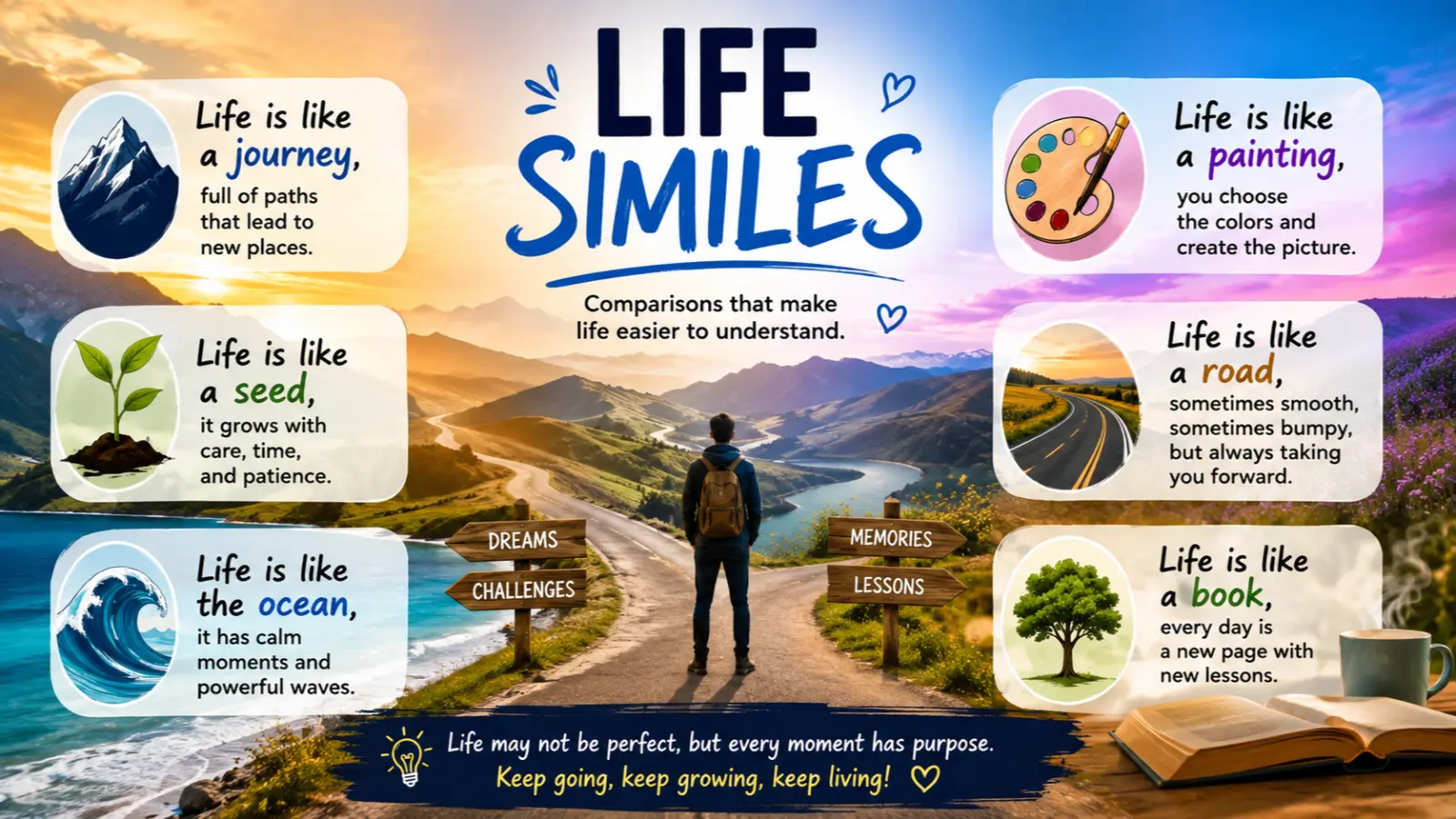
Life Similes is full of moments that can be difficult to describe directly. A Life Similes gives those moments shape by comparing one thing with another using words such as like or as.
For example, instead of saying, “Life changes quickly,” a writer might say, “Life is like a river that keeps finding new bends.” The comparison creates a picture while adding an emotional layer.
Life similes can appear in poems, stories, speeches, songs, personal essays, conversations, and everyday descriptions. The best ones do more than sound pretty—they help readers understand an experience they may already know.
This collection of life similes offers fresh comparisons along with explanations and practical ways to use them in your own writing.
What Is a Simile About Life?
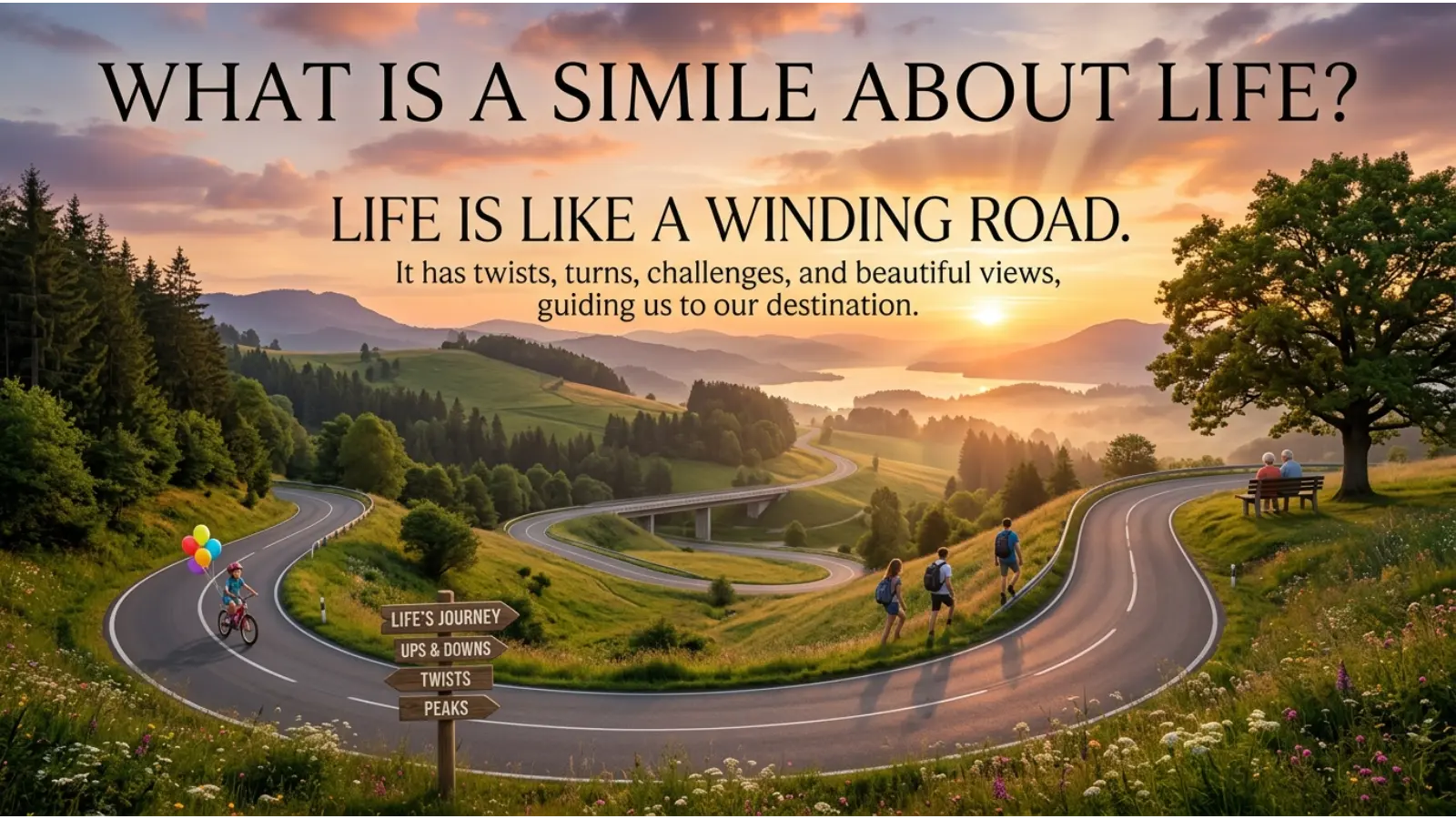
A life simile compares life, a stage of life, or a life experience to something else using like or as.
Example:
“Life is like a road with turns hidden beyond every hill.”
The road represents life’s uncertainty and movement. The comparison makes an abstract idea easier to imagine.
Quick Answer
Life similes are comparisons that describe life or human experiences by connecting them to familiar images, such as roads, rivers, seasons, books, storms, gardens, or journeys. They make abstract ideas about growth, change, struggle, happiness, and uncertainty easier to picture and remember.
30 Original Life Similes for Creative Writing
1. Life is like a road that redraws itself after every turn.
Meaning: Life rarely follows a completely predictable route.
Example:
“Life is like a road that redraws itself after every turn, so I stopped worrying about knowing the entire map.”
This works well for writing about change, uncertainty, and personal growth. The image suggests that the future is not simply hidden from us; it can develop as we move forward.
Writing tip: Use this comparison when a character has to make a decision without knowing what comes next.
2. Life is like a river carrying yesterday beneath today’s surface.
Meaning: The past remains part of us even while life continues moving.
Example:
“Life is like a river carrying yesterday beneath today’s surface.”
The river creates a sense of continuous movement while the hidden water suggests memories and experiences.
Best context: Reflective essays, poetry, memoir-style writing, and stories about memory.
3. Growing up is like opening a door to a room that keeps getting larger.
Meaning: Maturity often brings more possibilities, responsibilities, and questions.
Example:
“Growing up was like opening a door to a room that kept getting larger.”
The unusual image makes growing up feel both exciting and overwhelming.
Writing purpose: This is useful when you want to show that adulthood is not simply an arrival point but an expanding experience.
4. Life can be as unpredictable as a kite dancing in changing wind.
Meaning: Some circumstances are beyond our control.
Example:
“Her plans were as unpredictable as a kite dancing in changing wind.”
The kite gives the reader a visual sense of movement, instability, and adaptation.
Writing tip: Notice that the comparison does not merely say life is unpredictable. It shows how that unpredictability feels.
5. A difficult year can be like winter hiding seeds beneath the ground.
Meaning: Hard periods can contain the possibility of future growth.
Example:
“That difficult year was like winter hiding seeds beneath the ground.”
This simile creates a hopeful tone without pretending that hardship is easy.
Best context: Personal writing, motivational prose, and stories involving recovery or transformation.
6. Life is like a notebook filled in while the ink is still wet.
Meaning: Our story is constantly being created, and the future has not been completely decided.
Example:
“Life is like a notebook filled in while the ink is still wet; one page does not have to define the next.”
The notebook image works because readers understand pages, writing, mistakes, and unfinished stories.
Writing insight: Familiar objects can make abstract ideas powerful because readers already understand how those objects behave.
7. Childhood is like a window that makes ordinary days look enormous.
Meaning: Children can experience simple moments with extraordinary wonder.
Example:
“Childhood was like a window that made puddles look like oceans and backyards look like unexplored countries.”
This comparison is especially effective in nostalgic writing.
Best context: Childhood stories, memoirs, poems, and descriptions of family memories.
8. Life is as changeable as sunlight moving across a kitchen floor.
Meaning: Circumstances and emotions can shift gradually and naturally.
Example:
“Life was as changeable as sunlight moving across a kitchen floor.”
Unlike a dramatic storm image, this comparison suggests subtle change.
Writing tip: Choose gentle imagery when the emotional change you are describing is gentle.
9. A new beginning is like a blank wall waiting for its first color.
Meaning: A fresh start creates room for new choices.
Example:
“Leaving the old job felt like a blank wall waiting for its first color.”
The blank wall creates a feeling of possibility rather than certainty.
Best context: Stories about moving, starting school, changing careers, or beginning a new chapter.
10. Regret can cling to memory like rainwater on a window.
Meaning: Regret can remain visible in our thoughts even after the original event has passed.
Example:
“His regret clung to the memory like rainwater on a window.”
The image creates a quiet, reflective mood.
Writing purpose: This works particularly well when you want emotional depth without directly naming every feeling.
11. Hope is like a small lamp left on in an empty hallway.
Meaning: Hope can remain present even during uncertain or lonely periods.
Example:
“Her hope was like a small lamp left on in an empty hallway.”
The contrast between darkness and light gives the comparison emotional power.
Writing tip: Contrast often strengthens a simile. A small light feels more meaningful when the surrounding setting is dark.
12. Life is like a garden that changes according to what we tend.
Meaning: Some parts of life are influenced by our choices, attention, and effort.
Example:
“Life is like a garden that changes according to what we tend.”
This does not suggest that everything is under our control. Weather, seasons, and circumstances still affect a garden.
Best context: Essays about responsibility, habits, relationships, and personal development.
13. Friendship can be like a bench beneath a tree on a long walk.
Meaning: A good friendship can offer rest, comfort, and companionship.
Example:
“After a difficult day, their friendship felt like a bench beneath a tree on a long walk.”
The image is calm rather than exaggerated.
Writing purpose: Use it when describing dependable companionship rather than dramatic excitement.
14. Happiness can arrive like music drifting through an open window.
Meaning: Happiness can appear unexpectedly and transform an ordinary moment.
Example:
“Happiness arrived like music drifting through an open window.”
The sound imagery makes the emotion feel natural and spontaneous.
Writing tip: When writing about an emotion, compare it to something the reader can see, hear, touch, smell, or taste.
15. Grief can move through a day like a cloud that keeps changing shape.
Meaning: Grief can affect a person differently from one moment to another.
Example:
“Her grief moved through the day like a cloud that kept changing shape.”
The comparison avoids treating an emotion as fixed.
Best context: Reflective fiction, poetry, and sensitive personal writing.
16. Success is like climbing stairs while discovering new floors.
Meaning: Achieving one goal often reveals another challenge or opportunity.
Example:
“Success was like climbing stairs while discovering new floors above.”
The image challenges the idea that success is simply reaching one final destination.
Writing tip: Strong similes can contain an idea that makes the reader reconsider a familiar concept.
17. Failure can be like a wrong turn that teaches you the shape of the map.
Meaning: Mistakes can provide information that helps us understand what works and what does not.
Example:
“Failure was like a wrong turn that taught her the shape of the map.”
This is more specific than saying “failure is a lesson.”
Why it works: The wrong turn has a practical consequence: it teaches the traveler something about the route.
18. Memories are like photographs developing in a dark room.
Meaning: Memories can become clearer, stranger, or more meaningful as time passes.
Example:
“Some memories were like photographs developing in a dark room, becoming clearer years later.”
The darkroom image gives memory a physical process.
Best context: Nostalgic writing, family stories, poetry, and reflective essays.
19. Time is like sand slipping through an open hand.
Meaning: Time passes continuously and cannot be completely held onto.
Example:
“Time felt like sand slipping through an open hand.”
This is a simple comparison, but writers should use it carefully because similar time-and-sand imagery is common.
Writing tip: If you use a familiar concept, add a distinctive detail to make it your own.
20. A secret can sit in the mind like a stone at the bottom of a pocket.
Meaning: A secret may remain constantly present even when nobody else can see it.
Example:
“She carried the secret like a stone at the bottom of her pocket.”
The weight of the stone suggests the psychological burden without explaining it directly.
Writing purpose: Excellent for character development and suspense.
21. Courage can be as quiet as a hand reaching for a door handle.
Meaning: Courage does not always look dramatic.
Example:
“His courage was as quiet as a hand reaching for a door handle.”
The comparison turns an internal quality into a small physical action.
Writing insight: Quiet images can be more powerful than dramatic ones when the story calls for restraint.
22. Loneliness can feel like being the only window lit on a long street.
Meaning: Loneliness can involve feeling separate from everyone around you.
Example:
“At the party, she felt like the only window lit on a long street.”
The setting communicates isolation without simply stating, “She was lonely.”
Best context: Fiction, poetry, and introspective writing.
23. Curiosity is like a key that keeps finding locked doors.
Meaning: Curiosity encourages people to keep searching for answers.
Example:
“Curiosity was like a key that kept finding locked doors.”
The image suggests that every answer can lead to another question.
Writing tip: This is useful for describing curious characters because it gives curiosity an action.
24. Adulthood can feel like learning to steer a boat after leaving the dock.
Meaning: Growing older often involves making decisions independently.
Example:
“Adulthood felt like learning to steer a boat after leaving the dock.”
The comparison captures uncertainty without making adulthood sound entirely negative.
Best context: Coming-of-age writing and personal essays.
25. A dream can be like a distant lighthouse seen through fog.
Meaning: A dream can provide direction even when the destination is unclear.
Example:
“Her dream was like a distant lighthouse seen through fog.”
The lighthouse represents direction, while fog represents uncertainty.
Writing purpose: This works well when writing about ambition, creativity, or long-term goals.
26. Change can be like furniture being moved in a familiar room.
Meaning: Change can make a familiar environment feel strange even when everything is still recognizable.
Example:
“After the move, life felt like furniture being shifted around in a familiar room.”
This is particularly effective because it describes discomfort without disaster.
Writing tip: Not every change needs storm imagery. Ordinary comparisons can produce more believable emotions.
27. Wisdom is like a path made visible by many footsteps.
Meaning: Wisdom often develops through accumulated experience.
Example:
“Wisdom was like a path made visible by many footsteps.”
The image suggests that experience gradually creates a route others can recognize.
Best context: Reflective essays, speeches, and literary nonfiction.
28. A hard decision can be like standing between two trains arriving at different platforms.
Meaning: Difficult choices can create pressure because selecting one option means leaving another behind.
Example:
“The decision felt like standing between two trains arriving at different platforms.”
The moving trains create urgency and tension.
Writing purpose: Use this when a character has limited time to choose.
29. A peaceful life can be like a window open to a quiet morning.
Meaning: Peace can involve space, calm, and freedom from unnecessary noise.
Example:
“After years of rushing, the quiet routine felt like a window open to a peaceful morning.”
The image relies on sensory atmosphere rather than abstract explanation.
Writing tip: When describing positive emotions, sensory details can keep the writing from sounding generic.
30. Life is like a mosaic built from moments that looked unrelated at first.
Meaning: Individual experiences can eventually form a larger pattern.
Example:
“Life was like a mosaic built from moments that looked unrelated at first.”
A mosaic is made from separate pieces, making it a natural image for a life composed of different experiences.
Best context: Endings, memoirs, reflective essays, and stories about personal growth.
How to Make Life Similes More Vivid
A weak simile often compares one abstract word with another abstract word.
For example:
“Life is like happiness.”
The reader has little to visualize.
A stronger approach is to turn the abstract idea into something physical:
“Life is like sunlight moving across a room.”
Now the reader can imagine movement, warmth, changing light, and passing time.
Start With the Emotion or Idea
First decide what you actually want the reader to feel.
Are you describing:
- uncertainty?
- excitement?
- loneliness?
- growth?
- regret?
- peace?
- hope?
- confusion?
- freedom?
Then look for an object, place, action, or natural event that behaves in a similar way.
Use Specific Images
Instead of:
“Life is like a journey.”
Try:
“Life is like a trail whose next bend stays hidden until you reach it.”
The second version gives the reader something concrete to see.
Let the Comparison Do Some of the Explaining
A strong simile can reduce the need for extra explanation.
Instead of writing:
“He was nervous because he did not know what would happen next.”
You might write:
“His thoughts fluttered like papers caught in a sudden draft.”
The image communicates movement and lack of control.
How to Avoid Cliché Life Similes
Some comparisons have become so familiar that they may no longer create a strong image.
Examples include comparisons involving life as a journey, time as sand, or life as a roller coaster. These are not automatically wrong. They simply need a fresh angle when originality matters.
Compare:
“Life is a journey.”
with:
“Life is a road that redraws itself after every turn.”
The second version gives the familiar journey idea a more distinctive feature.
A Useful Test
Ask yourself:
Could another writer have written this exact sentence without knowing anything about my story?
If the answer is yes, add a detail from your setting, character, emotion, or experience.
A hospital hallway, an empty classroom, a crowded train station, a backyard garden, or a kitchen at midnight can make a general simile feel personal and specific.
How Professional Writers Build Better Comparisons
Good similes usually come from noticing shared qualities.
Suppose you want to describe uncertainty.
Think beyond the word “uncertain.” Ask:
- What moves without knowing its destination?
- What changes direction?
- What is partly hidden?
- What makes people wait?
- What cannot be controlled?
You might arrive at images such as fog, changing wind, an unfamiliar road, or a river bend.
The important part is not finding the fanciest object. It is finding an object whose behavior genuinely resembles the idea.
Try the Five-Senses Method
When you are stuck, choose one sense:
Sight:
“Her future looked like a distant shoreline through morning mist.”
Sound:
“His memories returned like footsteps in an empty hallway.”
Touch:
“The uncertainty felt like a loose thread caught between his fingers.”
Smell:
“Summer memories returned like the smell of rain on warm pavement.”
Movement:
“Life shifted like curtains moving in an open window.”
This technique helps transform abstract concepts into sensory writing.
How to Create Your Own Life Similes
Creating original comparisons becomes easier when you follow a simple process.
1. Choose one idea
Start with a single concept such as change.
2. Describe its behavior
Change can be:
- gradual
- sudden
- uncomfortable
- exciting
- unpredictable
- necessary
3. Find something physical that behaves similarly
You might think about:
- weather
- furniture
- water
- shadows
- roads
- plants
- music
- buildings
4. Connect the two
For example:
Change + familiar room =
“Change can be like furniture being moved in a familiar room.”
5. Remove anything unnecessary
A good simile does not need a long explanation. Let the image carry some of the meaning.
Creative Exercise: One Emotion, Five Images
Choose one emotion, such as hope.
Now describe hope as:
- a place
- a sound
- an object
- an animal
- a weather condition
For example, hope might become a lighthouse, distant music, a small lamp, a bird preparing to fly, or sunlight after rain.
Then choose the comparison that best fits your character or scene.
Creative Exercise: Make the Familiar Strange
Take a common statement:
“Life is unpredictable.”
Rewrite it without using the word unpredictable.
For example:
“Life is like a kite dancing in wind that keeps changing direction.”
The goal is not to make the sentence complicated. The goal is to make the reader experience the idea.
Simile vs. Metaphor: What’s the Difference?
A simile makes a comparison using words such as like or as.
“Life is like a river.”
A metaphor makes the comparison directly.
“Life is a river.”
Both can create imagery, but they produce slightly different effects.
A simile often feels more exploratory because it invites the reader to notice a resemblance. A metaphor can sound more direct and emphatic.
Simile, Imagery, and Personification
These literary devices can work together.
Imagery creates sensory pictures:
“Golden light spread across the empty street.”
A simile adds comparison:
“The golden light spread across the street like honey.”
Personification gives human qualities to something nonhuman:
“The morning welcomed the town with warm light.”
A writer can combine these techniques, but each should have a purpose.
Common Mistakes When Writing Life Similes
Using Too Many Comparisons
A paragraph packed with similes can become difficult to follow. One precise comparison can be stronger than five average ones.
Mixing Images
Avoid switching between unrelated images in the same comparison.
For example, if you begin with a sailing image, suddenly introducing a garden and a musical instrument can weaken the picture.
Keep the imagery coherent.
Choosing an Image That Does Not Fit
A comparison should share a meaningful quality with the subject.
If you describe calmness as something violent or chaotic, the reader may receive the wrong emotional message.
Explaining the Simile Too Much
If the comparison is clear, trust the reader.
Instead of:
“Her hope was like a small lamp in a dark hallway, which means she still believed something good could happen even though everything seemed uncertain.”
Try:
“Her hope was like a small lamp left on in an empty hallway.”
The image has more room to breathe.
Confusing a Simile With a Metaphor
Remember:
Simile: “Life is like a river.”
Metaphor: “Life is a river.”
Both are valid, but they are different literary constructions.
Choosing Beauty Over Accuracy
A complicated image is not automatically a good image.
The best comparison is the one that communicates the intended feeling clearly and naturally.
FAQ About Life Similes
What is a good simile for life?
A strong example is: “Life is like a road that redraws itself after every turn.” It suggests that life keeps changing and that the future cannot always be predicted.
What are some simple life similes?
Simple examples include “Life is like a river,” “Life is like a garden,” and “Life is like a road.” For more originality, add a specific detail that changes the image.
What is a simile for life changing?
“Life is like furniture being moved in a familiar room.” This suggests that change can make something familiar feel different without completely destroying what was there before.
What is a simile for growing up?
“Growing up is like opening a door to a room that keeps getting larger.” It captures the expanding possibilities and responsibilities that can come with maturity.
What is a simile for hope?
“Hope is like a small lamp left on in an empty hallway.” The image suggests that hope can remain present during uncertain or difficult moments.
How do I write a unique simile about life?
Start with the exact emotion or idea you want to express. Then find a physical object, place, sound, action, or natural event that behaves similarly. Add a specific detail from your scene to make the comparison distinctive.
Why are similes useful in creative writing?
Similes turn abstract ideas into concrete images. They can help readers visualize emotions, understand characters, establish atmosphere, and remember important moments.
Conclusion
Life is difficult to capture in a single definition because it contains movement, contradiction, memory, uncertainty, joy, loss, discovery, and change. That is why similes are so useful. They let writers approach complicated experiences through familiar images. The strongest life similes do not simply decorate a sentence. They reveal something. A road can suggest uncertainty, a river can suggest movement, a garden can suggest care, and a lamp can suggest hope. When creating your own comparisons, look closely at the world around you. Notice how ordinary things behave. A window, train, shadow, cup of coffee, empty classroom, changing sky, or worn notebook may contain exactly the image your writing needs. The goal is not to find the most complicated comparison. It is to find the one that makes your reader pause and think, “Yes—that is what it feels like.”

I am Helena Frost, a writer captivated by the beauty of language and the art of comparison. Through my words, I explore the world by turning ordinary moments into vivid similes and reflections. I enjoy crafting phrases that spark imagination, evoke emotion, and linger in the mind. My writing celebrates the subtle connections between people, nature, and the stories we live. For me, every sentence is an opportunity to reveal the extraordinary in the everyday.