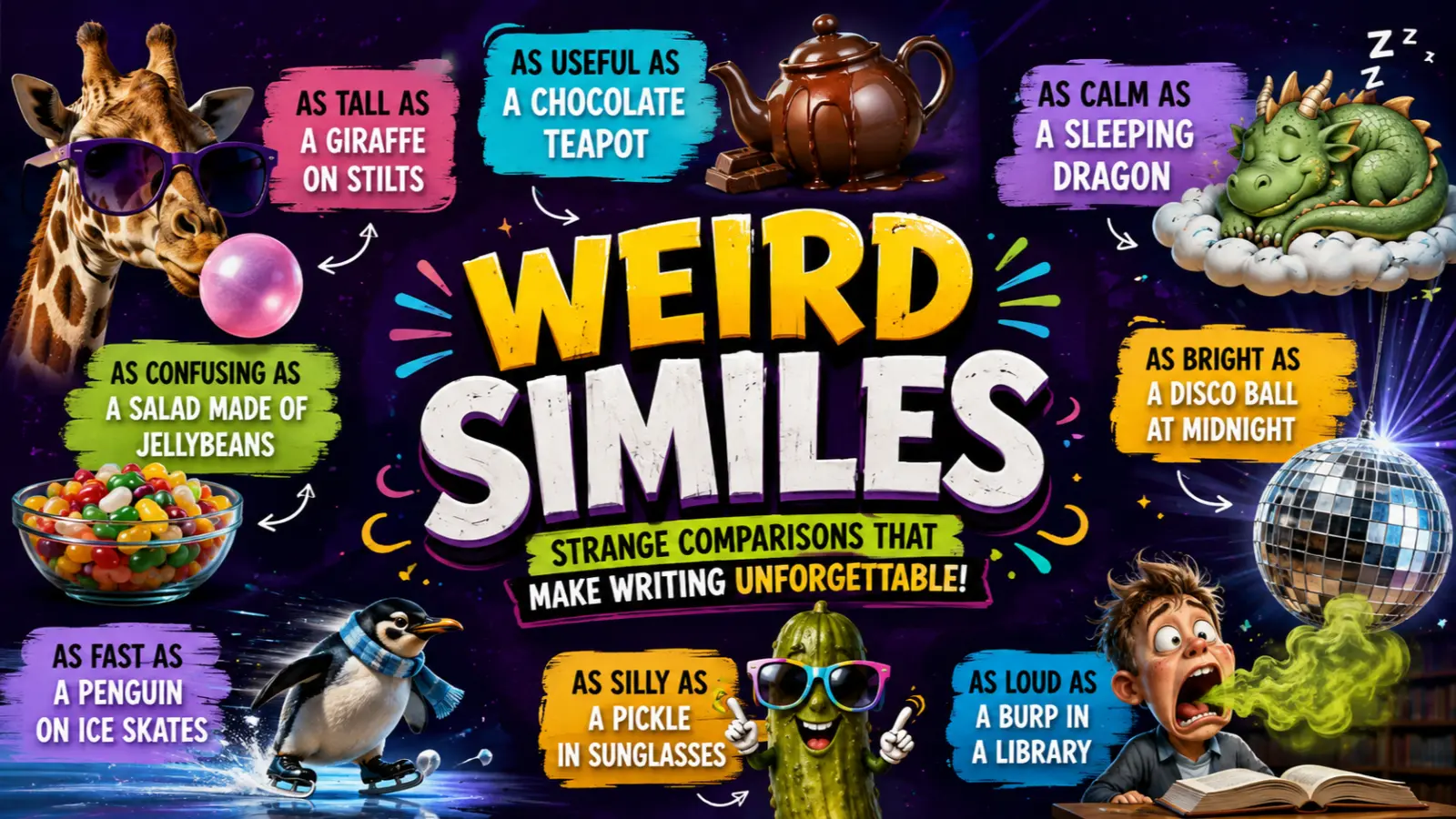
Similes compare one thing to another using the words like or as. They help readers picture an idea, understand emotions, and experience scenes more vividly. While familiar similes have their place, weird similes do something different—they surprise the audience with unexpected yet meaningful comparisons.
Writers use unusual similes in fiction, poetry, speeches, dialogue, blogs, and even everyday conversation. A fresh comparison can make an ordinary sentence impossible to forget.
In this guide, you’ll discover original weird similes, learn why they work, avoid common mistakes, and practice creating your own imaginative comparisons.
Quick Answer
Weird similes are unusual comparisons that connect two unexpected things using “like” or “as.” They create surprise, humor, vivid imagery, or emotional impact while helping readers see familiar ideas from a fresh perspective.
Why Weird Similes Make Writing More Memorable
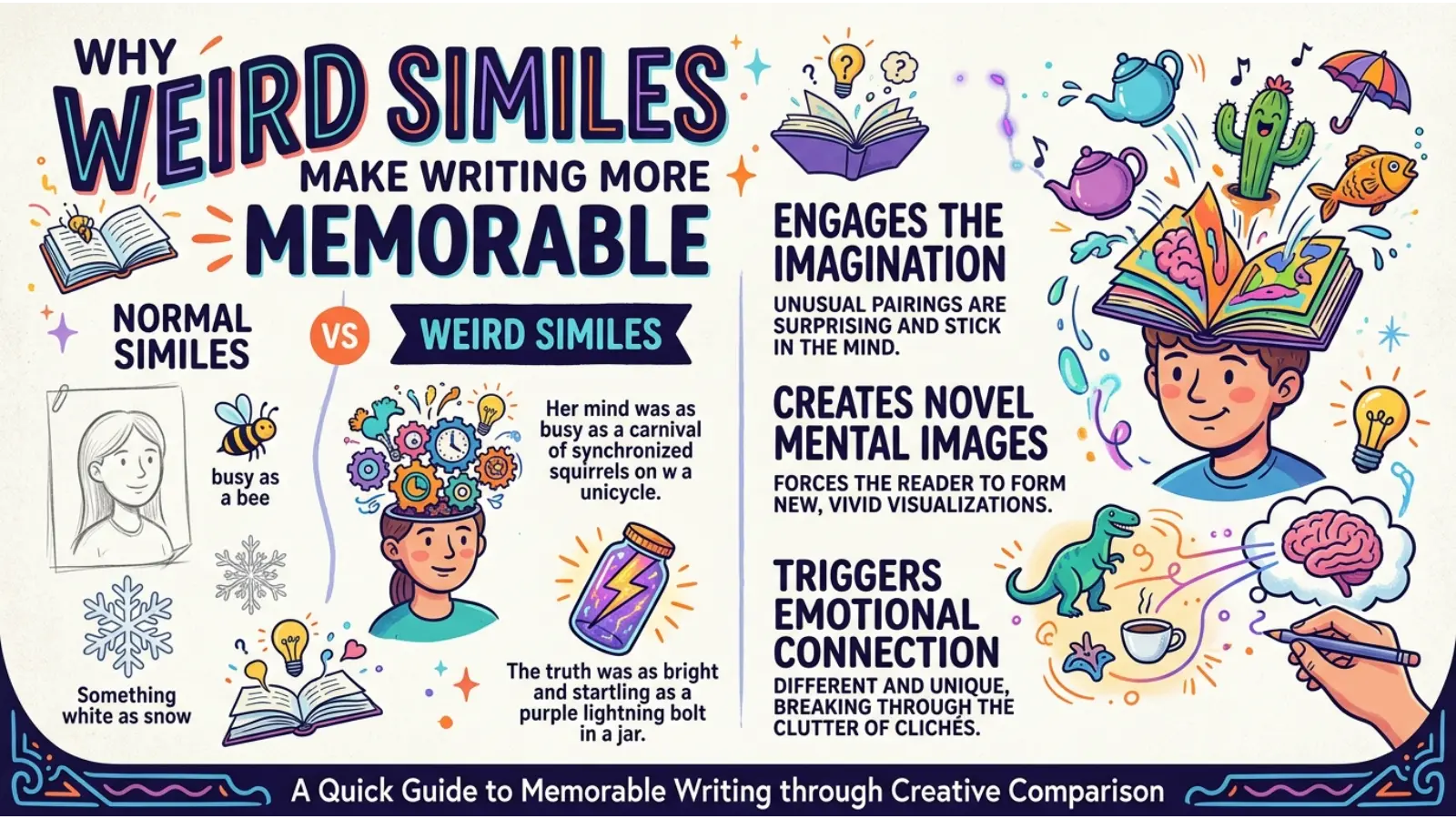
Our brains naturally notice things that break expectations.
Instead of writing:
The room was quiet.
You might write:
The room was as quiet as a library floating through space.
The image is unexpected but still understandable. That’s what makes weird similes effective—they combine imagination with clarity.
Good weird similes should still make emotional sense, even if the comparison is surprising.
30 Original Weird Similes
1. As confused as a compass inside a blender
Meaning: Completely disoriented.
Examples
- I felt as confused as a compass inside a blender after the meeting.
- The tourists looked as confused as a compass inside a blender.
Best for: Humor, storytelling.
Writing Tip: Great for chaotic situations.
2. Like popcorn trying to solve algebra
Meaning: Wildly energetic but unfocused.
Examples
- His ideas bounced around like popcorn trying to solve algebra.
- My thoughts felt like popcorn trying to solve algebra.
Effect: Funny and energetic.
3. As lonely as a forgotten sock on the moon
Meaning: Extremely isolated.
Examples
- He sat as lonely as a forgotten sock on the moon.
- She felt as lonely as a forgotten sock on the moon.
Storytelling: Works well for quirky fiction.
4. Like a cactus wearing mittens
Meaning: Awkward and impractical.
Examples
- His excuse fit the situation like a cactus wearing mittens.
- The design looked like a cactus wearing mittens.
5. As nervous as a goldfish at a shark convention
Meaning: Extremely anxious.
Examples
- I was as nervous as a goldfish at a shark convention.
- She entered the interview as nervous as a goldfish at a shark convention.
6. Like spaghetti climbing a ladder
Meaning: Clumsy or impossible.
Examples
- The plan worked like spaghetti climbing a ladder.
- His attempt looked like spaghetti climbing a ladder.
7. As bright as a flashlight filled with sunshine
Meaning: Exceptionally cheerful or intelligent.
Examples
- Her smile was as bright as a flashlight filled with sunshine.
- The classroom felt as bright as a flashlight filled with sunshine.
8. Like an octopus wearing roller skates
Meaning: Chaotic movement.
Examples
- The dancers scattered like an octopus wearing roller skates.
- Traffic moved like an octopus wearing roller skates.
9. As mysterious as a locked cloud
Meaning: Impossible to understand.
Examples
- His smile was as mysterious as a locked cloud.
- The message seemed as mysterious as a locked cloud.
10. Like a piano growing feathers
Meaning: Unexpected transformation.
Examples
- The project changed like a piano growing feathers.
- Her personality evolved like a piano growing feathers.
11. As stubborn as glue arguing with gravity
Meaning: Refusing to change.
Examples
- He stayed as stubborn as glue arguing with gravity.
- Their opinion remained as stubborn as glue arguing with gravity.
12. Like a banana reading philosophy
Meaning: Wonderfully absurd.
Examples
- The conversation became like a banana reading philosophy.
- His dream sounded like a banana reading philosophy.
13. As silent as a whisper inside a snow globe
Meaning: Deeply quiet.
Examples
- The forest was as silent as a whisper inside a snow globe.
- The room stayed as silent as a whisper inside a snow globe.
14. Like a rainbow wearing boots
Meaning: Colorful but unexpected.
Examples
- Her outfit looked like a rainbow wearing boots.
- The festival felt like a rainbow wearing boots.
15. As restless as coffee chasing sleep
Meaning: Unable to relax.
Examples
- I felt as restless as coffee chasing sleep.
- The children were as restless as coffee chasing sleep.
16. Like an umbrella searching for rain
Meaning: Waiting for purpose.
Examples
- He wandered like an umbrella searching for rain.
- The invention sat like an umbrella searching for rain.
17. As curious as a mirror watching people
Meaning: Deeply interested.
Examples
- She was as curious as a mirror watching people.
- The child looked as curious as a mirror watching people.
18. Like a cookie solving a mystery
Meaning: Innocent but determined.
Examples
- He investigated like a cookie solving a mystery.
- The puppy explored like a cookie solving a mystery.
19. As slippery as soap on a trampoline
Meaning: Difficult to catch or control.
Examples
- The truth was as slippery as soap on a trampoline.
- The fish became as slippery as soap on a trampoline.
20. Like thunder wearing slippers
Meaning: Powerful but surprisingly gentle.
Examples
- His voice arrived like thunder wearing slippers.
- The applause sounded like thunder wearing slippers.
21. As patient as a turtle knitting sweaters
Meaning: Extremely patient.
Examples
- My grandmother was as patient as a turtle knitting sweaters.
- The teacher remained as patient as a turtle knitting sweaters.
22. Like ice cream hiking through a volcano
Meaning: Clearly out of place.
Examples
- I felt like ice cream hiking through a volcano.
- The idea looked like ice cream hiking through a volcano.
23. As cheerful as confetti after a parade
Meaning: Happy despite everything ending.
Examples
- She stayed as cheerful as confetti after a parade.
- His attitude remained as cheerful as confetti after a parade.
24. Like a mailbox learning ballet
Meaning: Surprisingly graceful.
Examples
- He danced like a mailbox learning ballet.
- The robot moved like a mailbox learning ballet.
25. As tiny as a secret hiding in a raindrop
Meaning: Extremely small.
Examples
- The insect was as tiny as a secret hiding in a raindrop.
- The crack looked as tiny as a secret hiding in a raindrop.
26. Like a cloud borrowing shoes
Meaning: Odd but charming.
Examples
- The costume looked like a cloud borrowing shoes.
- The sculpture resembled a cloud borrowing shoes.
27. As busy as a squirrel organizing fireworks
Meaning: Extremely occupied.
Examples
- We were as busy as a squirrel organizing fireworks.
- She spent the day as busy as a squirrel organizing fireworks.
28. Like a teacup racing a comet
Meaning: Hopelessly mismatched.
Examples
- The competition felt like a teacup racing a comet.
- Their debate became like a teacup racing a comet.
29. As hopeful as a candle greeting sunrise
Meaning: Quiet optimism.
Examples
- He remained as hopeful as a candle greeting sunrise.
- She smiled as hopeful as a candle greeting sunrise.
30. Like a dictionary dreaming in color
Meaning: Rich with imagination.
Examples
- Her writing was like a dictionary dreaming in color.
- The novel unfolded like a dictionary dreaming in color.
Best Context: Creative writing, poetry, literary fiction.
What Makes a Weird Simile Work?
The best unusual similes balance surprise with understanding.
Ask yourself:
- Does the comparison create a clear image?
- Does it match the emotion?
- Is it memorable without becoming confusing?
- Would readers understand the intended feeling?
If the answer is yes, you’ve probably created a strong simile.
How Professional Writers Create Fresh Comparisons
Experienced writers rarely choose the first comparison that comes to mind.
Instead, they often:
- Observe ordinary objects in unusual ways.
- Combine unrelated ideas that share one quality.
- Focus on emotion before appearance.
- Revise until the comparison feels natural.
A weird simile should feel unexpected—not random.
Related Literary Devices
Metaphor
A metaphor makes a direct comparison without using like or as.
Simile: Her thoughts were like tangled headphones.
Metaphor: Her thoughts were tangled headphones.
Imagery
Imagery appeals to the senses. Weird similes often strengthen imagery by creating vivid mental pictures.
Personification
Personification gives human qualities to non-human things.
Example:
The wind argued with the windows.
Pairing personification with an unusual simile can create memorable descriptions.
Hyperbole
Hyperbole intentionally exaggerates.
A weird simile may include exaggeration, but its main purpose is comparison rather than overstatement.
Symbolism
Objects inside unusual similes can also symbolize emotions, memories, or change, adding deeper meaning to creative writing.
Create Your Own Weird Similes
Follow this simple process:
Step 1
Choose something you want to describe.
Example:
- Fear
- Happiness
- Confusion
- Silence
Step 2
Think of an unexpected object.
Examples:
- Toaster
- Kite
- Snow globe
- Telescope
- Jellyfish
Step 3
Find one shared quality.
Example:
Fear and melting ice both suggest instability.
Step 4
Turn it into a comparison.
Fear spread like ice forgetting how to stay frozen.
Creative Exercise
Write five unusual objects on one sheet of paper.
Write five emotions on another.
Randomly pair them and create original similes from each combination. You’ll discover surprising ideas that you might never think of otherwise.
Common Mistakes
Using Overused Comparisons
Readers have seen “as busy as a bee” countless times. Fresh imagery creates stronger impressions.
Mixing Different Images
Avoid combining unrelated pictures that confuse the reader.
Poor example:
He was like a volcano swimming through music.
Unless the story is intentionally surreal, the comparison lacks direction.
Making Similes Too Random
Being strange isn’t enough. Readers should still understand the intended meaning.
Confusing Similes with Metaphors
Remember:
- Similes use like or as.
- Metaphors make direct comparisons.
Forgetting the Context
A humorous weird simile may fit a comedy but interrupt a serious emotional scene.
Frequently Asked Questions
What is a weird simile?
A weird simile is an unusual comparison using like or as that creates surprising but meaningful imagery.
Why do writers use weird similes?
They make descriptions more memorable, imaginative, and emotionally engaging.
Can weird similes be funny?
Yes. Many are humorous because they connect unexpected ideas in creative ways.
Are weird similes appropriate for school writing?
Absolutely. They can improve descriptive writing as long as they remain clear and relevant.
How can I make my own weird similes?
Start with the quality you want to describe, then compare it to an unexpected object that shares that quality.
Should every sentence contain a simile?
No. Similes are most effective when used selectively to emphasize important moments.
What’s the difference between a weird simile and nonsense?
A weird simile still communicates a recognizable idea or emotion. Nonsense lacks a meaningful connection.
Conclusion
Weird similes invite readers to see ordinary experiences through a fresh lens. They add personality, humor, emotion, and vivid imagery that standard comparisons often cannot achieve. The strongest unusual similes don’t rely on randomness—they connect unexpected ideas with a clear purpose. Experiment with your own comparisons, revise them carefully, and don’t be afraid to surprise your readers. The more original your observations become, the more memorable your writing will be.