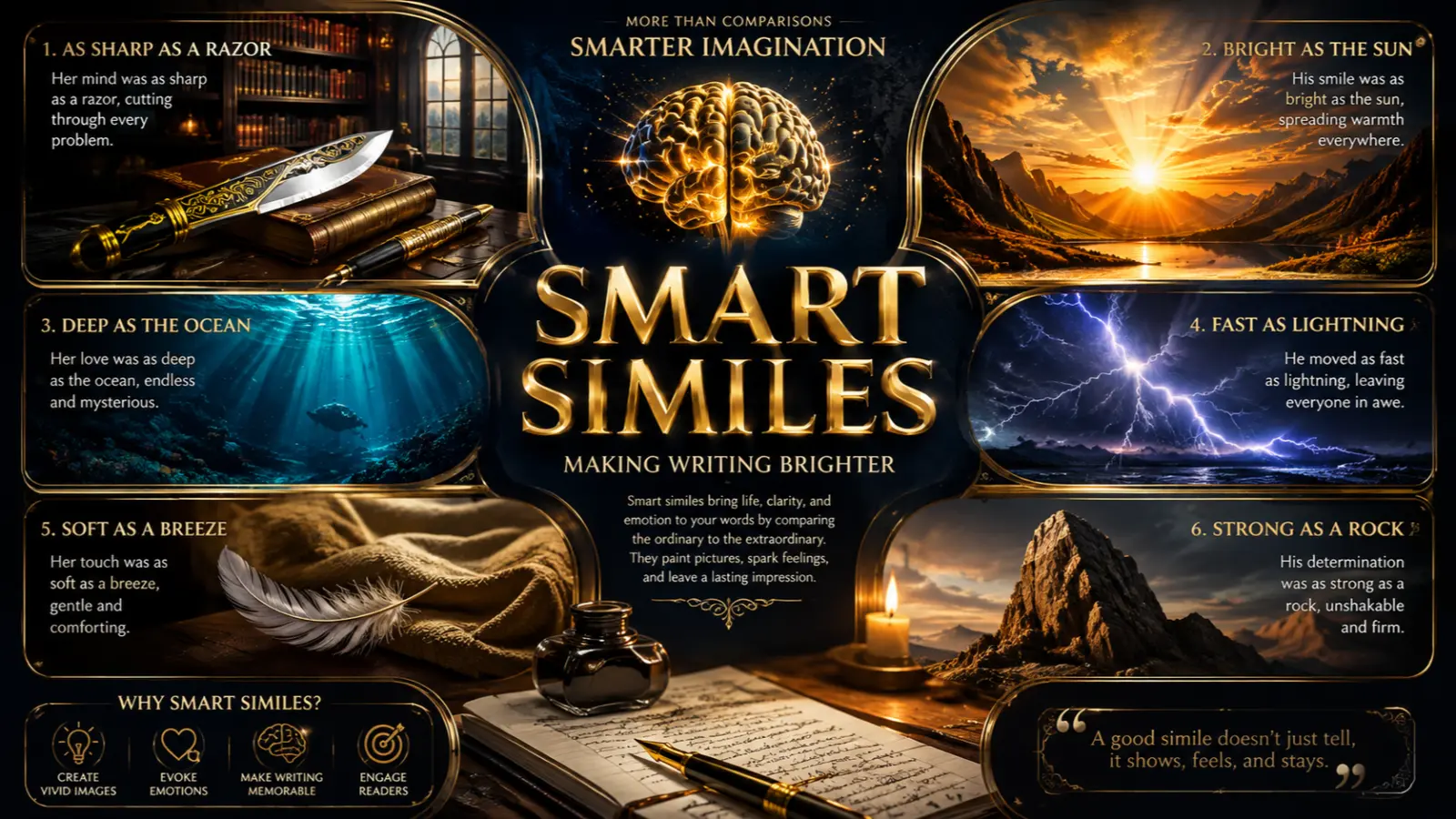
Smart similes help writers describe intelligence, quick thinking, wise decisions, and creative problem-solving through imaginative comparisons. A simile compares two different things using “like” or “as,” allowing readers to picture an idea more clearly. Whether you’re writing a story, speech, essay, poem, or conversation, Smart similes can make your characters sound sharper and your descriptions more engaging. In this guide, you’ll discover original smart similes, learn why they work, and find practical ways to create your own.
Quick Answer
Smart similes are comparisons that describe intelligence, wisdom, creativity, or quick thinking using like or as. They help readers instantly understand how clever, observant, or resourceful someone is while making writing more colorful and memorable.
What Makes a Smart Simile Effective?
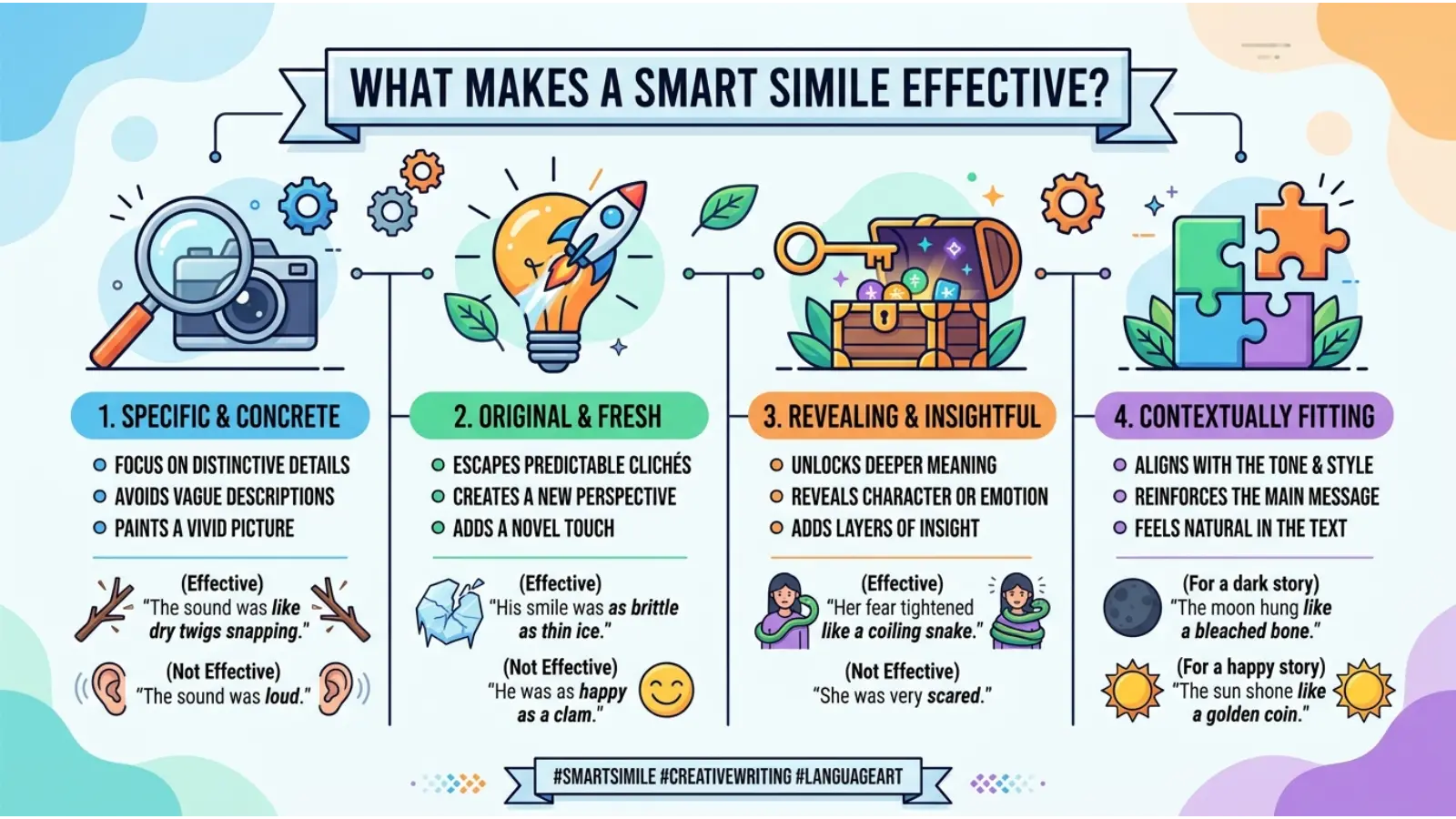
A smart simile does more than say someone is intelligent. It paints a picture that readers can instantly imagine.
The strongest smart similes usually:
- Create a fresh visual image.
- Match the personality or situation.
- Reveal something about a character.
- Feel natural instead of forced.
- Support the mood of the writing.
Instead of saying:
She was very smart.
You could write:
She solved the puzzle like sunlight finding every crack.
The second sentence tells readers more than intelligence—it suggests clarity, speed, and confidence.
30 Original Smart Similes
Like a Compass That Never Loses North
Meaning: Someone who consistently makes wise decisions.
Examples
- She chose the best solution like a compass that never loses north.
- His advice guided everyone like a compass through fog.
Emotional Effect
Creates confidence and trust.
Best For
Leadership, essays, and inspirational writing.
Conversation
“Ask Maya—she’s like a compass that never loses north.”
Writing Tip
Use when describing dependable judgment rather than raw intelligence.
As Sharp as Morning Frost
Meaning
Quick-minded and alert.
Examples
- His observations were as sharp as morning frost.
- She noticed every detail as sharp as morning frost.
Storytelling
The detective entered the room, his attention as sharp as morning frost.
Best Context
Mysteries and detective stories.
Like a Lantern in a Dark Library
Meaning
Someone who brings understanding to confusing situations.
Examples
- Her explanation was like a lantern in a dark library.
- His ideas illuminated the discussion like a lantern among forgotten shelves.
Writing Purpose
Explaining teachers, mentors, or experts.
As Clever as Rain Finding Every Path
Meaning
Excellent at solving problems creatively.
Examples
- She escaped the challenge as clever as rain finding every path.
- His strategy spread through obstacles as cleverly as rain.
Poetry
His thoughts flowed as clever as rain finding every path.
Like an Eagle Spotting a Ripple
Meaning
Excellent at noticing tiny details.
Examples
- She caught the mistake like an eagle spotting a ripple.
- He recognized the clue before anyone else.
Writing Tip
Works especially well in mysteries.
As Bright as the First Sunrise After a Storm
Meaning
Full of hopeful intelligence and fresh ideas.
Examples
- Her solution was as bright as the first sunrise after a storm.
- The student’s project impressed everyone.
Best Context
Academic writing and inspirational stories.
Like a Locksmith Opening Impossible Doors
Meaning
Able to solve difficult problems.
Examples
- He approached equations like a locksmith opening impossible doors.
- Every puzzle seemed easy to her.
As Resourceful as Roots Finding Water
Meaning
Creative under pressure.
Examples
- She adapted as resourceful as roots finding water.
- The team survived thanks to their creativity.
Emotional Effect
Determination and resilience.
Like a Hawk Reading the Wind
Meaning
Excellent judgment.
Examples
- The coach planned like a hawk reading the wind.
- She sensed trouble early.
As Wise as an Old Bridge
Meaning
Experienced and dependable.
Examples
- His advice felt as wise as an old bridge.
- Grandma spoke with calm wisdom.
Best For
Life lessons and memoirs.
Like Thread Pulling a Needle
Meaning
Ideas connect naturally.
Examples
- His reasoning moved like thread pulling a needle.
- Every answer led smoothly to the next.
As Calm as a Chess Master
Meaning
Thinking clearly under pressure.
Examples
- She stayed as calm as a chess master.
- He never rushed difficult decisions.
Like a Clock Knowing Every Second
Meaning
Precise thinking.
Examples
- Her timing was like a clock knowing every second.
- The engineer measured every detail carefully.
As Inventive as a River Carving Stone
Meaning
Creative and persistent.
Examples
- His imagination was as inventive as a river carving stone.
- She found unusual solutions.
Like a Telescope Finding New Stars
Meaning
Discovering opportunities others miss.
Examples
- He noticed possibilities like a telescope finding new stars.
- Her research revealed hidden patterns.
As Curious as a Child Opening Every Door
Meaning
Always eager to learn.
Examples
- She asked questions as curious as a child opening every door.
- His love of learning never faded.
Like Ink Spreading Across Fresh Paper
Meaning
Ideas develop naturally.
Examples
- Inspiration came like ink spreading across fresh paper.
- His thoughts expanded quickly.
As Patient as Snow Melting in Spring
Meaning
Careful and thoughtful.
Examples
- She studied as patiently as snow melting in spring.
- He never rushed important work.
Like a Builder Measuring Twice
Meaning
Careful planning.
Examples
- She planned like a builder measuring twice.
- Every decision was well considered.
As Balanced as Perfect Scales
Meaning
Fair and logical.
Examples
- His judgment stayed as balanced as perfect scales.
- She listened before deciding.
Like a Lighthouse Reading the Sea
Meaning
Guides others wisely.
Examples
- The professor taught like a lighthouse reading the sea.
- His leadership inspired confidence.
As Quiet as an Idea Before It’s Spoken
Meaning
Thoughtful intelligence.
Examples
- She listened as quietly as an idea before it’s spoken.
- His silence often led to brilliant answers.
Like Wind Turning a Mill
Meaning
Makes knowledge productive.
Examples
- He used information like wind turning a mill.
- Learning became action.
As Flexible as Bamboo in Rain
Meaning
Smart through adaptability.
Examples
- She adjusted as flexibly as bamboo in rain.
- The team adapted quickly.
Like a Map Drawn Before the Journey
Meaning
Excellent foresight.
Examples
- He prepared like a map drawn before the journey.
- Every risk had already been considered.
As Clear as Glass in Morning Light
Meaning
Easy to understand.
Examples
- Her explanation was as clear as glass in morning light.
- The lesson became simple.
Like Fire Warming Without Burning
Meaning
Intelligence combined with kindness.
Examples
- His advice warmed like fire without burning.
- She corrected mistakes gently.
As Focused as a Falcon Diving
Meaning
Exceptional concentration.
Examples
- She studied as focused as a falcon diving.
- Nothing distracted him.
Like a Key Fitting the Perfect Lock
Meaning
The ideal solution.
Examples
- His answer fit like a key fitting the perfect lock.
- The plan solved every problem.
As Creative as Moonlight Painting Water
Meaning
Beautiful imagination.
Examples
- Her writing was as creative as moonlight painting water.
- Every paragraph felt fresh.
Why These Similes Work
The best smart similes connect intelligence with familiar images.
Instead of repeating common comparisons, they show intelligence through:
- Nature
- Everyday objects
- Movement
- Light
- Craftsmanship
- Observation
- Discovery
Readers remember images far longer than plain descriptions.
Related Literary Devices
Metaphor
A metaphor states something is another thing.
Metaphor: His mind was a lighthouse.
Simile: His mind was like a lighthouse.
Imagery
Imagery helps readers see, hear, or feel a scene. Smart similes naturally strengthen imagery by creating vivid mental pictures.
Personification
Sometimes intelligence is described by giving human qualities to objects.
Example:
“The book whispered answers.”
Hyperbole
Hyperbole exaggerates for emphasis.
Example:
“She could solve a thousand puzzles before breakfast.”
Unlike similes, hyperbole doesn’t compare using like or as.
Symbolism
Objects such as keys, bridges, stars, or compasses often symbolize wisdom, discovery, or guidance, making them excellent foundations for smart similes.
How to Create Your Own Smart Similes
Creating original similes is easier when you focus on the quality you’re describing.
Step 1
Choose the type of intelligence.
- Quick thinking
- Wisdom
- Creativity
- Observation
- Problem-solving
- Curiosity
Step 2
Find an object or scene with the same quality.
Examples:
- River
- Telescope
- Compass
- Eagle
- Lantern
- Clock
Step 3
Connect them naturally.
Instead of forcing unusual comparisons, ask:
“What naturally behaves this way?”
Creative Exercise
Write one sentence for each of these ideas.
- Smart like _______
- Wise as _______
- Curious as _______
- Creative like _______
- Calm as _______
Then replace your first idea with a more surprising but believable image.
Common Mistakes to Avoid
Using Overused Comparisons
Phrases like “as smart as a fox” are familiar but often lack originality. Fresh images leave a stronger impression.
Mixing Images
Avoid combining unrelated comparisons in one sentence.
Incorrect:
She was like a lighthouse flying through clouds.
Choose one clear image instead.
Forcing the Comparison
If readers must stop to figure out the meaning, the simile is probably too complicated.
Confusing Similes and Metaphors
Remember:
- Simile uses like or as.
- Metaphor makes a direct comparison.
Forgetting the Character
The comparison should match the speaker, setting, and tone of your story.
Frequently Asked Questions
What is a smart simile?
A smart simile is a comparison using like or as to describe intelligence, wisdom, creativity, or thoughtful decision-making.
Why should writers use smart similes?
They make descriptions more vivid, memorable, and emotionally engaging while helping readers visualize ideas.
Can smart similes be used in essays?
Yes. They work well in descriptive essays, speeches, and creative nonfiction when used sparingly.
How can I avoid cliché similes?
Look for fresh images from nature, everyday life, or craftsmanship instead of relying on familiar comparisons.
Are smart similes suitable for children?
Absolutely. Simple, imaginative comparisons help young writers understand descriptive language and develop creativity.
What’s the difference between a simile and a metaphor?
A simile uses like or as, while a metaphor makes a direct comparison without those words.
Should every paragraph contain a simile?
No. Similes have the greatest impact when they appear naturally and support the writing rather than overwhelm it.
Conclusion
Smart similes transform ordinary descriptions into memorable images that readers can instantly understand. By comparing intelligence, wisdom, curiosity, and creativity to meaningful scenes or objects, you add depth without making your writing complicated. Experiment with different comparisons, observe the world around you, and don’t be afraid to invent fresh imagery. The most effective similes are the ones that feel natural, reveal character, and leave readers with a picture they won’t easily forget.

I am Helena Frost, a writer captivated by the beauty of language and the art of comparison. Through my words, I explore the world by turning ordinary moments into vivid similes and reflections. I enjoy crafting phrases that spark imagination, evoke emotion, and linger in the mind. My writing celebrates the subtle connections between people, nature, and the stories we live. For me, every sentence is an opportunity to reveal the extraordinary in the everyday.