Love is one of the most powerful emotions people try to describe, yet it can be surprisingly difficult to put into words. That’s where similes become valuable. A well-crafted simile compares one thing to another using like or as, helping readers feel an emotion instead of simply reading about it. Writers use similes for love in poems, novels, wedding speeches, greeting cards, song lyrics, personal journals, and everyday conversations. The right comparison can turn an ordinary sentence into one that lingers in the reader’s mind. In this guide, you’ll discover original similes for love, learn why they work, avoid common writing mistakes, and develop your own creative comparisons.
Quick Answer
A simile for love compares love to something else using the words like or as to make feelings easier to imagine. For example:
- Love spread through her heart like sunrise across quiet hills.
- Their love was as steady as the tide returning to shore.
Strong love similes create emotion, paint vivid images, and help readers connect with your writing.
Why Love Is Perfect for Similes
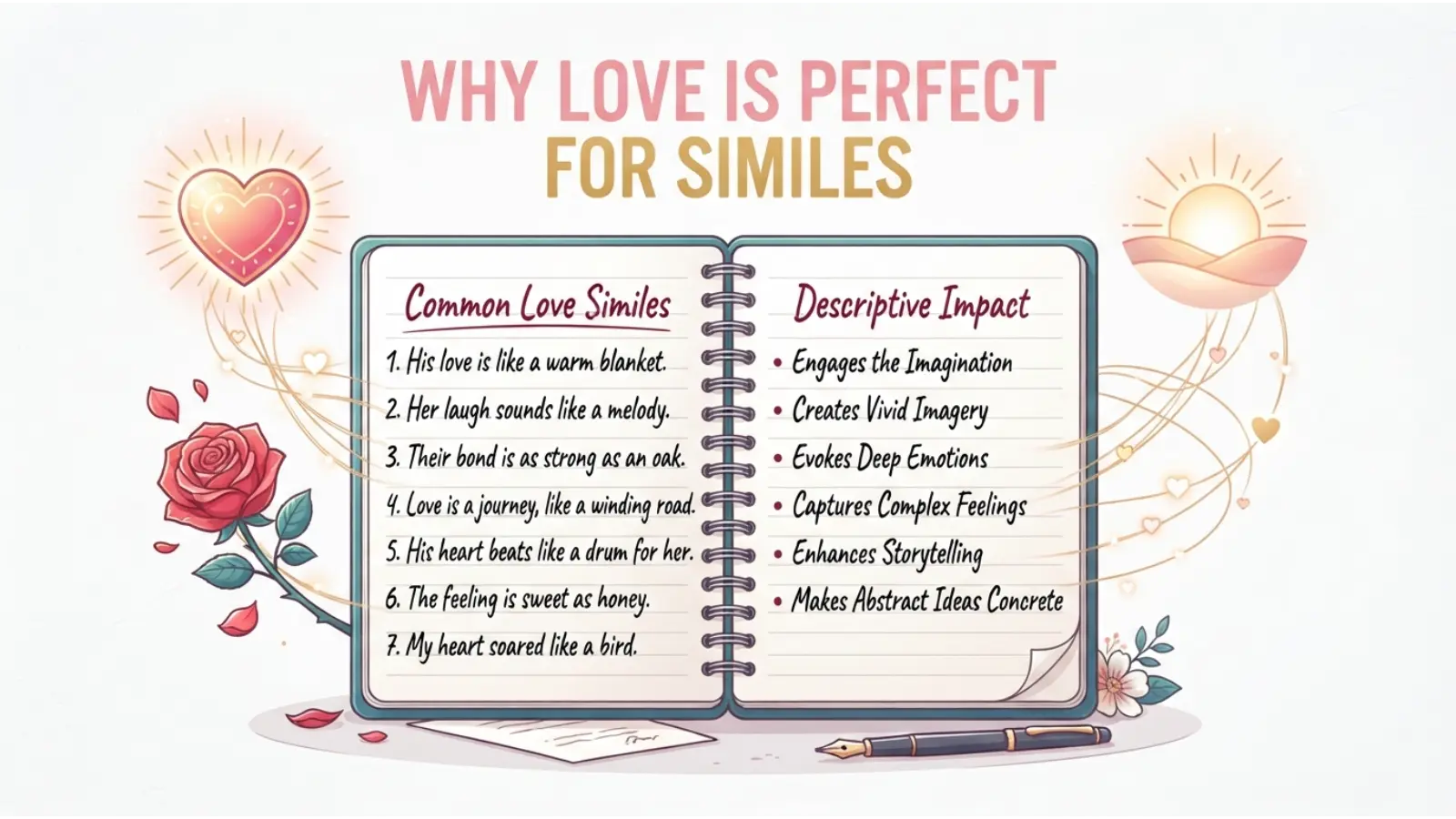
Love changes from one person to another. Sometimes it feels calm. Sometimes it feels exciting, comforting, uncertain, or overwhelming.
Instead of saying “they loved each other,” a simile lets readers experience that emotion.
Compare these:
They loved each other.
Now:
Their love settled between them like warm sunlight through an open window.
The second sentence invites readers into the moment.
Original Similes for Love
Love That Feels Safe
Love bloomed like a garden after gentle rain.
Meaning: Love grows when it’s cared for.
Example:
Their relationship bloomed like a garden after gentle rain, stronger with every passing season.
Best for: Romantic stories and wedding writing.
Love rested like a bird returning to its favorite branch.
This simile suggests comfort, belonging, and peace.
Conversation Example:
Being with you feels like a bird finding its favorite branch again.
Love wrapped around them like a soft winter blanket.
Perfect for describing emotional warmth.
Poetry Example:
Your love wrapped around me like a soft winter blanket beneath silent stars.
Love stood as steady as an old lighthouse.
This comparison highlights loyalty during difficult times.
Love settled like calm water after a storm.
Ideal when characters finally find peace together.
Love That Feels Exciting
Love raced through her heart like lightning across a summer sky.
This creates excitement without sounding exaggerated.
Love sparkled like morning dew catching the first sunlight.
A gentle image for new romance.
Love leaped between them like playful fireflies.
Perfect for youthful relationships.
Love danced like leaves in an autumn breeze.
Suggests joy and natural movement.
Love glowed like lanterns guiding travelers home.
Useful for hopeful, uplifting scenes.
Love That Grows Over Time
Love unfolded like a letter read one beautiful line at a time.
This emphasizes gradual discovery.
Love deepened like roots beneath an ancient tree.
Strong relationships often become stronger quietly.
Love matured like a favorite melody that never grows old.
Excellent for long-term relationships.
Love stretched across the years like a bridge built stone by stone.
Shows patience and commitment.
Love gathered memories like a river collecting smooth stones.
Perfect for anniversaries or memoirs.
Gentle Romantic Similes
Love felt as light as petals drifting on spring air.
Love lingered like the scent of fresh bread from childhood.
A nostalgic comparison.
Love shimmered like moonlight across a quiet lake.
Ideal for poetry.
Love arrived like the first warm day after winter.
Represents hope and renewal.
Love echoed like music in an empty cathedral.
Creates a sense of beauty and depth.
Deep Emotional Similes
Love held them together like invisible threads stitched through time.
Love burned like a candle that refused to surrender to the wind.
Represents resilience.
Love filled the silence like birds welcoming dawn.
Useful when dialogue is minimal.
Love flowed like clear water finding its path.
Suggests natural connection.
Love remained as faithful as the stars returning every night.
A timeless image without becoming cliché.
Creative Similes for Modern Writing
Love spread like color across a blank canvas.
Perfect for artistic characters.
Love fit between them like the final piece of a puzzle.
Shows completeness.
Love carried them forward like favorable winds filling a sail.
Excellent for inspirational writing.
Love shimmered like city lights reflected after rain.
Works well in contemporary fiction.
Love opened new dreams like windows welcoming fresh air.
Suggests possibility.
Poetic Similes for Love
Love floated like clouds painted gold at sunset.
Romance whispered like pine trees beneath mountain winds.
Love circled them like planets drawn by quiet gravity.
Pyar blossomed like hidden wildflowers in forgotten valleys.
Love stretched across their lives like constellations across the night sky.
Conversation-Friendly Similes
My love for you grows like the morning sun.
Your smile feels like sunshine after days of rain.
Being with you is like finally coming home.
Loving you is like discovering a new favorite song every day.
Our love feels as natural as breathing fresh air.
Why These Similes Work
Strong similes do more than compare two things.
They connect emotions with experiences readers already understand.
For example:
- Gardens suggest growth.
- Rivers suggest movement.
- Lanterns suggest hope.
- Trees suggest stability.
- Sunrise suggests new beginnings.
The more familiar the image, the easier readers connect emotionally.
How Professional Writers Create Better Love Similes
Instead of searching for dramatic comparisons, experienced writers observe ordinary life.
Ask yourself:
- What does this emotion remind me of?
- What moves in a similar way?
- What grows like this feeling?
- What changes over time in the same way?
Personal observations usually create stronger imagery than famous expressions.
Related Literary Devices
Metaphor
A metaphor states something is another thing.
Metaphor:
Love was an anchor.
Simile:
Love was like an anchor.
Imagery
Imagery helps readers experience sights, sounds, textures, and emotions.
Example:
Her love drifted like lavender carried on the evening breeze.
Personification
Personification gives human qualities to non-human things.
Example:
Love knocked patiently on every closed door.
Symbolism
Objects often symbolize love.
Examples include:
- Lanterns
- Roses
- Rivers
- Bridges
- Stars
- Gardens
Symbols can strengthen similes when used naturally.
Create Your Own Similes for Love
Writing original similes becomes easier with a simple process.
Step 1: Choose the feeling.
Examples:
- Comfort
- Excitement
- Trust
- Longing
- Joy
- Devotion
Step 2: Think of something with the same quality.
Comfort → blanket
Growth → tree
Hope → sunrise
Strength → mountain
Step 3: Connect them using like or as.
Example:
Love grew like ivy climbing an old stone wall.
Creative Exercise
Write one simile for each emotion:
- First love
- Long-distance love
- Family love
- Self-love
- Lost love
Avoid using hearts, roses, or fire until your second draft. This encourages fresh thinking.
Common Mistakes When Writing Love Similes
Relying on Overused Comparisons
Phrases like as red as a rose or love is like fire have appeared so often that they may no longer surprise readers.
Instead, look for fresh but believable images.
Mixing Different Images
Avoid combining unrelated comparisons.
Poor example:
Love was like sunshine swimming through thunder.
The imagery clashes instead of working together.
Forcing the Comparison
Choose images that naturally match the emotion.
Readers quickly notice comparisons that feel random.
Confusing Similes and Metaphors
Remember:
- Simile uses like or as.
- Metaphor does not.
Using Too Many Similes
A few memorable comparisons are more powerful than filling every paragraph with them.
Give each simile room to make an impression.
Frequently Asked Questions
What is a good simile for love?
A good simile compares love with something readers can easily imagine, such as light, nature, music, or home, while matching the emotion you want to express.
How do I write an original love simile?
Start with the feeling, then compare it to an everyday experience that shares the same qualities instead of copying familiar expressions.
Are similes useful in poetry?
Yes. Similes help poets create vivid emotional images that readers can immediately picture and feel.
Can similes improve romantic stories?
Absolutely. They make relationships feel more believable by showing emotions rather than simply naming them.
What is the difference between a simile and a metaphor?
A simile uses like or as, while a metaphor makes a direct comparison without those words.
Should every love scene include similes?
No. Similes are most effective when used selectively at meaningful emotional moments.
Conclusion
Love is endlessly complex, and similes give writers a way to capture that complexity with vivid, memorable language. The strongest comparisons don’t rely on famous sayings—they grow from careful observation, genuine emotion, and fresh imagination. As you practice, look beyond traditional symbols of romance. Notice the changing seasons, familiar places, quiet routines, and everyday moments around you. Those ordinary experiences often inspire the most original similes for love, helping your stories, poems, and conversations feel authentic and unforgettable.

I am Helena Frost, a writer captivated by the beauty of language and the art of comparison. Through my words, I explore the world by turning ordinary moments into vivid similes and reflections. I enjoy crafting phrases that spark imagination, evoke emotion, and linger in the mind. My writing celebrates the subtle connections between people, nature, and the stories we live. For me, every sentence is an opportunity to reveal the extraordinary in the everyday.