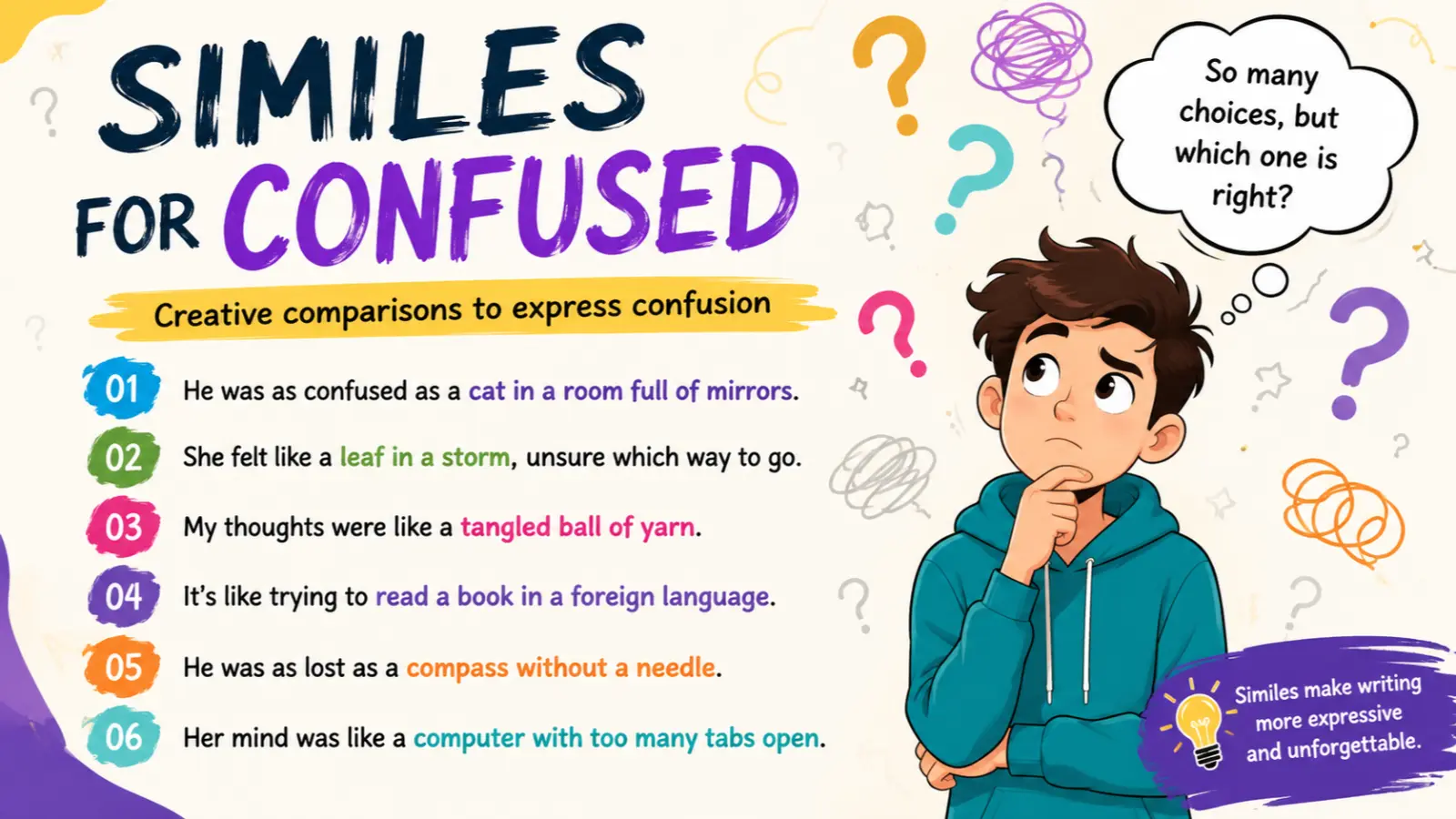
Similes for Confused is one of the most relatable human emotions. Everyone has experienced moments when thoughts become tangled, decisions feel impossible, or answers seem just out of reach. Describing that feeling effectively can make your writing more engaging and realistic. A simile compares one thing to another using “like” or “as.” These comparisons help readers picture emotions instead of simply being told about them. Whether you’re writing stories, poems, essays, or conversations, choosing the right simile can make confusion feel vivid and believable. This guide explores original similes for confused, explains why they work, and shows how to use them naturally in different kinds of writing.
Quick Answer
Similes for confused compare someone’s uncertainty or mental struggle to familiar experiences. A fresh simile helps readers understand the emotion through clear imagery instead of relying on plain descriptions. Original comparisons also make stories, poems, and dialogue more memorable.
Why Use Similes to Describe Confusion?
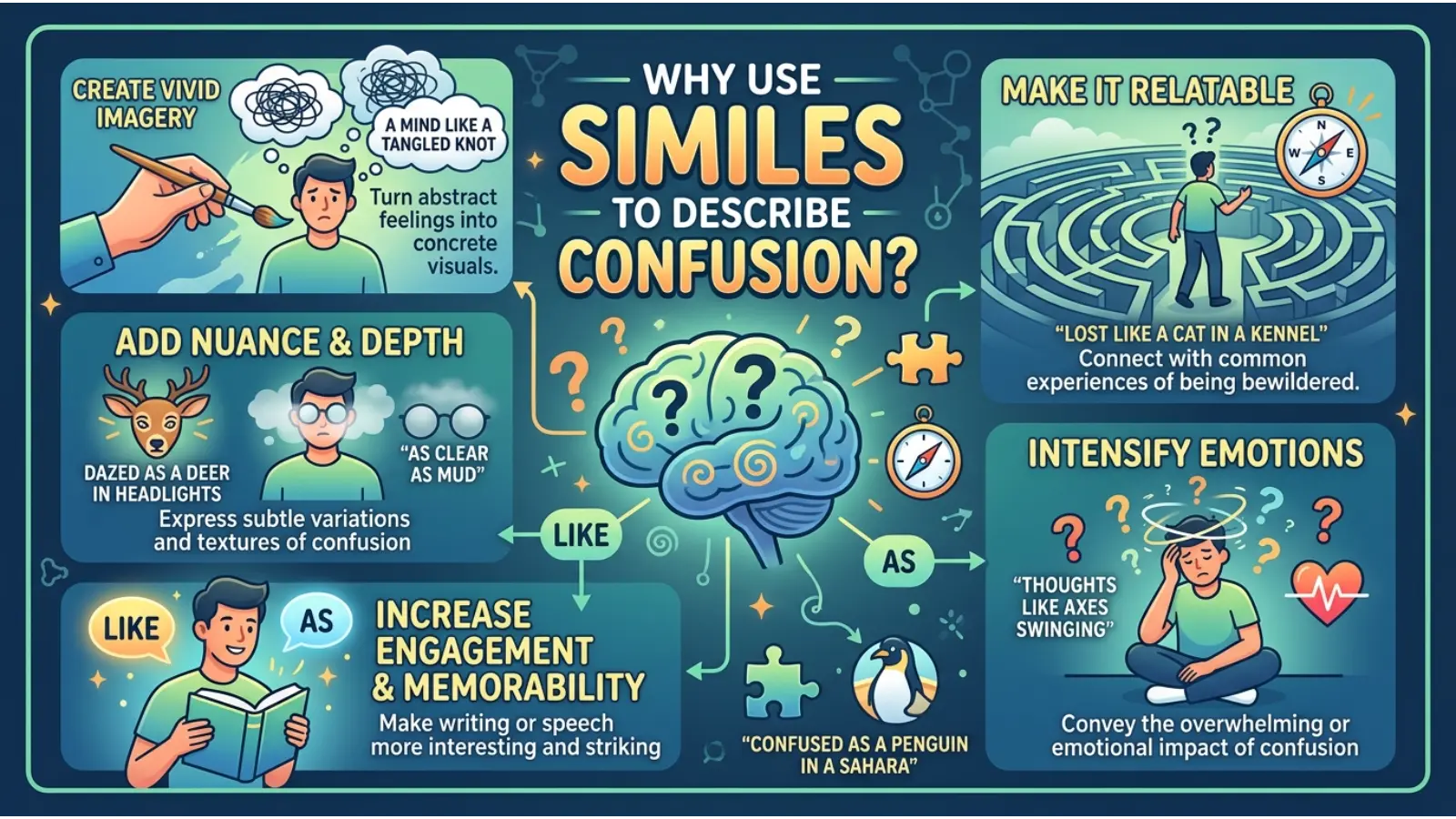
Confusion is invisible. Readers cannot see it unless a writer paints a picture.
Instead of writing:
She looked confused.
You might write:
She looked like someone searching for a doorway in a wall of mirrors.
The second sentence creates an image that readers can imagine immediately.
Good similes also:
- Build emotional connection.
- Improve character development.
- Create stronger visual imagery.
- Make dialogue sound more natural.
- Add personality to descriptive writing.
35 Original Similes for Confused
1. As confused as a traveler without a map
Meaning: Completely unsure where to go.
Examples
- She felt as confused as a traveler without a map during the interview.
- I was as confused as a traveler without a map after reading the instructions twice.
Best Use: Everyday writing and storytelling.
Writing Tip: Works well for characters facing unfamiliar situations.
2. Like a bird trapped inside a glass room
Meaning: Unable to find a clear solution.
Examples
- His thoughts bounced around like a bird trapped inside a glass room.
- She looked like a bird trapped inside a glass room during the exam.
Emotional Effect: Restlessness and frustration.
3. As confused as a compass near a magnet
Meaning: Pulled in conflicting directions.
Examples
- I was as confused as a compass near a magnet.
- Her emotions felt as confused as a compass near a magnet.
Storytelling: Perfect for internal conflict.
4. Like puzzle pieces from different boxes
Meaning: Ideas that refuse to fit together.
Examples
- The clues felt like puzzle pieces from different boxes.
- His explanation sounded like puzzle pieces from different boxes.
5. As confused as a shadow chasing sunlight
Meaning: Constantly missing the answer.
Examples
- She was as confused as a shadow chasing sunlight.
- I felt as confused as a shadow chasing sunlight all afternoon.
Poetic Use: Excellent for reflective writing.
6. Like reading a book with missing pages
Meaning: Important information is absent.
Examples
- The lesson felt like reading a book with missing pages.
- The mystery became like reading a book with missing pages.
7. As confused as a clock without hands
Meaning: Unable to judge direction or timing.
Examples
- He stood as confused as a clock without hands.
- They looked as confused as clocks without hands.
8. Like clouds covering every signpost
Meaning: Nothing seems clear.
Examples
- My thoughts were like clouds covering every signpost.
- Her mind became like clouds hiding every direction.
9. As confused as an echo without a voice
Meaning: Searching for meaning.
Examples
- He felt as confused as an echo without a voice.
- I became as confused as an echo without a voice.
10. Like a painter without colors
Meaning: Missing the tools needed to understand.
Examples
- She felt like a painter without colors.
- He answered like a painter without colors.
11. As confused as leaves spinning in the wind
Meaning: Constantly changing thoughts.
Examples
- My ideas were as confused as leaves spinning in the wind.
- Her plans became as confused as falling leaves.
12. Like a key that fits no lock
Meaning: Every attempt fails.
Examples
- His answer felt like a key that fits no lock.
- I searched like a key that fits no lock.
13. As confused as waves crossing each other
Meaning: Mixed emotions.
Examples
- She felt as confused as waves crossing each other.
- His thoughts crashed together like crossing waves.
14. Like a candle in a whirlwind
Meaning: Struggling to stay focused.
Examples
- My concentration was like a candle in a whirlwind.
- She looked like a candle fighting the wind.
15. As confused as a gardener in winter
Meaning: Unsure what comes next.
Examples
- He stood as confused as a gardener in winter.
- They looked as confused as gardeners waiting for spring.
16. Like footsteps disappearing in snow
Meaning: Every clue quickly vanishes.
17. As confused as a fish in the desert
Meaning: Completely out of place.
18. Like stars hidden behind thick fog
Meaning: The answer exists but cannot be seen.
19. As confused as a singer without a melody
Meaning: Missing direction.
20. Like a kite caught between two winds
Meaning: Pulled toward different choices.
21. As confused as unopened mail
Meaning: Full of unanswered questions.
22. Like a staircase leading nowhere
Meaning: Progress without purpose.
23. As confused as footprints circling themselves
Meaning: Repeating the same mistakes.
24. Like rain falling upward in a dream
Meaning: Reality feels strange.
25. As confused as a mirror facing another mirror
Meaning: Endless uncertainty.
26. Like a river forgetting its course
Meaning: Lost direction.
27. As confused as a lantern in daylight
Meaning: Unsure of its purpose.
28. Like unopened doors in a long hallway
Meaning: Too many unknown choices.
29. As confused as an artist facing a blank canvas
Meaning: Overwhelmed by possibilities.
30. Like smoke twisting through narrow streets
Meaning: Thoughts constantly changing.
31. As confused as a bee in a library
Meaning: Completely unfamiliar surroundings.
32. Like tangled strings after a storm
Meaning: Thoughts impossible to separate.
33. As confused as a bridge ending midair
Meaning: No clear conclusion.
34. Like moonlight trapped inside water
Meaning: Something almost understood but impossible to grasp.
35. As confused as an unopened compass
Meaning: Guidance exists but hasn’t been discovered.
How Professional Writers Create Strong Similes
The best similes don’t simply compare two random things. They connect emotions with experiences readers already understand.
When creating your own:
- Think about how confusion feels physically.
- Imagine an object that behaves the same way.
- Focus on movement, light, sound, or direction.
- Keep comparisons believable.
- Choose fresh images instead of overused ones.
Instead of saying someone is “as confused as a lost puppy,” try creating an image unique to your story.
Related Literary Devices
Metaphor
A metaphor makes a direct comparison without using like or as.
Simile: She was like a traveler without a map.
Metaphor: She was a traveler without a map.
Imagery
Imagery appeals to the senses. Similes often strengthen imagery by creating vivid mental pictures.
Personification
Personification gives human qualities to non-human things.
Example:
The unanswered question refused to leave his mind.
Hyperbole
Hyperbole exaggerates for emphasis.
Example:
I searched for the answer for a thousand years.
Symbolism
Objects can symbolize confusion.
Examples include:
- Fog
- Labyrinths
- Broken compasses
- Crossroads
- Mirrors
Create Your Own Similes for Confused
You don’t need to wait for inspiration. You can build effective similes with a simple process.
Step 1
Choose the emotion.
Example:
- Confused
- Unsure
- Lost
- Uncertain
Step 2
Think of something that behaves the same way.
Examples:
- Fog
- Maze
- Broken compass
- Tangled thread
Step 3
Connect them using like or as.
Example:
As confused as a river searching for the sea.
Creative Exercise
Write five situations where someone feels confused, such as starting a new job, taking a difficult test, moving to a new city, solving a mystery, or learning a new language. For each situation, create one original simile that reflects the character’s emotions without copying familiar expressions.
Common Mistakes When Writing Similes
Using Overused Comparisons
Readers remember fresh images more than familiar ones.
Mixing Imagery
Avoid combining unrelated pictures in one comparison.
Forcing Similes
Only use a simile when it naturally improves the sentence.
Confusing Similes with Metaphors
Remember:
- Similes use like or as.
- Metaphors do not.
Describing Without Purpose
Every simile should reveal something about the character, setting, or emotion.
Frequently Asked Questions
What is a good simile for confused?
A good simile creates a clear mental picture, such as “as confused as a compass near a magnet” or “like reading a book with missing pages.”
Are similes better than metaphors?
Neither is better. Similes make comparisons more explicit, while metaphors tend to be stronger and more direct.
Can I use similes in academic writing?
Use them sparingly. Similes are most effective in creative writing, speeches, and descriptive essays.
How many similes should I use in a story?
Use only enough to strengthen important moments. Too many comparisons can distract readers.
Why should I avoid clichés?
Overused similes lose their impact because readers have encountered them many times before.
Can children learn similes easily?
Yes. Comparing familiar objects to emotions helps children understand figurative language more naturally.
Conclusion
Strong similes do more than decorate sentences—they help readers experience emotions through vivid, memorable images. Whether you’re writing fiction, poetry, personal essays, or dialogue, original similes for confused can make uncertain moments feel authentic and engaging. The best comparisons come from careful observation and imagination. Rather than relying on familiar phrases, experiment with new images that reflect the unique emotions of your characters or ideas. With practice, you’ll create similes that readers remember long after they’ve finished your writing.
I am Helena Frost, a writer captivated by the beauty of language and the art of comparison. Through my words, I explore the world by turning ordinary moments into vivid similes and reflections. I enjoy crafting phrases that spark imagination, evoke emotion, and linger in the mind. My writing celebrates the subtle connections between people, nature, and the stories we live. For me, every sentence is an opportunity to reveal the extraordinary in the everyday.