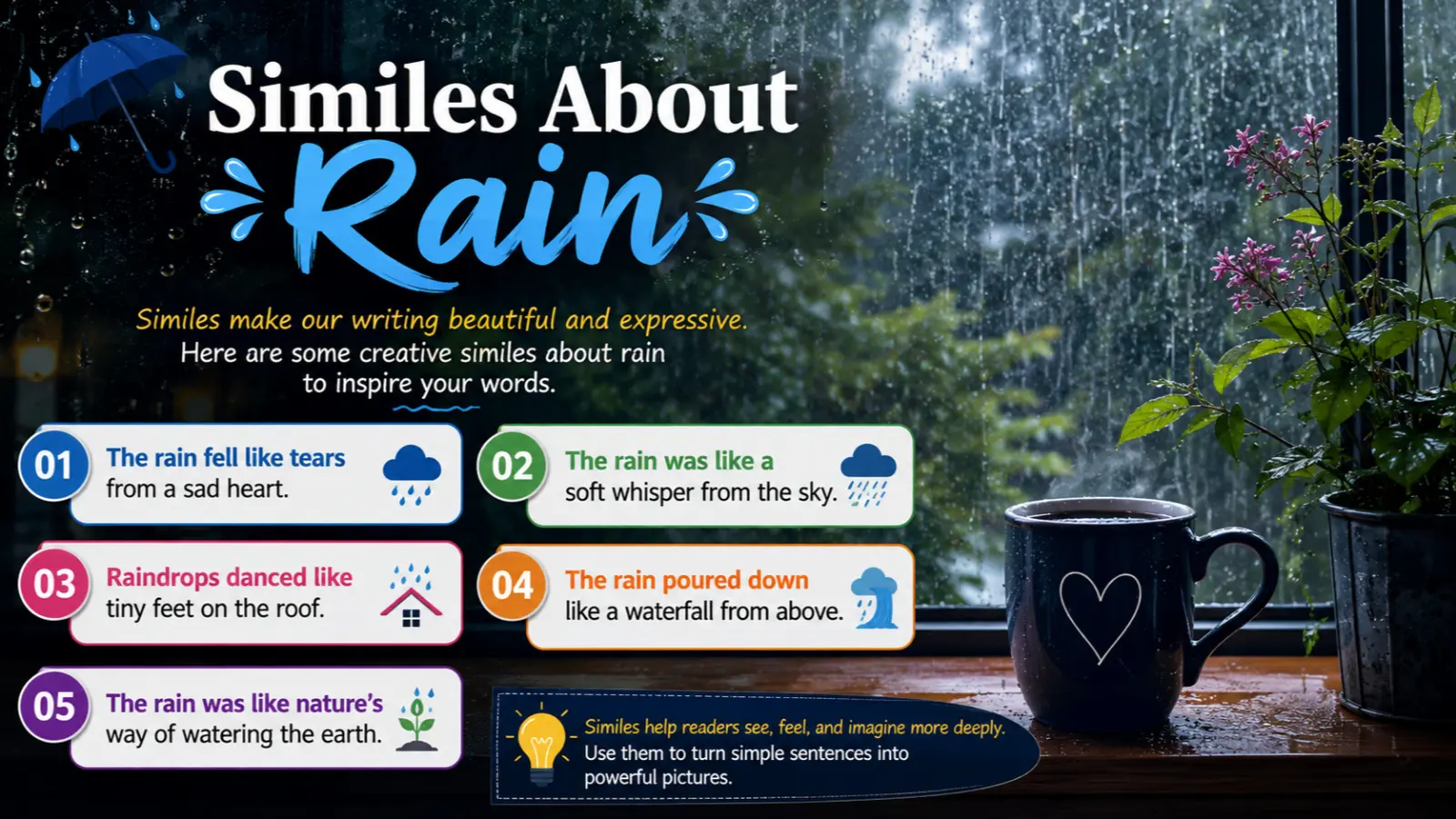
Similes About Rain has inspired writers for centuries because it can represent peace, sadness, hope, mystery, fear, or renewal. One of the best ways to capture those emotions is through similes. A simile compares two different things using words like “as” or “like,” helping readers picture a scene more clearly.
Whether you’re writing a story, poem, essay, or personal journal, well-crafted similes about rain can transform ordinary descriptions into memorable imagery.
This guide introduces fresh, original rain similes, explains why they work, and shows you how to create your own.
Quick Answer
Similes about rain compare rainfall to familiar objects or experiences using words such as like or as. They make writing more visual and emotional. For example, instead of writing “It rained heavily,” you might write, “The rain fell like thousands of tiny drummers on the roof.”
Why Rain Makes Such Powerful Similes
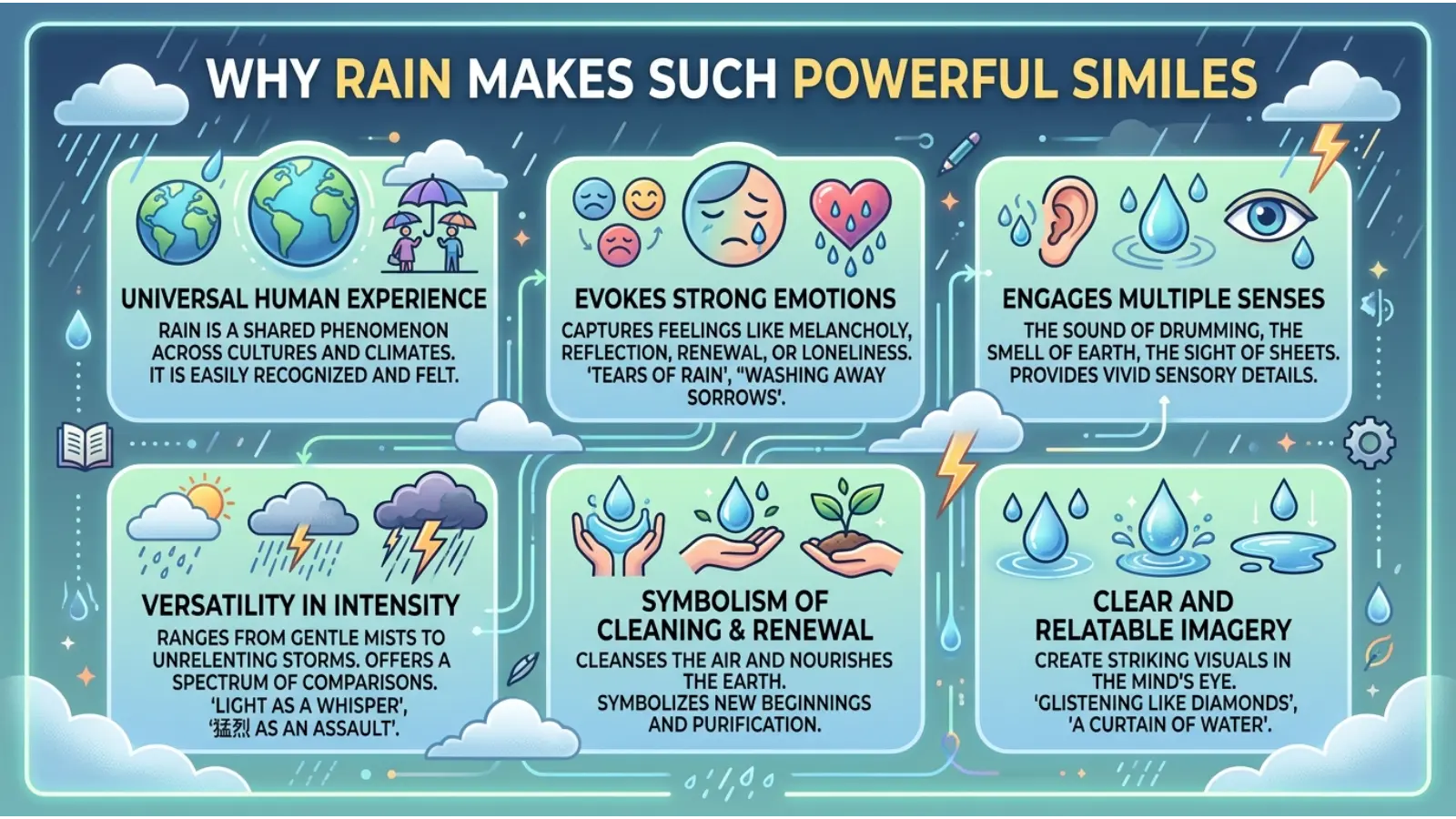
Rain constantly changes.
A gentle drizzle creates calm.
A thunderstorm creates tension.
A summer shower brings relief.
Because rain reflects so many emotions, writers often use it to strengthen imagery without lengthy explanations.
Good rain similes help readers:
- Picture the weather
- Feel the atmosphere
- Understand a character’s emotions
- Create memorable scenes
- Improve poetic language
30 Original Similes About Rain
1. Rain fell like silver threads stitched across the sky.
Meaning: Gentle, elegant rainfall.
Example Sentences
- Rain fell like silver threads stitched across the evening sky.
- The valley shimmered as rain drifted like silver threads.
Emotional Effect: Peaceful
Best Context: Nature writing, poetry
Writing Tip: Use for quiet scenes.
2. Rain danced like playful children across the pavement.
Meaning: Light rain bouncing on hard surfaces.
Example Sentences
- Rain danced like playful children outside my window.
- Tiny drops skipped like laughing children across the road.
Conversation Example
“It started raining, and the drops danced everywhere.”
3. Rain poured like a bucket tipped from the clouds.
Meaning: Extremely heavy rain.
Storytelling Example
Within seconds, rain poured like a bucket tipped from the clouds, soaking everyone waiting outside.
4. Rain whispered like old secrets through the trees.
Meaning: Soft rainfall with gentle wind.
Poetry Example
Rain whispered like forgotten secrets beneath the pine branches.
5. Rain sparkled like scattered diamonds.
Meaning: Rain reflecting sunlight.
Writing Purpose: Add beauty to descriptive passages.
6. Rain rolled down the windows like tiny travelers.
Meaning: Raindrops slowly sliding on glass.
Example Sentences
- Tiny drops wandered like travelers down the window.
- I watched the rain crawl like curious travelers.
7. Rain crashed like breaking waves.
Meaning: Violent storm.
Best Context: Storm scenes
8. Rain drifted like floating feathers.
Meaning: Very light drizzle.
Writing Tip: Ideal for peaceful openings.
9. Rain shimmered like polished glass.
Meaning: Bright rain after sunshine.
Formal Example
The afternoon rain shimmered like polished glass beneath the fading light.
10. Rain gathered like quiet applause.
Meaning: Soft rhythmic rainfall.
Emotional Effect: Comfort
11. Rain raced like eager runners downhill.
Meaning: Fast-flowing rainwater.
Storytelling Example
Water raced like eager runners toward the stream.
12. Rain wrapped the town like a cool blanket.
Meaning: Rain covering everything.
Best Context: Cozy descriptions
13. Rain shimmered like tiny lanterns beneath streetlights.
Meaning: Night rain.
Writing Purpose: Urban imagery.
14. Rain drifted like sleepy butterflies.
Meaning: Slow, delicate drizzle.
Poetry Example
The rain floated like sleepy butterflies over the meadow.
15. Rain echoed like distant applause.
Meaning: Continuous rainfall.
Emotion: Reflection
16. Rain bounced like tiny marbles.
Meaning: Heavy drops striking pavement.
Writing Tip: Creates movement.
17. Rain stretched across the hills like a gray curtain.
Meaning: Rain hiding distant scenery.
Best Context: Landscape descriptions
18. Rain glittered like fresh crystals.
Meaning: Bright rainfall in sunlight.
19. Rain drifted like soft smoke.
Meaning: Misty rain.
Emotional Effect: Mystery
20. Rain tapped like careful fingers on the roof.
Meaning: Gentle rhythmic rain.
Conversation Example
“The rain tapped all night, and I slept peacefully.”
21. Rain spread like watercolor paint across the fields.
Meaning: Rain gradually covering an area.
22. Rain rushed like excited crowds leaving a stadium.
Meaning: Sudden heavy rainfall.
23. Rain floated like tiny feathers from the clouds.
Meaning: Calm drizzle.
24. Rain shivered like glass beads in the wind.
Meaning: Wind-driven rainfall.
25. Rain circled the lake like curious birds.
Meaning: Rain creating ripples.
26. Rain scattered like handfuls of tiny pearls.
Meaning: Bright individual raindrops.
27. Rain curled like ribbons in the breeze.
Meaning: Wind-swept rain.
28. Rain glowed like melted silver beneath moonlight.
Meaning: Rain at night.
Best Context: Romantic scenes
29. Rain drifted over the fields like a gentle sigh.
Meaning: Calm countryside rain.
30. Rain settled like quiet music over the earth.
Meaning: Peaceful rainfall ending the day.
Writing Purpose: Emotional endings and reflective moments.
What Makes a Rain Simile Effective?
Strong similes focus on one clear image instead of comparing too many ideas at once.
Ask yourself:
- Can readers picture it immediately?
- Does it match the mood?
- Is it fresh rather than overused?
- Does it strengthen the scene?
Simple, specific comparisons usually leave the strongest impression.
How Professional Writers Create Vivid Rain Similes
Experienced writers observe rain before describing it.
Notice:
- The sound on different surfaces
- The speed of falling drops
- The color of clouds
- Reflections in puddles
- Wind movement
- Light after the storm
Instead of forcing unusual comparisons, choose images that naturally fit what readers can imagine.
Related Literary Devices
Metaphor
A metaphor says rain is something rather than comparing it.
Example:
The rain became a silver curtain.
Imagery
Imagery appeals to the senses.
Example:
Cold drops splashed against the wooden porch while the air smelled fresh.
Personification
Personification gives rain human qualities.
Example:
The rain knocked politely at the window.
Hyperbole
Hyperbole exaggerates for effect.
Example:
It rained enough to fill an ocean overnight.
Alliteration
Repeating beginning sounds makes descriptions more memorable.
Example:
Soft summer showers shimmered silently.
Symbolism
Rain often symbolizes:
- Renewal
- Change
- Sadness
- Cleansing
- Hope
- New beginnings
Create Your Own Rain Similes
You don’t need extraordinary vocabulary to write memorable similes.
Follow these steps:
Step 1
Observe the rain closely.
Step 2
Choose one quality:
- Sound
- Speed
- Shape
- Color
- Mood
Step 3
Think of another object with the same quality.
Step 4
Connect them using like or as.
Practice Exercise
Write one simile for each type of rain:
- Morning drizzle
- Thunderstorm
- Summer shower
- Rain at sunset
- Rain on a window
- Rain in a forest
Then read them aloud to see which sounds the most natural.
Common Mistakes to Avoid
Using Overused Comparisons
Avoid relying on familiar phrases readers have seen countless times. Fresh imagery is more memorable.
Mixing Images
Don’t combine unrelated comparisons in the same sentence. A clear image is stronger than several competing ones.
Forcing Creativity
A believable comparison is more effective than an unusual one that confuses readers.
Confusing Similes with Metaphors
Remember:
- Simile: The rain fell like silver threads.
- Metaphor: The rain was silver threads.
Ignoring the Mood
Match the comparison to the emotion of the scene. A playful simile may not fit a tragic moment.
Frequently Asked Questions
What is a simile about rain?
A simile about rain compares rainfall to something else using words like “like” or “as” to create stronger imagery.
Why should writers use rain similes?
They help readers visualize scenes, build atmosphere, and express emotion more vividly than plain descriptions.
Can rain similes be used in essays?
Yes. When appropriate, they make descriptive and narrative essays more engaging.
What’s the difference between a rain simile and a rain metaphor?
A simile uses like or as, while a metaphor states that one thing is another without those comparison words.
Are rain similes suitable for children?
Absolutely. Simple, imaginative comparisons encourage creativity and improve descriptive writing skills.
How can I avoid cliché rain similes?
Observe real rain, focus on one detail, and compare it with something unexpected yet believable.
Can I use rain similes in poetry?
Yes. Poetry often relies on similes to create rhythm, emotion, and memorable imagery.
Conclusion
Rain offers endless inspiration because it can be gentle, dramatic, comforting, or mysterious. The best similes about rain do more than describe the weather—they reveal emotion, deepen atmosphere, and help readers experience a scene through vivid imagery. As you practice, look beyond familiar comparisons and draw inspiration from the world around you. Observe how rain sounds, moves, reflects light, and changes the landscape. With thoughtful observation and a little creativity, you’ll develop original similes that make your writing stand out and leave a lasting impression on your readers.

I am Helena Frost, a writer captivated by the beauty of language and the art of comparison. Through my words, I explore the world by turning ordinary moments into vivid similes and reflections. I enjoy crafting phrases that spark imagination, evoke emotion, and linger in the mind. My writing celebrates the subtle connections between people, nature, and the stories we live. For me, every sentence is an opportunity to reveal the extraordinary in the everyday.