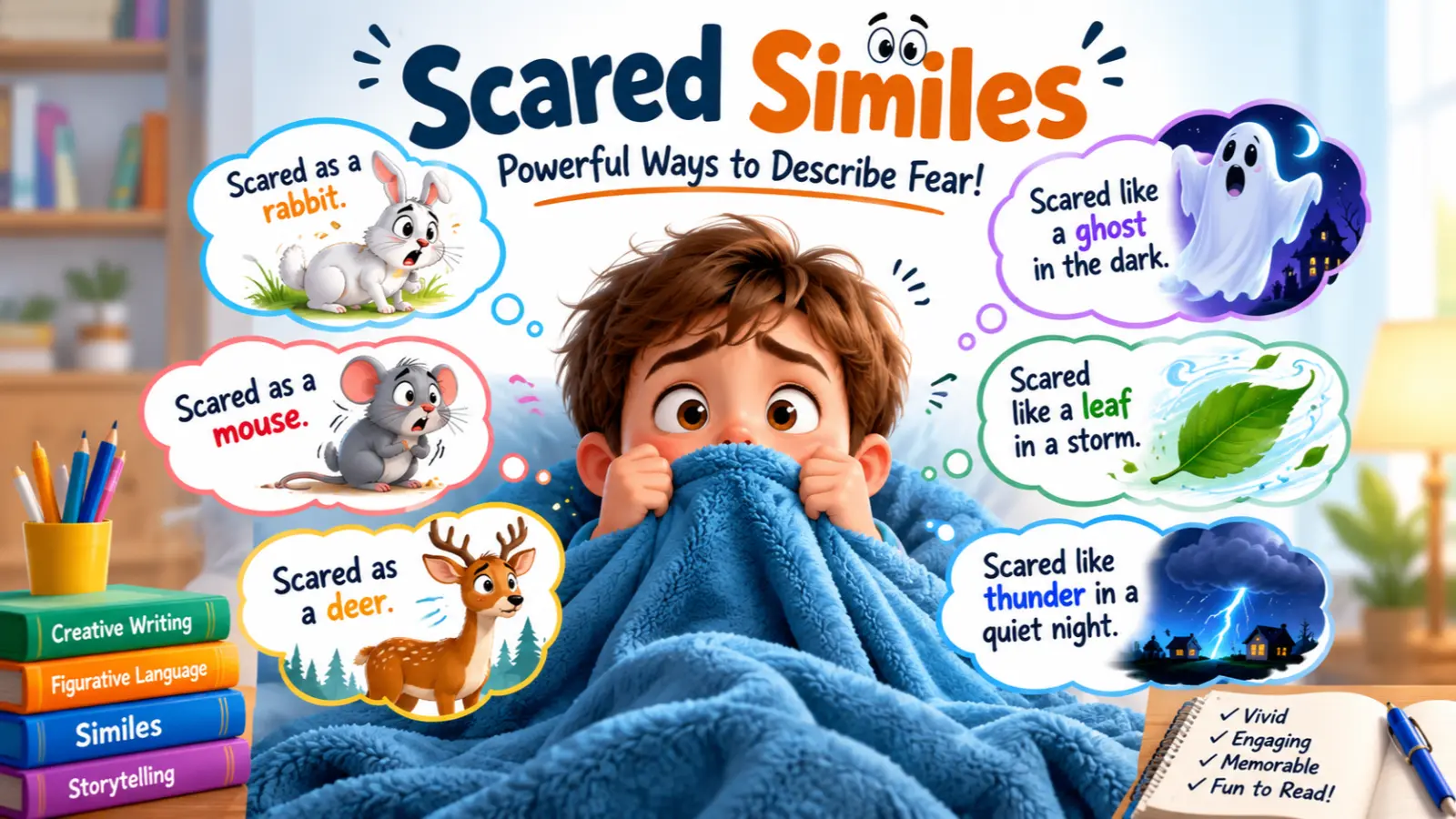
Fear is one of the strongest emotions a writer can describe, but simply saying someone was scared rarely leaves a lasting impression. That’s where similes become valuable. They compare one thing to another using like or as, helping readers picture emotions instead of merely reading about them. Scared similes appear in novels, poems, short stories, speeches, classroom writing, and everyday conversation. They make characters feel believable and scenes more memorable. In this guide, you’ll discover original scared similes, learn why they work, avoid common mistakes, and gain practical techniques for creating your own vivid comparisons.
What Are Scared Similes?
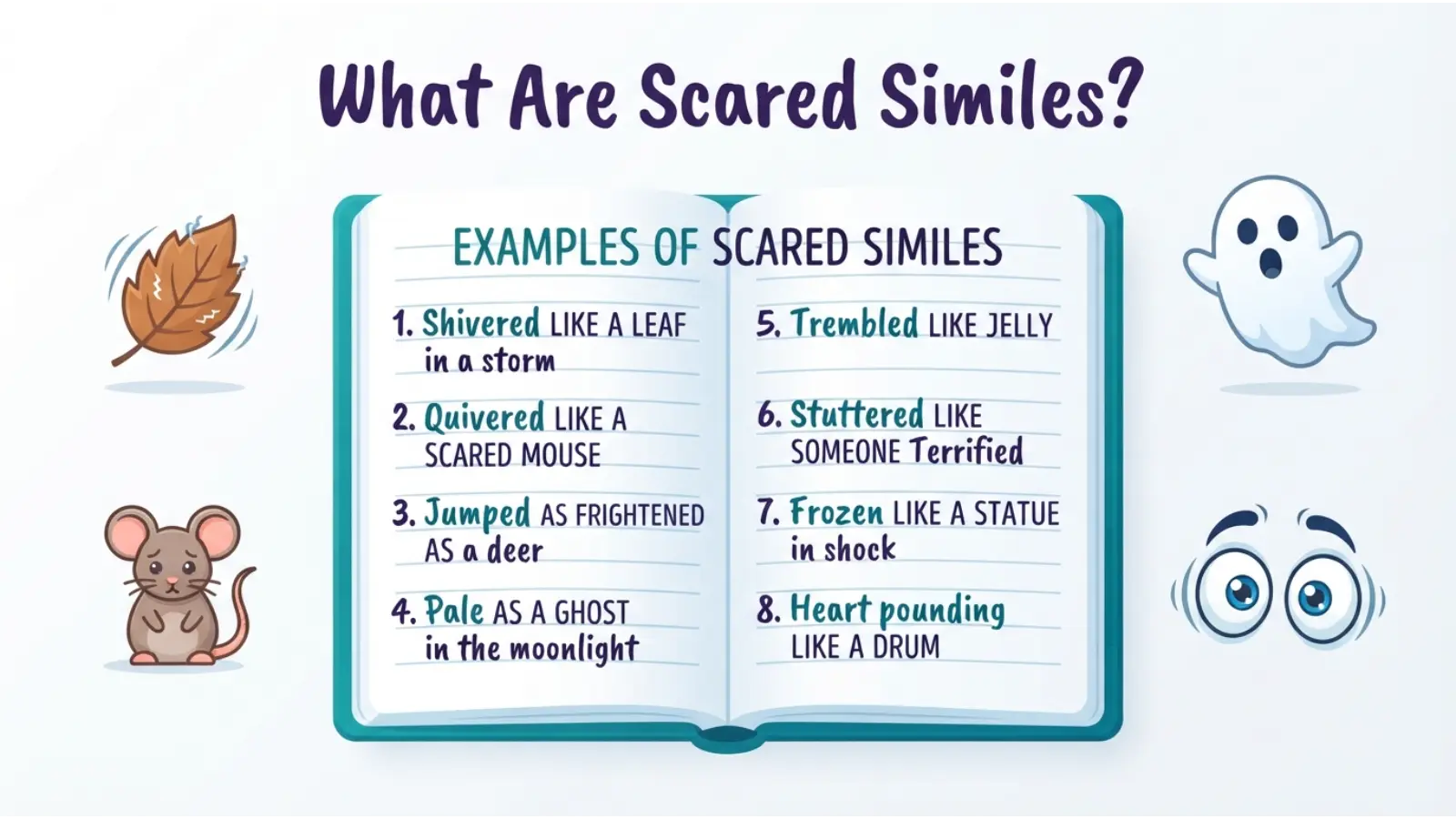
Scared similes compare fear to something readers can easily imagine.
Instead of writing:
She was scared.
You could write:
She froze like a bird hearing a hunter’s footsteps.
The second sentence paints a picture rather than simply naming an emotion.
Why Writers Use Scared Similes
Fear often shows itself through actions instead of words. A carefully chosen simile helps readers experience the emotion.
Good scared similes can:
- Build suspense.
- Reveal a character’s personality.
- Increase emotional tension.
- Make scenes more cinematic.
- Help readers connect with the story.
30 Original Scared Similes
1. As uneasy as a candle in a windy hallway
Meaning: Feeling vulnerable.
Story Example:
He waited outside the courtroom, as uneasy as a candle in a windy hallway.
Writing Tip: Great for quiet suspense.
2. Like a rabbit hearing distant footsteps
Meaning: Alert and ready to flee.
Conversation Example:
“She looked like a rabbit hearing distant footsteps when the principal called her name.”
3. As tense as a violin string before it snaps
Creates the feeling of pressure building.
Best for emotional scenes.
4. Like leaves trembling before a storm
Perfect for describing visible nervousness.
Poetry Example:
His hands shook like leaves trembling before a storm.
5. As frozen as morning dew in winter
Shows fear causing complete stillness.
6. Like a ship entering unseen fog
Meaning:
Fear of the unknown.
Works well in adventure writing.
7. As cautious as a fox crossing an open field
Suggests careful movement mixed with fear.
8. Like footsteps echoing in an empty tunnel
Creates quiet psychological fear.
9. As pale as moonlight on cold stone
Best for showing visible fright.
10. Like a door shaking in heavy wind
Excellent for physical trembling.
11. As silent as snowfall before dawn
Shows fear that steals words.
12. Like a mouse caught beneath an owl’s shadow
Creates immediate danger.
13. As restless as waves before a hurricane
Useful for building anticipation.
14. Like smoke searching for an escape
Shows anxious movement.
15. As fragile as thin ice beneath careful feet
Fear mixed with uncertainty.
16. Like a heartbeat racing ahead of its owner
A vivid way to describe panic.
17. As startled as birds bursting from tall grass
Works well during sudden surprises.
18. Like an unopened letter carrying terrible news
Suggests fear before something happens.
19. As shaky as a bridge in strong wind
Perfect for physical reactions.
20. Like a shadow shrinking from light
Shows someone pulling back in fear.
21. As watchful as a deer at the forest edge
Ideal for survival scenes.
22. Like rain clouds gathering without warning
Builds emotional tension.
23. As uncertain as footprints disappearing in snow
Represents confusion and fear together.
24. Like a lantern flickering underground
Suggests hope struggling against fear.
25. As guarded as a shell hiding its pearl
Shows emotional self-protection.
26. Like an actor forgetting every line on stage
Relatable everyday fear.
Conversation Example:
“I felt like an actor forgetting every line on stage.”
27. As hesitant as a child approaching deep water
Excellent for emotional storytelling.
28. Like a kite caught in tangled branches
Shows being trapped by fear.
29. As stiff as an old tree facing lightning
Useful for action scenes.
30. Like the last star fading before sunrise
Represents courage disappearing under fear.
Poetry Example:
His confidence faded like the last star before sunrise.
Why These Similes Feel Strong
Powerful similes don’t simply replace the word scared. They connect fear with images readers already understand.
Notice that these comparisons draw from:
- Nature
- Weather
- Animals
- Everyday experiences
- Light and darkness
- Sound and silence
These familiar images help readers experience fear naturally.
Make Your Fear Descriptions More Memorable
Instead of choosing dramatic comparisons every time, think about how the fear feels.
Ask yourself:
- Is the character frozen?
- Are they hiding?
- Are they expecting danger?
- Are they startled?
- Are they trying to stay calm?
The answer often leads to a stronger simile than simply describing fear itself.
Avoid These Common Mistakes
Relying on Overused Comparisons
Readers have seen phrases like as scared as a mouse countless times. Fresh imagery creates a stronger impression.
Mixing Images
Avoid comparisons that clash.
Example:
He was like frozen lightning.
The images don’t work together clearly.
Confusing Similes with Metaphors
Simile:
She stood like a frightened bird.
Metaphor:
She was a frightened bird.
Both are useful, but they work differently.
Using Similes Too Often
A memorable simile stands out because it’s occasional. If every sentence contains one, the writing becomes distracting.
Related Literary Devices
Imagery
Scared similes strengthen imagery by helping readers picture fear through sights, sounds, movement, and atmosphere.
Personification
Giving fear human qualities can increase emotional impact.
Example:
Fear knocked quietly at his thoughts.
Hyperbole
Sometimes writers exaggerate fear for dramatic effect, but moderation keeps the writing believable.
Symbolism
Objects like storms, broken bridges, dark forests, or fading candles often symbolize fear without directly stating it.
How to Create Your Own Scared Similes
Creating original similes becomes easier when you follow a simple process.
Step 1
Identify the exact kind of fear.
- Panic
- Nervousness
- Anxiety
- Terror
- Suspense
Step 2
Think of something that behaves similarly.
Examples:
- Animals
- Weather
- Light
- Music
- Water
- Plants
Step 3
Connect them naturally using like or as.
Step 4
Read the sentence aloud.
If it sounds forced or confusing, simplify it.
Creative Practice Exercise
Complete these comparisons using your own ideas.
- As scared as _____________
- Like _____________ before sunrise
- As nervous as _____________
- Like _____________ during a storm
- As silent as _____________
Then write one short paragraph using two of your new similes.
Frequently Asked Questions
What is a scared simile?
A scared simile compares fear to another image using like or as to make the emotion easier to imagine.
Why should writers use scared similes?
They create vivid descriptions, improve storytelling, and help readers connect emotionally with characters.
Can scared similes be used in essays?
Yes. They work well in creative essays, narratives, and descriptive writing, but they are usually avoided in formal academic papers.
What’s the difference between a simile and a metaphor?
A simile uses like or as, while a metaphor makes a direct comparison without those words.
Are original similes better than common ones?
Usually. Fresh comparisons surprise readers and make writing more memorable, provided they remain clear and believable.
How many similes should I use in one story?
Use them where they add meaning. A few strong similes often have more impact than many weak ones.
Conclusion
Scared similes transform ordinary descriptions into memorable moments. Rather than telling readers a character is afraid, they invite readers to experience that fear through vivid images and meaningful comparisons. Experiment with different sources of inspiration—nature, everyday life, weather, and movement—and don’t be afraid to invent your own original comparisons. The more you practice, the more naturally your writing will capture emotion in a way readers remember.
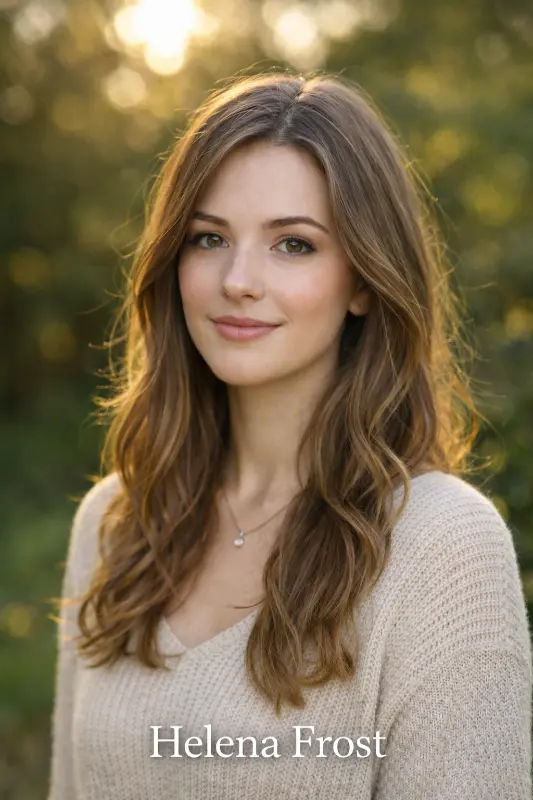
I am Helena Frost, a writer captivated by the beauty of language and the art of comparison. Through my words, I explore the world by turning ordinary moments into vivid similes and reflections. I enjoy crafting phrases that spark imagination, evoke emotion, and linger in the mind. My writing celebrates the subtle connections between people, nature, and the stories we live. For me, every sentence is an opportunity to reveal the extraordinary in the everyday.