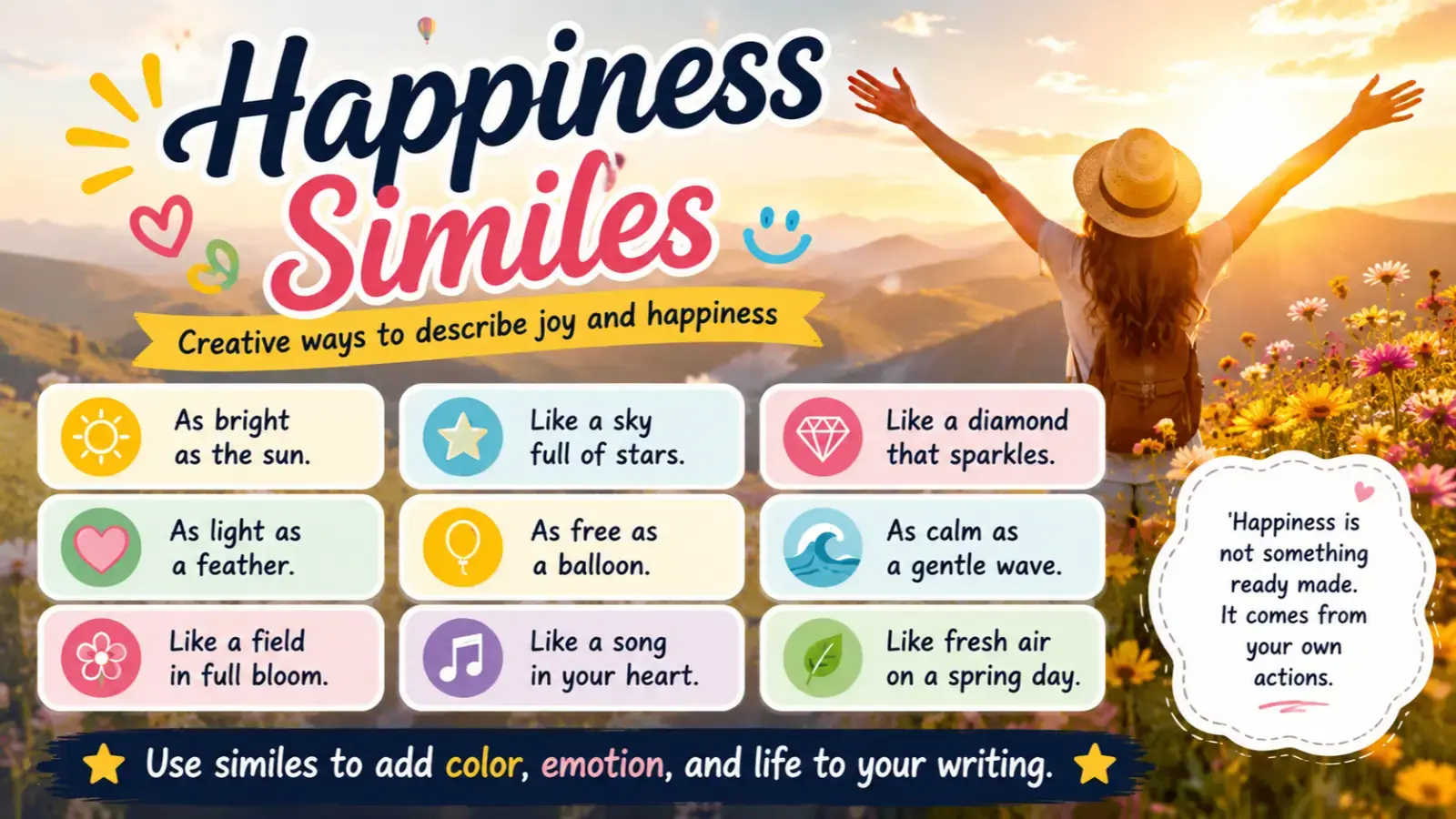
Happiness Similes can be difficult to describe because it is invisible. You can feel it instantly, but putting that feeling into words takes imagination. A well-crafted simile gives happiness a shape, sound, color, movement, or texture that readers can recognize.
A Happiness Similes compares two different things using words such as like or as. Writers use Happiness Similes to make abstract emotions easier to picture and remember. You will find them in poems, novels, personal essays, songs, speeches, everyday conversations, and creative writing.
This collection of happiness similes focuses on fresh comparisons rather than familiar phrases. Along the way, you will learn why certain comparisons work, how to make emotional imagery stronger, and how to create your own original similes.
What Is a Simile for Happiness?
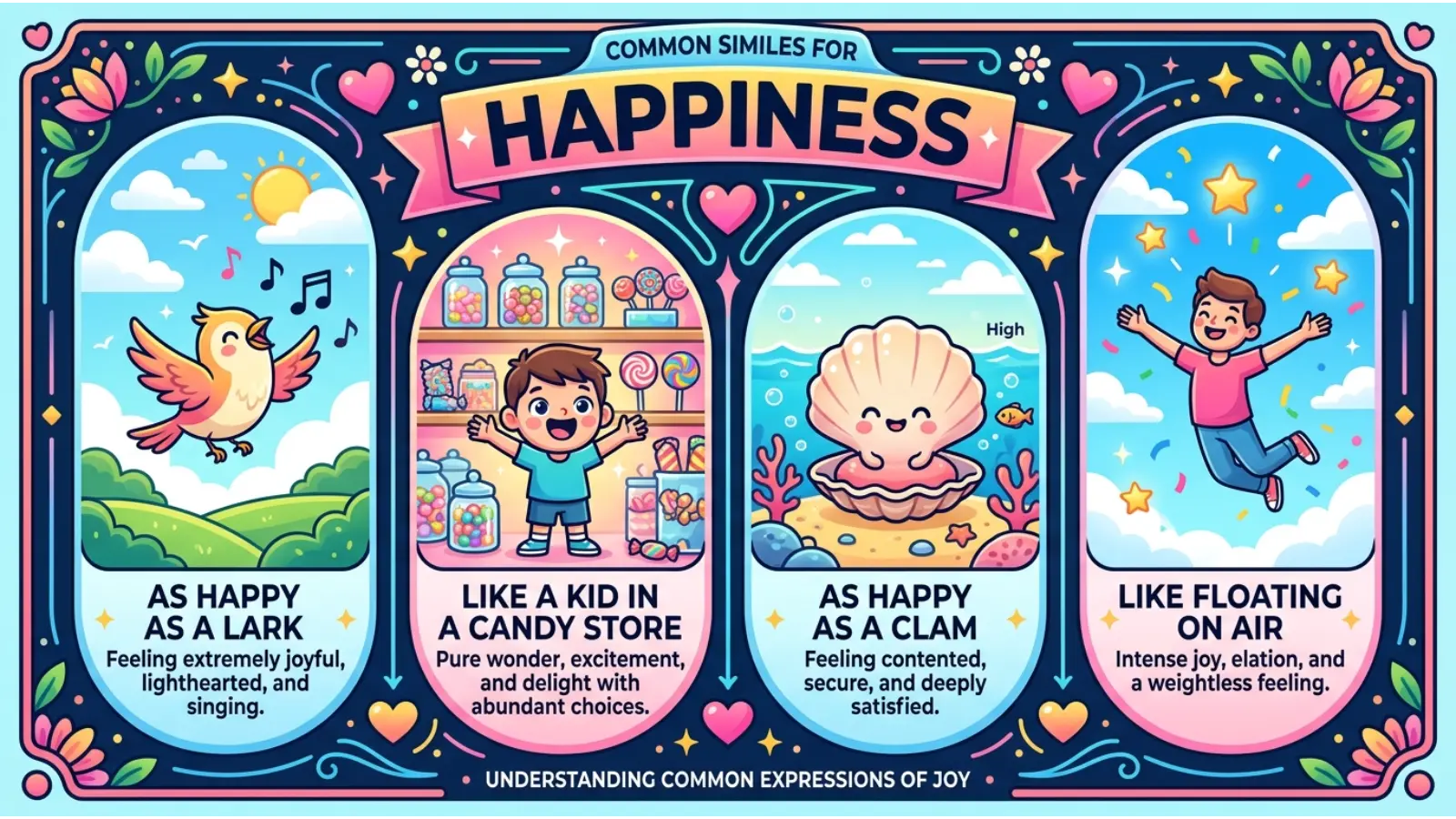
A happiness simile compares the feeling of happiness to something that expresses its energy, warmth, lightness, excitement, or peacefulness.
For example:
Her happiness spread through the room like sunlight slipping beneath a closed door.
The comparison works because sunlight does not literally represent happiness. Instead, it creates an image of something warm and uplifting gradually reaching a place that was previously dark.
Why Do Similes Make Happiness Easier to Describe?
“Happiness Similes filled her heart” tells readers what happened, but it does not give them much to imagine.
Compare it with:
Happiness fluttered inside her like a small bird discovering an open window.
The second sentence gives the emotion movement and a visual image. Readers can almost experience the feeling rather than simply being told about it.
Strong emotional similes usually connect an abstract feeling to something concrete:
- Light can suggest hope or delight.
- Warmth can suggest comfort.
- Movement can suggest excitement.
- Music can suggest emotional harmony.
- Nature can suggest peaceful joy.
- Color can suggest energy or celebration.
The key is choosing an image that matches the kind of happiness you mean.
30 Original Happiness Similes for Creative Writing
1. Her Happiness Was Like Sunlight Finding an Open Window
This comparison presents happiness as gentle, warm, and gradually spreading.
Example:
Her happiness was like sunlight finding an open window after a long gray morning.
Writing purpose: Use it for quiet relief, renewed hope, or peaceful joy.
Tip: This works especially well when happiness arrives after difficulty.
2. His Smile Sparkled Like Coins at the Bottom of a Clear Stream
The image suggests brightness without making the happiness feel exaggerated.
Example:
His smile sparkled like coins at the bottom of a clear stream.
The comparison creates a feeling of discovery and natural brightness.
Best context: Stories, character descriptions, and reflective essay
3. Her Joy Rose Like Bread Lifting Beneath a Warm Kitchen Towel
This unusual comparison makes happiness feel comforting and alive.
Example:
Her joy rose like bread lifting beneath a warm kitchen towel.
It is especially effective when happiness grows slowly rather than exploding suddenly.
Writing tip: Everyday objects can create memorable imagery when their physical qualities match an emotion.
4. The Children Were Happy Like Sparrows Discovering a Freshly Filled Birdbath
This comparison suggests energetic, spontaneous happiness.
Example:
The children scattered across the yard like sparrows discovering a freshly filled birdbath.
Instead of simply saying they were excited, the image shows their movement.
Best context: Childhood memories, family scenes, and playful stories.
5. Her Laughter Was Like Rain Tapping Brightly Against a Summer Window
The sound of rain gives the laughter a rhythm.
Example:
Her laughter was like rain tapping brightly against a summer window.
This works because both sounds can feel lively and contagious.
Writing tip: Sound-based similes are useful when you want readers to hear a scene.
6. His Happiness Glowed Like a Porch Light Welcoming Someone Home
This comparison connects happiness with warmth and belonging.
Example:
His happiness glowed like a porch light welcoming someone home.
Emotional effect: Comfort, acceptance, reunion, and affection.
It fits scenes involving family, friendship, or returning to a familiar place.
7. Her Good News Burst Through the Room Like a Kite Catching a Sudden Breeze
The comparison gives happiness speed and upward movement.
Example:
Her good news burst through the room like a kite catching a sudden breeze.
Best context: Celebrations and moments of unexpected success.
8. His Mood Lifted Like a Curtain Revealing a Bright Morning
Here, happiness represents a change from heaviness to possibility.
Example:
His mood lifted like a curtain revealing a bright morning.
This is useful when a character has been worried, tired, or discouraged.
Writing purpose: Showing emotional transformation.
9. Her Excitement Bubbled Like Lemonade in a Glass Jar
The comparison makes excitement feel active and difficult to contain.
Example:
Her excitement bubbled like lemonade in a glass jar.
It works particularly well for children, celebrations, surprises, and anticipation.
10. Their Happiness Spread Like Music Through an Empty Hall
The image emphasizes how one person’s joy can affect others.
Example:
Their happiness spread like music through an empty hall.
Why it works: Music travels, fills space, and changes the atmosphere.
Best context: Group celebrations and shared experiences.
11. His Smile Opened Like a Flower After Rain
This comparison suggests happiness that appears naturally after emotional pressure.
Example:
His smile opened like a flower after rain.
It is especially useful when a reserved character finally reveals genuine joy.
12. Her Heart Felt Light Like a Paper Boat Floating on Still Water
This simile focuses on peaceful happiness rather than excitement.
Example:
After hearing the good news, her heart felt light like a paper boat floating on still water.
Emotional effect: Calmness, relief, and freedom from worry.
13. Their Celebration Shimmered Like Sunlight on a Moving River
The comparison gives the scene energy without relying on exaggerated language.
Example:
Their celebration shimmered like sunlight on a moving river.
Writing tip: Dynamic natural images are useful for scenes with movement, conversation, and changing emotions.
14. Her Happiness Hummed Like a Refrigerator in a Quiet Kitchen
Not every happiness simile needs to be grand.
This comparison creates a quieter, more intimate feeling.
Example:
Her happiness hummed like a refrigerator in a quiet kitchen, steady and impossible to ignore.
Best context: Subtle character moments and realistic fiction.
15. His Excitement Flew Like a Note Released From an Open Notebook
This comparison suggests a sudden release of energy.
Example:
His excitement flew like a note released from an open notebook.
The image can work well when someone finally shares news they have been waiting to tell.
16. Her Joy Was Warm Like a Mug Between Cold Hands
This is a simple sensory comparison.
Example:
Her joy was warm like a mug between cold hands.
Why it works: Readers understand warmth through physical experience, making the emotional description easier to feel.
17. Their Smiles Lit Up the Table Like Candles at a Midnight Picnic
This image turns happiness into a source of light.
Example:
Their smiles lit up the table like candles at a midnight picnic.
Best context: Friendship, family gatherings, celebrations, and nighttime scenes.
18. His Relief Drifted Through Him Like Cool Air After a Summer Storm
This simile captures a softer form of happiness.
Example:
His relief drifted through him like cool air after a summer storm.
It works because the comparison includes both the previous discomfort and the pleasure that follows.
Writing lesson: Sometimes the strongest description of happiness comes from contrasting it with what came before.
19. Her Happiness Skipped Like a Stone Across a Calm Pond
The verb skipped makes the emotion feel playful.
Example:
Her happiness skipped like a stone across a calm pond.
This is a good choice for lighthearted scenes.
20. Their Laughter Rolled Like Marbles Across a Wooden Floor
This comparison focuses on sound and movement.
Example:
Their laughter rolled like marbles across a wooden floor.
It can create a playful, slightly chaotic atmosphere.
Best context: Friends joking together or children playing.
21. His Good Mood Was Like Finding an Extra Page in a Book You Thought You Had Finished
This comparison connects happiness with pleasant surprise.
Example:
His good mood was like finding an extra page in a book you thought you had finished.
It works particularly well in reflective or literary writing.
22. Her Joy Flickered Like Fairy Lights in a Window at Dusk
The image creates delicate, intimate happiness.
Example:
Her joy flickered like fairy lights in a window at dusk.
Emotional effect: Warmth, wonder, and quiet celebration.
23. Happiness Moved Through the Crowd Like a Wave at a Concert
This simile shows collective excitement.
Example:
Happiness moved through the crowd like a wave at a concert.
Writing purpose: Use it when describing a group responding emotionally to the same event.
24. His Face Brightened Like a Room When Someone Pulls Back the Curtains
The physical change mirrors an emotional one.
Example:
His face brightened like a room when someone pulls back the curtains.
This is useful for character writing because it shows happiness through visible behavior.
25. Her Excitement Crackled Like Toast Beneath a Hot Broiler
This comparison gives happiness an energetic, almost noisy quality.
Example:
Her excitement crackled like toast beneath a hot broiler.
Best context: Nervous excitement, anticipation, or humorous writing.
26. Their Friendship Felt Happy Like a Song Everyone Knew the Words To
The comparison links happiness with belonging.
Example:
Their friendship felt happy like a song everyone knew the words to.
Why it works: Familiar music can suggest connection and effortless participation.
27. His Spirit Rose Like a Balloon Released Into a Clear Sky
The upward movement suggests freedom and optimism.
Example:
After hearing the results, his spirit rose like a balloon released into a clear sky.
Best context: Achievement, encouragement, and overcoming disappointment.
28. Her Smile Spread Like Ink Blossoming in Water
This creates a visual image of happiness gradually expanding.
Example:
Her smile spread like ink blossoming in water.
It can work particularly well in poetic prose.
Writing tip: When using an unusual image, make sure the comparison still shares a recognizable quality with the emotion.
29. His Happiness Was Quiet Like Snow Settling on a Sleeping Town
Not all happiness is loud.
Example:
His happiness was quiet like snow settling on a sleeping town.
This is ideal for peaceful endings, private satisfaction, or moments of contentment.
30. The Room Felt Bright Like a Story Everyone Wanted to Hear
This comparison turns atmosphere into something emotionally engaging.
Example:
The room felt bright like a story everyone wanted to hear.
Best context: Social gatherings, reunions, celebrations, and scenes where people feel connected.
How to Choose the Right Happiness Simile
Before choosing a comparison, ask what kind of happiness your character is experiencing.
Quiet happiness might resemble:
A lamp glowing in a distant window.
Excited happiness might resemble:
A kite suddenly catching the wind.
Relieved happiness might resemble:
Cool air after a storm.
Childlike happiness might resemble:
Birds discovering an unexpected fountain.
Shared happiness might resemble:
Music filling a crowded room.
This approach is more effective than searching for a random object and adding like to the sentence.
The emotional quality should determine the image.
How to Make Happiness Similes More Vivid
A strong simile usually does more than identify a visual similarity. It can also activate the senses.
Instead of:
She was happy like a flower.
Try identifying a specific quality:
Her happiness opened like a flower turning toward the first warm day of spring.
The second version gives the reader movement, temperature, season, and direction.
You can strengthen a simile by asking:
- What does happiness feel like physically?
- What does it sound like?
- Does it move quickly or slowly?
- Is it bright or muted?
- Does it belong indoors or outdoors?
- Is it private or contagious?
- Does it arrive suddenly or build gradually?
The answers can lead you toward better comparisons.
Avoiding Clichés in Happiness Writing
Some comparisons become weak because readers have encountered them too many times.
Phrases involving sunshine, clouds, butterflies, or overflowing hearts can still work, but they may feel predictable when used without a fresh angle.
The problem is not necessarily the image itself. The problem is lack of specificity.
Compare:
Her happiness was like sunshine.
with:
Her happiness slipped across the breakfast table like a narrow stripe of morning sun.
The second version gives the familiar image a particular setting and movement.
A useful rule
Do not ask, “What usually represents happiness?”
Ask:
“What physical experience behaves like this particular happiness?”
That question usually produces more original imagery.
Simile vs. Metaphor: What’s the Difference?
A simile makes an explicit comparison:
His happiness was like a kite in a strong wind.
A metaphor makes the comparison directly:
His happiness was a kite in a strong wind.
Both create imagery, but the grammatical structure is different.
Similes can be especially useful when you want to explain an unfamiliar emotion through a familiar experience. Metaphors can feel more immediate and compressed.
Using Imagery to Show Happiness Instead of Telling It
Strong creative writing often combines a simile with physical action.
Instead of:
Maya was extremely happy.
Try:
Maya read the message twice, then smiled like a window suddenly catching morning light.
The simile is stronger because the sentence first gives the reader an observable action.
A useful pattern is:
Action + physical detail + comparison
For example:
He lowered the phone, stared at the ceiling, and grinned like someone who had just discovered a secret door.
The emotion becomes part of a scene rather than a label.
How Professional Writers Build Better Emotional Comparisons
Experienced writers usually do not begin with the phrase “I need a simile.”
They begin with the emotional experience.
Imagine a character receiving an acceptance letter. The happiness might involve:
- tension disappearing,
- physical energy increasing,
- laughter becoming uncontrollable,
- the future suddenly feeling possible,
- a sense of weight being removed.
Any of those experiences can generate an image.
For example, if the important idea is release, you might compare happiness with a knot coming undone.
If the important idea is energy, you might use something bouncing, rising, or moving quickly.
If the important idea is peace, you might use still water, quiet snowfall, or a softly lit room.
That process produces more precise writing than simply collecting attractive comparisons.
Create Your Own Happiness Similes
Try this five-step exercise.
Step 1: Name the exact emotion
Do not stop at happy.
Choose:
- relieved
- delighted
- peaceful
- excited
- grateful
- playful
- hopeful
- proud
- content
Step 2: Identify the emotion’s physical behavior
Ask what the feeling does.
Does it:
- rise?
- glow?
- spread?
- bounce?
- warm?
- hum?
- loosen?
- rush?
Step 3: Find a concrete object or experience
Choose something readers can easily picture.
For example:
Emotion: relief
Behavior: cools and loosens
Image: air after a storm
Step 4: Add a specific detail
Instead of:
Her relief was like rain.
Try:
Her relief was like cool rain arriving after a day of dry heat.
Step 5: Test the comparison
Ask whether the two things genuinely share a quality.
If the connection is difficult to explain, the simile may be forced.
A Quick Creative Exercise
Finish these sentences with your own comparisons:
His happiness moved like ________.
Her smile was as bright as ________.
Their laughter sounded like ________.
After the good news, my worry disappeared like ________.
The room became cheerful like ________.
Then revise each answer by adding one specific detail.
Common Mistakes When Writing Happiness Similes
Using the Same Familiar Images
If every happy character smiles like sunshine, the descriptions begin to sound interchangeable.
Look for images connected to the character’s world instead.
A baker might compare happiness to dough rising. A musician might compare it to a perfectly timed chord. A gardener might compare it to a new shoot appearing after rain.
Personal context creates originality.
Mixing Two Different Images
Avoid sentences such as:
Her happiness flew like a river and flowed like a bird.
The images compete with each other.
Choose one central comparison and develop it clearly.
Forcing a Simile Into Every Sentence
Similes are powerful partly because they stand out.
If every line contains a comparison, none of them feels special.
Use a simile when it adds an image that ordinary description cannot provide.
Making the Comparison Too Complicated
A creative comparison does not need to become confusing.
If readers must spend several seconds figuring out what two things have in common, the image may need revision.
Aim for fresh but understandable.
Confusing Similes With Idioms
An idiom has a conventional meaning that may differ from its literal words.
A simile directly compares two things, usually with like or as.
Knowing the difference helps you choose the right literary device for your purpose.
When to Use Other Literary Devices
Similes are only one way to express happiness.
Metaphor
Her happiness was a lantern in the dark.
Use metaphor when you want a direct, confident comparison.
Personification
Happiness knocked softly at his door.
Personification gives an abstract emotion human behavior.
Hyperbole
He was happier than he had been in a thousand years.
Hyperbole deliberately exaggerates for effect. It is best used when exaggeration suits the speaker’s voice.
Imagery
Warm light spilled across the table while everyone talked over one another.
Imagery can communicate happiness without explicitly naming the emotion.
Symbolism
A recurring object, such as a window, bird, or light, can gradually become associated with hope or happiness throughout a story.
The strongest writing often combines these techniques rather than depending on one device repeatedly.
Frequently Asked Questions About Happiness Similes
What is a good simile for happiness?
A good happiness simile connects the emotion with a concrete image that shares its specific quality. For example, happiness might be compared with sunlight entering a dark room, music filling a space, or a kite rising in fresh wind.
What are some similes for being happy?
Examples include “her happiness was like sunlight finding an open window” and “his spirit rose like a balloon released into a clear sky.” The best choice depends on whether the happiness is peaceful, energetic, surprising, or shared.
How do you describe happiness creatively?
Focus on what the emotion does rather than simply naming it. Describe its movement, sound, temperature, color, or physical effect, then connect that quality to a concrete image.
What is a simile for extreme happiness?
For intense happiness, choose an image involving strong movement or energy, such as something bursting, rising, racing, or filling a space. The comparison should match the character’s emotional intensity.
What is a simile for a happy person?
You can compare a happy person’s expression or behavior with something lively or bright. For example, “his face brightened like a room when someone pulls back the curtains.”
How can I make my happiness similes less cliché?
Avoid choosing the first familiar symbol that comes to mind. Instead, think about the character, setting, and exact type of happiness. Specific personal experiences often produce more original comparisons.
Can similes be used in everyday conversation?
Yes. People naturally use comparisons to make feelings easier to explain. A person might say that they feel “like a weight has been lifted” or describe someone’s smile using a familiar visual image.
Conclusion
The best happiness similes do not merely decorate a sentence. They help readers experience an emotion through something they can see, hear, touch, or imagine. When creating your own, start with the exact kind of happiness you want to express. Then identify how that feeling behaves and find a concrete experience that behaves in a similar way. A quiet joy needs a different image from wild excitement. Relief needs a different comparison from celebration. Personal context can make an ordinary image feel completely new. Experiment with unexpected objects, sensory details, movement, and setting. When the comparison feels precise rather than forced, your simile can turn a simple statement of happiness into an image readers remember.
I am Helena Frost, a writer captivated by the beauty of language and the art of comparison. Through my words, I explore the world by turning ordinary moments into vivid similes and reflections. I enjoy crafting phrases that spark imagination, evoke emotion, and linger in the mind. My writing celebrates the subtle connections between people, nature, and the stories we live. For me, every sentence is an opportunity to reveal the extraordinary in the everyday.