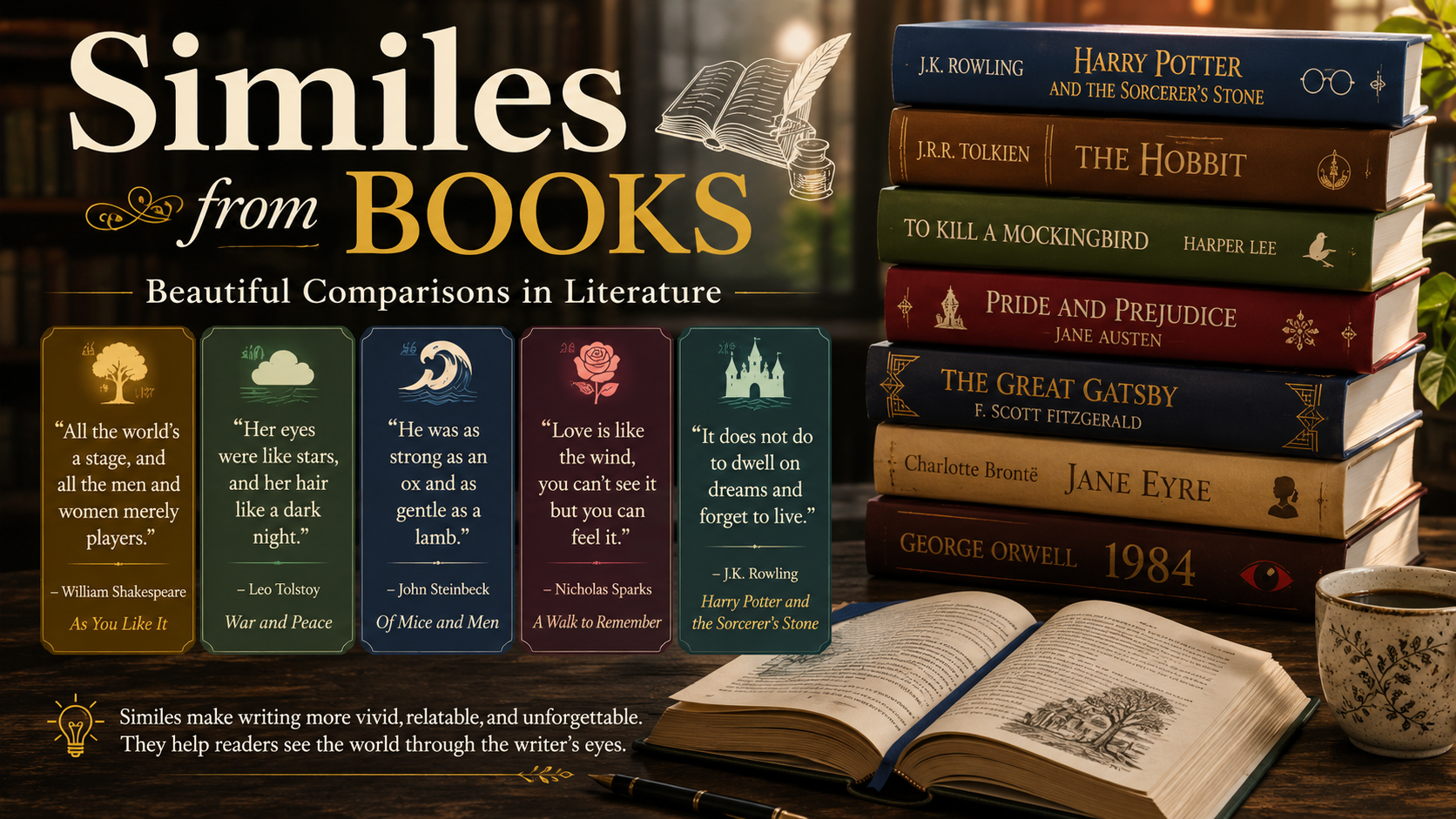
A Similes from Books does more than tell you what happens. It helps you see, hear, feel, and imagine the story. One of the simplest tools writers use to create that experience is the simile.
A Similes from Books compares two different things using words such as like or as. Instead of saying, “The hallway was quiet,” a writer might describe it as being as quiet as an abandoned theater after the final show. The comparison gives the reader something concrete to imagine.
Similes from books can be especially useful because storytelling depends on vivid description. Authors use comparisons to reveal personality, build atmosphere, intensify emotions, and make ordinary moments memorable.
This article explores original examples inspired by the kind of imaginative language found in literature. These are not quotations from published books. They are fresh examples designed to show you how literary similes work and how you can create your own.
Quick Answer: What Are Similes from Books?
Similes from books are comparisons used in literary writing to make characters, settings, emotions, actions, or ideas easier to visualize. They usually connect two unlike things with words such as like or as. For example: “The old library smelled like rain trapped inside a wooden box.”
Why Writers Use Similes in Books
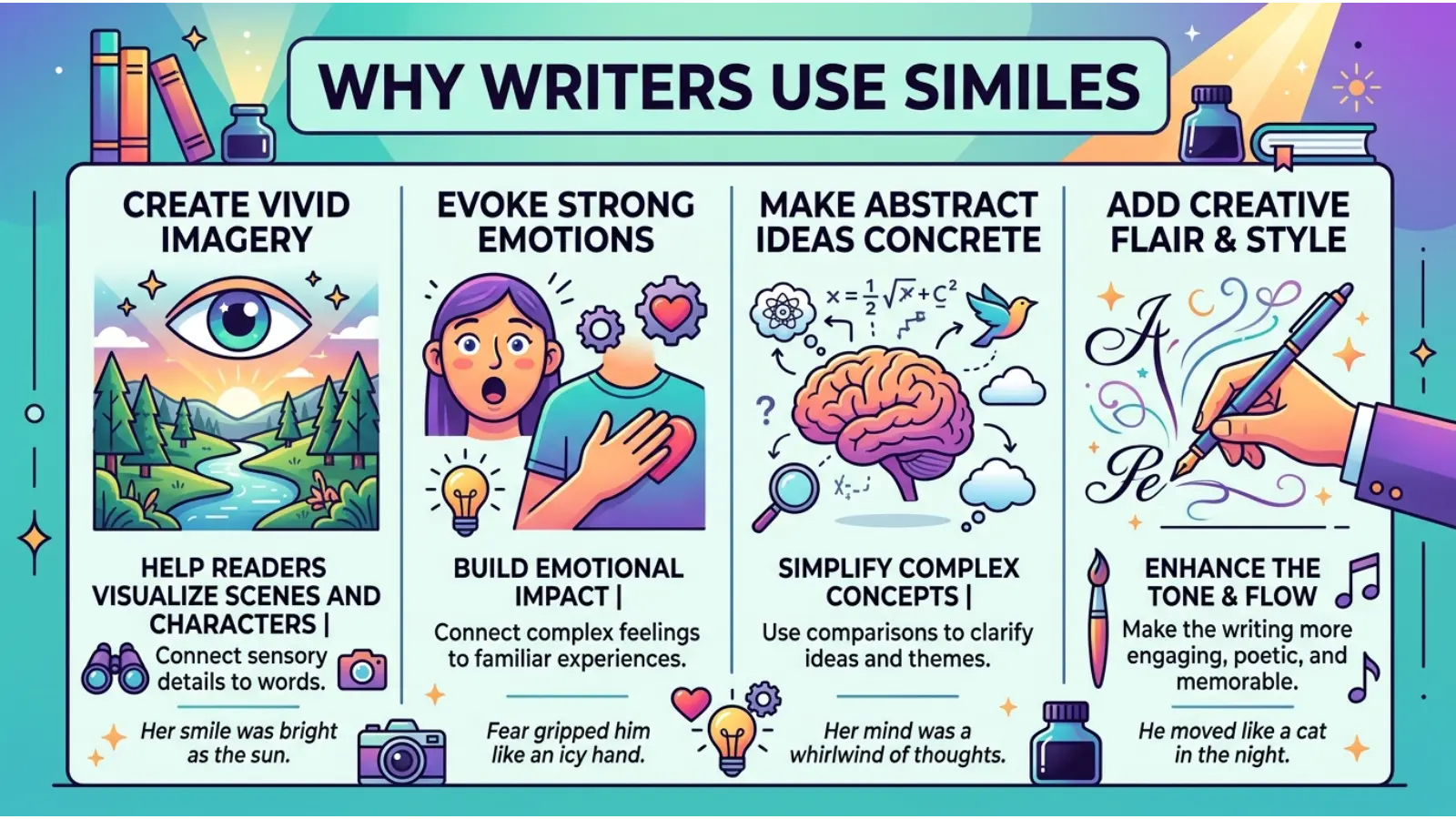
A Similes from Books plain description gives information. A strong simile gives information plus an image.
Consider these two sentences:
The character was nervous.
Now compare it with:
His thoughts fluttered like loose pages caught in a sudden wind.
The second sentence does more than identify nervousness. It suggests movement, uncertainty, and a lack of control.
That is the real strength of a literary simile: the comparison carries additional meaning.
Writers can use similes to:
- Make settings easier to visualize
- Show emotions without naming them directly
- Reveal a character’s personality
- Establish mood
- Make action more energetic
- Create memorable imagery
- Slow down an important moment
- Give ordinary objects unusual significance
The best similes do not decorate a sentence merely because the writer wants it to sound poetic. They have a job to perform.
30 Original Similes Inspired by Literary Writing
The examples below are original rather than quotations from existing books. Each demonstrates a different way a writer can use comparison in fiction, poetry, or descriptive prose.
1. Her Voice Was Like a Candle in a Dark Room
Meaning: Her voice provided comfort, warmth, or hope in an uncertain situation.
Example:
Her voice was like a candle in a dark room, small but impossible to ignore.
Writing purpose: This works well when introducing a reassuring character or creating emotional contrast.
Writing tip: Notice that the comparison does not simply say the voice was “nice.” It gives the reader a source of light to imagine.
2. The Old House Groaned Like a Ship Lost at Sea
Meaning: The house made deep, unsettling sounds.
Example:
During the storm, the old house groaned like a ship lost at sea.
This simile is useful for atmosphere. The house becomes connected with danger, isolation, and uncertainty.
Best context: Mystery, fantasy, horror, or suspense writing.
3. His Smile Appeared Like Sunrise Through Heavy Clouds
Meaning: His smile arrived suddenly after sadness or difficulty.
Example:
His smile appeared like sunrise through heavy clouds.
The comparison creates a sense of emotional relief without directly explaining the character’s feelings.
4. The Library Was as Still as a Sleeping Forest
Meaning: The library was extremely quiet.
Example:
The library was as still as a sleeping forest, with only the turning of pages disturbing the silence.
Why it works: The reader already understands the quietness of a forest at rest, so the comparison creates atmosphere quickly.
5. Her Thoughts Spun Like Leaves Inside a Whirlwind
Meaning: She was confused, overwhelmed, or unable to organize her thoughts.
Example:
Questions spun through her mind like leaves inside a whirlwind.
This is particularly useful for internal narration.
6. The Moon Hung Like a Silver Button Above the Roofs
Meaning: The moon looked small, bright, and round against the night sky.
Writing purpose: This creates a simple visual image without relying on an ordinary description.
Best context: Children’s stories, fantasy, poetry, and gentle nighttime scenes.
7. His Boots Hit the Floor Like Drumbeats
Meaning: His footsteps were loud, rhythmic, and noticeable.
Example:
His boots hit the wooden floor like drumbeats announcing the arrival of a parade.
The comparison adds sound and movement to the scene.
8. The Secret Sat Between Them Like an Unopened Letter
Meaning: Both characters knew about something important but were unwilling to discuss it.
Why it works: An unopened letter suggests information, anticipation, and silence all at once.
Best context: Drama, romance, mystery, and character-driven fiction.
9. The River Curled Through the Valley Like a Blue Thread
Meaning: The river was narrow and winding as it moved through the landscape.
Example:
From the hilltop, the river curled through the valley like a blue thread pulled across green cloth.
Writing lesson: Adding a second image—green cloth—can make the original comparison more visually complete.
10. His Anger Rose Like Smoke From a Hidden Fire
Meaning: His anger gradually became noticeable even though its source was initially concealed.
Writing purpose: This simile helps show an emotion developing rather than simply announcing, “He became angry.”
11. The Snow Covered the Town Like a Blank Page
Meaning: Fresh snow made the familiar landscape look clean, empty, or new.
Example:
By morning, snow covered the town like a blank page waiting for its first sentence.
This can also symbolize new beginnings.
12. Her Memory Was Like an Old Photograph With Faded Edges
Meaning: She remembered something imperfectly or from a distant time.
Why it works: The image suggests that the memory still exists but has lost some of its original clarity.
Best context: Reflective fiction, memoir-style narration, and emotional scenes.
13. The Crowd Moved Like a River Around the Station
Meaning: A large group of people flowed continuously through the space.
Example:
The crowd moved like a river around the station, separating and joining again at every doorway.
This is useful for describing large-scale movement.
14. His Promise Was as Fragile as Frost on a Window
Meaning: His promise seemed beautiful but easily broken.
Writing purpose: The comparison adds vulnerability and impermanence.
A useful lesson here is that a simile can communicate judgment. The writer is not merely describing the promise; the writer is telling us how the narrator perceives it.
15. The Clock Ticked Like a Tiny Hammer
Meaning: The clock’s sound felt sharp, repetitive, and distracting.
Example:
The clock ticked like a tiny hammer against the silence.
This works particularly well when a character is waiting anxiously.
16. The Garden Woke Like a Child After a Long Sleep
Meaning: The garden gradually became lively and colorful.
Example:
After the first warm rain, the garden woke like a child after a long sleep.
Related technique: This example also approaches personification, because the garden is given a human-like action.
17. The Road Stretched Ahead Like a Question Without an Answer
Meaning: The road represents uncertainty about the future.
Why it works: The comparison transforms a physical road into an emotional symbol.
Best context: Journeys, coming-of-age stories, adventure fiction, and reflective scenes.
18. Her Laughter Sparkled Like Coins at the Bottom of a Fountain
Meaning: Her laughter was bright, lively, and pleasing.
Writing tip: Unusual comparisons can be memorable when the two images share a genuine quality—in this case, brightness and movement.
19. The Classroom Buzzed Like a Beehive Before the Bell
Meaning: Students were talking excitedly and creating constant noise.
Best context: School stories, children’s writing, and humorous scenes.
Why it works: The reader can almost hear the scene without the writer needing to describe every conversation.
20. Fear Crept Through Him Like Cold Water
Meaning: Fear gradually spread through his body and thoughts.
Example:
Fear crept through him like cold water slipping beneath a door.
The added detail makes the emotion feel slow and unavoidable.
21. The Stars Looked Like Pinholes in a Giant Curtain
Meaning: The stars appeared as tiny points of light across the night sky.
Writing purpose: This gives the sky a physical dimension and creates a sense of wonder.
22. Her Words Fell Like Pebbles Into Still Water
Meaning: Her words disturbed a previously peaceful situation.
Example:
Her accusation fell like a pebble into still water, and the silence afterward seemed to spread outward.
Writing lesson: A simile becomes more powerful when the following sentence develops the image.
23. The Castle Rose Like a Mountain of Stone
Meaning: The castle appeared enormous, solid, and imposing.
Best context: Historical fiction, fantasy, adventure, and epic storytelling.
24. His Hope Flickered Like a Match in the Wind
Meaning: His hope was weak but still alive.
Writing purpose: This comparison creates emotional tension because the reader senses that the hope could disappear.
25. The Empty Street Was Like a Stage After the Audience Leaves
Meaning: The street felt strangely deserted after being busy.
Why it works: The comparison gives the emptiness a sense of aftermath.
26. The Letter Trembled in Her Hand Like a Bird Trying to Escape
Meaning: Her hand was shaking while she held the letter.
Writing purpose: This is useful when physical movement reflects emotional tension.
27. His Memory Returned Like a Song Heard Through a Wall
Meaning: He remembered something faintly and incompletely.
Best context: Reflective or mysterious storytelling.
The comparison suggests that the memory is recognizable but partly obscured.
28. The Wind Raced Through the Trees Like Children Late for School
Meaning: The wind moved quickly and noisily.
Why it works: The human comparison gives natural movement a playful quality.
29. Silence Spread Between Them Like Snow Across a Field
Meaning: The silence gradually became larger and harder to break.
Writing tip: This is stronger than simply writing “They were silent” because it gives the silence a visible shape.
30. The First Page Felt Like a Door Opening Into Another World
Meaning: Beginning a book or story can feel like entering a new place.
Writing purpose: This works especially well in reflective writing about reading, imagination, and storytelling.
How Great Literary Similes Make Readers See More
A strong simile usually contains a shared quality between the two things being compared.
For example:
The hallway was like a tunnel.
This gives the reader a general image.
But:
The hallway narrowed like a tunnel beneath the earth.
Now the comparison suggests confinement.
An even more developed version might be:
The hallway narrowed like a tunnel beneath the earth, swallowing the light behind her.
The simile now supports the scene’s mood.
This demonstrates an important writing principle: the best comparison is not necessarily the most unusual one. It is the one that contributes the most meaning.
How to Create Your Own Similes From a Book-Like Scene
When writing fiction, start with the thing you actually want to describe.
It might be:
- A character’s expression
- A storm
- A bedroom
- A city street
- A memory
- An argument
- A moment of happiness
- A character walking into an unfamiliar place
Then ask three questions.
1. What quality stands out?
Is it:
- Bright?
- Heavy?
- Restless?
- Fragile?
- Loud?
- Lonely?
- Fast?
- Mysterious?
2. What else has that quality?
If a character is nervous, you might think of:
- A trapped bird
- A vibrating phone
- A storm approaching
- A cup shaking on a table
- A door rattling in the wind
3. Which comparison adds the right emotion?
A nervous character compared to a trapped bird feels vulnerable.
The same character compared to a storm feels powerful and chaotic.
Both comparisons can work, but they tell different stories.
How to Make a Simile More Vivid
A weak simile often stops too early.
Compare:
The rain was like a curtain.
with:
Rain fell like a gray curtain between the house and the distant hills.
The second version gives the reader color, location, distance, and atmosphere.
You do not always need a long comparison, though. A short simile can be more powerful when the surrounding sentence already provides detail.
The goal is not to make every sentence poetic. The goal is to make the important image precise.
Avoid Cliché Similes
Some comparisons are so familiar that readers barely notice them.
Common examples include phrases such as:
- As busy as a bee
- As cold as ice
- As white as snow
- Like a lion
- Like a fish out of water
These are not grammatically wrong. They are simply familiar.
For creative writing, try asking:
What would this character notice that another character might miss?
A detective might describe rain differently from a child.
A sailor might describe a storm differently from someone living inland.
A musician might describe a crowd through sound.
A gardener might describe a city through plants.
The character’s perspective can make an ordinary comparison feel fresh.
Similes Should Match the Character’s Voice
Imagine a medieval character suddenly using a highly technical modern comparison. The simile may be clever, but it could feel unnatural.
A child’s comparison might be simple:
The clouds looked like giant pillows.
A scientist might think differently:
The clouds spread across the sky like layers of unfinished insulation.
Neither is automatically better. The important question is:
Would this character realistically make this comparison?
Good literary writing connects imagery with point of view.
Simile vs. Metaphor: What’s the Difference?
A simile makes a comparison using words such as like or as.
The city glittered like a field of stars.
A metaphor makes the comparison more directly.
The city was a field of stars.
Both create imagery, but they produce slightly different effects.
Similes can feel more exploratory because they invite readers to connect two images. Metaphors can feel more direct and emphatic.
Simile, Imagery, and Personification
A simile is one tool inside the larger craft of imagery.
Imagery uses descriptive language to create sensory experiences.
The wet pavement reflected the streetlights.
A simile can strengthen that image:
The wet pavement reflected the streetlights like broken pieces of glass.
Personification gives human qualities to nonhuman things:
The old house complained whenever the wind blew.
A writer can combine techniques:
The old house complained like an exhausted traveler returning from a long journey.
The house is personified, while like an exhausted traveler creates a simile.
Five Common Simile Mistakes Writers Make
1. Using a comparison that adds nothing
She ran quickly like a fast runner.
The comparison simply repeats the original idea.
Instead, choose an image that reveals something:
She ran like someone chasing the last train home.
Now urgency enters the scene.
2. Mixing unrelated images
Avoid combining images that fight each other.
A sentence that begins with a comparison to fire and suddenly shifts to ocean imagery can confuse the reader unless the contrast is intentional.
Choose one dominant image and develop it carefully.
3. Choosing cleverness over clarity
A strange comparison may attract attention, but attention is not always the goal.
Ask yourself:
Does this comparison help the reader understand something?
If not, remove it.
4. Adding too many similes
A paragraph packed with comparisons can become exhausting.
If every sentence says something is like something else, none of the images receives enough attention.
Use similes where they matter most.
5. Explaining the simile too much
Sometimes writers create a strong image and then immediately explain it.
For example:
Her smile was like sunlight through clouds, meaning that she looked happy after being sad.
The second part may be unnecessary. If the image already communicates the idea, trust the reader.
A Simple Exercise for Creating Better Similes
Choose one ordinary object in your room.
It could be:
- A lamp
- A chair
- A window
- A notebook
- A cup
- A backpack
Write five comparisons for it.
For a window, you might begin with:
The window was like…
Do not stop at the first idea.
Then change the emotion of the scene.
Describe the same window as:
- Peaceful
- Threatening
- Lonely
- Hopeful
- Mysterious
You will quickly discover that the best simile depends on the mood you want to create.
Another Exercise: Turn Plain Sentences Into Literary Descriptions
Start with:
The boy entered the room.
Now ask what the scene should feel like.
For suspense:
The boy entered the room like someone stepping into a house that had forgotten how to breathe.
confidence:
The boy entered the room like an actor walking onto a stage he had rehearsed for years.
For uncertainty:
The boy entered the room like a traveler reading an unfamiliar map.
The event has not changed. The reader’s experience has.
Frequently Asked Questions About Similes From Books
What is a good example of a simile in literature?
A good literary simile compares two things that share a meaningful quality and helps readers visualize a character, setting, emotion, or action. Original examples such as “The road stretched ahead like a question without an answer” demonstrate how a physical image can also suggest an emotional idea.
Why do authors use similes in books?
Authors use similes to make descriptions vivid, communicate emotions indirectly, establish atmosphere, reveal character, and help readers visualize scenes.
What is the difference between a simile and a metaphor in a book?
A simile usually makes a comparison with like or as, while a metaphor presents one thing as another. For example, “The moon was like a lantern” is a simile, while “The moon was a lantern” is a metaphor.
Are similes only used in poetry?
No. Similes appear in novels, short stories, memoirs, speeches, essays, children’s books, journalism, and everyday conversation. Fiction writers often use them to make descriptions and emotions more memorable.
How can I make my similes less cliché?
Start with the specific character, setting, and emotion. Instead of choosing the first comparison that comes to mind, generate several possibilities and select the one that reveals something unique about the scene.
Can a simile be more than one sentence?
Yes. A comparison can begin in one sentence and be developed in the next. This can be especially effective when the writer wants an image to influence the mood of an entire passage.
How many similes should I use in a story?
There is no fixed number. Use them when they strengthen the writing. A single precise simile can be more effective than several comparisons that compete for the reader’s attention.
Conclusion
Similes from books are valuable not because they make writing sound complicated, but because they help writers show more with fewer words. The strongest comparisons connect an unfamiliar feeling, object, or experience with something the reader can immediately picture. They can turn silence into snow, uncertainty into an unanswered question, memory into a faded photograph, or hope into a small light surviving the darkness. When creating your own similes, look beyond the obvious comparison. Think about your character’s perspective, the emotion of the scene, and the image you want readers to carry away. Then write several possibilities. Your first simile may be ordinary. Your fourth might be interesting. You tenth might be the one that belongs in the story. That process—observe, compare, revise, and choose—is how a simple comparison becomes memorable writing.
I am Helena Frost, a writer captivated by the beauty of language and the art of comparison. Through my words, I explore the world by turning ordinary moments into vivid similes and reflections. I enjoy crafting phrases that spark imagination, evoke emotion, and linger in the mind. My writing celebrates the subtle connections between people, nature, and the stories we live. For me, every sentence is an opportunity to reveal the extraordinary in the everyday.