Epic similes are more than simple comparisons. They slow a moment down, paint a vivid picture, and make readers feel as though they are standing inside the story. Unlike short everyday similes, epic similes expand an image with rich detail, helping emotions, actions, and settings come alive. Writers often use epic similes in fantasy, historical fiction, mythology, adventure novels, speeches, and poetry. They can also strengthen modern storytelling by making ordinary scenes feel larger than life.
In this guide, you’ll learn what epic similes are, why they work so well, and how to write your own. You’ll also find 30 original examples, practical writing advice, common mistakes to avoid, and creative exercises to sharpen your skills.
What Is an Epic Simile?
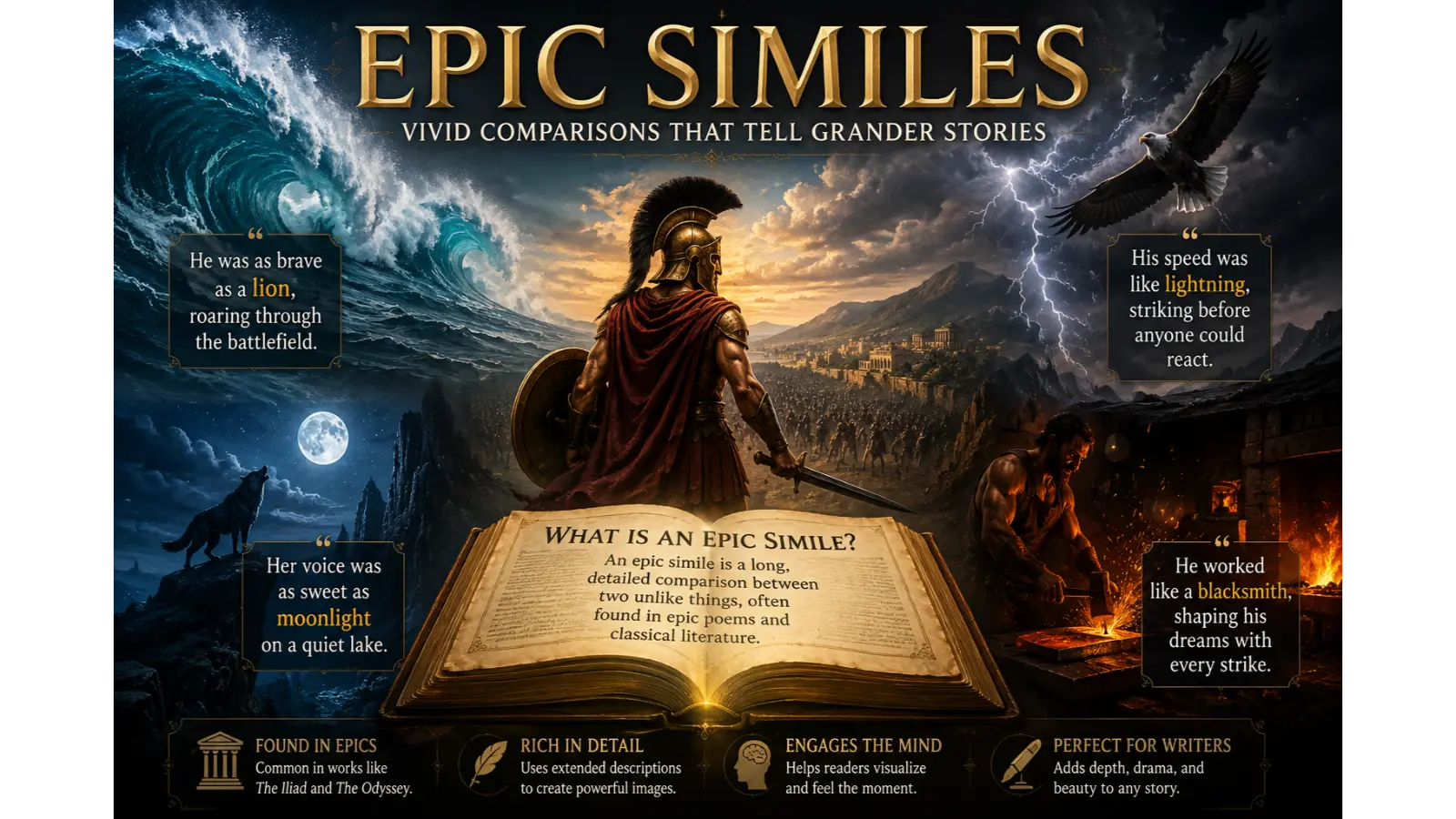
An epic simile is an extended comparison that uses words such as like or as while describing one idea through another in greater detail than a normal simile.
Instead of saying:
The warrior fought like a lion.
An epic simile develops the image further:
The warrior fought like a lion defending the last shade tree on a scorching plain, refusing every challenge until even the strongest rivals stepped away.
The added detail creates atmosphere, emotion, and dramatic impact.
Why Writers Use Epic Similes
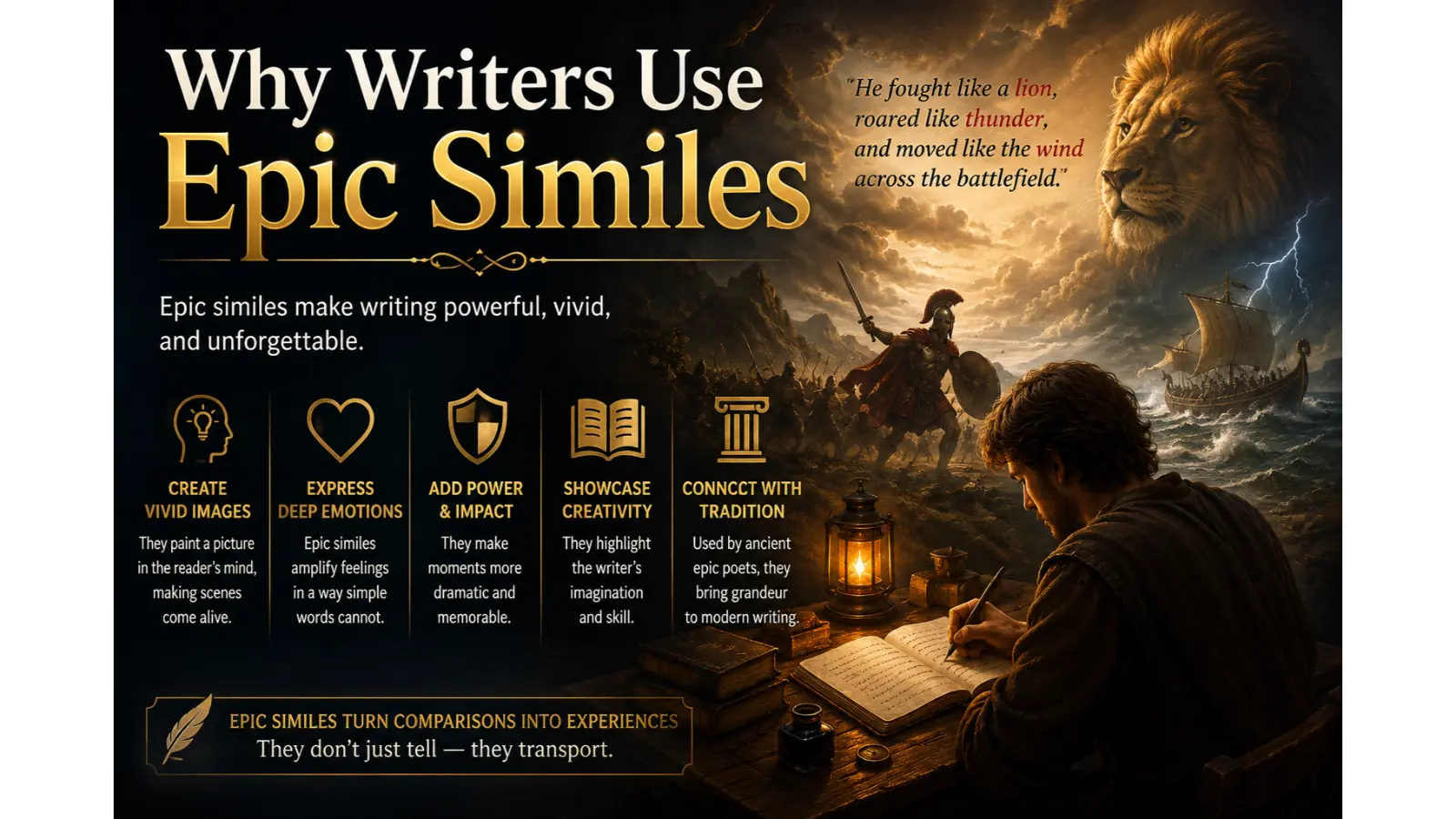
Epic similes do much more than decorate sentences.
They help readers:
- Visualize scenes more clearly.
- Feel stronger emotions.
- Understand characters through vivid imagery.
- Slow important moments for dramatic effect.
- Remember powerful descriptions long after finishing the story.
Great storytelling often depends on memorable images, and epic similes provide exactly that.
Original Epic Similes
1. Like a River Breaking Winter Ice
Simile
Her courage spread like a river breaking through winter ice, unstoppable once the first crack appeared.
Meaning
Bravery begins quietly before becoming impossible to stop.
Examples
- She finally spoke the truth, and her courage spread like a river breaking winter ice.
- Confidence grew through the classroom like water escaping frozen banks.
Best For
Character growth, inspirational fiction, speeches.
Writing Tip
Build the image from small change to unstoppable momentum.
2. As Steady as an Ancient Lighthouse
Meaning
Reliable despite chaos.
Examples
- His advice remained as steady as an ancient lighthouse through every crisis.
- She stood beside her family as steady as an old lighthouse against endless storms.
Emotional Effect
Trust and security.
3. Like Thunder Rolling Across Empty Mountains
Meaning
A powerful voice or announcement that echoes far beyond its source.
Examples
- His words rolled through the hall like thunder across empty mountains.
- The applause echoed like distant thunder over stone cliffs.
Best Context
Epic speeches and dramatic scenes.
4. Like Stars Gathering Before Dawn
Meaning
Hope appearing before difficult times end.
Examples
- Small victories gathered like stars before dawn.
- Their smiles appeared like stars brightening the final darkness.
5. As Fierce as a Forest Fire Chasing the Wind
Meaning
Intense determination that grows stronger.
Examples
- Her ambition burned as fierce as a forest fire chasing the wind.
- The team’s energy became unstoppable.
Writing Tip
Use natural forces to suggest increasing power.
6. Like an Eagle Riding Endless Skies
Meaning
Freedom without limits.
Examples
- His imagination soared like an eagle riding endless skies.
- The music drifted like an eagle above mountain winds.
7. As Patient as Mountains Watching Centuries Pass
Meaning
Extraordinary patience.
Examples
- She waited as patiently as mountains watching centuries pass.
- The old teacher listened without rushing anyone.
8. Like Rain Awakening a Sleeping Valley
Meaning
New hope bringing life.
Examples
- Her encouragement arrived like rain awakening a sleeping valley.
- Fresh ideas revived the project.
9. Like a Banner Dancing Above a Castle
Meaning
Proud confidence.
Examples
- His victory smiled above the crowd like a banner over a castle.
- Her achievements stood proudly before everyone.
10. As Bright as Sunrise Over Snow
Meaning
Pure optimism.
Examples
- His future looked as bright as sunrise over fresh snow.
- The child’s laughter brightened the room instantly.
11. Like Waves Carving Stone
Meaning
Persistence over time.
Examples
- Daily practice shaped her skills like waves carving stone.
- Kindness slowly changed hearts.
12. Like the First Bird Greeting Morning
Meaning
Beginning something with optimism.
Examples
- She entered the new job like the first bird greeting morning.
- The young artist welcomed every challenge.
13. As Calm as the Deep Ocean Below the Storm
Meaning
Peace beneath pressure.
Examples
- The captain stayed calm through every emergency.
- She answered every difficult question confidently.
14. Like Autumn Leaves Carried Across Hills
Meaning
Ideas spreading naturally.
Examples
- Rumors drifted like autumn leaves across hills.
- Inspiration traveled through the team.
15. As Unbreakable as a Cliff Meeting the Sea
Meaning
Strength despite constant pressure.
Examples
- Their friendship remained unbreakable.
- His determination never weakened.
16. Like Dawn Opening Golden Gates
Meaning
A hopeful beginning.
Examples
- Graduation felt like dawn opening golden gates.
- The new chapter brought endless possibilities.
17. Like Wolves Singing to the Moon
Meaning
Powerful unity.
Examples
- The choir rose together like wolves singing to the moon.
- Fans celebrated in one unforgettable voice.
18. As Endless as the Horizon
Meaning
Boundless opportunity.
Examples
- Her dreams seemed endless.
- Curiosity stretched beyond every answer.
19. Like a Tree Rooted Before the Storm
Meaning
Inner resilience.
Examples
- He remained calm during criticism.
- The community stood together through hardship.
20. Like Firelight Guiding Travelers
Meaning
Comfort during uncertainty.
Examples
- Her kindness guided strangers.
- Good leadership eased everyone’s fears.
21. As Bold as a Falcon Diving Through Clouds
Meaning
Fearless action.
Examples
- She accepted the challenge immediately.
- The athlete attacked every opportunity.
22. Like Rivers Joining the Sea
Meaning
Different paths leading toward one purpose.
Examples
- Their talents combined beautifully.
- Every effort supported the same goal.
23. Like the Moon Guarding Silent Waters
Meaning
Quiet protection.
Examples
- The mother watched over her children.
- The mentor quietly supported every student.
24. As Strong as Oak Roots Beneath Stone
Meaning
Hidden strength.
Examples
- His character never bent under pressure.
- Their values supported every decision.
25. Like Wind Filling a Sail
Meaning
New motivation.
Examples
- Encouragement filled her with confidence.
- Success inspired greater effort.
26. Like Snow Covering Old Scars
Meaning
Healing with time.
Examples
- Forgiveness softened painful memories.
- Peace slowly replaced anger.
27. As Brilliant as Lightning Revealing Mountains
Meaning
A sudden moment of clarity.
Examples
- The solution appeared instantly.
- His realization changed everything.
28. Like Seeds Waiting for Spring
Meaning
Hidden potential.
Examples
- Young talent simply needed time.
- Great ideas often begin quietly.
29. Like the Ocean Calling Every River Home
Meaning
An inevitable destiny.
Examples
- Adventure always found him.
- Every lesson prepared her for success.
30. As Grand as the Sky Holding Every Star
Meaning
Immense beauty or greatness.
Examples
- Their vision was as grand as the sky holding every star.
- The celebration felt unforgettable.
Storytelling Use
Perfect for endings, victories, and inspiring speeches.
Why Epic Similes Work So Well
Epic similes combine familiar images with fresh details. Readers already understand rivers, storms, mountains, forests, and oceans. Expanding those images creates stronger emotional connections without confusing the audience.
The best epic similes also match the mood of the scene. A peaceful moment benefits from gentle natural imagery, while a battle scene feels stronger with storms, cliffs, fire, or thunder.
Related Literary Devices
Metaphor
A metaphor says something is another thing, while a simile says it is like something else.
- Simile: Her hope was like sunrise.
- Metaphor: Her hope was sunrise.
Imagery
Epic similes rely heavily on imagery by appealing to sight, sound, movement, and emotion.
Personification
Adding human qualities to nature can strengthen an epic simile.
Example:
The wind welcomed the travelers like an old friend opening the village gate.
Hyperbole
Some epic similes include gentle exaggeration to increase drama, but they should still feel believable within the story.
How to Create Your Own Epic Similes
Step 1: Choose the Main Emotion
Ask yourself what you’re describing.
Examples:
- Courage
- Fear
- Joy
- Loneliness
- Determination
Step 2: Find a Powerful Image
Think about nature, history, animals, weather, or everyday experiences that reflect that emotion.
Step 3: Expand the Comparison
Instead of stopping after “like,” explain what makes the image meaningful.
Step 4: Match the Tone
A humorous story needs playful comparisons. An adventure novel benefits from grand, dramatic imagery.
Creative Exercises
Exercise 1
Write an epic simile describing hope without mentioning light.
Exercise 2
Describe a hero’s determination using weather imagery.
Exercise 3
Create an epic simile for friendship using two natural elements working together.
Exercise 4
Rewrite a simple simile by adding three vivid details.
Common Mistakes
Using Overused Comparisons
Avoid relying on familiar phrases that readers have seen countless times. Fresh imagery leaves a stronger impression.
Mixing Unrelated Images
Keep your comparison consistent. Don’t combine oceans, deserts, and outer space in one simile unless the connection is intentional.
Making Similes Too Long
Epic similes should add meaning, not distract from the story. Every detail should support the comparison.
Confusing Similes with Metaphors
Remember that similes use words such as like or as, while metaphors make direct comparisons.
Forgetting the Story
An impressive comparison should strengthen the narrative rather than interrupt it. If the simile doesn’t reveal emotion, setting, or character, simplify it.
Frequently Asked Questions
What is an epic simile?
An epic simile is an extended comparison that uses like or as while adding rich detail to create vivid imagery and stronger emotional impact.
Where are epic similes commonly used?
They appear in epic poetry, fantasy novels, historical fiction, mythology, speeches, and descriptive storytelling.
How is an epic simile different from a regular simile?
A regular simile is brief, while an epic simile expands the comparison with additional description that deepens meaning and atmosphere.
Can beginners write epic similes?
Yes. Start with a simple comparison, then add details that explain why the image fits the emotion or action.
Should every story include epic similes?
No. Use them for important scenes where slowing the pace and creating vivid imagery will improve the reader’s experience.
Can epic similes be used in modern writing?
Absolutely. Although they originated in classical literature, they work well in contemporary fiction, speeches, creative essays, and even inspirational writing when used thoughtfully.
Conclusion
Epic similes transform ordinary descriptions into unforgettable moments. By expanding a comparison with meaningful detail, they help readers see, hear, and feel the scene instead of merely reading about it. The strongest epic similes are original, purposeful, and closely connected to the emotion of the story. Practice creating your own by observing nature, everyday life, and human experiences, then build comparisons that reveal more than appearance—they reveal meaning. Over time, these vivid images will become one of the most powerful tools in your creative writing.

I am Helena Frost, a writer captivated by the beauty of language and the art of comparison. Through my words, I explore the world by turning ordinary moments into vivid similes and reflections. I enjoy crafting phrases that spark imagination, evoke emotion, and linger in the mind. My writing celebrates the subtle connections between people, nature, and the stories we live. For me, every sentence is an opportunity to reveal the extraordinary in the everyday.