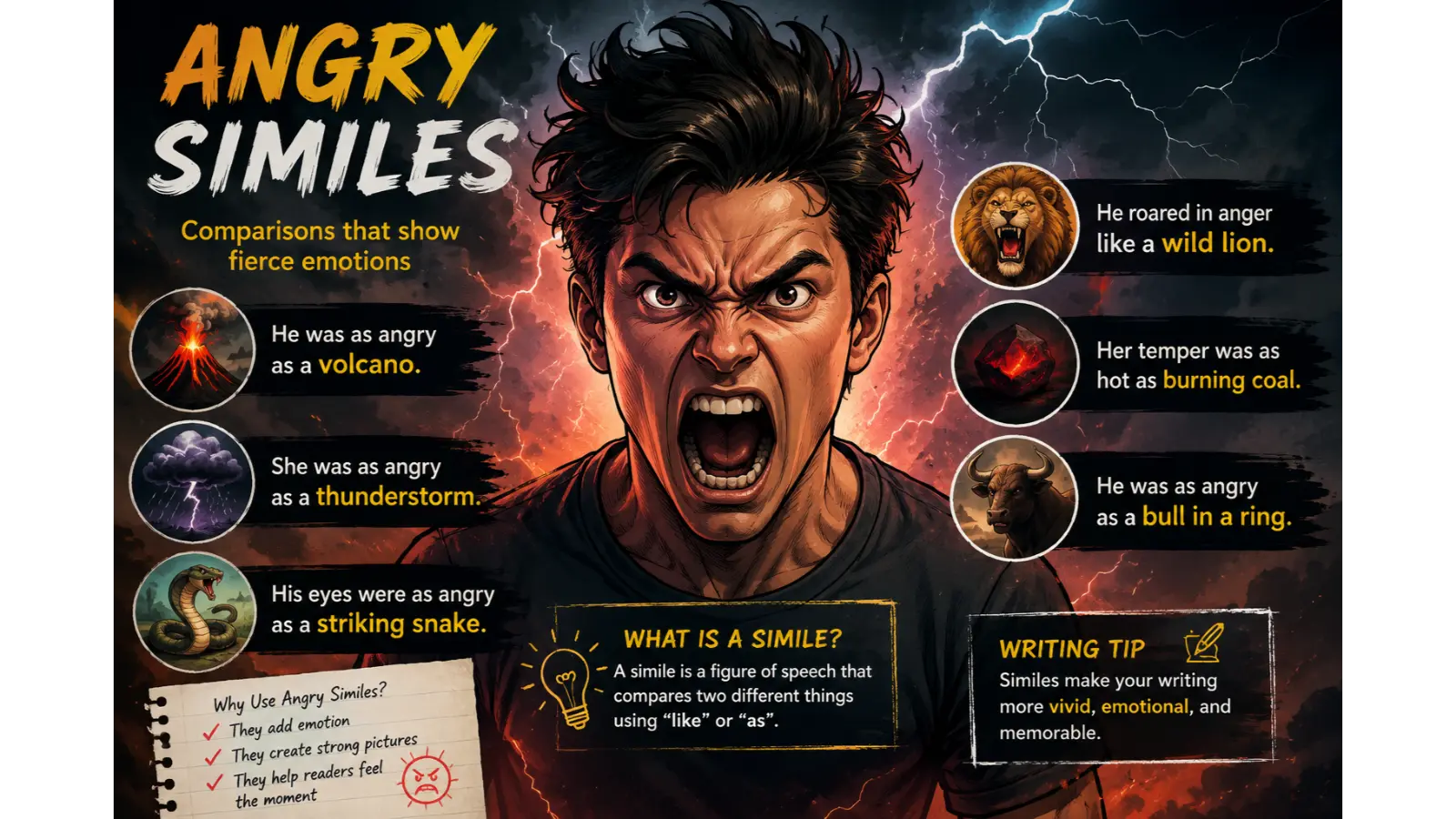
Anger is one of the strongest emotions a writer can describe, but simply saying someone was “angry” rarely leaves a lasting impression. This is where similes become powerful. A well-crafted simile paints a picture that readers can instantly imagine, making emotions feel more vivid and believable. A simile compares two different things using words such as like or as. Instead of telling readers that a character is furious, you show the intensity of that emotion through an imaginative comparison. Whether you’re writing stories, poems, essays, speeches, or everyday conversations, this collection of angry similes will help you express frustration, rage, irritation, and quiet resentment in creative and memorable ways.
Quick Answer
Angry similes are comparisons that describe anger using the words like or as. They help writers create stronger emotional imagery by comparing anger to familiar sights, sounds, or experiences, making characters and situations feel more realistic.
Why Writers Use Angry Similes
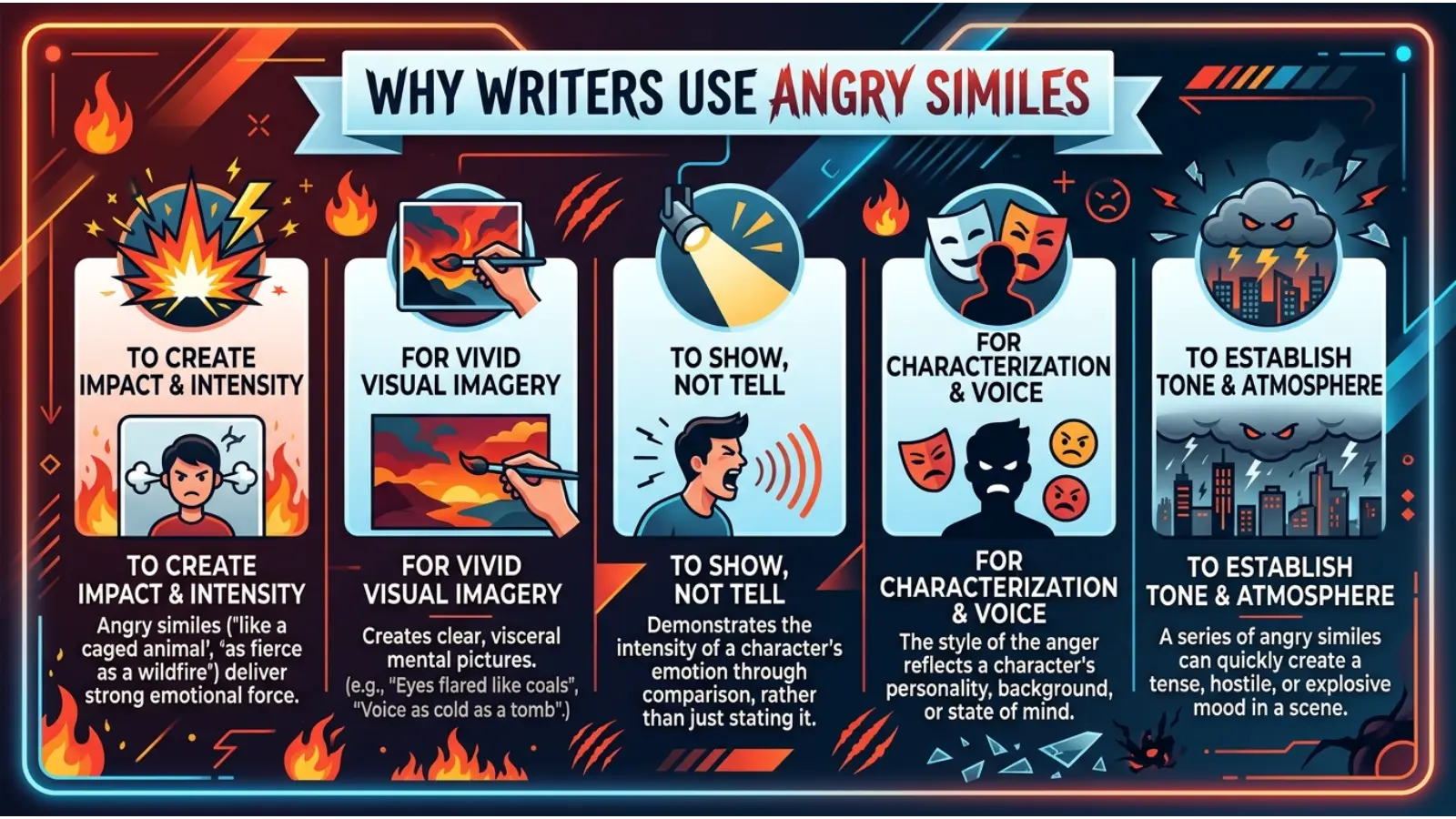
Anger comes in many forms. Sometimes it explodes without warning. Other times it builds slowly beneath the surface.
Strong similes help readers recognize these emotional differences. Instead of repeating words like mad, furious, or upset, writers can create unique images that reveal exactly how anger feels.
Good angry similes can:
- Make characters feel realistic.
- Add emotion to dialogue.
- Strengthen storytelling.
- Improve poetry and descriptive writing.
- Help readers visualize emotional scenes.
30 Original Angry Similes
1. As restless as thunder trapped inside a bottle
Meaning: Anger waiting to explode.
Example Sentences
- He paced the room, as restless as thunder trapped inside a bottle.
- She looked ready to burst at any second.
Writing Tip: Perfect for building suspense before an argument.
2. Like sparks chasing dry leaves
Meaning: Anger spreading quickly.
Example Sentences
- His irritation spread like sparks chasing dry leaves.
- One rude comment started the entire conflict.
Best Context: Fast-moving emotional scenes.
3. As sharp as shattered glass
Meaning: Harsh, cutting anger.
Example Sentences
- Her words were as sharp as shattered glass.
- Every sentence seemed to hurt.
Storytelling Use: Works especially well in emotional dialogue.
4. Like a storm pounding against closed windows
Meaning: Powerful anger being held back.
Example Sentences
- His frustration beat against his silence like a storm pounding closed windows.
- Everyone sensed something was wrong.
5. As fierce as a wildfire climbing a hillside
Meaning: Anger growing rapidly.
Example Sentences
- Her temper became as fierce as a wildfire climbing a hillside.
- Nobody dared interrupt her.
6. Like boiling water under a tight lid
Meaning: Suppressed anger.
Example Sentences
- He remained calm, but inside he felt like boiling water under a tight lid.
- Everyone knew he wouldn’t stay quiet forever.
7. As loud as crashing waves during a storm
Meaning: Explosive emotional outburst.
Example Sentences
- His voice became as loud as crashing waves during a storm.
- The room fell silent.
8. Like lightning searching for the tallest tree
Meaning: Anger seeking someone to blame.
Example Sentences
- She looked around like lightning searching for the tallest tree.
- Someone was going to hear about the mistake.
9. As tense as a stretched rope
Meaning: Anger mixed with stress.
Example Sentences
- He stood as tense as a stretched rope.
- Nobody wanted to test his patience.
10. Like smoke filling every corner
Meaning: Anger affecting everything.
Example Sentences
- His mood spread like smoke filling every corner.
- The entire office felt uncomfortable.
11. As hot as iron fresh from the forge
Meaning: Intense rage.
Examples
- She was as hot as iron fresh from the forge.
- His face glowed with anger.
12. Like a volcano waking beneath the earth
Meaning: Hidden anger preparing to erupt.
Writing Tip: Excellent for slow-building conflict.
13. As bitter as burnt coffee
Meaning: Lingering resentment.
Examples
- His reply sounded as bitter as burnt coffee.
- Old arguments resurfaced.
14. Like a hornet guarding its nest
Meaning: Defensive anger.
Conversation Example
- She reacted like a hornet guarding its nest.
15. As rough as broken stone
Meaning: Angry tone lacking kindness.
Poetry Use: Creates hard emotional imagery.
16. Like a furnace with its door thrown open
Meaning: Uncontrolled rage.
Examples
- His anger poured out like a furnace with its door thrown open.
- Nobody interrupted him.
17. As fierce as a river after heavy rain
Meaning: Powerful emotional force.
Writing Purpose: Action scenes and dramatic confrontations.
18. Like nails scraping old metal
Meaning: Irritating, unpleasant anger.
Examples
- Her voice sounded like nails scraping old metal.
19. As dark as smoke before sunrise
Meaning: Quiet, dangerous anger.
Best Context: Psychological fiction.
20. Like an engine pushed beyond its limit
Meaning: Frustration caused by pressure.
Examples
- He felt like an engine pushed beyond its limit.
21. As wild as wind trapped inside a canyon
Meaning: Unpredictable anger.
22. Like cracked ice beneath heavy boots
Meaning: Anger close to breaking.
23. As heavy as a sky full of storms
Meaning: Emotion weighing on someone.
24. Like a match dropped into dry grass
Meaning: Tiny event causing huge anger.
25. As relentless as pounding rain
Meaning: Continuous frustration.
26. Like a caged wolf circling in silence
Meaning: Controlled but dangerous anger.
27. As blazing as the afternoon desert sun
Meaning: Overwhelming rage.
28. Like waves crashing against stubborn cliffs
Meaning: Repeated anger meeting resistance.
29. As fierce as a hawk protecting its young
Meaning: Protective anger.
30. Like a drumbeat echoing through an empty valley
Meaning: Anger that refuses to fade.
Writing Tip: Useful when showing lasting resentment.
What Makes an Angry Simile Effective?
The strongest similes do more than compare two things. They capture a specific kind of anger.
Ask yourself:
- Is the anger sudden or gradual?
- Is it loud or silent?
- Is it justified or reckless?
- Does it fade quickly or linger?
The answers help you choose comparisons that match the emotional moment rather than relying on generic expressions.
How to Create Your Own Angry Similes
Creating original similes is easier when you focus on sensory details instead of copying familiar comparisons.
Step 1: Identify the Emotion
Decide whether the character feels:
- Frustration
- Irritation
- Rage
- Jealous anger
- Silent resentment
Step 2: Think of Real Images
Look at nature, weather, animals, sounds, objects, or everyday experiences.
Examples include:
- Storm clouds
- Cracking ice
- Overflowing rivers
- Flickering flames
- Grinding gears
Step 3: Find the Shared Quality
Ask what both things have in common.
For example:
- Growing pressure
- Sudden explosion
- Sharpness
- Heat
- Noise
Step 4: Keep It Believable
Creative comparisons should surprise readers without confusing them. If readers need to stop and decode the image, simplify it.
Related Literary Devices
Metaphor
A metaphor says something is another thing instead of using like or as.
- Simile: Her anger was like a storm.
- Metaphor: Her anger became a storm.
Imagery
Imagery appeals to the senses. Angry similes often use sounds, heat, movement, and color to help readers experience the emotion.
Hyperbole
Hyperbole intentionally exaggerates emotion.
Example:
- He was so angry it felt like the mountains themselves would shake.
Personification
Giving human actions to objects can strengthen emotional scenes.
Example:
- The wind screamed through the trees as if sharing her anger.
Common Mistakes When Writing Angry Similes
Relying on Overused Comparisons
Readers have seen phrases like “mad as a hornet” countless times. Fresh comparisons create stronger imagery.
Mixing Images
Avoid combining unrelated comparisons.
Weak:
He was like a volcano that barked like a dog.
Choose one clear image instead.
Using Similes Too Often
Not every sentence needs a comparison. A few memorable similes have greater impact than dozens of ordinary ones.
Forgetting the Character
The comparison should match the character’s personality, setting, and point of view. A sailor, scientist, and child may all describe anger differently.
Creative Exercises
Exercise 1
Describe a character who is angry without using the words angry, mad, furious, or rage.
Exercise 2
Write three similes inspired by weather.
Exercise 3
Create one angry simile using an animal, one using a machine, and one using music.
Exercise 4
Rewrite a simple sentence like:
“She was upset.”
Turn it into a vivid description using an original simile.
Frequently Asked Questions
What is an angry simile?
An angry simile compares anger to another object or experience using like or as to make the emotion more vivid.
Why should writers use similes for anger?
They help readers picture emotions instead of simply being told how a character feels.
Can angry similes be used in poetry?
Yes. They add rhythm, imagery, and emotional depth to poems.
What’s the difference between a simile and a metaphor?
A simile uses like or as, while a metaphor makes a direct comparison without those words.
Should every angry scene include a simile?
No. Similes are most effective when used selectively to highlight important emotional moments.
How can I avoid cliché similes?
Look for comparisons from everyday life, nature, technology, or personal experiences instead of repeating familiar expressions.
Can children use angry similes?
Absolutely. Simple, age-appropriate similes help young writers develop descriptive language and creativity.
Conclusion
Angry similes turn ordinary descriptions into memorable moments by giving readers an image they can instantly understand. Instead of relying on common expressions, experiment with comparisons that match the exact kind of anger your character feels—whether it’s quiet frustration, explosive rage, or lingering resentment. The more you observe the world around you, the easier it becomes to create fresh, believable similes that make your writing stand out.

I am Helena Frost, a writer captivated by the beauty of language and the art of comparison. Through my words, I explore the world by turning ordinary moments into vivid similes and reflections. I enjoy crafting phrases that spark imagination, evoke emotion, and linger in the mind. My writing celebrates the subtle connections between people, nature, and the stories we live. For me, every sentence is an opportunity to reveal the extraordinary in the everyday.