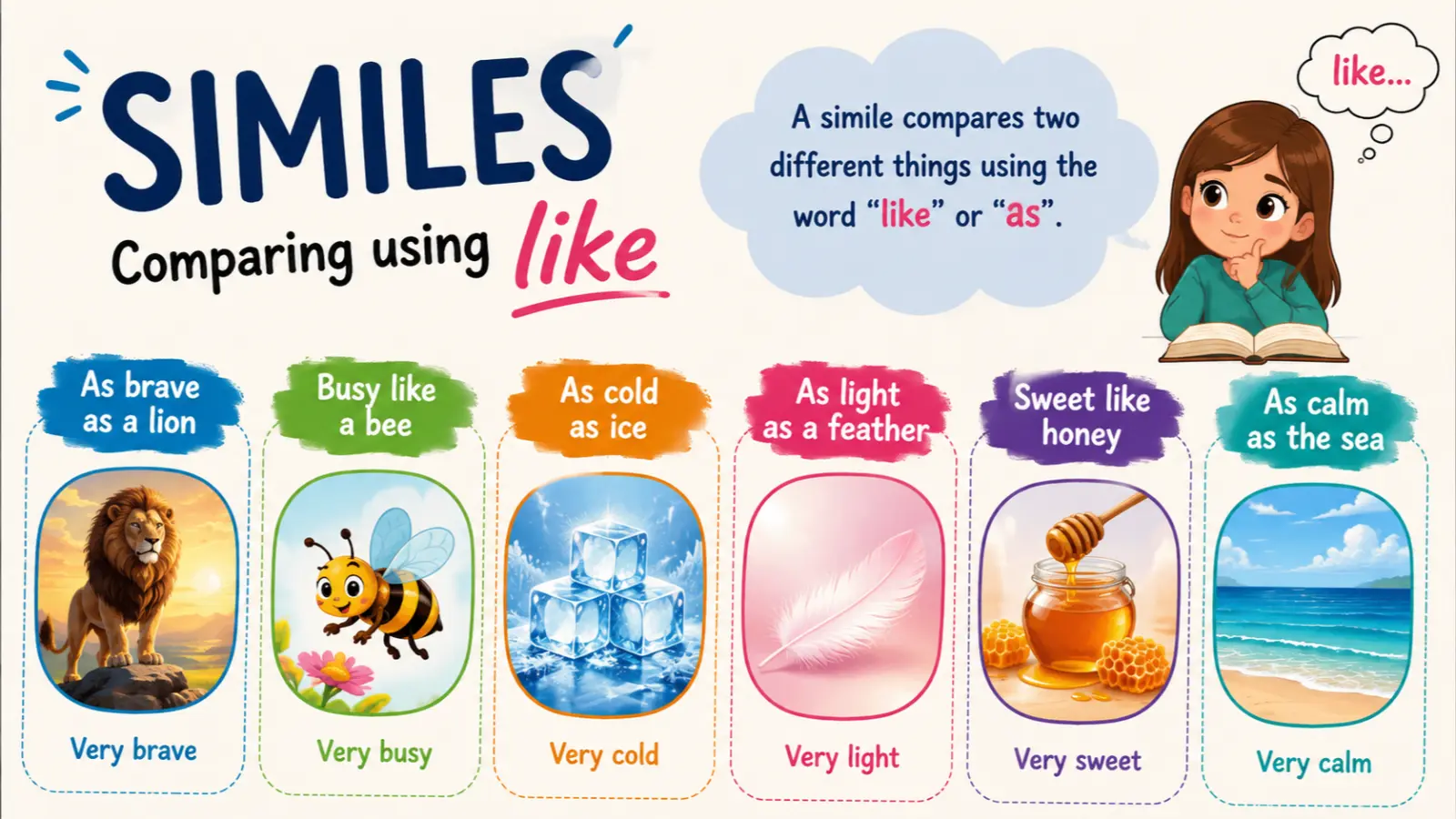
A Similes Examples good comparison can make an ordinary sentence memorable. Instead of simply saying that someone is nervous, a writer might say they are like a bird startled from a branch. The comparison gives the reader something concrete to picture.
Like similes are comparisons that commonly use the word “like” to connect two different things. They appear in everyday conversation, fiction, poetry, songs, speeches, advertising, and descriptive writing. When used thoughtfully, they can make an emotion easier to understand, strengthen imagery, and give writing a distinctive voice.
This guide explains how these similes work, provides original examples, and shows how to create comparisons that feel fresh rather than predictable.
What Is a Like Simile?
A like simile is a comparison between two different things using “like” or, in some cases, a closely related comparison structure.
For example:
The old house stood like a tired giant at the edge of the road.
The house is not literally a giant. The comparison suggests that it is large, imposing, and perhaps worn down by time.
A useful simile usually has three parts:
- The subject: what you are describing
- The comparison: what you compare it with
- The shared quality: the feature connecting them
For example:
Her laugh was like sunlight through an open window.
The laugh is the subject, sunlight is the comparison, and warmth or brightness is the shared quality.
Why Writers Use “Like” in Similes
A strong comparison does more than decorate a sentence. It gives readers a way to experience an idea.
Compare these two sentences:
The classroom was noisy.
The classroom buzzed like a crowded marketplace.
The second sentence creates a stronger sense of sound and activity. The reader can almost hear the overlapping voices.
Like similes can help writers:
- Make descriptions more vivid
- Explain unfamiliar ideas
- Express emotions indirectly
- Build atmosphere
- Create memorable characters
- Add rhythm to prose
- Strengthen poetry and storytelling
- Make everyday language more colorful
The key is choosing a comparison that adds meaning rather than simply adding words.
30 Creative Like Similes to Inspire Your Writing
The following examples are original comparisons designed for different emotions, settings, characters, and writing situations.
1. Her Smile Was Like a Window Opening After a Storm
Meaning: Her smile immediately created a feeling of relief and happiness.
Example sentences:
- Her smile was like a window opening after a storm.
- When she smiled, the tense room seemed to breathe again.
Emotional effect: Warm, hopeful, reassuring.
Best context: Character descriptions, friendship stories, romantic fiction, and uplifting scenes.
Writing tip: Compare a person’s expression with something that produces the same emotional response rather than merely describing its appearance.
2. His Voice Was Like Gravel Rolling Down a Hill
Meaning: His voice sounded rough, deep, or harsh.
Example sentences:
- His voice was like gravel rolling down a hill.
- Every sentence came out with a rough, uneven rumble.
Emotional effect: Tough, intimidating, rugged.
Best context: Character introductions and dramatic storytelling.
This works because the comparison focuses on sound, not appearance.
3. The Rain Fell Like Fingers Tapping on Glass
Meaning: The rain made a repeated, delicate sound against a window.
Example sentences:
- Rain fell like fingers tapping on glass.
- I listened to the drops tapping against the bedroom window.
Emotional effect: Calm, intimate, slightly mysterious.
Best context: Nature writing, poetry, reflective scenes, and descriptions of weather.
4. Her Thoughts Spun Like Leaves in a Whirlwind
Meaning: She was unable to organize her thoughts because she felt confused or overwhelmed.
Example sentences:
- Her thoughts spun like leaves in a whirlwind.
- Before the exam, every idea seemed to fly in a different direction.
Emotional effect: Confusion and anxiety.
Writing tip: Mental states become more vivid when you give them physical movement.
5. The Baby Slept Like a Feather Floating on Water
Meaning: The baby slept peacefully and gently.
Example sentences:
- The baby slept like a feather floating on water.
- Even the creak of the door failed to disturb him.
Emotional effect: Tender, peaceful, delicate.
Best context: Family writing and gentle storytelling.
6. The City Glowed Like Embers Beneath a Dark Sky
Meaning: City lights appeared warm and bright against the darkness.
Example sentences:
- The city glowed like embers beneath a dark sky.
- From the hilltop, thousands of lights shimmered below us.
Emotional effect: Atmospheric and cinematic.
Best context: Travel writing, nighttime scenes, and poetry.
7. His Excitement Bounced Like a Ball Across the Room
Meaning: His enthusiasm was energetic and difficult to contain.
Example sentences:
- His excitement bounced like a ball across the room.
- He could barely sit still while waiting for the announcement.
Emotional effect: Playful and energetic.
8. The Silence Was Like Snow Covering the Entire Street
Meaning: The silence felt complete and almost physically present.
Example sentences:
- The silence was like snow covering the entire street.
- Nobody spoke after the unexpected news.
Emotional effect: Still, heavy, reflective.
Writing tip: Abstract ideas such as silence become stronger when readers can imagine them as something tangible.
9. Her Words Cut Like Cold Wind
Meaning: Her words were emotionally painful or harsh.
Example sentences:
- Her words cut like cold wind.
- He remembered the conversation long after she had left.
Emotional effect: Hurt, distance, emotional tension.
10. The River Curved Like a Silver Ribbon Through the Valley
Meaning: The river followed a smooth, winding path through the landscape.
Example sentences:
- The river curved like a silver ribbon through the valley.
- Morning light flashed across its surface.
Emotional effect: Beautiful and peaceful.
Best context: Landscape descriptions and travel writing.
11. His Anger Rose Like Steam From a Kettle
Meaning: His anger gradually became stronger.
Example sentences:
- His anger rose like steam from a kettle.
- He tried to remain calm, but his frustration kept building.
Emotional effect: Tension and anticipation.
Writing tip: Comparisons involving gradual physical movement are especially useful for emotions that build over time.
12. The Old Clock Ticked Like a Patient Footstep
Meaning: The clock’s steady sound created a slow, deliberate rhythm.
Example sentences:
- The old clock ticked like a patient footstep.
- Each tick seemed louder as midnight approached.
Emotional effect: Suspenseful and thoughtful.
13. Her Kindness Was Like Shade on a Summer Afternoon
Meaning: Her kindness offered comfort and relief.
Example sentences:
- Her kindness was like shade on a summer afternoon.
- When everyone else was arguing, she gave us a quiet place to breathe.
Emotional effect: Comforting and grateful.
Best context: Friendship, family, character development, and personal essays.
14. The Crowd Moved Like a River Through the Stadium
Meaning: A large group moved continuously in one direction.
Example sentences:
- The crowd moved like a river through the stadium.
- Thousands of fans streamed toward the exits after the game.
Emotional effect: Energetic and expansive.
15. His Laugh Exploded Like Popcorn in a Hot Pan
Meaning: His laughter came suddenly and energetically.
Example sentences:
- His laugh exploded like popcorn in a hot pan.
- Soon everyone around the table was laughing too.
Emotional effect: Funny, lively, unexpected.
Best context: Humorous storytelling.
16. The Morning Air Felt Like a Freshly Washed Shirt
Meaning: The air felt clean, fresh, and pleasant.
Example sentences:
- The morning air felt like a freshly washed shirt.
- I opened the window and breathed in the cool air.
Emotional effect: Freshness and renewal.
This comparison works because it connects an abstract sensation with a familiar physical experience.
17. The Athlete Moved Like a Spark Skipping Across Dry Grass
Meaning: The athlete moved quickly, lightly, and unpredictably.
Example sentences:
- The athlete moved like a spark skipping across dry grass.
- His sudden change of direction caught the defender off guard.
Best context: Sports writing and action scenes.
18. Her Memory Was Like a Box Filled With Unsorted Photographs
Meaning: Her memories were numerous but difficult to organize.
Example sentences:
- Her memory was like a box filled with unsorted photographs.
- Some moments were perfectly clear while others had faded at the edges.
Emotional effect: Nostalgic and reflective.
19. The Wind Whistled Like Someone Calling From Far Away
Meaning: The wind produced a sound that resembled a distant call.
Example sentences:
- The wind whistled like someone calling from far away.
- We paused on the trail and listened.
Emotional effect: Mysterious and slightly haunting.
20. His Confidence Was Like a Lantern in a Dark Room
Meaning: His confidence helped him remain steady when circumstances were uncertain.
Example sentences:
- His confidence was like a lantern in a dark room.
- Even when the plan changed, he knew what to do next.
Emotional effect: Encouraging and hopeful.
21. The Children Raced Like Sparrows Released From a Cage
Meaning: The children suddenly ran with energy and excitement.
Example sentences:
- The children raced like sparrows released from a cage.
- The moment the bell rang, they rushed into the playground.
Best context: School stories, children’s literature, and lively scenes.
22. The Moon Hung Like a Pale Coin Above the Trees
Meaning: The moon looked round and bright against the night sky.
Example sentences:
- The moon hung like a pale coin above the trees.
- Its weak light barely reached the forest floor.
Emotional effect: Quiet and atmospheric.
23. Her Hope Flickered Like a Candle Near an Open Door
Meaning: Her hope remained present but felt fragile.
Example sentences:
- Her hope flickered like a candle near an open door.
- One encouraging message was enough to keep her trying.
Emotional effect: Vulnerable yet hopeful.
Writing tip: Fragile comparisons are useful when an emotion is uncertain rather than completely strong.
24. The Market Was Like a Puzzle Being Solved at Full Speed
Meaning: The market was busy, complicated, and constantly changing.
Example sentences:
- The market was like a puzzle being solved at full speed.
- Sellers called out prices while shoppers moved between crowded stalls.
Best context: Travel writing and descriptions of busy places.
25. The Snow Covered the Garden Like a Blank Page
Meaning: Fresh snow made the garden appear clean and untouched.
Example sentences:
- Snow covered the garden like a blank page.
- Not a single footprint crossed the white surface.
Emotional effect: Peaceful, clean, full of possibility.
26. His Secret Sat Like a Stone in His Pocket
Meaning: The secret constantly weighed on him mentally.
Example sentences:
- His secret sat like a stone in his pocket.
- He wanted to tell someone but could not find the courage.
Emotional effect: Burdened and uneasy.
Writing tip: Physical weight is an effective way to represent emotional pressure.
27. The Guitar Sounded Like Rain on a Tin Roof
Meaning: The guitar produced a rhythmic, textured sound.
Example sentences:
- The guitar sounded like rain on a tin roof.
- Its quick notes filled the small room.
Best context: Music writing, poetry, and sensory descriptions.
28. Her Friendship Was Like a Compass on a Foggy Road
Meaning: Her friendship provided direction and support during uncertainty.
Example sentences:
- Her friendship was like a compass on a foggy road.
- Whenever I felt lost, she helped me see my next step.
Emotional effect: Trust, loyalty, and gratitude.
29. The Story Unfolded Like a Door Opening Into an Unknown Room
Meaning: The story gradually revealed something mysterious or unexpected.
Example sentences:
- The story unfolded like a door opening into an unknown room.
- Every chapter revealed another surprising detail.
Best context: Book reviews, storytelling, and creative writing.
30. His Determination Burned Like a Small Fire in Winter
Meaning: His determination remained strong despite difficult circumstances.
Example sentences:
- His determination burned like a small fire in winter.
- Setbacks made the journey harder, but they did not stop him.
Emotional effect: Resilience and quiet strength.
How to Make a Like Simile More Vivid
Not every comparison is automatically effective. A weak simile may technically compare two things but give the reader little to imagine.
Consider:
The car was like a vehicle.
The comparison tells us almost nothing because the two things are too similar.
Now consider:
The old car rattled like a toolbox being dragged across concrete.
The second version gives the reader sound, texture, and movement.
Use specific details
Instead of comparing something with a broad category, choose a precise image.
Weak:
Her eyes were like stars.
Stronger:
Her eyes caught the streetlight like two drops of rain on black glass.
The second comparison gives the reader a more distinctive image.
Connect the comparison to the mood
A simile should fit the emotional atmosphere.
For a peaceful scene:
The lake rested like glass beneath the morning sky.
For a tense scene:
The lake waited like a trap beneath the silent trees.
The subject remains similar, but the comparison changes the mood.
How to Avoid Cliché Similes
Some comparisons have been used so often that readers barely notice them. Familiar phrases can still have a place, especially in everyday speech, but creative writing often benefits from fresher imagery.
Instead of automatically reaching for a familiar comparison, ask:
What does this subject actually remind me of?
If someone is very quiet, don’t immediately choose a comparison about a mouse. Think about the specific kind of silence.
Maybe:
He sat like a radio after the batteries had died.
That comparison suggests more than quietness. It suggests that the person has suddenly stopped contributing to the conversation.
A useful test is this:
Could another writer use the exact same comparison without changing anything?
If the answer is yes, look for a more personal image.
Like Similes vs. Metaphors
Similes and metaphors both create comparisons, but they usually signal those comparisons differently.
A simile commonly uses words such as like or as:
The clouds moved like ships across the sky.
A metaphor states the comparison more directly:
The clouds were ships crossing the sky.
Both can create imagery, but the simile makes the comparison explicit.
When should you use a simile?
Use one when you want to guide the reader toward a particular image without saying that the two things are literally the same.
When should you use a metaphor?
A metaphor can feel more direct and forceful when the comparison is central to the description.
Neither device is automatically better. The right choice depends on the voice and purpose of the sentence.
How Professional Writers Build Better Comparisons
Strong similes often come from observation rather than a search for fancy vocabulary.
Try noticing:
- Sounds
- Textures
- Movements
- Shapes
- Light
- Temperature
- Smells
- Familiar objects
- Everyday experiences
Suppose you want to describe nervousness.
Start with the emotion:
nervous
Then ask what nervousness physically feels like:
restless, shaky, quick, tight, uncertain
Then brainstorm physical experiences:
a loose wire, a trapped bird, a vibrating phone, a drumbeat
Now build the comparison:
Her nerves buzzed like a phone vibrating beneath a pillow.
The image is specific because it comes from a recognizable physical experience.
How to Create Your Own Like Similes
You can build original comparisons with a simple five-step process.
1. Choose one thing to describe
Start with something concrete.
For example:
A crowded hallway
2. Identify its strongest quality
Ask what stands out.
Perhaps it is:
fast-moving, loud, packed, unpredictable
3. Brainstorm unrelated objects
Think beyond the obvious:
- A river
- A beehive
- A train station
- A shaken jar
- A flock of birds
4. Find the most meaningful connection
A river may capture continuous movement.
Now create the comparison:
The hallway flowed like a river after the final bell.
5. Test the sentence
Ask:
- Does the comparison make sense?
- Does it create an image?
- Does it fit the tone?
- Is it more interesting than the original description?
- Is the comparison too familiar?
If the answer is yes, keep it.
Three Exercises for Practicing Similes
Exercise 1: Describe an Emotion
Choose one emotion:
joy, fear, frustration, loneliness, excitement, or calm.
Write five physical things that could represent that feeling.
Then create one like simile from your favorite image.
For example:
Excitement rushed through him like water released from a dam.
Exercise 2: Improve a Plain Sentence
Start with:
The wind was strong.
Create three different versions.
One could focus on sound:
The wind howled like a train passing through an empty station.
Another could focus on movement:
The wind pushed through the trees like an impatient traveler.
A third could focus on atmosphere:
The wind moved like an invisible crowd through the dark street.
The goal is to discover how changing the comparison changes the reader’s experience.
Exercise 3: Use an Unexpected Object
Choose something ordinary:
- Spoon
- Backpack
- Pencil
- Elevator
- Window
- Shoes
- Notebook
Now use it as the comparison in a sentence.
For example:
The waiting room felt like a backpack stuffed beyond its zipper.
The comparison suggests pressure, overcrowding, and discomfort without directly explaining those feelings.
Common Mistakes With Like Similes
Using an Overused Comparison
A familiar comparison may communicate the basic idea but fail to create a memorable image.
Fix: Add a specific detail or find an unexpected object.
Mixing Two Images
Avoid combining unrelated comparisons:
Her voice was like thunder that danced through the room like a river.
The images compete with one another.
Choose one central picture instead.
Forcing a Simile Into Every Sentence
A paragraph filled with comparisons can become tiring.
Readers need straightforward sentences too.
Use a simile when the comparison adds something that ordinary description cannot provide.
Making the Comparison Too Complicated
A simile should usually become clearer, not more confusing.
If the reader has to decode the comparison before understanding the original sentence, simplify it.
Choosing a Comparison With No Shared Quality
The two things do not need to be literally similar, but there should be a meaningful connection.
If you compare someone’s calm personality to a fireworks display, the reader may struggle to understand the intended quality unless the context explains it.
How Similes Improve Storytelling
In storytelling, a comparison can reveal character as well as describe a scene.
Consider:
He held the letter like it might disappear.
The sentence does not simply describe how he held the paper. It suggests fear, uncertainty, or emotional attachment.
A well-chosen simile can therefore perform several jobs at once:
Description + emotion + character development
That is one reason strong comparisons are valuable in fiction.
Using Like Similes in Poetry
Poetry gives similes more freedom because sound, rhythm, and emotion often matter as much as literal description.
For example:
The evening settled like dust on an abandoned road.
The comparison creates an atmosphere of stillness and loneliness.
When writing poetry, consider the sound of the entire line. A beautiful image can become awkward if the words are difficult to say or disrupt the rhythm.
Using Like Similes in Everyday Conversation
Similes do not belong only in literature.
People naturally use comparisons when they want to explain an experience quickly.
For example:
“The traffic was like a parking lot.”
Or:
“I was as nervous as a student before a surprise test.”
In conversation, simpler comparisons often work best because the listener needs to understand them immediately.
Frequently Asked Questions
What is a simile with “like”?
A simile with “like” compares two different things using the word like to highlight a shared quality. For example, “The water sparkled like glass.”
What are some examples of like similes?
Examples include “The rain fell like fingers tapping on glass,” “Her kindness was like shade on a summer afternoon,” and “The city glowed like embers beneath a dark sky.”
Is every sentence using “like” a simile?
No. The word like can have several grammatical functions. In a simile, it creates a comparison between different things.
For example, “I like chocolate” is not a simile because it expresses preference rather than comparison.
What is the difference between a simile and a metaphor?
A simile usually makes a comparison using words such as like or as, while a metaphor makes a direct comparison.
Simile: The road was like a ribbon.
Metaphor: The road was a ribbon.
Why do writers use similes?
Writers use similes to create imagery, explain abstract ideas, express emotions, establish mood, and make descriptions more memorable.
How can I make my similes more original?
Start with observation. Identify the exact quality you want to describe, brainstorm unusual objects or experiences that share that quality, and choose the comparison that creates the clearest image.
Can similes be used in academic writing?
Yes, but they should be used selectively. In formal academic writing, precise explanation usually matters more than decorative imagery. A comparison can be useful when it clarifies a difficult concept.
Conclusion
A useful simile does not exist simply to make writing sound fancy. Its real purpose is to help readers see, hear, feel, or understand something more clearly. The strongest comparisons often begin with ordinary observations. A ticking clock, a crowded hallway, a sudden laugh, cold wind, fresh snow, or a familiar object can become powerful imagery when connected to the right idea. When creating your own like similes, focus on the quality you want readers to experience. Then search for an image that captures that quality in a fresh and believable way. The goal is not to compare everything. It is to find the one comparison that makes the reader pause and think, “Yes—that is exactly what it feels like.”
I am Helena Frost, a writer captivated by the beauty of language and the art of comparison. Through my words, I explore the world by turning ordinary moments into vivid similes and reflections. I enjoy crafting phrases that spark imagination, evoke emotion, and linger in the mind. My writing celebrates the subtle connections between people, nature, and the stories we live. For me, every sentence is an opportunity to reveal the extraordinary in the everyday.







1 thought on “Like Similes : for Students, Writers, and Everyday Use”