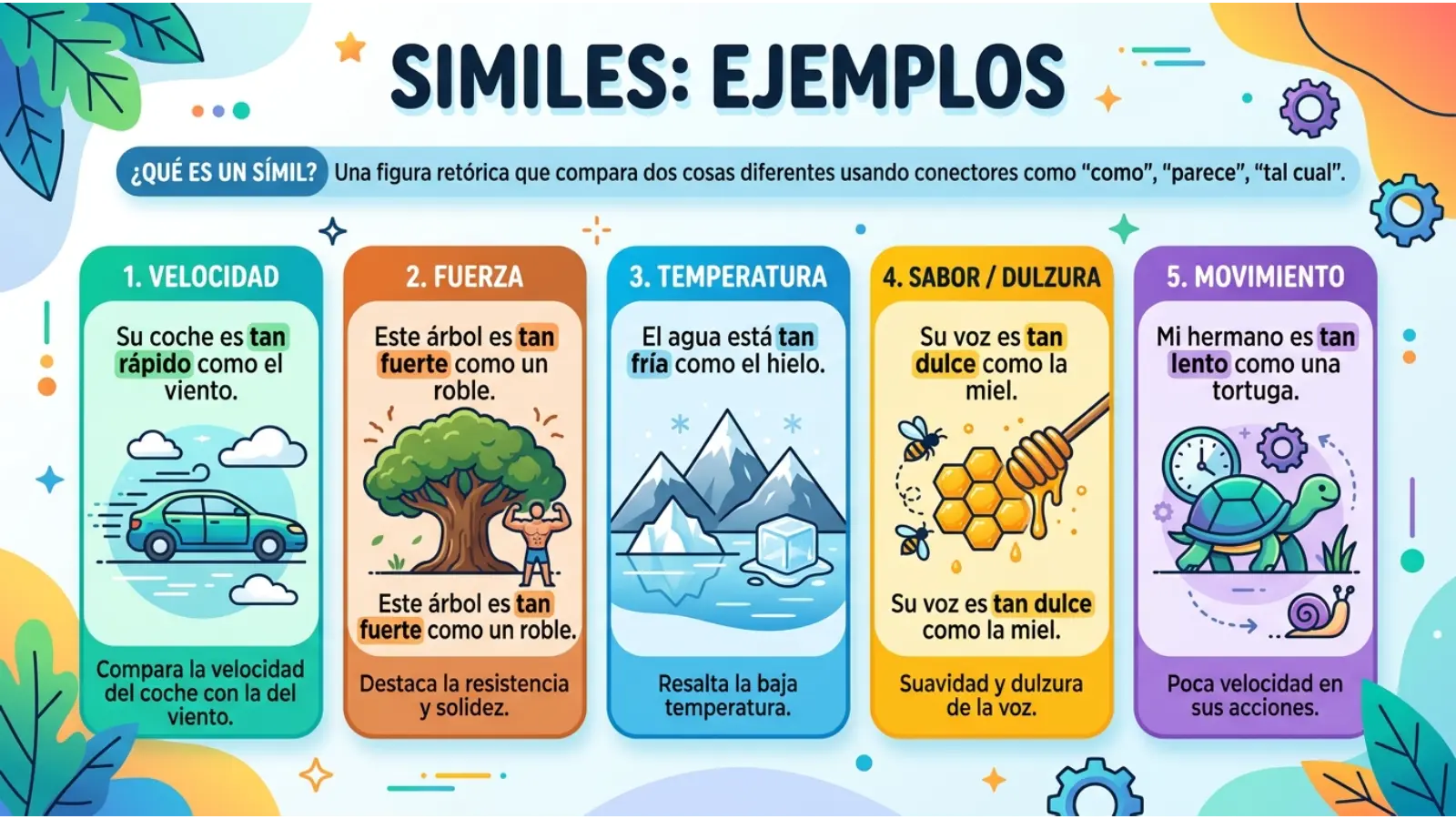
Similes ejemplos are examples of comparisons that use words such as like or as to connect one thing with another. In Spanish, similes commonly use expressions such as “como,” “parece,” or “igual que.” A strong Similes Ejemplos helps readers see, hear, feel, or imagine an idea more clearly.
Writers use Similes Ejemplos in poems, stories, songs, speeches, conversations, advertisements, and everyday descriptions. Instead of saying “the rain was heavy,” a writer might compare it to something familiar and visual: “The rain fell like a curtain of silver.”
The best comparisons do more than decorate a sentence. They give an abstract feeling a recognizable shape, make a character easier to picture, or create a mood that ordinary description cannot achieve.
This collection of similes ejemplos gives you original comparisons, explains why they work, and shows how to adapt them to your own writing.
What Is a Simile?
A Similes Ejemplos is a figure of speech that compares two different things using a comparison word or phrase.
Common English structures include:
- like — “The clouds moved like slow ships.”
- as…as — “Her voice was as gentle as falling snow.”
- as if — “He stared at the door as if it might answer him.”
In Spanish, como is especially common:
“Sus ojos brillaban como estrellas.”
This means:
“Her eyes shone like stars.”
The two things being compared do not need to be literally alike. Their similarity may come from appearance, movement, sound, emotion, behavior, or atmosphere.
Similes Ejemplos in Spanish
Here are several fresh Spanish similes with English meanings:
1. “Su sonrisa brillaba como una ventana abierta al amanecer.”
Meaning: Her Similes Ejemplos seemed bright, welcoming, and full of possibility.
This works because a window at dawn suggests light entering a dark room. The comparison creates warmth without simply saying “she had a beautiful smile.”
Writing tip: When describing happiness, compare it with something that lets light, warmth, or energy into a scene.
2. “La lluvia golpeaba el techo como dedos impacientes.”
Meaning: The rain sounded quick and persistent.
The comparison gives the rain human behavior. It can work especially well in suspense or restless scenes.
3. “Su amistad era como un puente sobre un río difícil.”
Meaning: Their friendship helped them cross difficult moments together.
This simile focuses on what friendship does, rather than merely describing it as “strong.”
4. “El silencio cayó como una manta sobre la habitación.”
Meaning: The room suddenly became completely quiet.
The image makes silence feel physical and surrounding.
5. “Sus palabras eran como pequeñas semillas en la mente.”
Meaning: What the person said stayed with others and gradually influenced their thinking.
This is useful when writing about advice, teaching, or meaningful conversations.
30 Original Similes Ejemplos for Creative Writing
The following comparisons are designed as writing inspiration rather than fixed phrases you must copy. Change the details to match your character, setting, and tone.
Similes for Happiness
1. “His happiness bubbled like sunlight dancing across a fountain.”
The image combines movement and brightness. It suggests lively, visible joy rather than quiet satisfaction.
Example:
After hearing the good news, his happiness bubbled like sunlight dancing across a fountain.
Best context: Celebrations, reunions, victories, and moments of discovery.
2. “She entered the room as cheerful as a window thrown open after a storm.”
This comparison makes happiness feel refreshing. It also implies that something difficult has just passed.
Writing purpose: Use this kind of simile when a character’s mood changes the atmosphere around them.
3. “Their laughter scattered like birds startled into the morning sky.”
The comparison makes laughter feel spontaneous and energetic.
Example:
Their laughter scattered like birds startled into the morning sky.
This works especially well in stories about friendship or family.
Similes for Friendship
4. “Their friendship held steady like a lantern on a windy porch.”
A lantern represents dependable light, while the wind suggests outside difficulties.
Meaning: Their relationship remained reliable even when circumstances became difficult.
5. “They understood each other like two musicians following the same rhythm.”
This comparison is useful because it emphasizes cooperation without suggesting that friends must be identical.
Example:
They understood each other like two musicians following the same rhythm.
Best context: Dialogue, teamwork, school stories, and descriptions of close friendships.
6. “His advice arrived like a compass when the road disappeared.”
A compass does not walk the road for you; it simply helps you find direction.
That makes the simile particularly effective for describing a supportive friend.
Similes for Rain
7. “Rain stitched the streets together with thin silver threads.”
This is a visual simile that turns falling rain into something delicate and connected.
Writing tip: Visual similes are strongest when they describe movement as well as appearance.
8. “The storm arrived like a drumbeat growing louder outside the window.”
The comparison emphasizes sound and rising tension.
Best context: Suspense, dramatic scenes, storms, and atmospheric fiction.
9. “The first drops landed like cautious footsteps on the roof.”
The word cautious changes the mood. Instead of making the rain violent, it makes the beginning of the storm feel uncertain.
Similes for Love
10. “Her affection grew like a garden watered a little each day.”
This comparison presents love as something that develops through consistent care.
It avoids treating love as something that appears instantly and explains why the image feels believable.
11. “Their love was like a melody that changed without losing its tune.”
The comparison suggests that relationships can change while keeping their central connection.
Best context: Reflective writing, poetry, relationship stories, and personal essays.
12. “His kindness warmed her like sunlight finding its way through winter clouds.”
The image combines emotional comfort with a recognizable natural scene.
Writing tip: For emotional similes, choose an image that creates the same feeling rather than simply naming the emotion.
Similes for Anger
13. “His anger rose like heat trapped beneath a closed roof.”
This comparison suggests pressure building without immediately exploding.
Best context: Character development and scenes involving restrained frustration.
14. “Her words snapped like dry branches beneath a heavy boot.”
The sound of breaking wood gives the dialogue a sharp, sudden quality.
Example:
Her words snapped like dry branches beneath a heavy boot.
The simile works because the reader can almost hear the comparison.
15. “He carried his frustration like a stone hidden inside his pocket.”
Unlike an explosive anger comparison, this one suggests quiet, persistent irritation.
Writing purpose: Use it for characters who conceal their emotions.
Funny Similes
16. “He ran toward the bus like his backpack had declared war on gravity.”
This humorous comparison exaggerates an ordinary situation without making the sentence meaningless.
17. “The puppy followed me like a tiny detective with no case to solve.”
The comparison gives the animal a personality.
Best context: Children’s writing, humorous stories, pet descriptions, and light social posts.
18. “My alarm sounded like a tiny boss demanding a meeting at sunrise.”
The humor comes from treating an ordinary alarm as an overly important person.
Writing tip: Funny similes often work best when they give an everyday object an unexpected role.
Similes for Nature and Weather
19. “The morning fog curled around the houses like a secret refusing to leave.”
This simile creates mystery rather than merely describing fog as thick.
20. “The trees leaned together like old friends sharing a private story.”
The comparison gives the landscape a sense of community.
This is also an example of how similes can overlap with personification.
21. “The river moved through the valley like a ribbon being slowly pulled across the earth.”
The comparison emphasizes the river’s long, flowing shape.
Best context: Travel writing, landscape description, nature poetry, and fiction.
Similes for People and Personality
22. “She listened like a photographer waiting for the perfect frame.”
The simile describes intense attention without directly saying “she listened carefully.”
23. “He was as patient as a gardener waiting for the first flower.”
This comparison connects patience with time, care, and expectation.
Writing tip: Character similes become stronger when the comparison reveals personality rather than appearance alone.
24. “Her curiosity moved through the conversation like a flashlight searching a dark room.”
This creates an active image of someone constantly looking for new information.
Similes for Sadness and Loneliness
25. “The empty house felt like a book with every important page removed.”
The comparison makes absence feel significant.
It is useful when you want readers to understand loneliness without repeatedly using words such as sad or alone.
26. “His silence sat beside him like an unwanted guest.”
This gives silence emotional weight and makes it feel difficult to escape.
Best context: Reflective fiction, poetry, and emotional storytelling.
27. “She carried the memory like a photograph tucked inside an old wallet.”
The image suggests something personal that is kept close even as time passes.
Similes for Common Situations
28. “The classroom became quiet like a theater just before the curtain rises.”
This works because both situations contain expectation.
Best context: School stories, presentations, performances, and moments before important events.
29. “The city woke like a machine receiving its first spark.”
This comparison creates a sense of movement and energy.
Instead of listing cars, people, lights, and sounds separately, the simile gives the whole city one connected image.
30. “The idea arrived like a key fitting a lock I had been turning for hours.”
This describes the feeling of suddenly understanding a difficult problem.
Writing purpose: It is useful for essays, stories, problem-solving scenes, and descriptions of creative discovery.
Why These Similes Work
A memorable simile usually contains more than two unrelated objects placed beside each other.
The strongest comparisons share a meaningful quality.
For example:
“His advice arrived like a compass when the road disappeared.”
A compass and advice are physically unrelated. Their connection is direction. Advice can help someone find a path just as a compass helps a traveler determine direction.
That underlying connection is what makes the comparison feel intentional.
A useful test is:
What exactly do these two things have in common?
If you cannot answer that question, the simile may need revision.
How to Make a Simile More Vivid
Start with the ordinary sentence:
The girl was nervous.
Now ask what nervousness actually looks or feels like.
You might write:
“Her thoughts fluttered like paper caught in a sudden wind.”
The second version gives the reader something to imagine.
Notice that the simile does not merely replace nervous with another adjective. It creates movement.
When creating your own comparisons, look for:
- Movement
- Texture
- Sound
- Temperature
- Shape
- Light
- Weight
- Speed
- Rhythm
- Physical sensations
These details give abstract emotions a concrete form.
How Writers Avoid Cliché Similes
Some comparisons are so familiar that readers barely notice them.
Phrases such as “busy as a bee” or “cold as ice” can still be understandable, but they usually create less surprise than a fresh comparison.
Instead of asking:
“What is the most obvious thing this resembles?”
ask:
“What unusual object behaves in the same way?”
For example, instead of describing someone as busy as a bee, consider the person’s actual behavior:
“She moved through the office like a pinball bouncing between flashing machines.”
The comparison gives the reader speed, direction, and energy.
The goal is not to make every simile strange. It is to make each comparison specific to the moment.
Similes in Music and Poetry
Similes are especially useful in music and poetry because they compress an idea into a memorable image.
A songwriter may need to communicate longing, excitement, loneliness, or hope in very few words. A comparison can accomplish that quickly.
For example:
“The memory stayed like a melody heard from another room.”
The image suggests something distant but still recognizable.
In poetry, similes can also establish rhythm and sound:
“The leaves trembled like small notes before a song.”
The comparison connects nature with music while keeping the sentence visual.
When writing your own poetic similes, pay attention not only to meaning but also to sound. Read the line aloud. A technically clever comparison can still feel weak if the words are difficult to say.
Simile vs. Metaphor: What’s the Difference?
A simile openly compares two things, usually with words such as like or as.
“The moon looked like a silver coin.”
A metaphor makes the comparison directly:
“The moon was a silver coin.”
Both can create imagery, but they produce slightly different effects.
The simile leaves more distance between the two ideas. The metaphor makes the identification stronger and more immediate.
Simile vs. Personification
Personification gives human qualities to something nonhuman.
“The wind whispered through the trees.”
A simile compares things:
“The wind moved like someone whispering through the trees.”
A sentence can use both techniques at once, but they are not the same literary device.
How to Create Your Own Similes
Try this five-step process.
1. Start with the idea
Choose something you want to describe:
fear, excitement, friendship, rain, anger, confidence, confusion, or silence.
2. Identify its strongest quality
Ask what the subject actually does.
Does it:
- spread?
- hide?
- rush?
- linger?
- shake?
- glow?
- break?
- surround?
3. Search beyond the obvious
For anger, don’t immediately choose fire.
Think about pressure, noise, machinery, weather, broken objects, crowded rooms, or physical weight.
4. Build the comparison
Connect the emotional quality with your new image.
For example:
Anger → pressure → sealed container → pressure trapped inside a pressure cooker
Then refine it into your own sentence.
5. Remove anything unnecessary
A good simile should strengthen the sentence rather than make it heavier.
If removing the comparison makes the writing clearer and more powerful, you may not need the simile.
Three Creative Exercises for Better Similes
Exercise 1: Replace the Adjective
Take five ordinary sentences:
- The room was quiet.
- She was nervous.
- He was happy.
- The storm was loud.
- The child was curious.
Rewrite each one using a simile.
The goal is to make the reader experience the description rather than simply receive information.
Exercise 2: Use an Unexpected Object
Choose an emotion such as anger.
Write down five unrelated objects:
- a kettle
- a locked drawer
- a drum
- a cracked wall
- a traffic light
Now find a genuine connection between the emotion and one object.
This exercise trains you to avoid predictable comparisons.
Exercise 3: Change the Mood
Take one basic simile:
“The rain fell like threads.”
Now make it:
- peaceful
- frightening
- romantic
- funny
- mysterious
The comparison should change according to the emotional purpose.
This teaches an important writing principle: imagery is not neutral.
Common Simile Mistakes to Avoid
Using Too Many Similes
A paragraph filled with comparisons can become exhausting.
If every sentence contains a simile, none of them receives enough attention.
Choose the comparisons that contribute something important.
Mixing Images
Avoid combining unrelated comparison systems.
For example, if a sentence begins with an image of sailing and suddenly switches to machinery, the reader may struggle to follow the picture.
Keep the imagery coherent.
Forcing a Clever Comparison
A simile should feel natural within the scene.
If readers notice the writer trying too hard to sound clever, the image can distract from the story.
Clarity comes first.
Explaining the Simile Too Much
If you write:
“Her smile was like sunlight, meaning it was bright, warm, cheerful, positive, and made everyone feel good.”
the explanation weakens the image.
Trust the reader to understand a strong comparison.
Choosing an Image That Does Not Match the Emotion
A beautiful image is not automatically a useful image.
A peaceful garden may be visually attractive, but it might be the wrong comparison for panic.
Always ask:
Does this image create the emotion I want?
Frequently Asked Questions About Similes Ejemplos
What are 5 examples of similes?
Here are five original examples:
- The rain tapped the window like impatient fingers.
- Her laughter floated through the room like a bright melody.
- He carried the secret like a stone in his pocket.
- The city woke like a machine receiving its first spark.
- Their friendship stood like a lantern in the wind.
What does “similes ejemplos” mean?
“Similes ejemplos” means “simile examples” in Spanish. It usually refers to examples that demonstrate how similes work in Spanish or another language.
What is a simple simile example in Spanish?
A simple example is:
“Corre como el viento.”
The phrase compares someone’s speed with the speed of the wind using como, meaning “like.”
What are common words used in similes?
In English, common comparison words include like, as, as if, and than in certain comparative constructions.
In Spanish, como is one of the most common words used to form similes.
What is the difference between a simile and a metaphor?
A simile makes an explicit comparison, often using like or as. A metaphor makes the comparison directly.
Simile: “Her voice was like rain.”
Metaphor: “Her voice was rain.”
How do I make my similes less cliché?
Look beyond the first comparison that comes to mind. Identify the exact quality you want to communicate, then find an unexpected but believable object, action, or scene that shares that quality.
Can similes be used in everyday conversation?
Absolutely. People use comparisons in conversation to make stories funnier, clearer, or more memorable. The difference is that literary writing usually gives more attention to the precision and emotional effect of the comparison.
Conclusion
The best similes ejemplos are not simply decorative phrases. They help readers experience an idea. A strong simile can turn happiness into movement, anger into pressure, friendship into support, rain into sound, and loneliness into something the reader can almost touch. When you write your next description, pause before choosing the first comparison that comes to mind. Ask what the subject actually feels, sounds, looks, or behaves like. Then search for an image that is specific to your scene. Experiment with ordinary objects, unexpected connections, sound, movement, and emotion. The more carefully you observe the world around you, the more original your similes will become—and the more vividly your writing will speak to readers.
I am Helena Frost, a writer captivated by the beauty of language and the art of comparison. Through my words, I explore the world by turning ordinary moments into vivid similes and reflections. I enjoy crafting phrases that spark imagination, evoke emotion, and linger in the mind. My writing celebrates the subtle connections between people, nature, and the stories we live. For me, every sentence is an opportunity to reveal the extraordinary in the everyday.