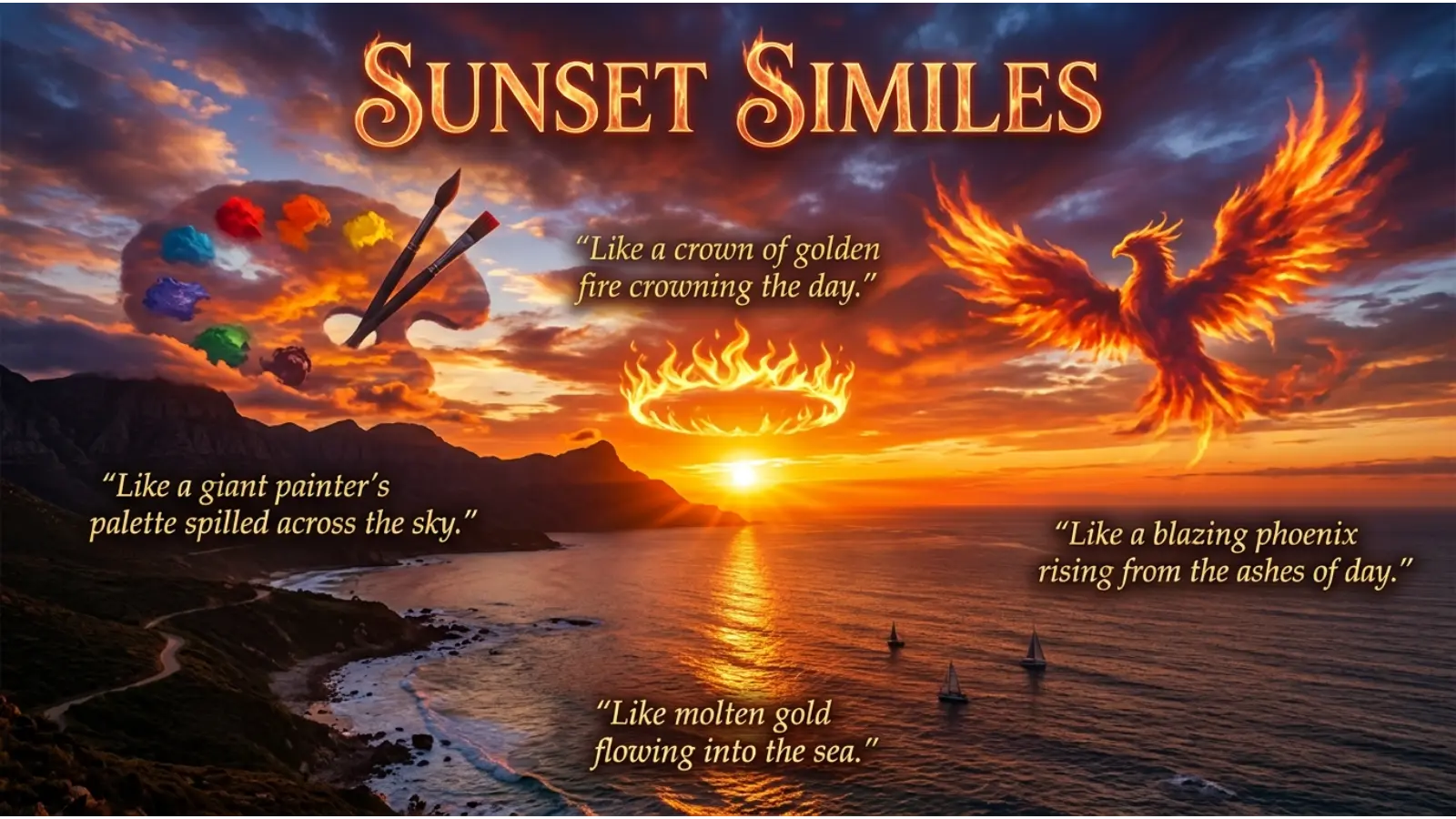
Sunset Similes naturally invite comparison. A sky can seem painted, glowing, melting, or quietly changing as daylight disappears. A well-crafted simile gives those colors and emotions a sharper shape by connecting them to something familiar.
A simile compares two different things using words such as like or as. Instead of simply writing, “The sunset was beautiful,” you might write, “The sunset spread across the horizon like warm honey.” The second sentence gives the reader something concrete to imagine.
Sunset similes are useful in poetry, fiction, essays, journaling, photography captions, speeches, and everyday conversation. This collection focuses on fresh comparisons while also showing how to build stronger imagery yourself.
What Is a Sunset Simile?
A sunset simile compares a sunset, its colors, light, movement, or emotional effect to something else using like or as.
For example:
The sunset glowed like an ember hidden beneath glass.
The sunset is not literally an ember. The comparison helps the reader imagine its deep orange-red glow.
The strongest sunset similes do more than say something is beautiful. They reveal color, mood, movement, atmosphere, temperature, or emotion.
Quick Answer: What Are Some Good Similes for a Sunset?
Some original sunset similes include:
- The sunset glowed like an ember hidden beneath glass.
- The clouds drifted like torn pieces of rose-colored silk.
- The horizon burned like a lantern behind a curtain.
- The evening sky softened like watercolor touched by rain.
- The last sunlight stretched like golden thread across the sea.
- The sun sank like a coin slipping beneath dark water.
- The clouds gathered like quiet ships around a glowing harbor.
- The sunset faded like a song reaching its final note.
These comparisons work because each one gives the reader a specific visual or emotional image instead of relying only on the word beautiful.
30 Original Sunset Similes to Spark Better Writing
1. The Sunset Glowed Like an Ember Hidden Beneath Glass
Meaning: This comparison emphasizes the sunset’s intense orange and red glow while suggesting something warm but contained.
Example:
The sunset glowed like an ember hidden beneath glass.
We stood silently as the last light settled over the fields.
Writing purpose: Use this when you want a sunset to feel warm, powerful, and slightly mysterious.
2. The Sky Blushed Like a Face After a Secret
This simile gives the evening a shy, almost personal quality.
Example:
The sky blushed like a face after a secret.
Even the quiet street seemed to notice the change.
It works especially well in romantic or reflective scenes because blushed suggests emotion without directly naming it.
3. The Last Sunlight Stretched Like Golden Thread Across the Sea
Here, sunlight becomes something delicate and continuous.
Example:
The last sunlight stretched like golden thread across the sea.
Small waves caught the brightness and carried it toward shore.
Best context: Poetry, travel writing, peaceful descriptions, and reflective scenes.
4. The Horizon Burned Like a Lantern Behind a Curtain
This comparison makes the horizon feel bright while the approaching darkness remains visible.
The contrast between lantern and curtain creates depth: something luminous is still present, but night is beginning to cover it.
Writing tip: Contrasting images often make descriptions more memorable than a single adjective such as bright.
5. The Clouds Floated Like Torn Pieces of Rose-Colored Silk
This simile focuses on texture as well as color.
Example:
The clouds floated like torn pieces of rose-colored silk above the rooftops.
The word torn adds irregularity, preventing the image from feeling too polished.
6. The Sun Sank Like a Coin Slipping Beneath Dark Water
This comparison emphasizes the sun’s gradual disappearance.
Example:
The sun sank like a coin slipping beneath dark water.
Within minutes, the bright edge had vanished.
Writing purpose: Use it when the movement of the sunset matters more than its color.
7. The Evening Sky Softened Like Watercolor Touched by Rain
This creates a gentle image of colors blending together.
It works particularly well when a sunset changes from sharp orange and pink into softer shades of purple and blue.
8. The Clouds Gathered Like Quiet Ships Around a Glowing Harbor
The clouds become part of a larger landscape.
Example:
The clouds gathered like quiet ships around a glowing harbor.
This is useful for storytelling because it creates a sense of scale without describing every cloud individually.
9. The Sunset Spilled Like Peach-Colored Paint Over the Hills
The verb spilled gives the sunset movement.
Instead of treating the sky as a static picture, the comparison makes the colors seem to travel across the landscape.
Writing tip: Strong similes often become more vivid when paired with an active verb.
10. The Sunlight Rested on the Buildings Like Melted Gold
This simile emphasizes warmth and reflection.
Example:
Sunlight rested on the buildings like melted gold.
Windows flashed briefly before evening took over.
It works well in urban descriptions because glass, metal, and windows can reflect the imagined golden light.
11. The Sunset Spread Across the Sky Like Jam on Warm Toast
This is a more playful comparison.
It can work in children’s writing, casual descriptions, humorous captions, or scenes that should feel cozy rather than majestic.
Best context: Informal writing.
12. The Red Clouds Hung Like Ribbons Caught in the Wind
This comparison combines color and movement.
The reader can imagine long, irregular strips of red moving across the sky.
13. The Evening Light Flickered Like a Candle Near an Open Window
This gives the sunset a fragile quality.
Emotional effect: It can suggest peace, uncertainty, nostalgia, or the feeling that a moment is about to disappear.
14. The Sky Turned Purple Like Ink Spreading Through Water
This simile is particularly effective during the transition from sunset to twilight.
The image suggests that the color does not appear all at once; instead, it gradually expands.
Writing purpose: Use it to show change rather than simply describe a finished sunset.
15. The Sun Looked Like a Copper Button Sewn Into the Sky
This unusual comparison gives the sun a small, tangible shape.
It is useful when the sun is low on the horizon and appears round and sharply defined.
16. The Sunset Shimmered Like a Secret No One Wanted to Explain
This is more emotional than visual.
The comparison works when the sunset is being used to represent mystery, silence, or an unspoken feeling.
Example:
The sunset shimmered like a secret no one wanted to explain, and neither of us spoke.
17. The Golden Horizon Looked Like a Door Left Open to Another World
This comparison turns the sunset into an invitation.
Best context: Fantasy, adventure, reflective fiction, and imaginative poetry.
It can suggest possibility rather than simply beauty.
18. The Clouds Glowed Like Warm Stones Fresh From a Fire
This creates a sense of heat and texture.
The simile is especially useful for deep orange clouds during a dramatic sunset.
19. The Sunset Faded Like Footprints Washed From the Shore
This comparison focuses on disappearance.
It can carry an emotional suggestion of memory, endings, or something temporary.
Example:
The sunset faded like footprints washed from the shore.
Short similes like this can be powerful in poetry because they leave room for the reader to interpret the emotion.
20. The Sky Shone Like a Window Lit From the Other Side
This is a quieter alternative to comparisons involving fire or gold.
It works well when the sunset is pale rather than intensely red or orange.
21. The Sun Hovered Like a Red Balloon Above the Fields
This gives the sunset a lighter, more playful mood.
Best context: Children’s stories, family scenes, summer descriptions, and cheerful writing.
22. The Clouds Stretched Like Brushstrokes Across a Fresh Canvas
This comparison connects the sky with painting without simply saying that the sky is “painted.”
It is useful when clouds appear in long, thin shapes.
23. The Evening Glowed Like a Fireplace in a Distant Room
This simile creates warmth while maintaining distance.
Emotional effect: Comfort mixed with longing.
It can be particularly effective in stories where a character is watching the sunset from somewhere far away.
24. The Sun Disappeared Like a Stage Light After the Final Scene
This comparison emphasizes an ending.
The sunset becomes the conclusion of a performance, making it especially suitable for stories about farewell, completion, or change.
25. The Horizon Smoldered Like Paper Holding a Hidden Spark
This gives the sunset a dramatic quality without describing destruction.
It works when the sky contains deep reds, oranges, and dark edges.
26. The Evening Sky Folded Like a Blanket Over the Sleeping Town
This shifts the focus from color to atmosphere.
Example:
The evening sky folded like a blanket over the sleeping town.
The comparison creates a peaceful, protective feeling and works well in bedtime stories or quiet narrative scenes.
27. The Sunset Sparkled Like Tiny Windows on a Distant Hill
This is useful when sunlight catches buildings, trees, or other objects across a landscape.
It helps the writer describe reflected light without repeating golden or bright.
28. The Last Rays Reached Out Like Fingers Across the Grass
This gives sunlight human-like movement.
Technically, this combines simile with personification because the rays are described as reaching.
Writing purpose: Use it when you want the fading sunlight to feel active rather than passive.
29. The Sunset Was Like a Quiet Goodbye Written Across the Sky
This is an emotional simile rather than a purely visual one.
It works particularly well when a scene involves separation, memory, or the end of an important moment.
30. Twilight Arrived Like Blue Ink Slowly Covering a Page
This comparison captures the transition after sunset.
It is especially useful because it describes time passing, not just appearance.
Writing tip: When describing natural events, ask yourself what the scene is doing. Movement and change often produce stronger imagery than static descriptions.
How to Make a Sunset Simile More Vivid
A weak simile often looks like this:
The sunset was like a beautiful painting.
There is nothing grammatically wrong with it, but beautiful painting gives the reader little information.
A stronger version identifies a specific quality:
The sunset stretched across the hills like wet watercolor bleeding beyond the edge of a page.
Now the reader gets information about color, movement, softness, and irregularity.
When creating your own sunset simile, consider five questions:
- What color dominates the scene?
- How is the light moving?
- What does the sunset make you feel?
- What familiar object shares that quality?
- Can the comparison reveal something beyond appearance?
The goal is not to find the fanciest comparison. It is to find the comparison that fits the scene.
Match the Simile to the Mood
The same sunset can create completely different emotions depending on the comparison.
For a Peaceful Sunset
Choose gentle images such as:
The evening sky folded like a blanket over the sleeping town.
Words connected with blankets, quiet water, soft fabric, and warm rooms can create comfort.
For a Romantic Sunset
Try an emotional comparison:
The sunset was like a quiet goodbye written across the sky.
Romantic writing often becomes stronger when the image carries an emotion instead of simply announcing romance.
For a Dramatic Sunset
Use comparisons involving strong light, contrast, or movement:
The horizon burned like a lantern behind a curtain.
The contrast between brightness and darkness creates tension.
For a Sad Sunset
Choose an image associated with disappearance or distance:
The sunset faded like footprints washed from the shore.
This makes the sunset symbolize something temporary.
For a Playful Sunset
Unexpected everyday objects can work better than grand imagery:
The sunset spread like peach-colored jam across the sky.
A playful comparison keeps the description approachable.
Why Specific Details Make Similes Stronger
Consider these two sentences:
The sunset was like fire.
The sunset glowed like an ember hidden beneath glass.
Both use comparison, but the second gives the reader more to imagine.
The word ember suggests a particular kind of fire. Hidden beneath glass adds containment and depth.
This demonstrates an important principle of creative writing: specificity creates imagery.
Instead of searching for another synonym for beautiful, identify one physical characteristic and build the comparison around it.
Sunset Similes for Poetry
Poetry often benefits from short, emotionally loaded comparisons.
For example:
The last light
stretched like golden thread
across the water.
The comparison is simple, but golden thread suggests delicacy, connection, and something that may soon break.
When writing a poetic simile, you do not need to explain everything. Sometimes the strongest image is the one that gives the reader enough information to complete the thought.
Sunset Similes for Stories
Fiction gives you more room to connect a simile with a character’s experience.
Instead of:
The sunset was beautiful.
Try:
The sunset faded like footprints washed from the shore, and Mara realized the day had ended before she was ready to leave.
The simile now does two jobs. It describes the setting and reinforces the character’s emotional state.
This is one of the most useful techniques for narrative writing: let description interact with the story instead of decorating it separately.
Sunset Similes for Captions and Everyday Writing
Short comparisons are often best for captions.
Examples:
- Sunset glowing like an ember behind the hills.
- The horizon shining like a doorway to somewhere new.
- Twilight arriving like blue ink across the sky.
- Golden light resting like warm dust on the rooftops.
For a caption, avoid explaining the image too much. One memorable comparison can be enough.
How Professional Writers Avoid Cliché Similes
Common comparisons can become invisible because readers have encountered them so many times.
For example, descriptions involving a sunset as “a painting” or “a ball of fire” may be understandable, but they are familiar.
You do not have to avoid every traditional comparison. The better approach is to add specificity or a fresh angle.
Instead of:
The sky was like a painting.
Try asking:
What kind of painting?
Perhaps it resembles watercolor, an unfinished mural, a child’s brushstrokes, or a canvas being slowly covered.
The more precise your observation, the easier it becomes to create an original comparison.
Common Mistakes When Writing Sunset Similes
Using Too Many Similes
A paragraph filled with comparisons can overwhelm the reader.
If every sentence says something is like something else, none of the images gets enough attention.
Choose the strongest image and allow the surrounding prose to breathe.
Mixing Unrelated Images
A sentence such as:
The sunset was like a golden ocean of burning velvet floating through the sky.
contains several competing ideas.
Ocean, fire, velvet, and sky each suggest different textures and shapes. Combining too many images can make the description confusing.
Choosing a Comparison That Does Not Fit
A simile should match the actual scene.
A soft pastel sunset probably should not be compared to something violently explosive unless the purpose is deliberate contrast.
Explaining the Simile Too Much
If you write:
The sunset was like a golden thread because it was long, thin, bright, and stretched across the sky like thread does.
the explanation removes much of the pleasure of the image.
Trust the reader.
Confusing a Simile With a Metaphor
A simile usually uses like or as:
The sunset glowed like an ember.
A metaphor makes the comparison directly:
The sunset was an ember above the horizon.
Both can create strong imagery. They simply use different grammatical structures.
Simile vs. Metaphor in Sunset Writing
These two literary devices are closely related.
Simile:
The clouds were like torn silk.
Metaphor:
The clouds were torn silk.
The simile signals that the comparison is imaginative. The metaphor makes the comparison more direct.
Use a simile when you want a clear connection between two images. Use a metaphor when you want the image to feel more immediate or symbolic.
Other Literary Devices That Work With Sunset Similes
Imagery
Imagery appeals to the senses.
The last sunlight stretched like golden thread across the sea.
The reader can visualize the color and shape.
Personification
Personification gives human qualities to something nonhuman.
The last rays reached out like fingers across the grass.
The sunlight is treated as though it can reach.
Symbolism
A sunset can symbolize endings, transition, peace, aging, change, or closure depending on the context.
The meaning comes from the surrounding writing rather than from the sunset alone.
Alliteration
Repeating initial sounds can add rhythm:
Soft sunset shadows slipped across the street.
Alliteration should support the image rather than distract from it.
How to Create Your Own Sunset Similes
Try this simple process.
Step 1: Observe One Detail
Do not describe the entire sunset at once.
Look at one thing:
- the color
- the shape of the sun
- the clouds
- the reflection
- the changing light
- the darkness arriving
Step 2: Choose a Familiar Object
Ask what else has that quality.
If the sunlight is thin and bright, you might think of thread.
A the clouds are soft, you might think of fabric.
If the sunset is disappearing, you might think of footprints being erased.
Step 3: Add an Unexpected Specificity
Instead of:
The clouds were like fabric.
Try:
The clouds drifted like torn pieces of rose-colored silk.
The extra details make the comparison distinctive.
Step 4: Test the Emotion
Ask what your simile makes the reader feel.
Is it peaceful? Exciting? Lonely? Warm? Nostalgic? Playful?
If the emotion does not fit your scene, change the comparison.
Step 5: Remove Anything Unnecessary
A strong simile does not need several adjectives.
Compare:
The incredibly beautiful, warm, bright sunset looked like a huge, glowing golden ball.
with:
The sun hovered like a red balloon above the fields.
The second is simpler but gives the reader a clearer image.
A Creative Exercise: Build Five Sunset Similes
Write five sentences using the same sunset but change the comparison each time.
- Compare it to something in nature.
- Compare it to something in a house.
- Compare it to something edible.
- Compare it to something connected with music.
- Compare it to a feeling or memory.
Then choose the strongest one.
This exercise teaches an important writing skill: original imagery often comes from unexpected connections.
Another Exercise: Change the Mood
Start with:
The sunset looked like ______.
Complete it three ways:
- peaceful
- mysterious
- sad
You might discover that the sunset itself has not changed. Your choice of comparison changes the emotional meaning.
That is the power of figurative language.
Frequently Asked Questions About Sunset Similes
What is a good simile for a sunset?
A strong sunset simile describes a specific quality rather than simply calling the sunset beautiful. For example, “The last sunlight stretched like golden thread across the sea” emphasizes brightness, shape, and movement.
What are some poetic similes for sunsets?
Poetic options include comparisons to golden thread, watercolor, glowing embers, distant fireplaces, ribbons, or doors opening into another world. The best choice depends on the poem’s mood.
How do you describe a sunset without saying beautiful?
Focus on what you can actually observe. Describe the changing colors, shadows, reflections, cloud shapes, fading light, or movement of the sun. Then compare one detail to something familiar.
Can a sunset simile be emotional?
Yes. A sunset can be compared to a goodbye, a fading memory, a closing door, or another emotional experience. This allows the description to support the deeper meaning of a scene.
What is the difference between a sunset simile and a sunset metaphor?
A simile makes an explicit comparison using like or as, such as “The sunset glowed like an ember.” A metaphor makes the comparison directly, such as “The sunset was an ember.”
How can I make my sunset similes original?
Start with an observation rather than a familiar phrase. Notice one unusual feature of the sunset and connect it to an object that shares that quality. Specific details usually produce fresher comparisons.
Are sunset similes useful in essays?
They can be, especially in personal essays, descriptive writing, literary analysis, and creative assignments. In formal academic writing, use figurative language selectively so that clarity remains the priority.
How many similes should I use in one paragraph?
There is no fixed number. One strong simile can be more effective than several weak ones. Use enough imagery to create the desired effect without making every sentence figurative.
Conclusion
A sunset does not need more adjectives to become memorable. It needs the right comparison. A carefully chosen simile can turn fading light into thread, a horizon into a doorway, clouds into silk, or twilight into ink. The goal is not to make every description elaborate. It is to help readers see, feel, and remember the moment. When writing your own sunset similes, begin with observation. Find one detail, connect it to something unexpected, and make sure the comparison serves the mood of your scene. The most effective simile is rarely the fanciest one. It is the one that makes the reader pause and think, “Yes—that is exactly what it feels like.”
I am Helena Frost, a writer captivated by the beauty of language and the art of comparison. Through my words, I explore the world by turning ordinary moments into vivid similes and reflections. I enjoy crafting phrases that spark imagination, evoke emotion, and linger in the mind. My writing celebrates the subtle connections between people, nature, and the stories we live. For me, every sentence is an opportunity to reveal the extraordinary in the everyday.