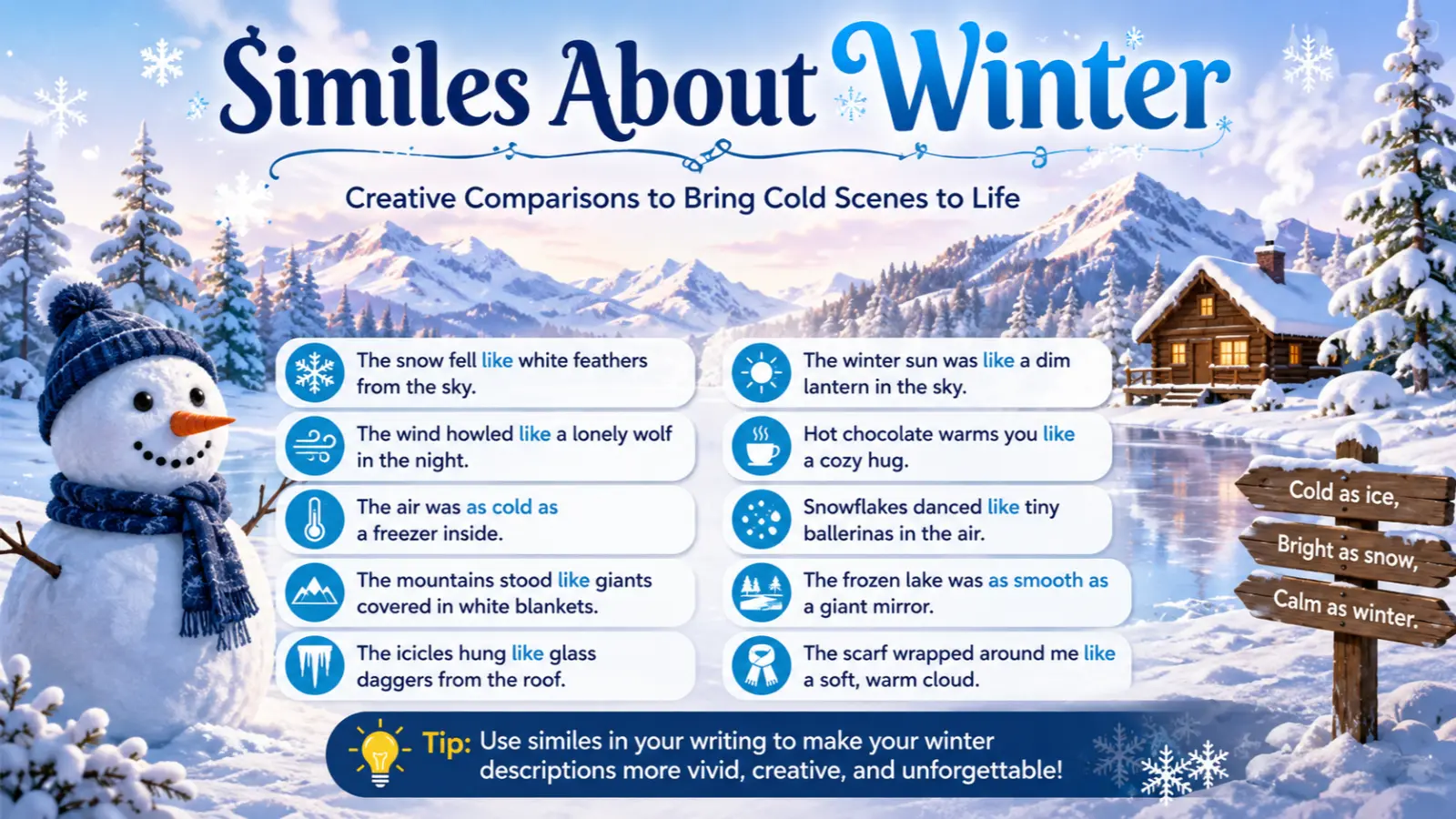
Similes About Winter gives writers a powerful collection of sensory details: icy sidewalks, pale sunlight, frosted windows, sharp winds, quiet streets, and snow-covered landscapes. A good simile turns those familiar details into something readers can picture and feel.
A simile compares two different things using words such as like or as. Instead of simply writing, “The winter wind was cold,” you might write, “The winter wind was like a thin blade slipping through the cracks.” The comparison gives the reader a stronger sense of the cold.
Writers use winter similes in stories, poems, essays, descriptions, speeches, and everyday conversation. This collection of similes about winter focuses not only on examples but also on why each comparison works and how you can create stronger ones yourself.
What Is a Simile About Winter?
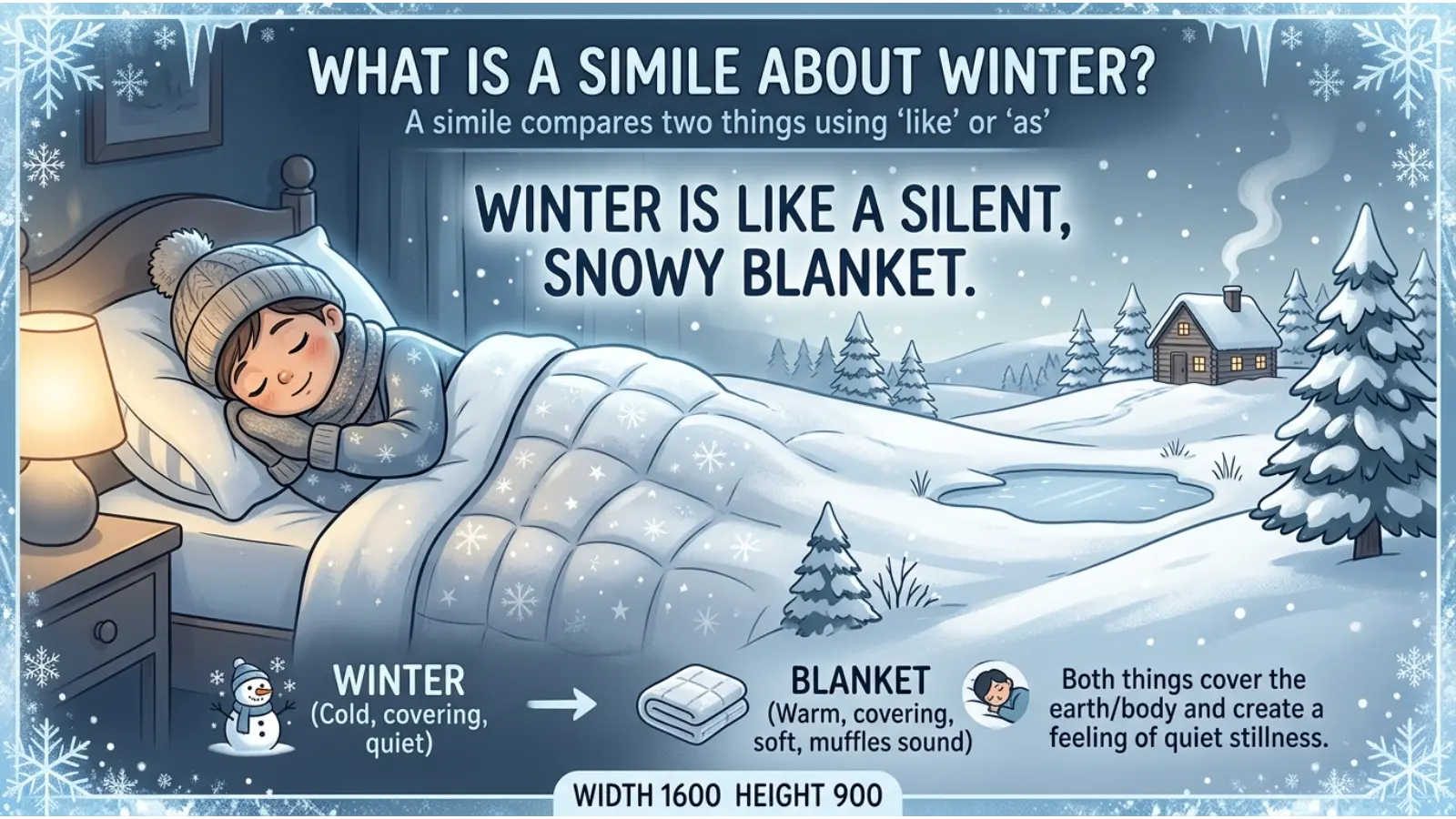
A winter simile compares something connected to winter with another object, feeling, person, or experience to create a clearer image.
For example:
The snow covered the rooftops like a blanket of untouched paper.
The snow is compared with paper because both can create a smooth, pale surface. The comparison helps readers visualize the scene rather than simply being told that snow is present.
Quick Answer
Similes about winter are comparisons that use words such as “like” or “as” to describe winter weather, snow, cold, ice, darkness, landscapes, and seasonal feelings in a more vivid way.
30 Creative Similes About Winter
1. The Snow Fell Like Feathers From a Silent Sky
Meaning: This compares falling snow to soft feathers, emphasizing how gently and quietly it descends.
Example:
The snow fell like feathers from a silent sky, covering the garden without making a sound.
Why it works: The comparison creates a peaceful image rather than focusing only on the whiteness of snow.
Best context: Poetry, peaceful storytelling, winter descriptions.
Writing tip: When describing snow, consider its movement, not just its color.
2. The Winter Wind Was Like a Needle Through My Coat
Meaning: The wind feels sharp and penetrating.
Example:
The winter wind was like a needle through my coat as I hurried toward the house.
This simile creates discomfort without simply saying that the wind was freezing. The word “needle” gives the cold a physical quality.
Best context: Adventure stories, dramatic descriptions, realistic winter scenes.
3. The Frozen Lake Shone Like a Sheet of Silver
Meaning: The comparison emphasizes the lake’s bright, reflective surface.
Example:
At sunrise, the frozen lake shone like a sheet of silver beneath the pale sky.
Writing purpose: This works especially well when sunlight interacts with ice.
Tip: Match your comparison to the lighting in your scene. Ice at sunrise may look very different from ice beneath a gray afternoon sky.
4. The Trees Stood Like Skeletons Against the Gray Sky
Meaning: Leafless trees are compared with skeletons because their bare branches can look thin and exposed.
Example:
The trees stood like skeletons against the gray sky, their branches reaching in every direction.
Emotional effect: The simile can create loneliness, mystery, or uneasiness.
Best context: Gothic fiction, suspense, reflective poetry, and moody descriptions.
5. The Morning Frost Sparkled Like Tiny Pieces of Glass
Meaning: Frost catches the light and appears bright and delicate.
Example:
Morning frost sparkled like tiny pieces of glass along the fence.
Why it works: It focuses on the visual quality of frost rather than simply calling it “beautiful.”
6. The Snowy Road Curved Like a White Ribbon Through the Forest
Meaning: A winding road is compared with a ribbon because both can form a long, flowing shape.
Example:
The snowy road curved like a white ribbon through the dark forest.
Writing purpose: This comparison helps readers understand the road’s shape while adding visual beauty.
7. The Cold Air Felt Like Water Against My Face
Meaning: The comparison makes the sensation of cold air feel immediate and physical.
Example:
The cold air felt like water against my face when I stepped outside.
Writing tip: Sensory similes are often stronger than purely visual ones because they let readers experience the scene.
8. The Snowdrifts Rose Like Waves Along the Road
Meaning: Large piles of windblown snow are compared with waves.
Example:
Snowdrifts rose like waves along the road, blocking the lower parts of the fences.
Why it works: It gives shape and movement to something that is normally still.
9. The Winter Sun Was Like a Weak Lantern in the Clouds
Meaning: The winter sun is presented as dim and distant.
Example:
The winter sun was like a weak lantern hidden behind layers of cloud.
Emotional effect: This can create a feeling of quietness, isolation, or melancholy.
10. The Fireplace Glowed Like an Orange Heart in the Dark
Meaning: The fireplace becomes a symbol of warmth and comfort.
Example:
The fireplace glowed like an orange heart in the dark room.
Writing purpose: This works particularly well when contrasting indoor warmth with the cold outside.
11. The Icicles Hung Like Crystal Teeth From the Roof
Meaning: Long, sharp icicles are compared with teeth.
Example:
Icicles hung like crystal teeth from the old cabin roof.
Emotional effect: The comparison can make an ordinary winter scene feel mysterious or slightly threatening.
Best context: Fantasy, suspense, adventure, and imaginative storytelling.
12. The Snowbank Was as High as a Garden Wall
Meaning: The comparison gives the reader a sense of the snow’s height.
Example:
The snowbank was as high as a garden wall beside the driveway.
Writing tip: Comparisons are useful when you want readers to understand scale.
13. Her Breath Floated Like Little Clouds
Meaning: Visible breath in cold weather is compared with small clouds.
Example:
Their breath floated like little clouds as they talked outside.
Best context: Children’s stories, winter scenes, and gentle descriptive writing.
14. The Night Was Like a Heavy Wool Blanket
Meaning: The winter darkness feels thick, quiet, and enclosing.
Example:
The winter night settled over the village like a heavy wool blanket.
Why it works: Wool is associated with warmth and weight, making the darkness feel tangible.
15. The Bare Branches Scratched the Window Like Restless Fingers
Meaning: Branches moving against glass are compared with fingers.
Example:
Bare branches scratched the window like restless fingers during the storm.
Emotional effect: This creates tension and gives the weather an unsettling personality.
Related device: The comparison also works alongside personification, because the branches seem to behave like living hands.
16. The Snowfield Stretched Like a Blank Page
Meaning: An untouched snowfield resembles a blank page waiting to receive writing.
Example:
Beyond the cabin, the snowfield stretched like a blank page beneath the morning sun.
Writing purpose: This is especially useful for stories about beginnings, possibilities, or exploration.
Creative insight: A strong simile can carry an idea as well as an image. Here, snow can suggest possibility.
17. The Wind Roared Like a Train in the Distance
Meaning: A powerful winter wind is compared with the deep sound of a distant train.
Example:
The wind roared like a train in the distance throughout the night.
Best context: Storm scenes and dramatic storytelling.
Tip: Sound-based similes can make weather descriptions more immersive.
18. The Frozen Grass Crunched Like Crushed Crackers
Meaning: Frost-covered grass makes a brittle sound underfoot.
Example:
The frozen grass crunched like crushed crackers beneath our boots.
Why it works: This comparison uses sound and texture, making the scene more sensory.
19. The Snowflakes Swirled Like Confetti in a Slow Dance
Meaning: Windblown snowflakes move unpredictably through the air.
Example:
Snowflakes swirled like confetti in a slow dance around the streetlights.
Emotional effect: This gives a snowfall a playful and celebratory quality.
20. The Cabin Looked Like a Small Lantern in the Snow
Meaning: A warmly lit cabin stands out against a snowy landscape.
Example:
From the hilltop, the cabin looked like a small lantern in the snow.
Writing purpose: Use this when you want to emphasize shelter, warmth, or hope.
21. The Snow Covered the Fence Like Thick Frosting on a Cake
Meaning: Snow piled along the fence resembles a layer of frosting.
Example:
Fresh snow covered the fence like thick frosting on a cake.
Best context: Lighthearted writing, children’s stories, and playful descriptions.
Tip: Unexpected comparisons can make familiar scenes feel fresh.
22. The Cold Morning Was as Quiet as an Empty Library
Meaning: The comparison emphasizes the unusual silence of a winter morning.
Example:
The cold morning was as quiet as an empty library before sunrise.
Why it works: Readers already understand the quiet atmosphere of an empty library, so the comparison transfers that feeling to the winter scene.
23. The Ice Cracked Like a Breaking Window
Meaning: This comparison emphasizes the sudden, sharp sound of cracking ice.
Example:
The ice cracked like a breaking window somewhere beneath the frozen surface.
Best context: Suspenseful winter scenes.
Writing tip: When writing about potentially dangerous conditions, focus on atmosphere rather than unnecessary detail.
24. The Snowflakes Rested on Her Scarf Like Tiny Stars
Meaning: Snowflakes appear small, bright, and scattered across the fabric.
Example:
Snowflakes rested on her dark scarf like tiny stars.
Emotional effect: Gentle and dreamy.
Best context: Poetry, reflective writing, and quiet character moments.
25. The Frost Painted the Window Like an Invisible Artist
Meaning: Frost patterns appear as if an artist created them.
Example:
Frost painted the window like an invisible artist working before dawn.
Related device: This combines simile with a touch of personification.
Writing purpose: It transforms a natural process into something imaginative.
26. The Snowy Hills Rolled Like Sleeping Giants
Meaning: Large hills are compared with enormous sleeping creatures.
Example:
The snowy hills rolled like sleeping giants beneath the cloudy sky.
Emotional effect: This creates scale and a sense of quiet power.
Best context: Fantasy, landscape writing, and adventure stories.
27. The Winter Clouds Hung Like Heavy Curtains
Meaning: Thick clouds appear to cover the sky like curtains.
Example:
Winter clouds hung like heavy curtains over the town.
Writing purpose: This comparison can make the sky feel closed, gloomy, or enclosed.
28. The Streetlights Glowed Like Warm Coins in the Snow
Meaning: Small round lights stand out against the cold white surroundings.
Example:
Streetlights glowed like warm coins along the snowy road.
Why it works: The contrast between “warm” and “snow” makes the image more noticeable.
Writing tip: Contrast is one of the easiest ways to make a simile more memorable.
29. The Winter Garden Looked Like a Painting Waiting for Spring
Meaning: The dormant garden resembles a finished but temporarily paused artwork.
Example:
The winter garden looked like a painting waiting for spring to add its colors.
Emotional effect: Hopeful and reflective.
Best context: Essays, literary fiction, and personal writing.
30. The First Snow Was Like a New Story Beginning
Meaning: First snowfall is compared with the beginning of a story.
Example:
The first snow was like a new story beginning, changing the familiar neighborhood overnight.
Writing purpose: This comparison works because both snow and stories can transform the way we see familiar things.
Best context: Introductions, reflective essays, poetry, and seasonal storytelling.
How to Make Winter Similes More Vivid
A weak winter simile often names the obvious comparison:
The snow was like cotton.
It is easy to understand, but it does not give the reader much beyond the basic idea of softness or whiteness.
A stronger approach asks what exactly about the snow reminds you of something else.
Consider these possibilities:
- Snow can be compared by texture.
- Wind can be compared by sound.
- Ice can be compared by appearance.
- Darkness can be compared by weight or movement.
- Frost can be compared by patterns.
- A winter landscape can be compared by shape.
- Cold can be compared by physical sensation.
For example:
The snowfield stretched like a blank page.
This comparison does more than describe color. It suggests emptiness, possibility, and a place where something new can happen.
Use Specific Details
Instead of asking, “What does winter look like?” ask:
What does this particular winter moment look, sound, smell, or feel like?
That question produces more original comparisons.
Compare:
The wind was cold.
with:
The wind slipped through the doorway like a draft of unfinished winter.
The second sentence gives the reader a more distinctive experience.
How to Avoid Cliché Winter Similes
Some comparisons appear so often that they no longer surprise readers. Familiar comparisons are not automatically wrong, but writers should use them deliberately.
When a comparison feels predictable, change the angle.
Instead of comparing snow only with something white, consider:
- its silence
- its weight
- its movement
- its texture
- its effect on people
- its relationship with light
- the way it changes familiar places
For example, snow is not only white. It can make a neighborhood feel unfamiliar, turn sound into silence, or transform a road into a blank path.
Originality often comes from noticing something specific rather than trying to sound poetic.
How Professional Writers Build Strong Similes
Effective writers usually begin with observation rather than a thesaurus.
Imagine a winter street at night. Notice what actually happens:
The road is dark. Snow reflects the streetlights. Cars move slowly. Footsteps sound different. Windows glow from inside.
From those observations, comparisons become easier:
The streetlights glowed like warm coins in the snow.
The simile works because it comes from a real visual relationship: small points of warm light against a cold, pale landscape.
Start With the Sensory Detail
Ask five questions:
- What can the character see?
- What can the character hear?
- What can the character feel?
- What can the character smell?
- What changes because of the weather?
Then choose the strongest detail and build your comparison around it.
Simile vs. Metaphor: What’s the Difference?
A simile makes a comparison using words such as like or as.
The snow was like a blank page.
A metaphor makes the comparison directly:
The snow was a blank page.
Both can create imagery, but they produce slightly different effects. A simile signals the comparison clearly, while a metaphor can make the comparison feel more immediate or absolute.
Winter Similes and Other Literary Devices
Winter descriptions become even more effective when similes work alongside other literary techniques.
Imagery
Imagery uses descriptive language to help readers experience a scene through the senses.
The frozen grass crunched like crushed crackers beneath our boots.
The simile strengthens the sound and texture of the scene.
Personification
Personification gives human qualities to nonhuman things.
The wind whispered against the shutters.
A writer could combine it with a simile:
The wind whispered like an impatient visitor outside the door.
Alliteration
Alliteration repeats beginning sounds:
Soft snow settled across the street.
Used carefully, it can give winter prose a particular rhythm.
Symbolism
Winter can symbolize different things depending on context: stillness, isolation, change, hardship, rest, or a pause before renewal.
A winter simile can support that symbolism without explaining it directly.
How to Create Your Own Winter Similes
Try this simple process.
Step 1: Choose One Winter Detail
Pick something specific:
snow, ice, wind, frost, darkness, chimney smoke, frozen grass, bare trees, winter sunlight
Step 2: Describe Its Most Noticeable Quality
For example:
- snow → silent
- wind → sharp
- ice → reflective
- frost → delicate
- trees → bare
- sunlight → pale
Step 3: Brainstorm Unusual Comparisons
For “silent snow,” you might think of:
- a blank page
- an unopened letter
- a sleeping room
- a closed book
Step 4: Choose the Comparison That Adds Meaning
Do not choose a comparison simply because it sounds pretty. Choose one that tells the reader something useful.
Step 5: Test the Sentence
Ask:
Can the reader picture it?
Does it fit the mood?
it sound natural when read aloud?
Does the comparison add something beyond the original noun or adjective?
If the answer is yes, the simile is probably doing useful work.
Creative Exercises for Writing Winter Similes
Exercise 1: Five Senses
Write one simile for each sense.
- Sight:
- Sound:
- Touch:
- Smell:
- Taste:
The goal is to prevent every winter description from becoming visual.
Exercise 2: Change the Mood
Describe the same snowfall three ways:
Peaceful:
The snow fell like…
Mysterious:
The snow fell like…
Joyful:
The snow fell like…
This exercise teaches an important lesson: the best simile depends on the emotion you want the reader to feel.
Exercise 3: Ban the Obvious
Write five winter similes without using:
- snow
- ice
- white
- cold
- Christmas
This forces you to notice less obvious aspects of winter.
Exercise 4: Build a Character Simile
Describe how a character experiences winter.
A confident character, a lonely character, and an excited child might all see the same snow differently.
The weather stays the same. The comparison changes because the point of view changes.
Common Mistakes When Writing Winter Similes
Using Overused Comparisons
If readers have encountered the same comparison hundreds of times, it may not create a strong image.
Try changing the source of your comparison rather than simply adding more adjectives.
Mixing Images
Avoid creating confusing combinations:
The snow was like a roaring ocean of feathers made from glass.
Each image points in a different direction. The reader has to work too hard to understand the intended picture.
Choose one dominant comparison.
Forcing a Simile Into Every Sentence
Not every sentence needs figurative language.
Too many similes can make writing feel crowded. Let some sentences remain simple so the strongest comparisons have room to stand out.
Confusing Similes With Metaphors
Remember:
Simile: The wind was like a whistle.
Metaphor: The wind was a whistle.
Knowing the difference helps you choose the right technique.
Using a Comparison That Does Not Fit the Mood
A playful comparison can weaken a serious scene.
For example, describing a dangerous winter storm as “like a birthday party” would create a very different tone from “like a locked door rattling in the dark.”
Always consider the emotional purpose of the scene.
Frequently Asked Questions About Winter Similes
What are some good similes about winter?
Good winter similes make specific comparisons involving snow, ice, wind, frost, darkness, light, and winter landscapes. For example, “The snowy road curved like a white ribbon through the forest” creates both shape and visual imagery.
What is a simile for snow?
A snow simile can focus on appearance, movement, texture, or sound. For example: “The snowfield stretched like a blank page.” The comparison suggests both whiteness and possibility.
What is a simile for cold weather?
You can compare cold weather with something that communicates its physical effect. For example: “The winter wind was like a needle through my coat.” This makes the cold feel sharp and penetrating.
What is a simile for a winter storm?
A winter storm can be compared with something powerful or noisy. For example: “The wind roared like a train in the distance.” Sound is especially effective when describing storms.
How do you write a creative winter simile?
Start with a specific winter detail, identify its strongest quality, and compare that quality with something readers already understand. Avoid choosing a comparison only because it sounds poetic.
Can winter similes be used in poems?
Absolutely. Similes are particularly useful in poetry because they can compress an image, emotion, and idea into a short line.
What is the difference between a winter simile and a winter metaphor?
A winter simile uses an explicit comparison, usually with like or as. A metaphor makes the comparison directly. For example, “The snow was like a blanket” is a simile, while “The snow was a blanket” is a metaphor.
Why are similes useful in winter writing?
Winter can involve familiar subjects such as snow, cold, darkness, and ice. A fresh simile gives those familiar subjects a new angle, helping readers visualize the scene and connect with its mood.
Conclusion
The strongest similes about winter do more than decorate a sentence. They help readers see the shape of a snowy road, hear the sound of frozen grass, feel the bite of wind, or sense the quiet of a winter morning. When creating your own comparisons, start with observation. Notice one specific detail, identify what makes it interesting, and then find an unexpected but believable comparison. Keep the image clear, match it to the mood, and remove it if it does not add anything. Winter offers endless material for creative writing. Look beyond snow and cold, and you will find comparisons hidden in the silence, light, movement, texture, and changing landscape of the season. The more carefully you observe, the more original your similes can become.
I am Helena Frost, a writer captivated by the beauty of language and the art of comparison. Through my words, I explore the world by turning ordinary moments into vivid similes and reflections. I enjoy crafting phrases that spark imagination, evoke emotion, and linger in the mind. My writing celebrates the subtle connections between people, nature, and the stories we live. For me, every sentence is an opportunity to reveal the extraordinary in the everyday.