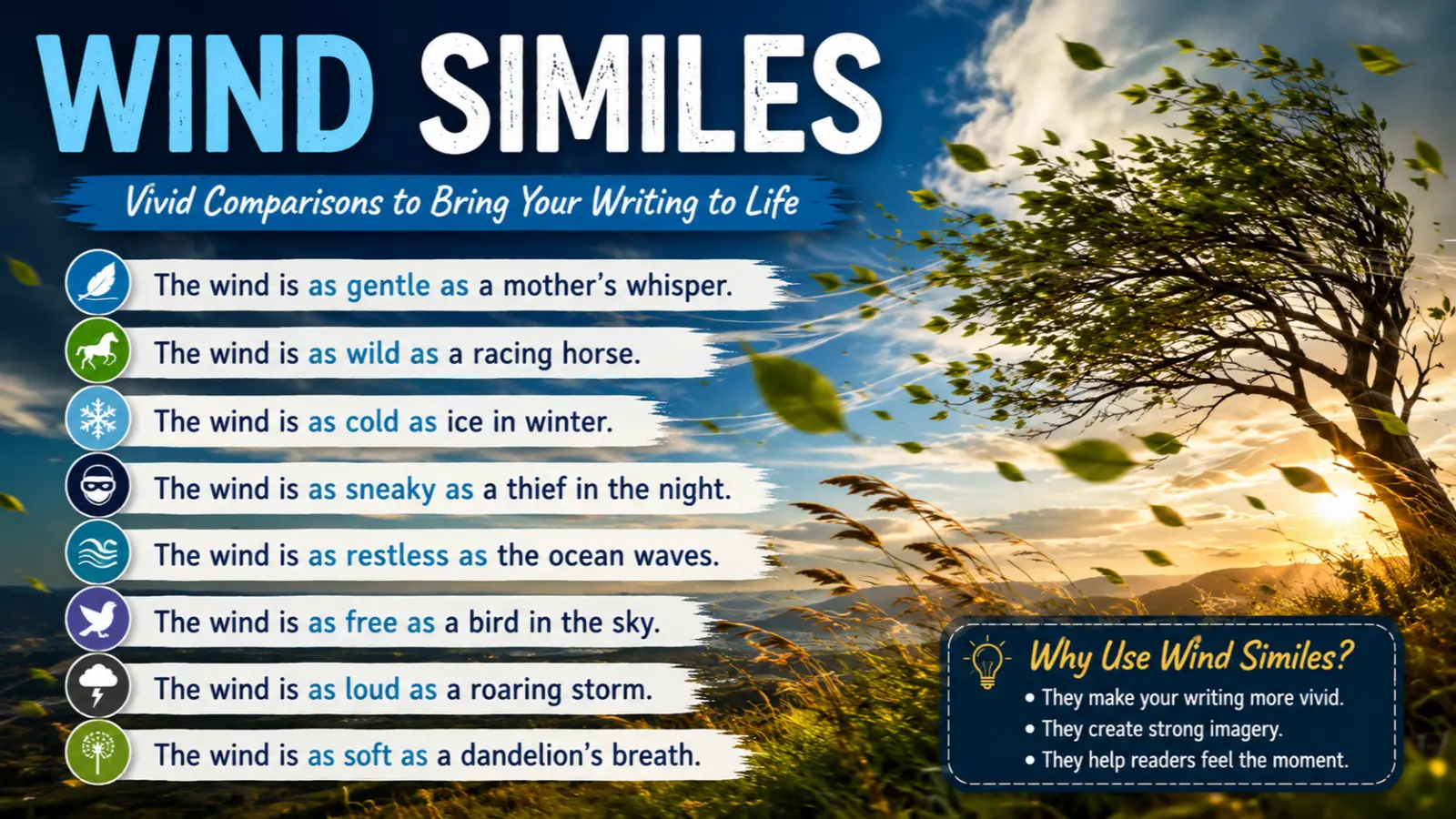
Wind Similes can be gentle, restless, playful, or powerful. Because you cannot see it directly, writers often use similes to help readers imagine how it moves, sounds, and feels. A strong wind simile compares the wind to something familiar, turning an invisible force into a vivid picture.
A simile uses words such as “like” or “as” to make a comparison. Writers use similes in poetry, stories, essays, descriptions, speeches, and everyday conversation. Instead of simply saying “the wind was strong,” a writer can compare it to something that gives the reader a clearer sense of movement or power.
This collection offers original wind similes, explains what makes them effective, and shows how to use them naturally in your own writing.
What Is a Wind Simile?
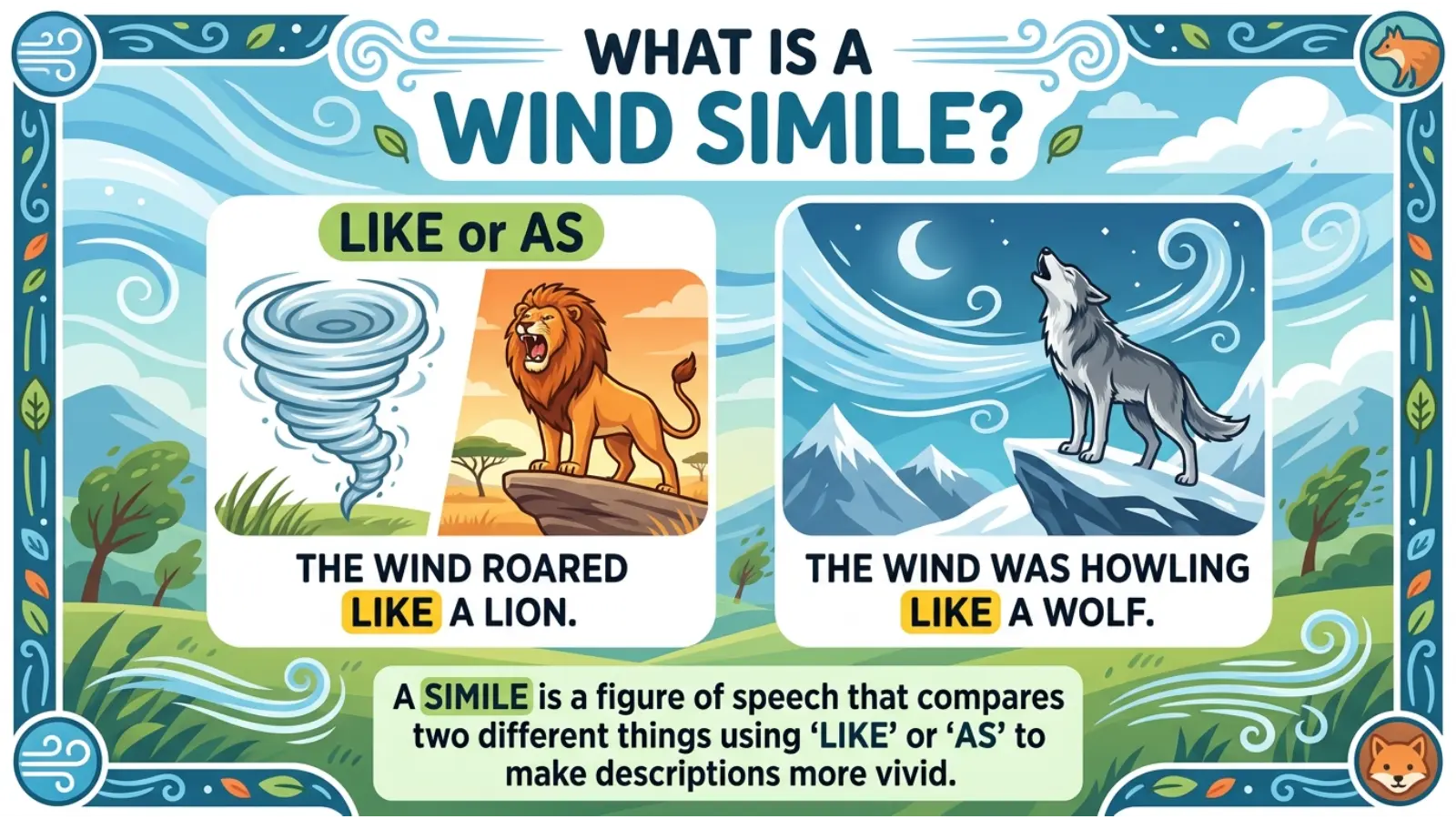
A wind simile compares the wind or its effects to another image using like or as.
For example:
The wind slipped through the trees like a secret messenger.
The comparison gives the wind a sense of movement and mystery. Rather than merely describing air, it creates an image readers can picture.
A useful wind simile should do more than decorate a sentence. It should help readers understand the wind’s speed, sound, temperature, direction, strength, or emotional effect.
25 Original Wind Similes for Writing
1. The wind moved like a ribbon through the branches.
Meaning: The wind flowed smoothly between the branches.
Example:
The wind moved like a ribbon through the branches, making the leaves tremble softly.
Writing purpose: This works well for peaceful outdoor scenes because “ribbon” suggests smooth, graceful movement.
2. The wind rushed past like a late train.
Meaning: The wind moved quickly and with force.
Example:
The wind rushed past like a late train, scattering dry leaves across the sidewalk.
Best context: Use this comparison in action scenes or descriptions of sudden weather.
3. The morning breeze was as gentle as a feather brushing the skin.
Meaning: The breeze felt extremely soft.
Example:
The morning breeze was as gentle as a feather brushing the skin.
Emotional effect: It creates a calm, delicate atmosphere.
Writing tip: Soft objects such as feathers, silk, and mist work especially well when describing a mild breeze.
4. The wind whistled like a traveler calling from far away.
Meaning: The sound of the wind resembles a distant call.
Example:
The wind whistled like a traveler calling from far away beyond the hills.
Best context: This fits mysterious or lonely scenes.
5. The cold wind nipped at my cheeks like tiny needles.
Meaning: The wind felt sharply cold against the skin.
Example:
The cold wind nipped at my cheeks like tiny needles as I walked home.
Why it works: The comparison creates a physical sensation rather than simply telling readers that the weather was cold.
6. The wind danced through the meadow like a child chasing butterflies.
Meaning: The wind moved playfully through the grass.
Example:
The wind danced through the meadow like a child chasing butterflies.
Emotional effect: Cheerful and energetic.
Best context: Nature writing, children’s stories, and joyful scenes.
7. The evening breeze curled around the porch like warm smoke.
Meaning: The breeze moved slowly and gently around the porch.
Example:
The evening breeze curled around the porch like warm smoke.
Writing purpose: This comparison emphasizes the wind’s flowing movement rather than its strength.
8. The wind shook the windows like an impatient visitor.
Meaning: Strong wind repeatedly struck the windows.
Example:
The wind shook the windows like an impatient visitor waiting to be let inside.
Why it works: It gives the wind human-like urgency without directly turning the sentence into personification.
9. The breeze wandered through the garden like a curious explorer.
Meaning: The wind moved gently from one part of the garden to another.
Example:
The breeze wandered through the garden like a curious explorer, stirring every flower it passed.
Best context: Descriptive storytelling.
10. The wind swept across the field like a silver brush.
Meaning: The moving air seemed to brush across the landscape.
Example:
The wind swept across the field like a silver brush, bending the tall grass in waves.
Writing tip: Visual comparisons are especially effective when the wind causes something visible to move.
11. The storm wind roared like a giant engine.
Meaning: The wind was extremely loud and powerful.
Example:
The storm wind roared like a giant engine outside the house.
Best context: Storm scenes and dramatic narratives.
12. The breeze touched the curtains like a careful hand.
Meaning: The wind moved the curtains gently.
Example:
The breeze touched the curtains like a careful hand and disappeared into the hallway.
Emotional effect: Quiet, intimate, and slightly mysterious.
13. The wind raced down the street like a messenger carrying urgent news.
Meaning: The wind moved quickly through the street.
Example:
The wind raced down the street like a messenger carrying urgent news, lifting scraps of paper behind it.
Writing purpose: This creates movement and urgency.
14. The winter wind was as sharp as a freshly sharpened pencil.
Meaning: The cold wind felt biting and uncomfortable.
Example:
The winter wind was as sharp as a freshly sharpened pencil against my exposed hands.
Why it works: An unexpected comparison can make an ordinary weather description more memorable.
15. The wind fluttered around the tent like nervous birds.
Meaning: The wind moved rapidly and unevenly around the tent.
Example:
The wind fluttered around the tent like nervous birds trapped beneath the trees.
Best context: Adventure stories and tense outdoor scenes.
16. The breeze drifted across the lake like a quiet thought.
Meaning: The breeze moved slowly and peacefully.
Example:
The breeze drifted across the lake like a quiet thought, barely disturbing the water.
Emotional effect: Reflective and peaceful.
17. The wind tugged at my jacket like a playful puppy.
Meaning: The wind repeatedly pulled at the jacket.
Example:
The wind tugged at my jacket like a playful puppy as I crossed the open field.
Best context: Lighthearted descriptions.
18. The autumn wind scattered leaves like cards thrown across a table.
Meaning: The wind spread leaves in different directions.
Example:
The autumn wind scattered leaves like cards thrown across a table.
Writing purpose: This comparison gives readers a strong visual image of scattered leaves.
19. The wind slipped beneath the door like a thin silver snake.
Meaning: A narrow current of air entered through the gap beneath the door.
Example:
The wind slipped beneath the door like a thin silver snake.
Emotional effect: Eerie and suspenseful.
Best context: Mystery, suspense, and gothic-style scenes.
20. The breeze was as light as a whisper.
Meaning: The breeze was barely noticeable.
Example:
The breeze was as light as a whisper, barely moving the curtains.
Writing tip: Keep gentle comparisons simple. An elaborate comparison can make a quiet scene feel unnecessarily dramatic.
21. The wind hammered the rooftop like handfuls of thrown stones.
Meaning: Strong wind and weather struck the roof repeatedly.
Example:
The wind hammered the rooftop like handfuls of thrown stones throughout the night.
Best context: Storm scenes where you want readers to sense force and noise.
22. The sea wind curled around us like a cool blue scarf.
Meaning: The breeze felt cool and wrapped around the people nearby.
Example:
The sea wind curled around us like a cool blue scarf as we watched the sunset.
Emotional effect: Relaxing and coastal.
Why it works: The scarf provides both a visual image and a sense of physical sensation.
23. The wind raced through the canyon like water escaping a broken dam.
Meaning: The wind moved rapidly and powerfully through a narrow space.
Example:
The wind raced through the canyon like water escaping a broken dam.
Best context: Dramatic landscapes and adventure writing.
24. The night wind murmured like an old radio between stations.
Meaning: The wind produced an uneven, distant sound.
Example:
The night wind murmured like an old radio between stations outside the cabin.
Emotional effect: Strange, lonely, and atmospheric.
Writing tip: Sound-based comparisons are useful when the reader cannot see the thing being described.
25. The first spring breeze arrived like an unopened letter.
Meaning: The breeze suggests the arrival of something new and promising.
Example:
The first spring breeze arrived like an unopened letter, carrying the promise of warmer days.
Emotional effect: Hopeful and anticipatory.
Best context: Poetry, reflective writing, and seasonal descriptions.
How to Choose the Right Wind Simile
The best comparison depends on what you want the reader to notice.
If the wind is gentle, compare it with something soft or delicate:
The breeze floated through the room like a loose silk thread.
If the wind is violent, choose something associated with force:
The wind charged across the valley like a runaway machine.
the wind is mysterious, use an image that creates uncertainty:
The wind moved through the empty house like a message no one could understand.
If the wind is playful, choose something energetic:
The breeze skipped across the grass like a child late for recess.
The important question is not “What rhymes with wind?” It is “What quality of the wind am I trying to show?”
How to Make Wind Descriptions More Vivid
A common beginner mistake is describing the weather only with adjectives.
Instead of:
The wind was strong and cold.
Try focusing on what the wind does:
The wind tugged at the trees and slipped icy fingers beneath my collar.
The second sentence gives readers movement and sensation.
You can also combine a simile with a concrete detail:
The wind swept through the wheat like a giant brush, leaving waves behind it.
The simile works because the reader can see the wheat moving.
Use the Wind’s Effect on the Environment
Wind itself may be invisible, but its effects are visible.
Look at:
- Leaves spinning
- Curtains lifting
- Grass bending
- Dust drifting
- Waves changing direction
- Branches shaking
- Doors rattling
- Clouds moving
- Hair blowing
- Paper flying
These details give your simile something tangible to attach to.
Avoid Cliché Wind Similes
Some comparisons have been used so often that they no longer create a strong image.
For example, phrases such as “wind like a hurricane” may communicate intensity, but they can feel predictable when used without a specific purpose.
Instead, search for a comparison connected to your particular scene.
A windy schoolyard might need a different image from a windy beach. A mountain storm should not sound exactly like a summer breeze.
Think about the setting first, then build the comparison.
Why Specific Similes Feel More Original
Originality does not require an extremely strange comparison.
A believable image can feel fresh when it is specific.
Compare:
The wind was like a monster.
with:
The wind battered the empty playground like a drummer refusing to stop.
The second comparison gives the reader sound, movement, and atmosphere.
A good simile usually has a clear connection between the two things being compared.
Wind Similes for Different Moods
Peaceful Wind
For peaceful scenes, choose images connected with softness and slow movement.
The breeze rested over the pond like a thin blanket.
This creates a calm atmosphere without making the description complicated.
Sad or Lonely Wind
For loneliness, distant sounds and empty spaces can be effective.
The wind moved through the empty station like a voice with no one left to answer.
The comparison adds emotional weight to an otherwise ordinary weather detail.
Exciting Wind
For action, use quick movement and energetic images.
The wind shot through the trees like an arrow released from a bow.
The verbs “shot” and “released” reinforce the sense of speed.
Frightening Wind
For suspense, use unfamiliar or unsettling images.
The wind crept around the abandoned house like a warning nobody could read.
The comparison suggests danger without explaining exactly what will happen.
Wind Similes in Poetry
Poetry often uses similes to turn natural elements into emotional symbols.
Consider:
The evening wind folded across the fields like a fading song.
The comparison does not simply describe movement. It connects the wind with something disappearing, giving the scene a reflective mood.
When writing poetry, avoid adding a simile simply because you need figurative language. Ask whether the comparison contributes to the poem’s sound, rhythm, image, or emotional meaning.
A strong poetic simile should earn its place.
Simile vs. Metaphor: What’s the Difference?
A simile makes an explicit comparison using words such as “like” or “as.”
The wind moved like a dancer across the field.
A metaphor makes the comparison directly.
The wind was a dancer across the field.
Both can create imagery, but they produce slightly different effects.
Similes can feel more exploratory because they invite readers to connect two separate images. Metaphors can sound more direct and forceful.
Simile and Personification Can Work Together
Personification gives human qualities to something nonhuman.
For example:
The wind knocked impatiently against the door.
This is personification because the wind is behaving like a person.
You can combine personification with comparison:
The wind knocked against the door like an impatient visitor.
The first part gives the wind human behavior; the simile strengthens the picture.
How to Create Your Own Wind Similes
Try this simple process.
Step 1: Identify the Wind’s Quality
Choose one:
- Gentle
- Cold
- Hot
- Fast
- Loud
- Restless
- Sudden
- Mysterious
- Playful
- Powerful
Step 2: Notice What the Wind Does
Ask:
What moves because of the wind?
Maybe it bends grass, shakes branches, rattles windows, lifts dust, or pushes clouds.
Step 3: Choose a Familiar Image
Think of objects or actions that behave similarly.
For example:
Wind moves through grass → brush moves across paper.
Then develop the comparison:
The wind moved through the grass like a brush sweeping across a giant green canvas.
Step 4: Check the Logic
Ask whether the comparison actually helps.
If the wind is supposed to feel peaceful, comparing it to an exploding engine would create the wrong emotional effect.
Step 5: Remove Extra Words
Strong imagery does not need unnecessary explanation.
Instead of:
The wind moved very quickly and loudly across the field like a very fast racing car that was moving quickly down a road.
Try:
The wind tore across the field like a racing car on an empty highway.
Cleaner writing usually creates a stronger image.
Creative Exercises for Writers
Exercise 1: Five Wind Moods
Write one simile for each mood:
- Peaceful
- Angry
- Lonely
- Excited
- Mysterious
Make sure each comparison creates a different emotional response.
Exercise 2: Use One Object
Choose an object such as a flag, curtain, tree, or window.
Write three sentences describing the wind affecting that object. Use a different simile each time.
This teaches you how changing the comparison can change the mood.
Exercise 3: Make the Invisible Visible
Write a paragraph about wind without using the words strong, gentle, cold, hot, fast, or loud.
Instead, show the wind through what it does.
This is a useful exercise because effective description often comes from observable details rather than stacks of adjectives.
Common Mistakes When Writing Wind Similes
Using the Same Comparison Repeatedly
If every windy scene sounds like a storm, your writing loses variety. Match the comparison to the actual conditions.
Mixing Unrelated Images
Avoid jumping between several unrelated comparisons in one sentence.
The wind was like a tiger, a river, and a broken violin.
Each image suggests a different quality, so the sentence becomes confusing.
Choose the image that best supports your main idea.
Choosing a Comparison Just to Sound Clever
A complicated comparison is not automatically a good one.
If readers have to stop and decode the image, the simile may be distracting rather than helpful.
Forgetting the Setting
A wind simile should belong to its environment.
A comparison involving sails might work beautifully near the ocean but feel less natural in an urban office.
Explaining Too Much
Once a clear simile has created the image, trust the reader.
Instead of:
The wind moved like a ribbon, which means it moved smoothly and gracefully.
In a finished story, simply let the image work:
The wind moved like a ribbon through the branches.
Frequently Asked Questions About Wind Similes
What is a good simile for wind?
A good wind simile compares the wind to something that shares its particular quality. For example, a gentle breeze might be compared to a ribbon, while a powerful storm wind might be compared to a rushing engine.
How do you describe wind creatively?
Focus on what the wind does rather than only describing it with adjectives. Show leaves spinning, branches bending, curtains lifting, windows rattling, or waves changing direction.
What is a simile for strong wind?
One original example is:
The wind charged across the valley like a runaway machine.
It emphasizes speed and force.
What is a simile for a gentle breeze?
You could write:
The breeze drifted across the lake like a quiet thought.
This creates a peaceful, reflective mood.
What is a poetic simile for wind?
A poetic option is:
The evening wind folded across the fields like a fading song.
It combines movement with an emotional image.
What is the difference between a wind simile and personification?
A wind simile compares wind to something using words such as “like” or “as.” Personification gives wind human qualities, such as saying that the wind “knocked” or “whispered.”
How can I make my wind similes more original?
Start with the specific scene rather than searching for a generic comparison. Decide what the wind feels, sounds, or looks like in that particular moment, then find an image that naturally shares that quality.
Conclusion
The most effective wind similes do more than tell readers that air is moving. They give invisible movement a shape, sound, texture, or emotional meaning. When creating your own comparisons, begin with the scene. Notice what the wind is doing, decide what mood you want, and then search for an image that naturally carries that feeling. A simple, precise comparison will usually be stronger than an elaborate one that exists only to sound impressive. Experiment with different images, read your sentences aloud, and pay attention to whether each simile makes the scene clearer. Once you learn to connect movement, sensation, setting, and emotion, even an ordinary breeze can become memorable on the page.

I am Helena Frost, a writer captivated by the beauty of language and the art of comparison. Through my words, I explore the world by turning ordinary moments into vivid similes and reflections. I enjoy crafting phrases that spark imagination, evoke emotion, and linger in the mind. My writing celebrates the subtle connections between people, nature, and the stories we live. For me, every sentence is an opportunity to reveal the extraordinary in the everyday.