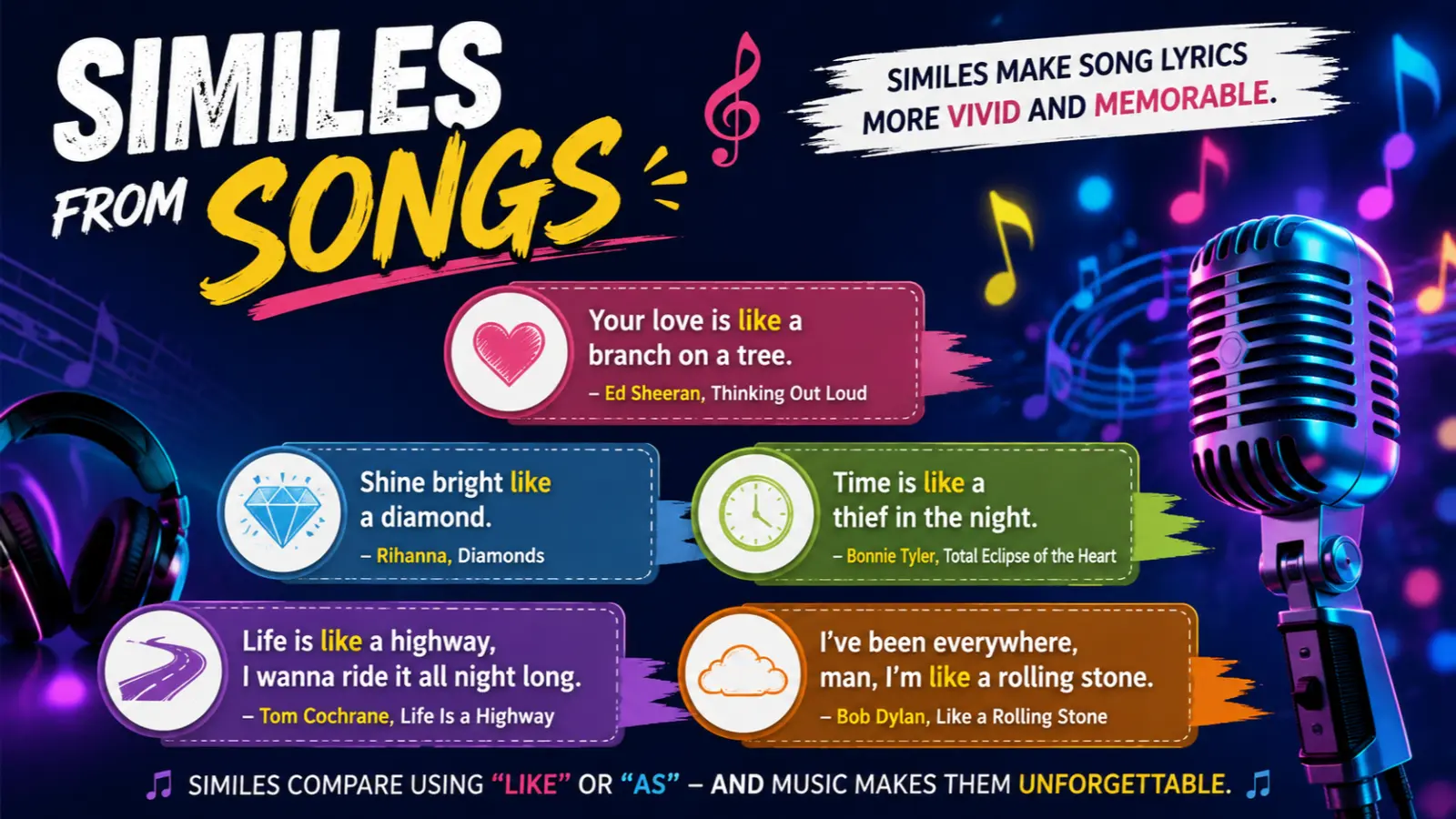
Similes from songs are comparisons that connect one idea, feeling, person, or experience to another using words such as “like” or “as.” Songwriters use them to turn abstract emotions into images listeners can easily picture.
For example, instead of simply saying “I miss you,” a songwriter might compare missing someone to an empty room after the music stops. The comparison gives the emotion shape.
Similes From Songs appear naturally in music, poetry, storytelling, advertising, and everyday conversation. In Similes From Songs especially, they can make a short line feel memorable because listeners can connect an emotion with a concrete image.
This guide explores original examples inspired by the kinds of comparisons songwriters use. The examples below are newly written rather than quotations from existing songs, so you can study the technique without copying another writer’s lyrics.
Quick Answer: Why Do Songwriters Use Similes?
Songwriters use Similes From Songs to make emotions and ideas easier to visualize. A strong comparison can turn feelings such as love, loneliness, excitement, anger, or hope into memorable images that listeners can immediately understand.
How Similes Make Songs More Memorable

Similes From Songs already combines sound, rhythm, and emotion. A well-chosen simile adds another layer: imagery.
Consider the difference:
Her voice was beautiful.
and:
Her voice moved through the room like sunlight through a window.
The second sentence gives the reader something to imagine. The voice is no longer only “beautiful”; it feels warm, gentle, and illuminating.
That is one reason Similes From Songs work particularly well in songwriting. A song has limited space, so a single vivid comparison can communicate an entire emotional situation.
The Best Song Similes Usually Do More Than Compare
A weak simile simply says that two things are similar.
A stronger one reveals something about the speaker.
For example:
My thoughts circled like birds that couldn’t find a place to land.
The comparison suggests restlessness and uncertainty. The image tells us something about the speaker’s emotional state without directly explaining it.
30 Original Similes Inspired by Songwriting
The following examples are original and designed to demonstrate different moods and songwriting situations.
1. “Her laughter was like sunlight spilling across a quiet kitchen.”
Meaning: Her laughter brings warmth and life into an otherwise ordinary space.
Writing purpose: This works well when you want happiness to feel physical rather than simply naming the emotion.
Example:
When she laughed, the whole morning changed; her laughter was like sunlight spilling across a quiet kitchen.
2. “His goodbye fell like a stone into still water.”
Meaning: The goodbye creates a disturbance that continues long after it is spoken.
Emotional effect: Sadness and emotional shock.
Best context: A reflective song about separation.
3. “My heart raced like sneakers on a staircase.”
Meaning: The speaker’s excitement or nervousness feels sudden and energetic.
Writing tip: Unexpected everyday comparisons can feel fresher than familiar romantic imagery.
4. “The city glowed like a secret nobody had discovered.”
Meaning: The city appears mysterious, exciting, and full of possibilities.
Best context: A nighttime song or story about starting over.
5. “Your memory stayed like perfume on an old jacket.”
Meaning: Even after someone leaves, reminders of them remain.
Why it works: Perfume is invisible but recognizable, making it a useful image for memory.
6. “Hope rose like a small lantern in the dark.”
Meaning: Hope begins quietly but provides direction.
Emotional effect: Comfort and optimism.
Example:
When everything seemed finished, hope rose like a small lantern in the dark.
7. “Her words cut like winter wind through an open door.”
Meaning: Her words feel painful and unexpectedly harsh.
Writing purpose: This comparison connects emotional pain with a physical sensation.
8. “The crowd moved like one enormous wave.”
Meaning: Many people are moving together with shared energy.
Best context: Concerts, celebrations, sports events, or energetic songs.
9. “His dreams were like paper boats on a restless river.”
Meaning: His ambitions are fragile and vulnerable to circumstances.
Writing tip: Combining a delicate object with a powerful setting creates tension.
10. “Our conversation faded like chalk beneath the rain.”
Meaning: The connection gradually disappeared.
Emotional effect: Nostalgia and loss.
11. “Her confidence shone like a mirror catching morning light.”
Meaning: Her confidence is noticeable and bright.
Best context: A song about personal growth.
12. “The silence between us was like an unopened letter.”
Meaning: Important feelings exist but remain unspoken.
Why it works: The unopened letter represents communication that never happened.
13. “My worries followed me like loose threads.”
Meaning: Small concerns keep attaching themselves to the speaker.
Writing purpose: Useful for describing persistent anxiety without simply repeating words such as worried or stressed.
14. “The old melody returned like a familiar street.”
Meaning: Hearing the melody brings back memories and familiarity.
Best context: Nostalgic music or songs about childhood.
15. “His anger burned like a stove left unattended.”
Meaning: His anger grows dangerously when it is not controlled.
Writing tip: Comparisons become stronger when the image suggests movement or consequences.
16. “Your kindness felt like shade beneath a summer sky.”
Meaning: Someone’s kindness provides relief during a difficult time.
Emotional effect: Gratitude and comfort.
17. “The bass shook the room like thunder under the floor.”
Meaning: The music feels powerful and physical.
Best context: Describing a live performance.
18. “Her courage stood like a lighthouse against the storm.”
Meaning: Her courage provides stability during hardship.
Writing purpose: This works especially well for inspirational or motivational writing.
19. “My loneliness stretched like an empty highway.”
Meaning: The speaker experiences loneliness as something long and seemingly endless.
Example:
After everyone left, my loneliness stretched like an empty highway.
20. “The chorus lifted like birds escaping a quiet field.”
Meaning: The chorus creates a feeling of release and freedom.
Best context: Describing the emotional effect of music.
21. “His promise was as fragile as ice beneath spring sunlight.”
Meaning: The promise may not survive pressure or changing circumstances.
Why it works: The comparison communicates uncertainty without directly stating it.
22. “Their friendship grew like vines around an old garden wall.”
Meaning: Their friendship developed gradually and became deeply connected.
Best context: Songs or stories about lasting friendship.
23. “Her sadness lingered like rain on a window.”
Meaning: The sadness remains present even after the immediate cause has passed.
Writing tip: Choose images that can continue existing after the main action. This creates emotional depth.
24. “The melody danced like sparks above a campfire.”
Meaning: The melody feels lively, bright, and energetic.
Best context: Joyful or celebratory music.
25. “My memories opened like drawers in an abandoned room.”
Meaning: Old memories suddenly become accessible.
Emotional effect: Mystery, nostalgia, and perhaps uneasiness.
26. “His voice was as steady as a train crossing open country.”
Meaning: His voice feels calm, consistent, and controlled.
Writing purpose: This comparison emphasizes steadiness rather than volume.
27. “The night wrapped around us like a velvet curtain.”
Meaning: The darkness feels soft, enclosing, and theatrical.
Best context: Romantic, mysterious, or cinematic songwriting.
28. “Her smile arrived like spring after a long gray season.”
Meaning: Her smile brings renewal after a difficult period.
Why it works: The seasonal image gives emotional change a recognizable pattern.
29. “My thoughts scattered like receipts in a sudden wind.”
Meaning: The speaker cannot keep their thoughts organized.
Writing tip: Ordinary objects can produce surprisingly vivid imagery when placed in an unusual situation.
30. “The final note hung like a question in the air.”
Meaning: The ending leaves uncertainty or emotional tension.
Best context: A reflective song ending or a dramatic scene.
How to Write Better Similes for Songs
A good song simile usually starts with an emotion, not with the word “like.”
Instead of asking:
“What can I compare this to?”
start by asking:
“What does this emotion feel like?”
If the emotion is loneliness, you might think about empty streets, unused chairs, distant lights, closed doors, or unanswered messages.
If the emotion is excitement, you might think about sparks, rushing water, racing footsteps, fireworks, or a crowded stadium.
The goal is not to find the most complicated comparison. The goal is to find an image that captures the particular feeling.
Start With the Emotion
Write down the emotion you want to communicate.
For example:
Emotion: anticipation
Then brainstorm physical experiences connected with anticipation:
- waiting for a door to open
- watching a countdown
- hearing footsteps approach
- standing before a starting line
- waiting for a phone to ring
Now turn one of those ideas into a comparison:
Anticipation climbed through me like footsteps approaching a closed door.
The simile feels specific because it grew from the emotion itself.
How to Avoid Cliché Similes
Some comparisons have become so common that readers barely notice them.
Common phrases can still have a place, especially in casual speech, but creative writing often benefits from a more specific image.
Instead of reaching immediately for:
cold as ice
ask what kind of cold you actually mean.
Maybe the cold feels:
- sharp like metal left outside overnight
- sudden like an open freezer door
- dry like winter air in an empty hallway
Specificity gives familiar emotions a new surface.
Don’t Make a Simile Strange Just to Make It Original
Original does not mean random.
A comparison should have a meaningful connection between the two things being compared.
For example:
Her voice was like a blue bicycle arguing with the moon.
It may be unusual, but the reader has little reason to understand the connection.
A stronger comparison gives the reader an emotional or sensory bridge:
Her voice was like a warm lamp in an unfamiliar room.
Now the image communicates comfort and familiarity.
How Professional Writers Build Strong Imagery
Writers often work through several layers before settling on a comparison.
Imagine the basic idea is:
“The character is nervous.”
A first attempt might be:
He was nervous like a scared animal.
That tells us the general idea, but it is broad.
A more specific version might be:
His thoughts fluttered like birds trapped inside a small room.
Now we can visualize the nervous energy.
The important lesson is that strong imagery often comes from specific observation. Pay attention to sounds, textures, movement, temperature, light, and ordinary objects.
Simile vs. Metaphor: What’s the Difference?
A simile makes an explicit comparison, commonly using “like” or “as.”
The melody was like a river.
A metaphor makes the comparison directly.
The melody was a river.
Both can create imagery, but they produce slightly different effects.
Similes often feel more explanatory because they invite the reader to connect two separate things. Metaphors can feel more immediate because they temporarily treat one thing as another.
Songwriters can use either technique depending on the mood and rhythm of the line.
Other Literary Devices That Work With Similes
Imagery
Imagery uses descriptive language to create sensory experiences.
A simile is particularly powerful when it contains strong imagery:
The piano notes scattered like raindrops across the wooden floor.
The reader can almost hear and see the scene.
Personification
Personification gives human qualities to nonhuman things.
The old radio whispered like a tired storyteller.
The radio is personified as a storyteller, while “like” creates the simile.
Hyperbole
Hyperbole deliberately exaggerates an idea.
I waited a thousand years for the chorus to begin.
This is not a literal measurement. It exaggerates the speaker’s impatience.
Alliteration
A repeats initial consonant sounds.
Soft songs shimmered through the street.
Alliteration can make a lyrical line more musical, while a simile supplies the comparison.
How to Create Your Own Song Similes
Try this simple five-step method.
1. Choose One Emotion
Pick one clear feeling:
joy, loneliness, anger, hope, fear, excitement, nostalgia, or relief.
2. Describe the Feeling Physically
Ask what the emotion might feel like in the body or environment.
Does it feel heavy, fast, warm, sharp, restless, bright, or quiet?
3. Brainstorm Concrete Images
Choose things you can see, hear, touch, smell, or experience.
Avoid abstract words when possible.
4. Connect the Image With “Like” or “As”
Turn the observation into a comparison.
For example:
My excitement jumped like sparks from a campfire.
5. Read It Aloud
Songwriting is partly about sound. A simile may look excellent on the page but feel awkward when spoken or sung.
Read the entire line aloud and listen for rhythm, unnecessary words, and difficult sounds.
Creative Exercises for Better Similes
Exercise 1: One Emotion, Five Images
Choose sadness.
Write five things that could represent sadness without using words such as sad, depressed, or heartbroken.
Then turn your favorite image into a simile.
Exercise 2: Make a Familiar Simile Fresh
Start with a familiar comparison such as:
as bright as the sun
Now replace the second image with something more personal and specific.
For example:
Her smile was as bright as the kitchen light my grandmother always left on.
The second version carries a sense of memory as well as brightness.
Exercise 3: Write Three Versions
Take one idea and write it as:
- a plain statement
- a simile
- a metaphor
For example:
Plain: The night was quiet.
Simile: The night was as quiet as an empty theater.
Metaphor: The night was an empty theater.
This exercise helps you understand how different forms change the mood.
Common Mistakes When Writing Song Similes
Using Too Many Similes
A song does not become more poetic simply because every line contains a comparison.
Too many similes can compete for attention.
Choose the strongest images and allow important lines to breathe.
Mixing Unrelated Images
Avoid jumping between images without a reason.
If one section develops a storm metaphor, suddenly introducing unrelated space imagery may weaken the emotional connection.
Consistency helps the listener follow the imaginative world of the song.
Choosing a Comparison That Explains Nothing
Ask yourself:
“What does this comparison reveal?”
If the answer is “nothing,” replace it.
A useful simile should reveal emotion, character, atmosphere, movement, or meaning.
Confusing Similes With Metaphors
If you write:
The city is a sleeping giant.
you have created a metaphor.
If you write:
The city is like a sleeping giant.
you have created a simile.
Understanding the difference helps you deliberately choose the effect you want.
Prioritizing Originality Over Meaning
A strange comparison is not automatically a good comparison.
The best similes usually feel surprising and understandable.
That balance is what makes an image memorable.
FAQ About Similes From Songs
What is a simile in a song?
A simile in a song is a comparison between two different things, usually using “like” or “as.” Songwriters use similes to make emotions, people, settings, and experiences easier to imagine.
Why are similes useful in songwriting?
Similes can turn abstract emotions into concrete images. Instead of simply naming an emotion, a songwriter can show what that emotion feels like through a memorable comparison.
Can I use similes in my own song lyrics?
Yes. Creating your own similes is a useful songwriting technique. Focus on original images that fit your song’s emotion, story, rhythm, and voice.
What is the difference between a simile and a metaphor in music?
A simile explicitly compares two things, usually with “like” or “as.” A metaphor makes the comparison directly without those comparison words.
How can I make my song similes more original?
Start with specific observations rather than familiar phrases. Think about sounds, objects, places, textures, movement, memories, and sensory experiences connected to your emotion.
Should every song have similes?
No. Similes are a tool, not a requirement. A strong song can rely on direct language, metaphor, storytelling, symbolism, repetition, or other techniques.
Are these examples actual song lyrics?
No. The examples in this article are original examples created to demonstrate songwriting and simile-writing techniques. They are not quotations from existing songs.
Conclusion
Similes from songs show how a simple comparison can carry a surprisingly large amount of emotion. The strongest ones do not exist merely to make language sound poetic; they help listeners see, feel, or remember something. When writing your own lyrics, begin with the emotion you want the audience to experience. Look for a concrete image that shares something essential with that feeling. Then shape the comparison until it sounds natural when spoken or sung. Don’t be afraid to experiment. Sometimes the most memorable simile begins with an ordinary object viewed from an unexpected angle. The goal is not to sound complicated. It is to make the listener see the feeling.

I am Helena Frost, a writer captivated by the beauty of language and the art of comparison. Through my words, I explore the world by turning ordinary moments into vivid similes and reflections. I enjoy crafting phrases that spark imagination, evoke emotion, and linger in the mind. My writing celebrates the subtle connections between people, nature, and the stories we live. For me, every sentence is an opportunity to reveal the extraordinary in the everyday.