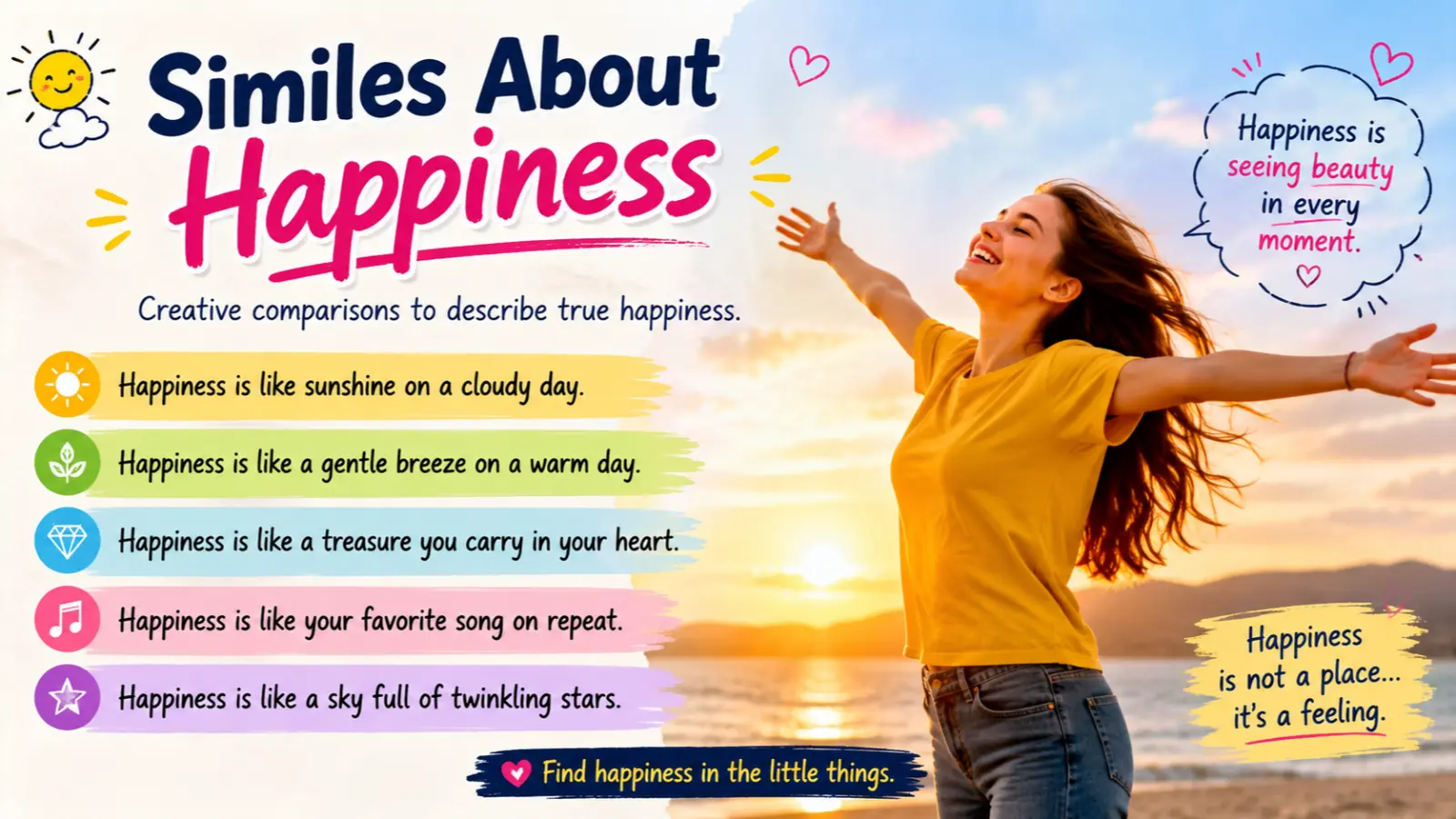
Similes About Happiness can be difficult to describe with ordinary words. Saying someone is “very happy” tells the reader the emotion, but it does not help them experience it. A strong simile can turn that simple feeling into a vivid picture.
A Similes About Happiness compares two different things using words such as like or as. Writers use Similes About Happiness in poems, stories, conversations, speeches, songs, essays, and everyday descriptions. When used well, they make an emotion easier to see, feel, and remember.
This collection of similes about happiness focuses on fresh comparisons rather than familiar clichés. Each example shows how a joyful feeling can be expressed in a different way, whether you are writing fiction, poetry, personal essays, or everyday conversation.
What Is a Simile for Happiness?
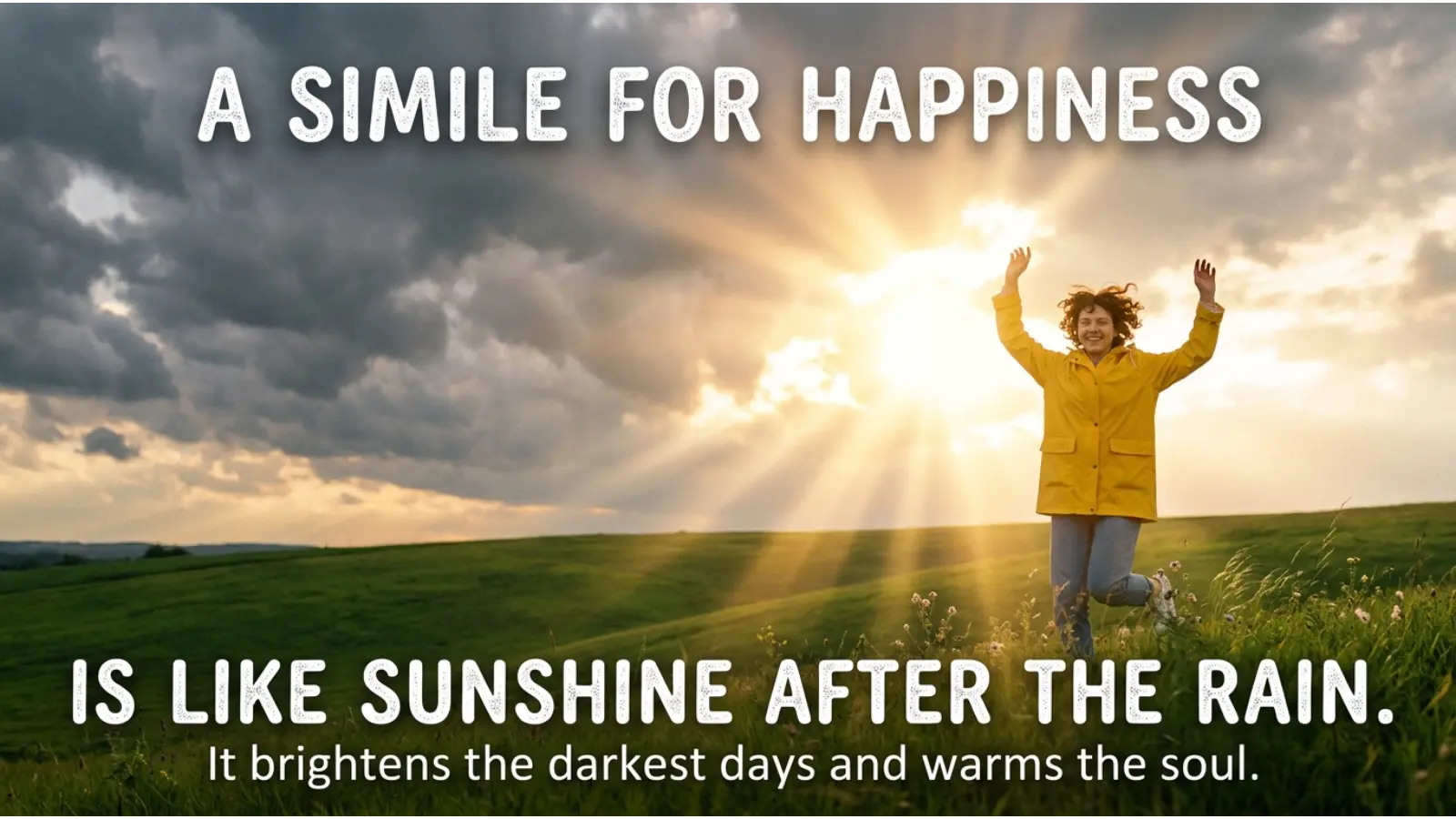
A Similes About Happiness compares a joyful feeling to something that suggests brightness, freedom, warmth, movement, comfort, or excitement.
For example:
Her happiness rose like sunlight filling an empty room.
The comparison works because sunlight gradually transforms a dark space. The reader can imagine happiness spreading in a similar way.
30 Original Similes About Happiness
1. Her happiness spread like sunlight across a quiet room.
Meaning: Her joy gradually reached everything around her.
Example:
When she heard the good news, her happiness spread like sunlight across a quiet room.
Why it works: The image suggests warmth and transformation without simply saying that she was cheerful.
Best context: Stories, personal writing, and reflective essays.
2. His smile was as bright as a window opening onto spring.
This comparison connects happiness with freshness and possibility.
Example:
His smile was as bright as a window opening onto spring after a long winter.
The simile creates a feeling of relief and renewal, making it especially useful when happiness follows a difficult period.
3. She felt as light as a paper kite caught by a friendly breeze.
The image suggests freedom rather than loud excitement.
Example:
After finishing her final exam, she felt as light as a paper kite caught by a friendly breeze.
Use this kind of simile when happiness comes from relief, freedom, or release.
4. Their laughter bounced like marbles across a wooden floor.
Instead of describing happiness directly, this comparison focuses on sound and movement.
Example:
Their laughter bounced like marbles across a wooden floor as they remembered the old story.
The unusual image gives the scene energy and makes the laughter feel impossible to contain.
5. His joy flickered like a porch light welcoming someone home.
This simile gives happiness a warm, welcoming quality.
Example:
His joy flickered like a porch light welcoming someone home.
It works especially well for scenes involving family, friendship, reunion, or belonging.
6. Her excitement fluttered like a handful of paper stars.
This comparison captures nervous, energetic happiness.
Example:
Her excitement fluttered like a handful of paper stars when she saw her name on the list.
The word fluttered makes the emotion feel active instead of static.
7. The child’s happiness popped like bubbles in bright afternoon air.
This is playful and suitable for children’s stories or lighthearted scenes.
Example:
The child’s happiness popped like bubbles in bright afternoon air as the birthday decorations appeared.
The comparison suggests small bursts of delight happening one after another.
8. He was as cheerful as a window full of morning light.
The comparison gives cheerfulness a calm, bright quality.
Example:
He walked into the kitchen as cheerful as a window full of morning light.
This works well when the character’s happiness is obvious but peaceful.
9. Her good mood rolled through the room like a friendly wave.
Here, happiness becomes something contagious.
Example:
Her good mood rolled through the room like a friendly wave, lifting everyone’s spirits.
This is useful when one person’s happiness affects other people.
10. His happiness glowed like a lantern beside a dark road.
The contrast between darkness and light makes the emotion stronger.
Example:
His happiness glowed like a lantern beside a dark road after he finally received the message he had been waiting for.
Writing tip: Contrast can make an emotional simile more powerful. Pairing brightness with darkness naturally emphasizes joy.
11. She smiled like someone who had just discovered a hidden garden.
The comparison suggests surprise as well as happiness.
Example:
She smiled like someone who had just discovered a hidden garden behind an ordinary wall.
Use it when happiness comes from discovery, wonder, or unexpected beauty.
12. His laughter was as warm as tea on a rainy afternoon.
This simile creates comfort rather than excitement.
Example:
His laughter was as warm as tea on a rainy afternoon.
It fits intimate but non-romantic scenes involving friendship, family, or companionship.
13. Their excitement raced like bicycles downhill.
The image suggests speed and growing enthusiasm.
Example:
Their excitement raced like bicycles downhill when the coach announced the final result.
This is particularly effective for sports stories, competitions, celebrations, and adventures.
14. Her happiness unfolded like a letter carrying wonderful news.
The comparison suggests anticipation followed by discovery.
Example:
Her happiness unfolded like a letter carrying wonderful news.
This works well when joy develops gradually rather than arriving all at once.
15. He felt as peaceful as a lake before the first breeze.
Not every form of happiness is loud. This simile captures quiet contentment.
Example:
After the long journey ended, he felt as peaceful as a lake before the first breeze.
It is a useful reminder that happiness can be still, quiet, and reflective.
16. Her grin stretched like a sunrise reaching over the hills.
The comparison combines expression, light, and expansion.
Example:
Her grin stretched like a sunrise reaching over the hills when she saw her family waiting.
The image is especially useful for moments of reunion.
17. His joy crackled like a new idea in an empty notebook.
This comparison connects happiness with creativity.
Example:
His joy crackled like a new idea in an empty notebook when he finally solved the problem.
Use it for writers, students, inventors, artists, or characters experiencing a breakthrough.
18. She was as delighted as a child finding an extra gift beneath the tree.
This comparison emphasizes unexpected pleasure.
Example:
She was as delighted as a child finding an extra gift beneath the tree.
Because the image is familiar and visual, it works particularly well in conversational writing.
19. Their happiness drifted through the afternoon like music from an open window.
This is a softer image of shared joy.
Example:
Their happiness drifted through the afternoon like music from an open window.
The simile works well in reflective prose and descriptive storytelling.
20. His excitement spun like a pinwheel in a summer breeze.
The movement makes the emotion feel energetic and playful.
Example:
His excitement spun like a pinwheel in a summer breeze when the team won.
This is a good choice for children’s writing and upbeat scenes.
21. Her happiness was as fresh as rain on a dusty sidewalk.
The comparison presents happiness as something cleansing and renewing.
Example:
After apologizing to her friend, her happiness was as fresh as rain on a dusty sidewalk.
The simile is useful when joy follows emotional tension.
22. His smile opened like curtains revealing a bright stage.
The image suggests that happiness becomes visible after being hidden.
Example:
His smile opened like curtains revealing a bright stage when he heard the announcement.
Use it for characters who have been worried, shy, or uncertain.
23. Her joy hummed like a refrigerator in a quiet kitchen.
This unusual comparison shows happiness as a steady background feeling.
Example:
Her joy hummed like a refrigerator in a quiet kitchen, constant and strangely comforting.
Not every simile needs to be grand. Unexpected ordinary objects can create memorable imagery.
24. They were as happy as travelers spotting their destination after a long road.
This comparison connects happiness with completion and relief.
Example:
They were as happy as travelers spotting their destination after a long road.
It works particularly well when characters have worked hard to reach a goal.
25. His happiness burst like confetti from a paper envelope.
The image suggests sudden, energetic excitement.
Example:
His happiness burst like confetti from a paper envelope when he opened the results.
This is a strong choice for celebrations and surprising good news.
26. Her joy settled around her like a warm blanket.
This simile focuses on comfort and emotional security.
Example:
Her joy settled around her like a warm blanket as she listened to her family laughing nearby.
It is useful when happiness feels safe rather than energetic.
27. His cheerful mood skipped like a stone across calm water.
The comparison gives happiness a playful rhythm.
Example:
His cheerful mood skipped like a stone across calm water, touching everyone he met.
The image also suggests that one person’s mood can affect others.
28. She felt as delighted as a gardener seeing the first flower bloom.
This comparison connects happiness with patience and reward.
Example:
She felt as delighted as a gardener seeing the first flower bloom after months of work.
Use it when happiness comes after effort, patience, or hope.
29. Their laughter rose like birds startled into flight.
This creates a lively image of spontaneous happiness.
Example:
Their laughter rose like birds startled into flight when the joke finally made sense.
It works particularly well in scenes with groups of friends or family.
30. His happiness glimmered like sunlight caught in a glass of water.
This is a quieter, more delicate image.
Example:
His happiness glimmered like sunlight caught in a glass of water as he watched the children play.
The simile is useful when you want happiness to feel subtle rather than dramatic.
How to Make a Happiness Simile More Vivid
A weak sentence tells readers exactly what to feel:
She was very happy.
A stronger sentence gives the reader an image:
Her happiness spread like sunlight across the room.
The second version does more than replace one adjective. It creates a visual experience.
Choose an Image That Matches the Emotion
Happiness has many forms.
It can be:
- energetic
- peaceful
- surprising
- playful
- comforting
- relieved
- proud
- hopeful
- contagious
Choose your comparison accordingly.
For energetic happiness, consider movement:
His excitement raced like bicycles downhill.
peaceful happiness, use stillness:
She felt as peaceful as a lake before the first breeze.
For relief, choose an image of release or renewal:
Her happiness was as fresh as rain on a dusty sidewalk.
The emotional type should determine the image.
Why Unexpected Comparisons Often Work Better
Writers sometimes reach automatically for familiar comparisons such as happiness being “like sunshine” or someone being “as happy as a clam.”
These expressions are understandable, but readers have encountered them many times.
A fresher comparison makes the reader pause.
Compare:
She was happy like sunshine.
with:
Her happiness glimmered like sunlight caught in a glass of water.
The second image gives the reader something specific to visualize.
A useful rule: Don’t search for the biggest image. Search for the most appropriate image.
How Professional Writers Build Strong Similes
A useful way to create a simile is to start with the emotion and then ask questions.
Step 1: Name the emotion
Start with:
He felt happy.
Step 2: Identify the exact kind of happiness
Was he relieved? Excited? Peaceful? Proud? Surprised?
Suppose the answer is relieved.
Step 3: Think of physical experiences of relief
What becomes easier after pressure disappears?
A door opening.
A heavy bag being put down.
Rain arriving after heat.
A long road finally ending.
Step 4: Turn one experience into an image
For example:
His relief was like putting down a heavy backpack after a long climb.
Step 5: Make the image specific
Specific details usually create stronger imagery than vague abstractions.
Instead of:
She was happy like a beautiful thing.
Try:
Her smile opened like curtains revealing a bright stage.
Similes About Happiness in Different Types of Writing
In Stories
Use happiness similes to reveal character without explaining everything.
Instead of:
Maya was happy about the surprise.
Try:
Maya’s smile opened like curtains revealing a bright stage.
The reader can infer the emotion from the image.
In Poetry
Poetry often benefits from compact, sensory comparisons.
Her joy hummed
like a quiet kitchen
after everyone comes home.
The comparison creates an atmosphere rather than simply naming an emotion.
In Conversation
Keep conversational similes easy to understand.
I felt as light as a kite after that exam was finally over.
Natural speech usually benefits from simple, recognizable imagery.
In Essays
Use similes selectively. Academic or analytical writing generally needs precision, so figurative language should clarify an idea rather than decorate every sentence.
For example:
The news spread through the school like a friendly wave.
That can work in a personal essay describing how quickly a positive event affected people.
Related Literary Devices That Can Strengthen Happiness Writing
Simile vs. Metaphor
A simile uses an explicit comparison:
Her happiness was like sunlight.
A metaphor makes the comparison directly:
Her happiness was sunlight filling the room.
Both can create strong imagery. Similes are often easier for readers to follow because the comparison is clearly signaled.
Imagery
Imagery uses sensory details to help readers picture or experience something.
Instead of simply writing:
He was happy.
You might describe:
His grin stretched across his face, and his laughter filled the kitchen.
Adding a carefully chosen simile can make that imagery even stronger.
Personification
Personification gives human qualities to nonhuman things.
For example:
The morning seemed to welcome her.
Combined with a simile, it can create a richer emotional atmosphere:
The morning welcomed her like an old friend.
Hyperbole
Hyperbole deliberately exaggerates.
I was so excited I could have danced across the entire city.
It can express intense happiness, but use it carefully. Too much exaggeration can make a scene feel unrealistic.
Common Mistakes When Writing Happiness Similes
Using the Same Comparison Everyone Knows
Clichés are not automatically wrong, but they can make writing predictable.
Better approach: Look for a more specific image connected to the character or setting.
Choosing an Image That Does Not Match the Emotion
A peaceful character probably does not need a comparison involving fireworks unless the scene calls for intense excitement.
The image should support the emotional temperature.
Mixing Two Different Images
Avoid constructions such as:
Her happiness flew like a roaring ocean of sunshine.
The sentence combines unrelated images and becomes difficult to visualize.
Choose one dominant comparison.
Making Every Sentence Figurative
If every sentence contains a simile, none of them feels special.
Let some sentences remain direct. A well-placed comparison will have more impact when it appears among clear, straightforward prose.
Explaining the Simile Too Much
Once a comparison works, trust the reader.
Instead of:
Her happiness spread like sunlight, showing that she was becoming happier and happier because sunlight represents joy and warmth.
Simply write:
Her happiness spread like sunlight across the room.
Let the image do its job.
A Simple Exercise for Creating Your Own Happiness Similes
Try this five-minute exercise.
1. Choose a kind of happiness:
joy, relief, excitement, pride, comfort, surprise, or contentment.
2. Pick one sensory category:
light, sound, movement, texture, temperature, taste, or nature.
3. Brainstorm five objects:
For happiness involving movement, you might think of kites, bicycles, waves, leaves, or spinning wheels.
4. Connect one object to the emotion:
Ask what the object actually does.
5. Write three versions.
For example:
Her excitement was like a kite.
Then make it more precise:
Her excitement tugged like a kite against its string.
Finally, place it in a scene:
When the results arrived, her excitement tugged like a kite against its string.
The final version gives the emotion movement and context.
How to Make Your Own Similes Sound Original
Originality does not require making comparisons strange just for the sake of being different.
Instead, connect the emotion to something specific to the scene.
If your character is a musician, happiness might be compared with a melody finally resolving.
your character is a gardener, happiness might resemble the first flower opening.
If your character has just completed a difficult journey, happiness might resemble seeing the destination ahead.
The strongest image often comes from the character’s world.
Frequently Asked Questions
What is a good simile for happiness?
A good happiness simile connects joy with a vivid image that matches the specific kind of happiness. For example, “Her happiness spread like sunlight across a quiet room” suggests warmth and gradual emotional change.
What are some creative similes for being happy?
Creative examples include “His joy crackled like a new idea in an empty notebook” and “Her excitement fluttered like a handful of paper stars.” The best choice depends on whether the happiness is energetic, peaceful, surprising, or comforting.
How do you describe happiness without saying happy?
Use sensory details, body language, actions, and comparisons. Instead of saying “She was happy,” describe her laughter, smile, movement, voice, or surroundings and connect them to a fitting image.
What is a simile for extreme happiness?
For intense happiness, use an image involving sudden movement, sound, brightness, or expansion. For example: “His happiness burst like confetti from a paper envelope.”
What is a simile for quiet happiness?
Quiet happiness can be compared with calm or comforting images. For example: “He felt as peaceful as a lake before the first breeze.”
How can I avoid clichés when writing similes?
Think beyond common symbols such as sunshine, rainbows, and fireworks. Look at the character’s surroundings and choose an ordinary object that behaves in a way that genuinely matches the emotion.
Can similes be used in poetry?
Yes. Similes are especially useful in poetry because they compress an emotional or abstract idea into a concrete image. A carefully chosen comparison can establish mood in only a few words.
Conclusion
The best similes about happiness do not simply decorate a sentence. They give an invisible emotion a shape the reader can see, hear, or feel. When creating your own, first decide what kind of happiness you want to express. Then find an image that behaves in a similar way. A sudden joy might burst, a peaceful joy might settle, and a contagious joy might travel from one person to another. Try moving beyond familiar comparisons and look closely at the world around your character. A kite, an open window, a notebook, a lantern, or even an everyday kitchen can become the source of memorable imagery. A strong simile does not tell readers what happiness means. It gives them a moment they can experience.
I am Helena Frost, a writer captivated by the beauty of language and the art of comparison. Through my words, I explore the world by turning ordinary moments into vivid similes and reflections. I enjoy crafting phrases that spark imagination, evoke emotion, and linger in the mind. My writing celebrates the subtle connections between people, nature, and the stories we live. For me, every sentence is an opportunity to reveal the extraordinary in the everyday.