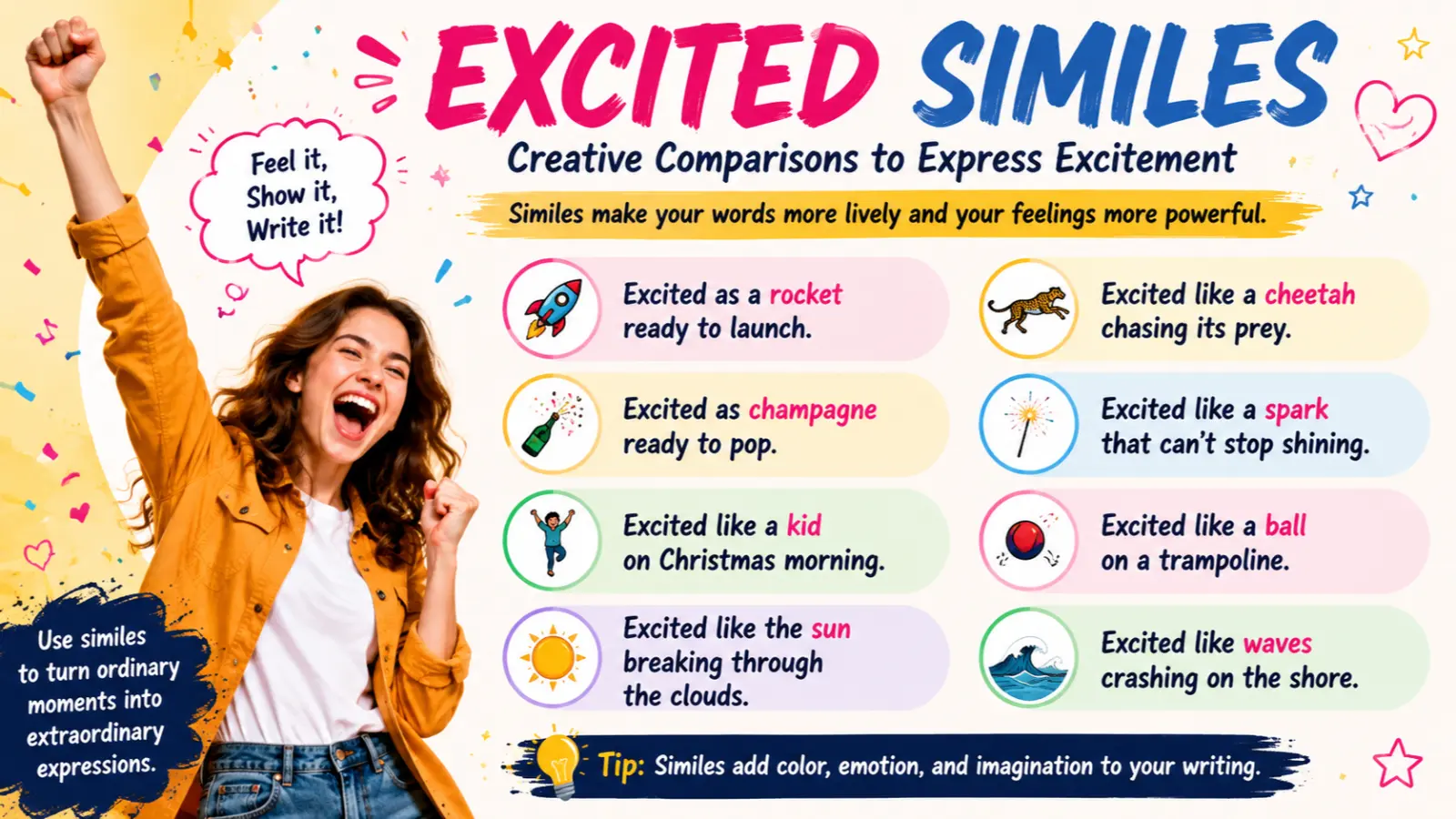
Excited Similes Excitement can be difficult to describe with ordinary words. Saying someone was “very excited” tells readers the emotion, but it does not let them experience it. A strong simile can turn that feeling into something visible, energetic, and memorable.
An excited simile compares excitement to something familiar, often using like or as. For example, “Her thoughts bounced like popcorn in a hot pan.” The comparison gives the reader a sense of restless, unpredictable energy.
Writers use excited similes in stories, poems, conversations, advertisements, songs, speeches, and everyday descriptions. They can describe the excitement of winning a game, seeing a friend, opening a gift, performing onstage, hearing good news, or waiting for something important.
This collection of original excited similes will help you understand why these comparisons work and show you how to create your own.
What Is an Excited Simile?
An excited simile is a comparison that makes feelings of enthusiasm, anticipation, joy, nervous energy, or eagerness easier to imagine.
For example:
He was as excited as a kite caught by a sudden gust.
The person is not literally a kite. The comparison suggests movement, lift, freedom, and sudden energy.
A useful excited simile should do more than replace the words very excited. It should reveal how the excitement feels.
Quick Answer: What Are Some Good Excited Similes?
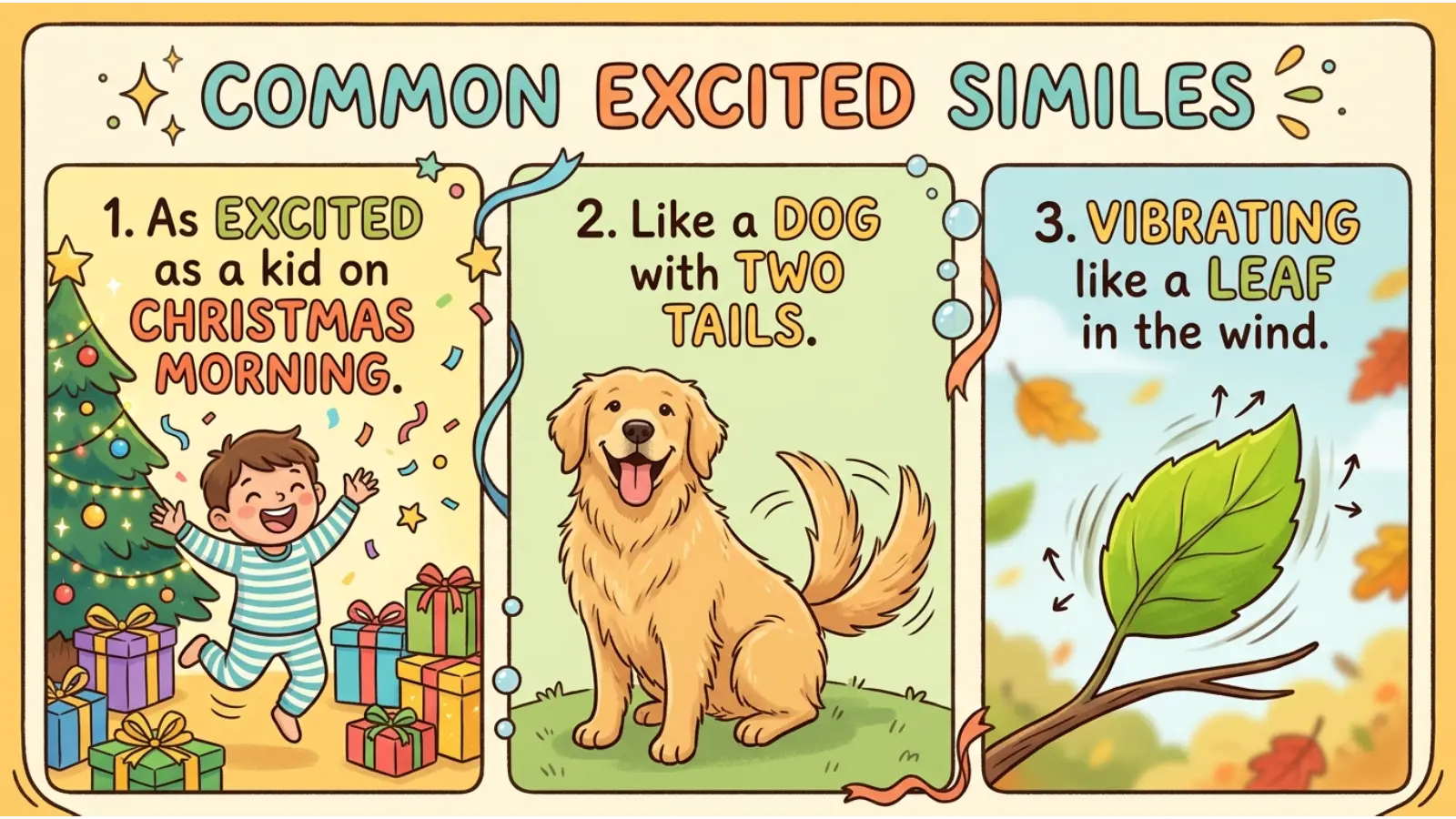
Some original excited similes include:
- As excited as a kite catching its first strong wind.
- Her thoughts jumped like sparks from a campfire.
- He rushed forward like a train finally leaving the station.
- Their anticipation stretched like a spring pulled tight.
- She smiled like a window suddenly filled with morning light.
- His excitement fizzed like soda freshly opened.
- The children scattered like fireflies released into the evening.
- My heart felt like a drum waiting for the first beat.
The best choice depends on the kind of excitement you want to show—joyful, nervous, energetic, playful, or full of anticipation.
30 Original Excited Similes for Creative Writing
1. As excited as a kite catching its first strong wind
Meaning: This suggests sudden, uplifting excitement.
Example:
Lena was as excited as a kite catching its first strong wind when she heard her name announced.
Why it works:
A kite rising into the air creates an image of freedom and movement. It works especially well when excitement feels light and joyful.
Best context: Stories, celebrations, achievements, and moments of good news.
2. His thoughts jumped like sparks from a campfire
This simile describes a mind filled with rapid ideas and restless enthusiasm.
His thoughts jumped like sparks from a campfire as he planned the adventure.
The image suggests that excitement is difficult to contain. It is particularly useful for creative characters who suddenly have many ideas.
Writing tip: Use this when excitement affects someone’s thinking rather than just their physical behavior.
3. Her smile opened like a window to morning light
This comparison connects excitement with brightness and emotional openness.
Her smile opened like a window to morning light when she saw the surprise waiting for her.
Unlike a highly energetic simile, this one creates warm excitement. It works when a character is delighted without becoming frantic.
4. His excitement fizzed like freshly opened soda
The bubbling movement of soda makes this a playful comparison.
His excitement fizzed like freshly opened soda when the concert tickets arrived.
The word fizzed gives the sentence extra energy. This is a useful technique: choose a verb that belongs naturally to the thing you are comparing.
5. Their anticipation stretched like a spring pulled tight
This simile is ideal for excitement mixed with suspense.
Their anticipation stretched like a spring pulled tight as they waited for the final announcement.
The comparison suggests that the emotion is building and may soon be released.
Best context: Competitions, reveals, performances, announcements, and important decisions.
6. She bounced like a ball on a fresh court
This creates an energetic, physical image.
She bounced like a ball on a fresh court while waiting for her friends to arrive.
It works especially well for younger characters or situations involving playful excitement.
7. His excitement flashed like sunlight between moving clouds
This comparison suggests brief but powerful bursts of emotion.
His excitement flashed like sunlight between moving clouds whenever he imagined the trip.
It is useful when excitement appears in waves rather than remaining constant.
8. The children raced around like leaves caught in a whirlwind
This simile emphasizes movement and barely controlled energy.
The children raced around like leaves caught in a whirlwind after the doors opened.
The comparison works because both images involve unpredictable motion.
Writing lesson: When describing group excitement, compare the characters to something that moves collectively.
9. Her words spilled out like marbles rolling down stairs
This captures fast, uncontrolled speech.
Her words spilled out like marbles rolling down stairs as she explained what had happened.
The simile does not simply say she was excited. It shows the effect of excitement on her speech.
10. His grin stretched like a sunrise across the horizon
This gives excitement a broad, cheerful quality.
His grin stretched like a sunrise across the horizon when he realized he had won.
The comparison works particularly well in uplifting scenes because sunrise naturally suggests brightness and new possibilities.
11. My anticipation buzzed like a phone receiving message after message
This modern comparison captures restless anticipation.
My anticipation buzzed like a phone receiving message after message before the results appeared.
It fits contemporary stories and informal writing.
12. She moved like a dancer hearing her favorite song
This simile suggests excitement that naturally turns into movement.
She moved like a dancer hearing her favorite song when the music finally started.
It is especially effective for describing someone whose excitement is confident and expressive.
13. His hopes climbed like vines toward a sunny wall
This comparison focuses on growing excitement and expectation.
His hopes climbed like vines toward a sunny wall as the opportunity came closer.
The image is slower and more reflective than comparisons involving bouncing or racing.
Best context: Dreams, opportunities, competitions, and future plans.
14. The room crackled like a storm waiting to break
This describes excitement shared by an entire group.
The room crackled like a storm waiting to break before the winner was announced.
The word crackled creates tension as well as energy.
15. Her laughter burst like bubbles released underwater
This creates a playful image of happiness suddenly escaping.
Her laughter burst like bubbles released underwater when she heard the joke.
It works particularly well when excitement and amusement happen together.
16. He sprang forward like a door flung open by the wind
This simile focuses on sudden movement.
He sprang forward like a door flung open by the wind when the race began.
It gives the character immediate physical energy.
17. Their excitement glowed like lanterns along a dark path
This comparison treats excitement as a source of emotional light.
Their excitement glowed like lanterns along a dark path as they prepared for the journey.
It works well in reflective storytelling because the excitement becomes part of the atmosphere.
18. She was as eager as a puppy hearing its name
This is playful and friendly.
She was as eager as a puppy hearing its name when the teacher announced the activity.
The comparison is especially suitable for casual writing, children’s stories, and humorous scenes.
19. His questions popped like kernels in a hot pan
This describes someone who cannot stop asking questions.
His questions popped like kernels in a hot pan as soon as the mystery was mentioned.
The simile turns curiosity into visible action.
Writing tip: Excitement can appear through behavior. You do not always need to describe the emotion directly.
20. Her heartbeat felt like a drum warming up before a parade
This suggests anticipation with a strong physical component.
Her heartbeat felt like a drum warming up before a parade as she waited backstage.
It is useful for performances, competitions, speeches, and other moments before an important event.
21. The news traveled through them like electricity through a wire
This portrays excitement spreading rapidly between people.
The news traveled through them like electricity through a wire when the team heard the announcement.
The comparison works particularly well when several characters react together.
22. His imagination raced like a bicycle downhill
This suggests fast-moving thoughts combined with enthusiasm.
His imagination raced like a bicycle downhill as he planned the new project.
The downhill movement creates a feeling of speed and momentum.
23. She shone like a room suddenly filled with confetti
This creates a colorful image of visible happiness.
She shone like a room suddenly filled with confetti when her friends surprised her.
The comparison is bright and celebratory without relying on the usual “as happy as…” construction.
24. Their cheers rose like birds startled from a tree
This simile shows a sudden burst of collective excitement.
Their cheers rose like birds startled from a tree when the final point was scored.
The upward movement makes the excitement feel instantaneous.
25. He was as restless as a clock waiting for midnight
This focuses on impatience and anticipation.
He was as restless as a clock waiting for midnight before the journey began.
It is a good choice when excitement makes waiting difficult.
26. Her excitement fluttered like pages in a book caught by wind
This gives excitement a softer, more delicate quality.
Her excitement fluttered like pages in a book caught by wind as she imagined what might happen next.
This works especially well for quiet anticipation rather than loud celebration.
27. The crowd surged like a wave reaching the shore
This describes powerful collective movement.
The crowd surged like a wave reaching the shore when the performer appeared.
The simile is useful when excitement affects a large group.
28. His voice rang like a bell struck in a quiet room
This emphasizes how excitement changes someone’s voice.
His voice rang like a bell struck in a quiet room when he shared the announcement.
The comparison makes the voice feel bright, clear, and impossible to ignore.
29. Her excitement grew like a garden after spring rain
This represents excitement developing gradually.
Her excitement grew like a garden after spring rain as the date of the trip approached.
Unlike a sudden burst of excitement, this simile is about emotional growth.
30. The moment arrived like a match finally finding its flame
This is useful for a long-awaited event.
The moment arrived like a match finally finding its flame when the curtain rose.
The comparison connects anticipation with release. The waiting is over, and the energy finally begins.
How to Choose the Right Excited Simile
Not every kind of excitement feels the same.
Someone receiving wonderful news may feel light and bright. Someone waiting for an important result may feel tense and restless. A crowd at a championship may feel loud and explosive.
Choose the comparison according to the emotion underneath the excitement.
| Type of excitement | Useful imagery |
|---|---|
| Joyful | sunlight, balloons, birds, flowers |
| Energetic | sparks, waves, bouncing objects |
| Nervous | clocks, springs, trembling objects |
| Anticipatory | doors, storms, matches, stretched springs |
| Playful | bubbles, soda, puppies, confetti |
| Collective | crowds, waves, electricity, fireworks-like movement |
The goal is not to find the fanciest comparison. The goal is to find the most accurate image.
How to Make Excited Similes More Vivid
A weak sentence might say:
She was very excited about the trip.
A stronger version shows what the excitement does:
Her questions popped like kernels in a hot pan as she packed for the trip.
The second sentence gives readers something to see and hear.
Use Specific Objects
Instead of comparing excitement to something vague, choose a concrete object.
Compare:
He was excited like something moving quickly.
with:
His thoughts raced like a bicycle downhill.
The bicycle provides movement that readers can immediately visualize.
Match the Speed to the Emotion
Fast imagery creates energetic excitement:
Her thoughts jumped like sparks.
Slow-growing imagery creates anticipation:
Her excitement grew like a garden after spring rain.
The pace of the comparison should match the pace of the scene.
Use Strong Verbs
The verb often matters as much as the comparison.
Instead of:
Her excitement was like soda.
Try:
Her excitement fizzed like freshly opened soda.
Fizzed gives the emotion movement.
How Professional Writers Avoid Cliché Similes
Some comparisons have become so familiar that readers barely notice them. Common phrases can still be useful, especially in dialogue, but original writing often benefits from more specific imagery.
Instead of automatically writing:
He was as excited as a child.
Ask:
What does this character actually do when excited?
Maybe he talks too quickly. she keeps checking the clock. someone’s hands cannot stay still. Maybe a whole room suddenly becomes noisy.
Turn that behavior into imagery.
For example:
His questions popped like kernels in a hot pan.
This feels more personal because it shows a particular behavior.
Excited Similes in Storytelling
Similes can change the energy of an entire scene.
Consider a character waiting backstage:
The curtain trembled slightly. Her heartbeat felt like a drum warming up before a parade. She glanced toward the audience, then smiled.
The simile helps establish anticipation before the character even performs.
A good storytelling simile should support the scene rather than interrupt it. If the moment is tense, use imagery that builds tension. If the moment is playful, choose something lighter.
Excited Similes in Poetry
Poetry gives similes more freedom because sound, rhythm, and imagery can work together.
For example:
Her excitement fluttered
like pages in a book
caught by wind.
The comparison does not merely explain the emotion. It gives the emotion movement and texture.
When writing poetry, consider the sound of the words surrounding your simile. Short, energetic words can make excitement feel quicker, while softer sounds can create gentle anticipation.
Excited Similes in Everyday Conversation
Not every simile needs to sound literary.
In casual conversation, a simple comparison may be more natural:
“I was bouncing like a ball when I heard the news.”
In dialogue, the character’s personality matters more than originality. A teenager, comedian, teacher, athlete, and novelist may all describe excitement differently.
Use polished imagery in narration, but let dialogue sound like something the character would actually say.
Simile vs. Metaphor: What’s the Difference?
A simile makes a comparison using words such as like or as.
Her excitement fizzed like soda.
A metaphor makes the comparison directly.
Her excitement was a bottle of fizz.
Both create imagery, but they do it differently.
Similes can feel more conversational and explanatory, while metaphors can make a comparison feel more direct and powerful.
Excited Similes and Other Literary Devices
Several literary devices can work alongside similes.
Imagery creates sensory details that help readers picture or experience a scene.
Personification gives human qualities to something nonhuman:
The waiting room seemed to hold its breath.
Hyperbole deliberately exaggerates:
He had a thousand ideas racing through his head.
Alliteration repeats beginning sounds and can add rhythm:
Bright, bouncing excitement filled the room.
Using these techniques together can make emotional writing much richer. The key is moderation. Too many devices competing for attention can make a passage feel forced.
How to Create Your Own Excited Similes
You do not need to search for a comparison every time you write. You can build one from the scene itself.
Step 1: Identify the Type of Excitement
Ask whether the emotion is:
- joyful
- nervous
- impatient
- energetic
- playful
- surprised
- hopeful
Step 2: Notice the Character’s Behavior
What changes because the character is excited?
Do they:
- talk faster?
- smile?
- move around?
- ask questions?
- stare at the clock?
- struggle to sit still?
- imagine what will happen?
Step 3: Find a Concrete Comparison
If the character cannot sit still, think of things that move constantly.
A bouncing ball, flickering flame, spinning wheel, or fluttering page might lead you toward an original image.
Step 4: Give the Comparison a Precise Verb
Don’t stop at “Her excitement was like…”
Try:
A excitement fluttered…
Her surged…
excitement crackled…
Her excitement bubbled…
A climbed…
Step 5: Read It Aloud
A simile may look good on the page but sound awkward when spoken.
Read your sentence aloud and ask:
Does this sound like something a real writer or character would say?
If the comparison feels decorative rather than useful, simplify it.
Creative Exercises for Better Similes
Exercise 1: Replace “Very Excited”
Write five sentences beginning with:
She was very excited when…
Then remove very excited from each sentence and replace it with an action or image.
Exercise 2: Use Your Setting
Choose a setting such as:
- a stadium
- a classroom
- an airport
- a theater
- a birthday party
- a train station
Find three objects in that setting and turn each one into a possible comparison.
Exercise 3: Change the Emotion
Take this basic idea:
He was excited about the competition.
Rewrite it three ways:
- Excited but nervous.
- Excited and confident.
- Excited and unable to wait.
Your comparisons should change with the emotional shade.
Exercise 4: Build a Fresh Comparison
Complete this sentence:
Her excitement moved like ______.
Then ask:
- Why does that object move?
- Is its movement fast or slow?
- Is it noisy or quiet?
- Does it rise, fall, bounce, spread, or spin?
These questions help transform a random comparison into a meaningful one.
Common Mistakes When Writing Excited Similes
Using the Same Old Comparisons
If every excited character is “like a kid on Christmas morning,” your writing may start to feel predictable.
Use the character’s situation to create something more specific.
Mixing Two Images
Avoid combining unrelated comparisons:
His excitement raced like a bubbling volcano.
A race and a bubbling volcano create different types of movement. Choose one dominant image.
Forcing a Simile Into Every Sentence
A simile should earn its place.
If a sentence already creates a strong image, another comparison may only clutter it.
Choosing an Unbelievable Comparison
An unusual comparison is not automatically a good comparison.
Ask whether readers can understand the connection quickly. If they have to stop and decode the image, the simile may be distracting from the emotion.
Explaining Too Much
After a strong simile, you usually do not need several sentences explaining exactly what it means.
Let the image do some of the work.
Confusing a Simile With a Metaphor
Remember:
Simile: Her excitement moved like a wave.
Metaphor: Her excitement was a wave.
Both are valid. Just use the form intentionally.
Frequently Asked Questions About Excited Similes
What is a good simile for being excited?
A good excited simile depends on the type of excitement. For energetic excitement, “His thoughts jumped like sparks from a campfire” works well. For anticipation, “Their anticipation stretched like a spring pulled tight” creates a stronger sense of tension.
What is a simile for extreme excitement?
For intense excitement, use an image involving powerful movement, sound, or energy. For example, “The crowd surged like a wave reaching the shore” conveys excitement spreading through many people at once.
How do you describe excitement in creative writing?
Show what excitement does to a person’s body, thoughts, speech, and behavior. Then choose a concrete comparison that matches those details. This usually creates stronger writing than simply saying someone is excited.
What is a simile for a happy person?
You could use a bright comparison such as “Her grin stretched like a sunrise across the horizon.” The comparison connects happiness with warmth, brightness, and emotional openness.
Can excited similes be funny?
Yes. Playful comparisons can make excitement humorous. For example, describing someone’s questions as “popping like kernels in a hot pan” can make their enthusiasm feel energetic and amusing.
Are similes useful in storytelling?
Absolutely. Similes help readers visualize emotions, settings, actions, and characters. They are especially useful when an emotion is difficult to explain directly.
How can I make my similes more original?
Start with the specific scene instead of searching for a generic comparison. Notice objects, sounds, movements, and details around the character, then connect one of those details to the emotion.
Conclusion
The strongest excited similes do not simply tell readers that a character feels happy or enthusiastic. They reveal what that excitement feels like in motion. A character’s thoughts might jump like sparks. Their anticipation might tighten like a spring. A crowd’s energy might rise like birds startled from a tree. Each comparison gives the emotion a different shape. When creating your own similes, start with the emotion, observe the character’s behavior, and search the surrounding scene for concrete images. Choose comparisons that fit the character and moment rather than reaching automatically for familiar phrases. The more specifically you observe excitement, the more memorable your writing becomes.
I am Helena Frost, a writer captivated by the beauty of language and the art of comparison. Through my words, I explore the world by turning ordinary moments into vivid similes and reflections. I enjoy crafting phrases that spark imagination, evoke emotion, and linger in the mind. My writing celebrates the subtle connections between people, nature, and the stories we live. For me, every sentence is an opportunity to reveal the extraordinary in the everyday.