Analogies and similes help writers explain unfamiliar ideas, sharpen descriptions, and give emotions a shape readers can picture. A Analogies and Similes well-chosen comparison can turn a plain sentence into something memorable without making the writing complicated.
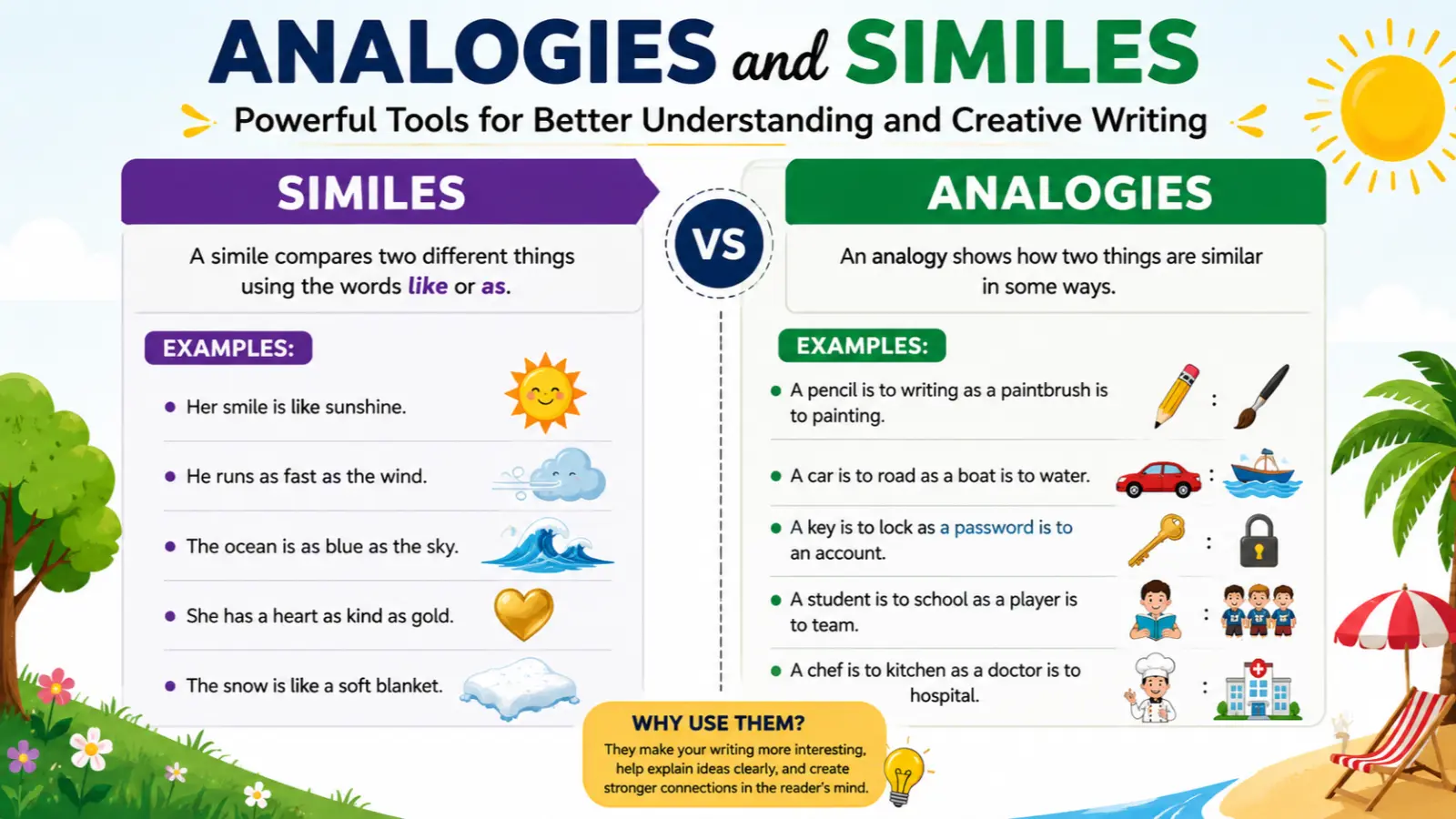
A Analogies and Similes compares two different things using words such as like or as. An analogy goes further by explaining how two things are similar in a meaningful way. Both are useful in creative writing, poetry, storytelling, speeches, essays, and everyday conversation.
You might use a simile to describe happiness, friendship, rain, love, or anger. You might use an analogy to explain a difficult idea by connecting it to something familiar. Learning the Analogies and Similes difference—and knowing when to use each—can make your writing clearer and more expressive.
What Are Analogies and Similes?
A Analogies and Similes is a direct comparison between two unlike things, usually using like or as.
Her excitement fluttered like a paper kite in a strong breeze.
The comparison does not mean her excitement is literally a kite. Instead, the image suggests movement, energy, and lightness.
An analogy compares two situations, ideas, or relationships to help explain something.
For example:
Learning to write is like learning to play an instrument: practice may feel awkward at first, but repetition gradually makes difficult movements feel natural.
The analogy connects writing practice with learning music. It explains an idea rather than simply decorating a description.
Simile vs. Analogy
A useful distinction is:
- Simile: creates an image through comparison.
- Analogy: explains an idea through a relationship or similarity.
- Metaphor: says one thing is another to create a figurative connection.
A simile might say:
The classroom was as quiet as a closed museum.
An analogy might explain:
A classroom discussion is like a tennis match: one person’s idea gives the next person something to return, question, or build upon.
The Analogies and Similes creates atmosphere. The analogy develops understanding.
Why Do Writers Use Analogies and Similes?
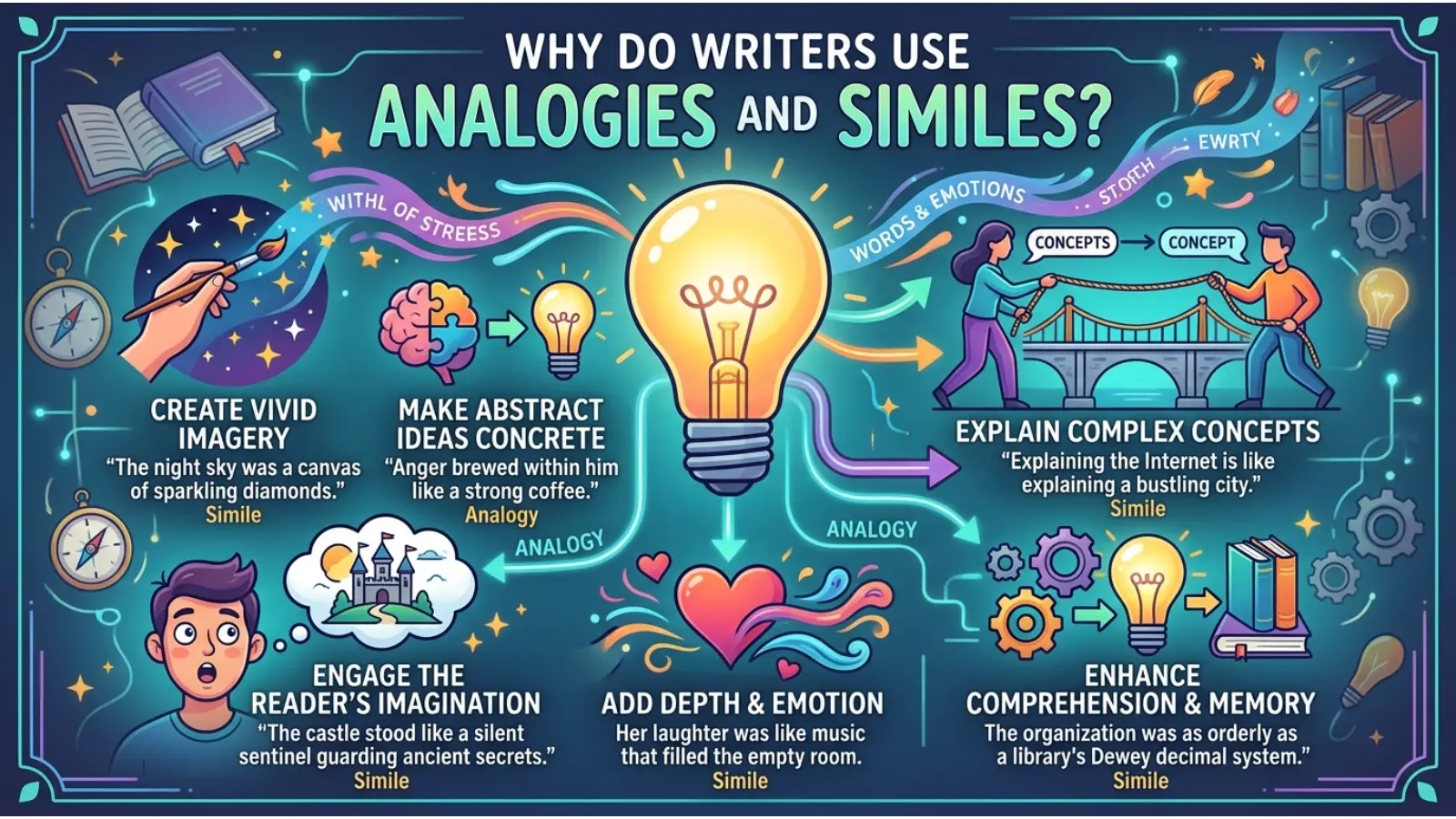
Comparisons give readers something familiar to hold onto.
Instead of writing:
The storm was intense.
you can create a stronger image:
The storm pressed against the windows like an impatient visitor.
The second sentence gives the weather a sense of pressure and personality.
Analogies can also make abstract subjects easier to understand. Ideas such as patience, memory, creativity, fear, and responsibility are difficult to visualize directly. A carefully chosen comparison gives those concepts a recognizable shape.
The key is relevance. A comparison should reveal something—not merely sound decorative.
25 Original Similes to Inspire Better Writing
The following examples are designed as writing prompts rather than fixed phrases. Each one can be adapted to different characters, settings, emotions, and situations.
1. Happiness
Simile:
Her happiness rose like sunlight spilling through a half-open curtain.
Meaning: Her happiness arrives gradually but fills the space around her.
Example sentences:
- His happiness spread like sunlight across a dark room.
- The good news opened her mood like morning light through a window.
Writing purpose: This works well when happiness follows uncertainty or sadness. The contrast makes the emotion more powerful.
Writing tip: When describing an emotion, compare it with something that behaves in a similar way. Happiness might rise, spread, glow, bounce, or overflow.
2. Friendship
Simile:
Their friendship held steady like a bridge over a restless river.
The comparison suggests trust and stability despite problems.
Example:
Even when they disagreed, their friendship held steady like a bridge over a restless river.
This is especially useful in stories where characters experience conflict but remain connected.
3. Rain
Simile:
Rain tapped against the roof like thousands of impatient fingertips.
The repeated sound becomes easier for the reader to imagine.
Example sentences:
- Rain tapped the windows like impatient fingertips.
- By midnight, the rain drummed on the roof like a restless crowd.
Best context: Fiction, poetry, atmospheric descriptions, and opening scenes.
Writing lesson: Sound-based similes can make settings feel more immediate because they engage the reader’s imagination through hearing.
4. Love
Simile:
Their affection grew like a garden that neither of them noticed they were tending.
This comparison presents love as something gradual rather than sudden.
Why it works: The garden image suggests patience, care, time, and quiet growth.
Best context: Reflective fiction, poetry, personal essays, and character development.
5. Anger
Simile:
His anger tightened like a knot pulled deeper with every word.
Instead of simply telling readers that the character is angry, the sentence shows increasing emotional pressure.
Writing tip: For strong emotions, choose an image that changes as the emotion changes. Anger can tighten, rise, crack, burn, or boil.
6. Confusion
Simile:
Her thoughts scattered like receipts caught in a sudden wind.
The comparison gives confusion physical movement.
Example:
After hearing three different explanations, his thoughts scattered like receipts caught in a sudden wind.
Best context: Character reactions, humorous scenes, and moments of uncertainty.
7. Fear
Simile:
Fear moved through him like a cold draft beneath a locked door.
The image suggests that fear can enter unexpectedly, even when someone believes they are protected.
Writing purpose: This is stronger than simply saying “he was afraid” because it focuses on how fear feels and behaves.
8. Silence
Simile:
The silence settled over the room like fresh snow.
The comparison makes silence feel complete and almost physical.
Best context: Suspense, emotional conversations, nighttime scenes, and reflective writing.
9. Confidence
Simile:
She walked onto the stage like someone who had already heard the applause.
The image communicates confidence without directly naming it.
Writing lesson: Strong similes often reveal character through behavior rather than explanation.
10. Loneliness
Simile:
The empty house felt like a station after the final train had left.
This comparison creates loneliness through absence.
Why it works: Instead of describing loneliness directly, it gives the reader a familiar scene associated with departure and emptiness.
11. Hope
Simile:
Hope flickered like a porch light during a power outage.
The image suggests that hope may be small but noticeable against darkness.
Best context: Stories involving difficulty, uncertainty, recovery, or perseverance.
12. Curiosity
Simile:
Her curiosity poked at the mystery like a child testing thin ice with a stick.
This creates a playful but slightly cautious feeling.
Writing tip: A comparison can communicate two qualities at once. Here, curiosity is both adventurous and careful.
13. Exhaustion
Simile:
By midnight, his thoughts dragged like a suitcase with a broken wheel.
The comparison combines tiredness with frustrating effort.
Example:
After studying all evening, her thoughts dragged like a suitcase with a broken wheel.
This works particularly well because the image is specific rather than simply saying someone was “very tired.”
14. Excitement
Simile:
The crowd buzzed like a power line before the lights came on.
The comparison suggests anticipation, energy, and contained force.
Best context: Sports, concerts, celebrations, competitions, and major announcements.
15. Embarrassment
Simile:
Heat climbed into his face like water rising in a sink.
The comparison focuses on the physical sensation of embarrassment.
Writing lesson: Physical imagery can make emotional writing more believable.
16. Determination
Simile:
She kept moving like a compass needle pulled toward north.
The image suggests a strong internal direction.
Best context: Character arcs, motivational writing, adventure stories, and personal narratives.
17. Memory
Simile:
The memory returned like a song heard through a wall.
This suggests something recognizable but distant and incomplete.
Why it works: Memory is intangible, so comparing it with a sensory experience gives it texture.
18. A Busy Street
Simile:
The street moved like a river carrying a hundred different stories.
The comparison transforms ordinary traffic and pedestrians into a living flow.
Writing tip: When describing a crowded place, compare movement rather than simply counting objects.
19. A Difficult Decision
Simile:
The decision sat before her like a locked door with two keys.
This suggests that the choice is difficult because both possibilities seem significant.
Best context: Fiction, essays, personal narratives, and reflective writing.
20. A New Idea
Simile:
The idea appeared like a match struck in a dark room.
The comparison captures sudden discovery.
Example:
While staring at the blank page, an idea appeared like a match struck in a dark room.
This is useful when writing about creativity itself.
21. A Nervous Speaker
Simile:
His first words came out like coins dropped onto a wooden floor.
The image suggests awkward, scattered, noticeable speech.
Writing purpose: It shows nervousness through sound and movement instead of simply labeling the character as nervous.
22. A Difficult Lesson
Simile:
The lesson landed like a stone dropped into still water.
This suggests that the lesson creates consequences that continue beyond the initial moment.
Best context: Reflective essays and stories involving personal growth.
23. A Beautiful Voice
Simile:
Her voice moved through the room like warm light beneath a doorway.
The comparison emphasizes comfort and reach without relying on an overused description.
Writing tip: Avoid automatically comparing every beautiful voice to an angel or a songbird. Unexpected but believable images often feel fresher.
24. A Fast Runner
Simile:
He crossed the field like a spark jumping between dry branches.
The image emphasizes speed and sudden movement.
Best context: Sports writing, action scenes, and energetic storytelling.
25. A Difficult Memory
Simile:
The memory stayed in the corner of his mind like a box he was afraid to open.
The comparison suggests avoidance and emotional weight.
Writing lesson: The strongest emotional similes often leave some meaning for the reader to infer.
How to Make a Simile More Vivid
A weak simile usually compares something to an image that is too general.
For example:
She was as happy as a person could be.
This tells the reader almost nothing.
A more vivid comparison gives happiness a recognizable action:
Her happiness spilled across the kitchen like sunlight finding every open window.
The second version gives the emotion movement, direction, and atmosphere.
Use Specific Images
Compare:
The boy was nervous like an animal.
with:
The boy watched the classroom door like a rabbit watching the shadow of a hawk.
The second image contains more information. It suggests alertness, vulnerability, and anticipation.
Choose a Shared Quality
A successful simile needs a meaningful connection between the two things being compared.
Ask:
What exactly do these things have in common?
Maybe both are:
- unpredictable
- delicate
- noisy
- persistent
- quick
- comforting
- overwhelming
- difficult to control
Once you identify the shared quality, the comparison becomes easier to construct.
How Professional Writers Avoid Cliché Similes
Some comparisons have been used so often that readers barely notice them.
Common examples include comparisons involving:
- being busy as a bee
- being quiet as a mouse
- being cold as ice
- being white as snow
These aren’t grammatically wrong. They can still work when the familiar expression fits the voice or context. The problem occurs when every description depends on familiar comparisons.
Try changing the angle.
Instead of:
The room was as cold as ice.
Consider what the cold actually does:
The room pinched every exposed finger with invisible teeth.
That version creates a more distinctive experience.
When an Analogy Is Better Than a Simile
Use a simile when you want to create a quick image.
Use an analogy when you need to explain a relationship.
For example:
Writing a first draft is like clearing a path through tall grass.
That is a simile-like comparison.
A fuller analogy might explain:
Writing a first draft is like clearing a path through tall grass. You do not need to make the entire route beautiful on the first pass; you first need enough space to see where the path could go.
The analogy develops the idea of drafting. It does not merely decorate the sentence.
Analogies Can Make Difficult Ideas Easier
Suppose you want to explain why revision matters.
You could write:
Revision improves writing.
That is clear but limited.
An analogy gives the reader a mental model:
Revision is like adjusting a camera lens. The scene already exists, but small changes in focus can determine what the viewer notices first.
The comparison helps readers understand that revision is not necessarily about replacing everything. Sometimes it is about changing emphasis and clarity.
Similes for Different Writing Situations
In Music and Songwriting
Similes can translate sound and emotion into images.
The guitar notes fell like rain on a tin roof.
A musician or lyricist can use comparisons to suggest rhythm, texture, speed, or mood.
The best comparisons in music usually support the feeling of the piece rather than interrupting it.
In Poetry
Poetry gives similes room to become more compressed and suggestive.
Morning opened like a letter no one expected.
The comparison leaves space for interpretation. Poetry does not always need to explain every connection.
In Storytelling
Fiction benefits from similes that reveal character.
Instead of describing a character as nervous:
She held the envelope like it contained a question she wasn’t ready to answer.
The comparison reveals both behavior and emotional conflict.
In Conversation
Everyday speech usually favors short, immediately understandable comparisons.
That meeting lasted like three separate Mondays.
The comparison adds personality without requiring a long explanation.
In Essays
Similes can make abstract arguments easier to understand, but they should support the point.
A strong thesis is like a map: it does not describe every detail of the journey, but it tells the reader where the argument is going.
Here the comparison has an explanatory purpose.
Related Literary Devices
Metaphor
A metaphor makes a direct figurative comparison without using like or as.
Her voice was a lantern in the dark.
A simile would say:
Her voice was like a lantern in the dark.
The two devices can create similar effects, but the metaphor often feels more direct.
Imagery
Imagery uses sensory details to help readers experience a scene.
A simile can strengthen imagery:
The bread smelled like toasted wheat after summer rain.
The comparison activates smell and memory at the same time.
Personification
Personification gives human qualities to nonhuman things.
The old house complained in the wind.
A simile could then extend that image:
The old house groaned like an exhausted traveler.
Hyperbole
Hyperbole deliberately exaggerates.
I waited a thousand years for the bus.
A simile does not require exaggeration. It focuses on comparison.
Symbolism
A comparison can also contribute to symbolism when an image carries a deeper meaning.
For example, comparing hope to a small light may suggest persistence during hardship. The meaning comes from the larger context, not from the comparison alone.
How to Create Your Own Similes
Creating original comparisons becomes easier when you stop searching for “beautiful words” and start observing how things behave.
Step 1: Name the Subject
Choose something you want to describe.
It could be:
- anger
- a crowded room
- a difficult exam
- a lonely character
- summer heat
- a sudden idea
Step 2: Identify Its Strongest Quality
Ask what stands out.
Is it:
- loud?
- restless?
- delicate?
- sudden?
- heavy?
- persistent?
- warm?
- confusing?
Step 3: Search for a Physical Experience
Now think of something physical that behaves similarly.
For example:
Subject: anxiety
Quality: builds slowly
Physical image: water rising in a container
You might create:
Anxiety gathered like water rising behind a closed door.
Step 4: Test the Comparison
Ask three questions:
- Is the connection clear?
- Does the image add something useful?
- Would the sentence still work without the comparison?
If the answer to the second question is no, the simile may be unnecessary.
Step 5: Revise for Precision
Your first simile does not have to be your final one.
Try changing the image, verb, or sensory detail until the comparison feels natural.
Three Creative Exercises for Better Similes
Exercise 1: Ordinary Object Challenge
Choose an ordinary object such as a spoon, backpack, window, shoe, or pencil.
Write five comparisons for it.
For example:
The pencil rested on the desk like a tiny fallen branch.
Then create a completely different comparison:
The pencil waited beside the notebook like an unanswered question.
The second version may reveal more about the scene.
Exercise 2: Emotion Without Naming It
Choose an emotion but do not use its name.
Instead of writing anger, describe what anger does.
For example:
His hands became fists before his words could catch up.
Now add a simile:
His hands closed like doors slammed by the wind.
This exercise teaches you to show emotion instead of merely labeling it.
Exercise 3: Replace the Cliché
Write a familiar comparison such as:
She was as quiet as a mouse.
Now ask:
What does her silence actually feel like in this scene?
You might write:
Her silence sat between them like an unopened envelope.
The new comparison is connected to the situation rather than borrowed from a familiar phrase.
Common Mistakes Writers Make With Similes
Using Too Many Similes
A paragraph packed with comparisons can become exhausting.
If every sentence contains a simile, none of them gets enough attention.
Choose the comparison that contributes the most.
Mixing Images
Avoid combining unrelated comparisons:
His anger was a boiling ocean that burned like a falling star.
The images compete rather than cooperate.
A cleaner comparison is usually stronger.
Forcing the Comparison
Sometimes writers create a simile simply because they think every description needs one.
It doesn’t.
Plain language is often better:
She closed the window.
There is no need to turn every action into figurative language.
Explaining the Simile Too Much
If your comparison already communicates the idea, trust the reader.
Instead of:
His smile was like sunrise, showing that he was happy, hopeful, warm, and beginning to feel better.
Try:
His smile arrived like sunrise after a long night.
The image does more work when it is allowed to stand on its own.
Choosing an Unrelated Image
A clever comparison is not automatically a good comparison.
If readers have to stop and solve the connection, the simile may distract from the writing.
Clarity should come before cleverness.
Frequently Asked Questions
What is the difference between an analogy and a simile?
A simile creates a comparison, usually with like or as, while an analogy explains a relationship between two ideas or situations. A simile is often brief; an analogy can develop across several sentences.
What is a good example of a simile?
A good simile makes a clear and useful connection between two different things. For example, “Her thoughts scattered like papers in the wind” connects mental confusion with physical movement.
Are analogies and similes the same thing?
No. They overlap because both use comparison, but they serve different purposes. Similes are commonly used to create imagery, while analogies are especially useful for explaining ideas or relationships.
How do I make my similes more original?
Start with the specific behavior or sensory quality you want to describe. Then look for an unexpected object or experience that behaves in the same way. Avoid choosing an image simply because it sounds poetic.
Can I use similes in academic writing?
Yes, when they clarify an idea and fit the subject. An analogy can be particularly useful when explaining a complex concept. In formal writing, avoid comparisons that are vague, exaggerated, or distracting.
Why do some similes become clichés?
A comparison becomes clichéd when it is used so frequently that readers no longer experience it as fresh imagery. Familiar expressions can still be useful, but original writing often benefits from more specific observations.
How many similes should I use in a paragraph?
There is no fixed number. Use enough to strengthen the writing without overwhelming it. One precise comparison can be more effective than several weak ones.
What makes a simile powerful?
A powerful simile is relevant, specific, easy enough to understand, and capable of adding an emotional or sensory layer to the sentence. The best comparisons reveal something the plain description could not communicate as effectively.
Conclusion
Analogies and similes are more than decorative language. They are tools for thinking, explaining, and seeing familiar things from a different angle. A strong simile gives readers an image. A strong analogy gives them a way to understand an idea. Both become more effective when the comparison is specific, purposeful, and connected to the subject. When writing your next story, poem, essay, or description, don’t ask only, “What sounds poetic?” Ask a better question: “What does this thing behave like, feel like, sound like, or remind me of?” That question can lead you toward comparisons that feel personal, precise, and memorable. Experiment with unusual images, revise the weak ones, and keep the comparisons that make the reader see your idea more clearly.

I am Helena Frost, a writer captivated by the beauty of language and the art of comparison. Through my words, I explore the world by turning ordinary moments into vivid similes and reflections. I enjoy crafting phrases that spark imagination, evoke emotion, and linger in the mind. My writing celebrates the subtle connections between people, nature, and the stories we live. For me, every sentence is an opportunity to reveal the extraordinary in the everyday.