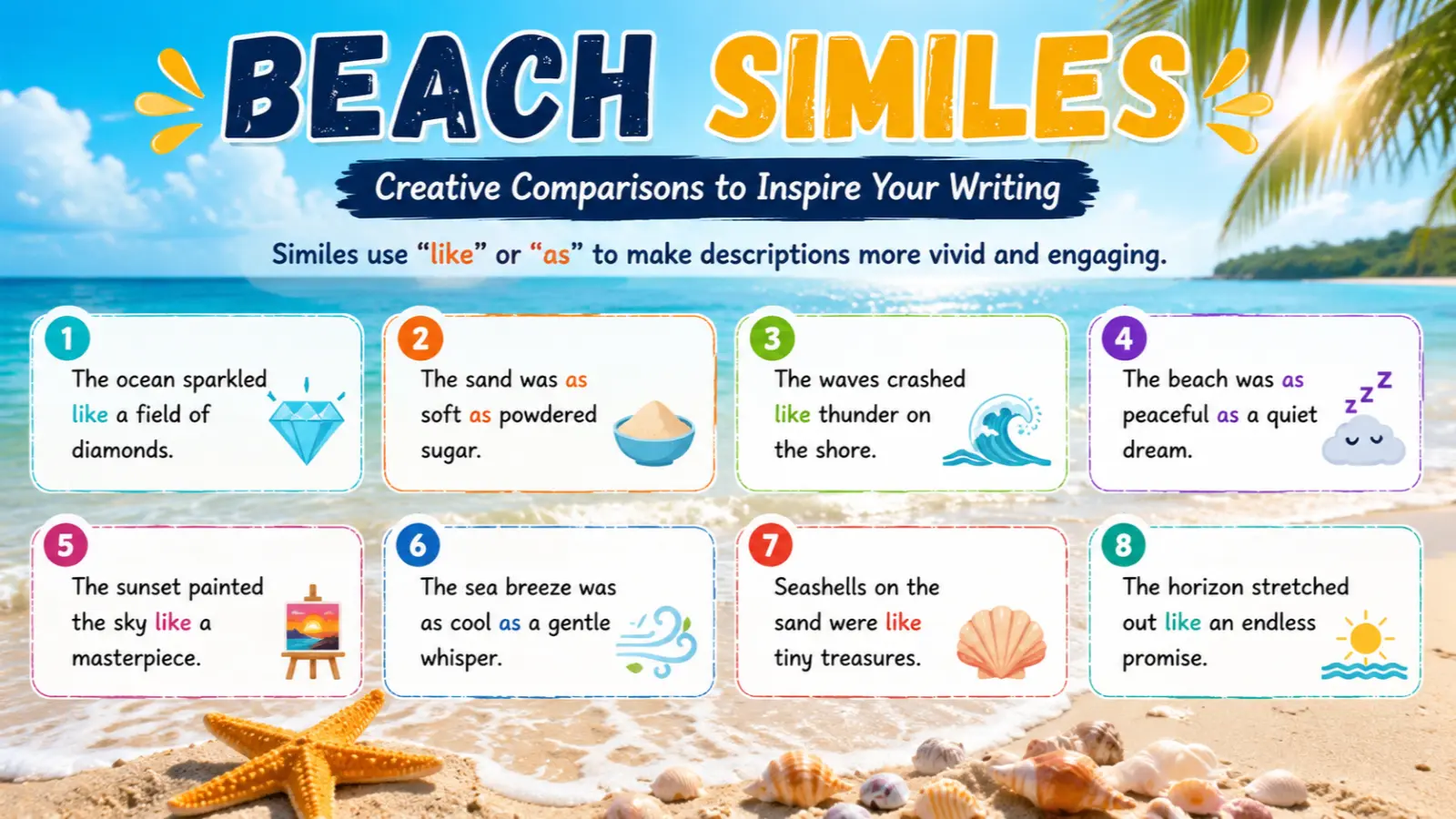
The Beach Similes is one of the richest settings for creative writing. It combines movement, sound, color, light, weather, and emotion in a single place. Whether you’re describing a peaceful sunrise, a crowded shoreline, or a violent storm at sea, the right simile can make readers feel as if they’re standing in the sand beside your characters.
A simile compares two different things using words such as like or as. Instead of simply saying a beach is beautiful, a simile helps readers imagine exactly how it looks, sounds, or feels.
Beach similes appear in novels, poems, travel writing, personal essays, children’s stories, and even conversations. In this guide, you’ll discover original beach similes, learn why they work, and gain practical techniques for creating your own memorable comparisons.
Quick Answer
Beach similes compare the beach or beach-related experiences with another object or idea using like or as. They create vivid imagery, strengthen emotional impact, and help readers picture scenes more clearly. Effective beach similes are fresh, natural, and suited to the mood of your writing.
Why Beach Similes Make Writing More Memorable
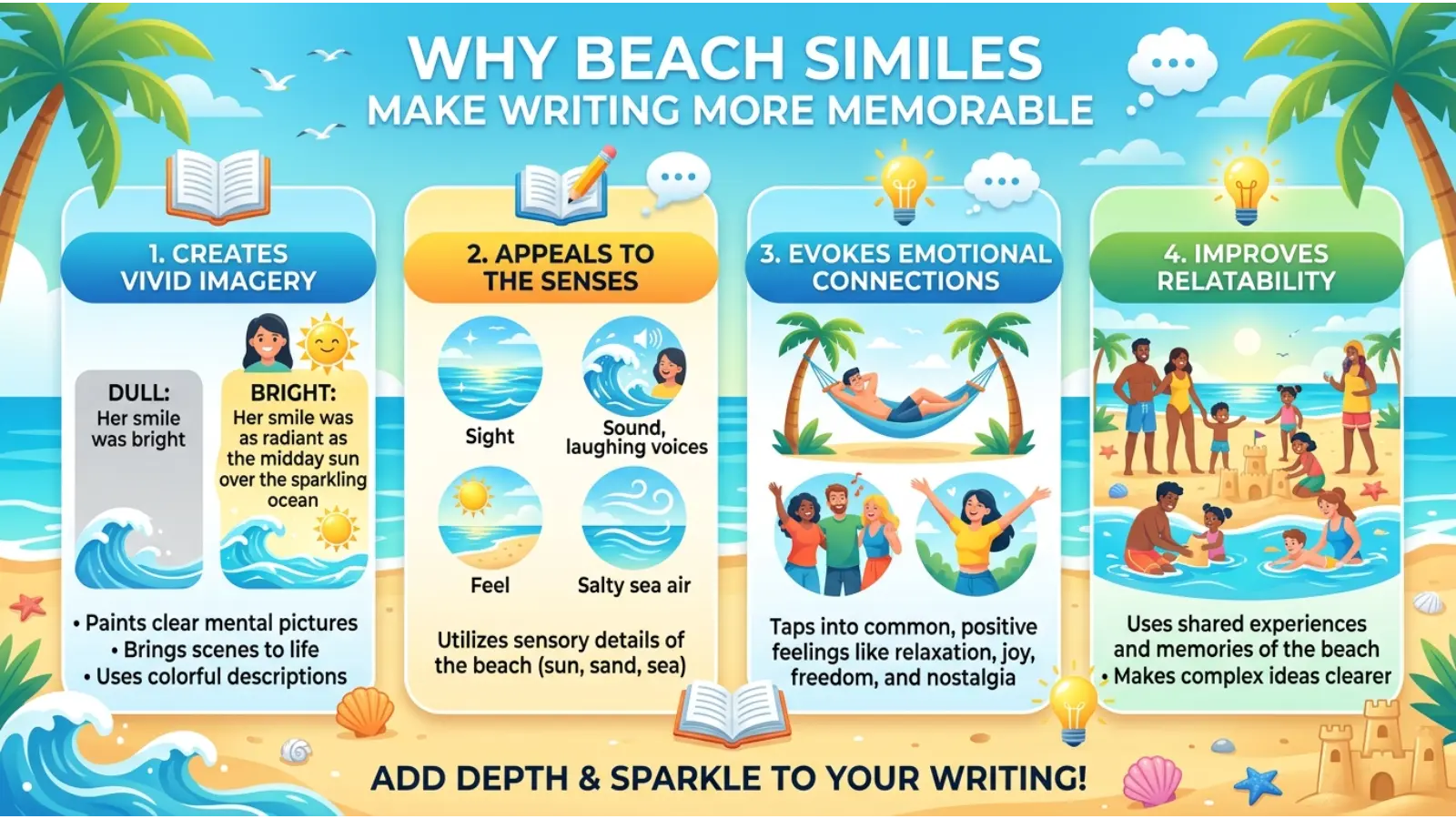
A beach appeals to every sense.
You can hear crashing waves, smell salty air, feel warm sand beneath your feet, and watch sunlight shimmer across the water.
Because beaches naturally engage the senses, similes help transform simple descriptions into scenes readers can experience.
Compare these examples:
Plain: The beach was quiet.
With a simile: The beach rested like a sleeping giant beneath the morning mist.
The second sentence paints a stronger mental image while suggesting calmness and hidden power.
30 Original Beach Similes
1. The beach stretched like an endless golden ribbon.
Meaning: The shoreline seems long and graceful.
Examples
- The beach stretched like an endless golden ribbon beneath the afternoon sun.
- From the cliff, the beach looked like an endless golden ribbon beside the sea.
Best for: Travel writing, landscape descriptions
Writing Tip: Use when emphasizing distance and beauty.
2. The waves rolled in like curious visitors.
Meaning: Waves arrive gently and repeatedly.
Examples
- Gentle waves rolled in like curious visitors greeting the shore.
- Every few seconds, another wave arrived like a curious visitor.
Creates: Peaceful curiosity
3. The sand felt as soft as fresh flour.
Meaning: Exceptionally fine and smooth sand.
Examples
- Bare feet sank into sand as soft as fresh flour.
- Children laughed while walking across sand as soft as fresh flour.
Best Context: Family stories and vacations
4. The shoreline curved like a painter’s brushstroke.
Meaning: Smooth, artistic coastline.
Examples
- The shoreline curved like a painter’s brushstroke.
- From above, the beach resembled a painter’s brushstroke across the sea.
Writing Purpose: Scenic imagery
5. The ocean sparkled like scattered crystals.
Meaning: Water reflects brilliant light.
Examples
- Morning sunlight made the ocean sparkle like scattered crystals.
- Every wave shimmered like scattered crystals.
6. The breeze drifted like a whispered secret.
Meaning: Quiet, gentle wind.
Examples
- A cool breeze drifted like a whispered secret.
- Evening air moved like a whispered secret across the beach.
Emotion: Calmness
7. The tide moved like a patient artist.
Meaning: Slow, careful movement.
Examples
- The tide shaped the shore like a patient artist.
- Waves worked like a patient artist smoothing rough edges.
8. Seashells scattered like forgotten treasures.
Meaning: Beautiful objects lying everywhere.
Examples
- Seashells lay like forgotten treasures along the sand.
- Children searched for shells scattered like forgotten treasures.
9. The sunset melted like warm honey across the horizon.
Meaning: Slow, glowing sunset.
Examples
- The sunset melted like warm honey over the sea.
- Orange light spread like warm honey across the horizon.
10. The foam danced like tiny lace ribbons.
Meaning: Delicate white foam.
Examples
- White foam danced like tiny lace ribbons.
- The shoreline shimmered with foam like lace ribbons.
11. The waves crashed like applause after a performance.
Meaning: Powerful rhythmic sound.
Examples
- Waves crashed like applause after a performance.
- Every breaker sounded like endless applause.
12. The horizon rested like a quiet promise.
Meaning: Peaceful distance filled with hope.
Examples
- The horizon rested like a quiet promise.
- Travelers stared toward the horizon like a quiet promise.
13. The beach glowed like polished amber.
Meaning: Warm golden color.
Examples
- Evening light made the beach glow like polished amber.
- Wet sand shimmered like polished amber.
14. The gulls circled like playful dancers.
Meaning: Graceful movement.
Examples
- Seagulls circled like playful dancers above the surf.
- Birds floated like playful dancers in the wind.
15. The waves whispered like old friends.
Meaning: Familiar, comforting sound.
Examples
- The waves whispered like old friends sharing stories.
- At night, the sea sounded like old friends talking softly.
16. The beach shimmered like a mirror sprinkled with gold.
Meaning: Bright reflective shoreline.
Writing Tip: Excellent for sunrise scenes.
17. Footprints disappeared like erased chalk drawings.
Meaning: Temporary marks washed away.
Examples
- The tide erased footprints like chalk drawings.
- Memories faded like footprints erased from wet sand.
18. The sea breeze wrapped around us like a cool blanket.
Meaning: Refreshing comfort.
19. The surf raced like excited children.
Meaning: Energetic movement.
20. The clouds floated like sails above the shore.
Meaning: Slow, peaceful sky.
21. The beach echoed like an open cathedral.
Meaning: Vast and majestic atmosphere.
22. The morning light spread like liquid silver.
Meaning: Soft reflective brightness.
23. The palm trees swayed like gentle musicians.
Meaning: Rhythmic movement.
24. The sea stretched like polished glass.
Meaning: Exceptionally calm water.
25. The shoreline sparkled like scattered diamonds after rain.
Meaning: Brilliant reflections.
26. The sand shifted like drifting silk.
Meaning: Smooth movement.
27. The waves curled like unfurling ribbons.
Meaning: Elegant wave shapes.
28. The evening sky blushed like a seashell.
Meaning: Soft pink colors.
29. The beach welcomed visitors like an old friend.
Meaning: Warm and inviting atmosphere.
30. The ocean breathed like a sleeping giant.
Meaning: Powerful but peaceful rhythm.
Examples
- The ocean breathed like a sleeping giant beneath the moon.
- We listened as the sea breathed like a sleeping giant.
Storytelling Use: Creates both peace and quiet strength.
Choosing the Right Beach Simile
Not every beach scene needs the same kind of comparison.
For peaceful scenes, choose gentle imagery such as whispers, silk, honey, or glass.
For energetic scenes, compare waves to applause, dancers, racing children, or galloping horses.
Stormy beaches benefit from stronger images that suggest movement, tension, or power.
Always match the simile to the emotion you want readers to experience.
How Professional Writers Build Strong Similes
Experienced writers usually begin by observing details instead of searching for comparisons.
Ask yourself:
- What does the beach sound like?
- How does the light behave?
- What emotion does the place create?
- Which everyday object shares that quality?
Instead of choosing familiar comparisons, look for unexpected but believable connections. Readers remember originality more than exaggeration.
Related Literary Devices
Metaphor
A metaphor says something is another thing instead of comparing it.
Simile: The beach was like a golden ribbon.
Metaphor: The beach was a golden ribbon.
Imagery
Imagery appeals to the senses. Beach similes naturally strengthen imagery by helping readers see, hear, smell, and feel the setting.
Personification
Giving human qualities to nature creates emotional depth.
Example:
“The waves welcomed every traveler.”
Hyperbole
Hyperbole deliberately exaggerates for effect.
Example:
“The waves were as tall as mountains.”
Use sparingly to avoid unrealistic descriptions.
Symbolism
A beach can symbolize freedom, change, peace, reflection, or new beginnings. Pairing symbolism with thoughtful similes can make your writing more meaningful.
Create Your Own Beach Similes
Creating original similes is easier when you follow a simple process.
Step 1: Observe
Notice one detail.
Examples:
- Sand
- Foam
- Wind
- Waves
- Tide
- Sky
Step 2: Choose One Quality
Ask what stands out.
- Soft
- Bright
- Loud
- Endless
- Calm
- Powerful
Step 3: Find a Fresh Comparison
Think of an object that shares the same quality.
Example:
“The tide returned like a careful collector.”
Step 4: Read It Aloud
If the comparison feels natural and easy to picture, it is probably effective.
Creative Writing Exercises
Exercise 1
Write three similes describing the beach at sunrise.
Exercise 2
Describe the same beach during a thunderstorm using only sensory details.
Exercise 3
Replace one ordinary adjective in your writing with an original simile.
Exercise 4
Describe the ocean from the viewpoint of a child, a sailor, and a photographer. Notice how each perspective changes the comparison.
Common Mistakes to Avoid
Relying on Overused Comparisons
Phrases such as “blue as the ocean” rarely surprise readers. Look for fresh details instead.
Mixing Imagery
Avoid combining unrelated comparisons in one sentence.
Weak: The beach was like velvet while roaring like fireworks beneath silent clouds.
Choose one clear image at a time.
Confusing Similes with Metaphors
Remember that similes use like or as, while metaphors make direct comparisons.
Forcing Comparisons
If a comparison feels unnatural or confusing, simplify it. Clarity is more important than complexity.
Ignoring the Mood
A playful simile may not fit a serious or emotional scene. Match your comparison to the tone of your writing.
Frequently Asked Questions
What is a beach simile?
A beach simile compares the beach, ocean, sand, or shoreline to something else using like or as to create vivid imagery.
Why are beach similes useful in creative writing?
They help readers picture settings more clearly, create emotional atmosphere, and make descriptions more memorable.
Can beach similes be used in poetry?
Yes. Beaches offer rich sensory details that work especially well in poetry and lyrical writing.
What makes a beach simile effective?
An effective beach simile is original, easy to visualize, and appropriate for the mood of the scene.
Are beach similes suitable for children?
Absolutely. Simple, imaginative comparisons make descriptive writing more enjoyable for young writers.
How can I avoid cliché beach similes?
Observe real details, focus on one specific quality, and compare it with something unexpected but believable.
Should I use many similes in one paragraph?
Usually not. One or two strong similes often have more impact than several crowded together.
Conclusion
Beach similes do more than decorate a sentence—they help readers experience a place through vivid images and emotion. By paying close attention to movement, sound, color, and texture, you can create comparisons that feel fresh instead of familiar. Use the examples in this guide as inspiration rather than formulas. The strongest similes often come from careful observation and your own unique perspective. With practice, you’ll develop comparisons that make your stories, poems, and descriptions feel more immersive, memorable, and alive.
I am Helena Frost, a writer captivated by the beauty of language and the art of comparison. Through my words, I explore the world by turning ordinary moments into vivid similes and reflections. I enjoy crafting phrases that spark imagination, evoke emotion, and linger in the mind. My writing celebrates the subtle connections between people, nature, and the stories we live. For me, every sentence is an opportunity to reveal the extraordinary in the everyday.