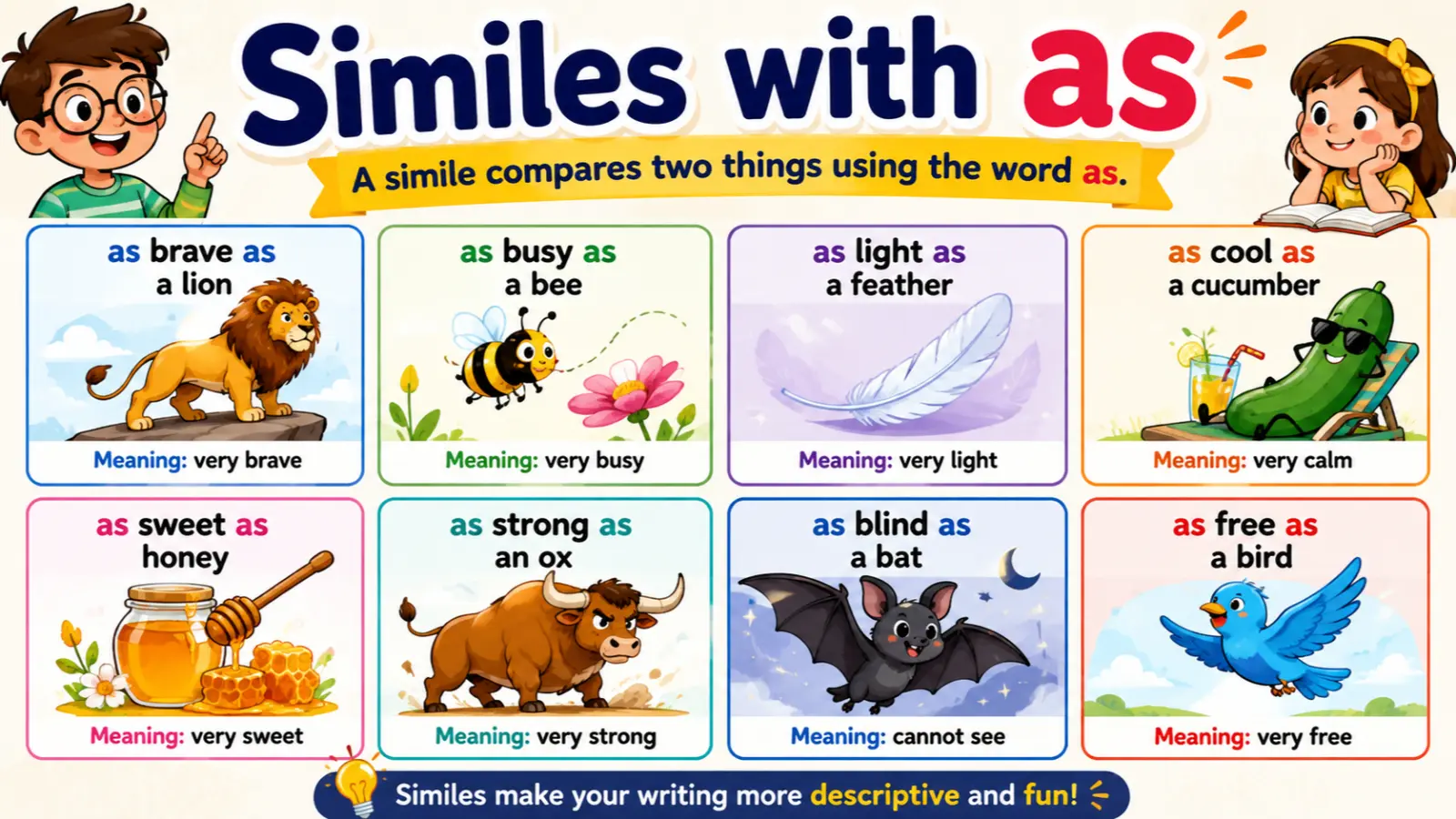
Every great writer knows that a simple comparison can turn an ordinary sentence into one readers remember. One of the easiest ways to create that effect is by using similes with “as.” These comparisons help readers picture emotions, actions, sounds, colors, and personalities with greater clarity.
A simile compares two different things using “like” or “as.” While “like” similes often compare actions or objects, “as…as” similes describe qualities, making them especially useful in stories, essays, poetry, speeches, and everyday conversation.
In this guide, you’ll discover original similes with “as,” learn why they work, see them used in different situations, and pick up practical techniques that can strengthen your own creative writing.
Quick Answer
Similes with “as” compare one thing to another by highlighting a shared quality using the pattern “as + adjective + as.” They help readers visualize ideas, create emotion, and make descriptions more memorable. For example:
As calm as a moonlit lake.
Unlike overused comparisons, fresh similes create stronger imagery and leave a lasting impression.
Why Writers Use Similes With “As”
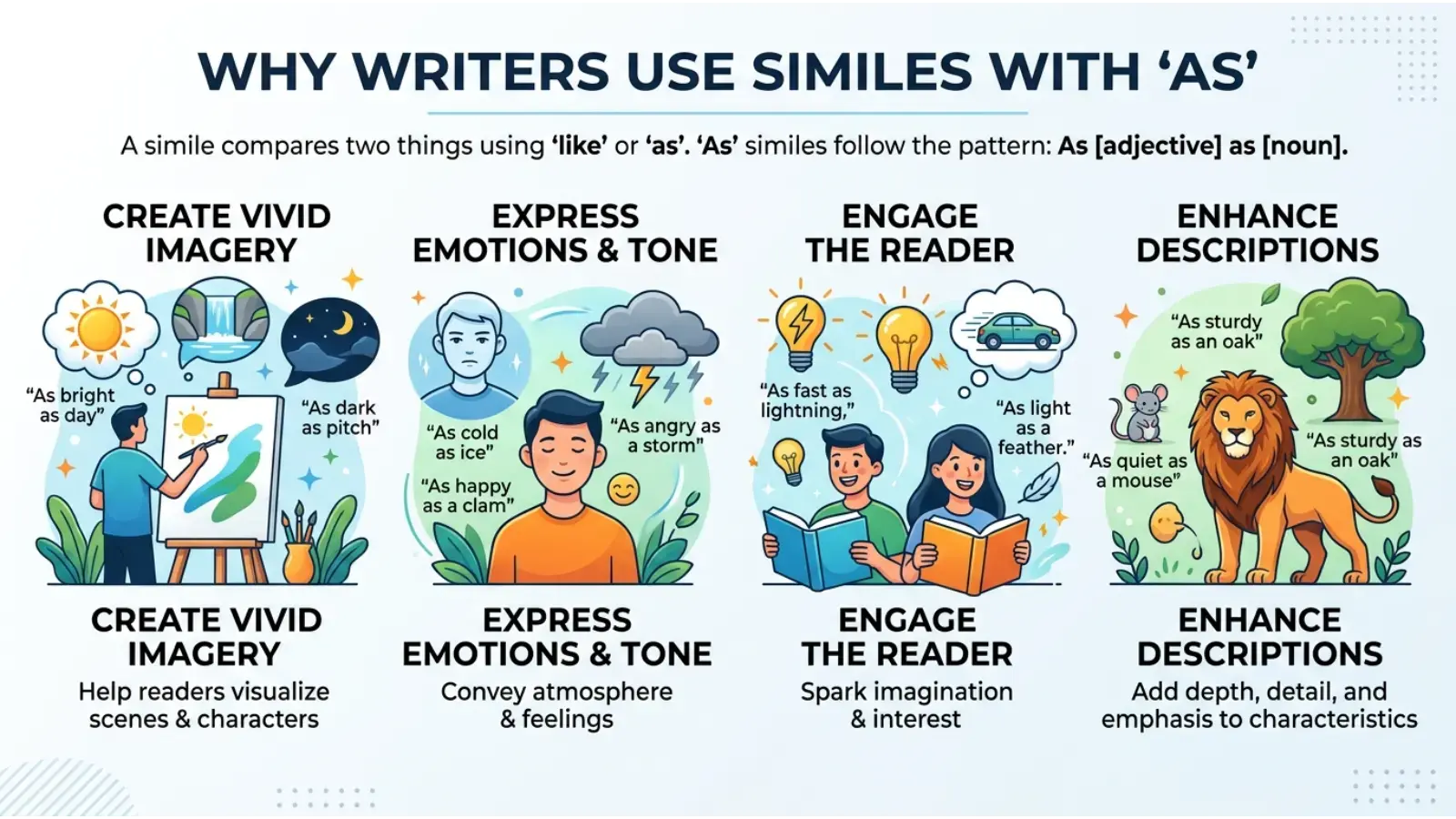
The structure is simple, but the possibilities are nearly endless.
“As” similes can:
- Paint vivid mental images
- Show emotion without lengthy explanations
- Strengthen dialogue
- Add rhythm to poetry
- Improve storytelling
- Make everyday writing more engaging
The best similes don’t just compare—they reveal something meaningful about the subject.
Understanding the Structure
Most follow this pattern:
As + adjective + as + comparison
Examples:
- As gentle as…
- As bright as…
- As restless as…
- As silent as…
The adjective tells readers which quality is being compared, while the second part creates the image.
30 Original Similes With As
1. As patient as a mountain waiting for sunrise
Meaning: Extremely patient.
Examples
- The teacher was as patient as a mountain waiting for sunrise.
- Dad stayed as patient as a mountain while fixing the old bike.
Writing Purpose: Shows quiet endurance rather than simple waiting.
Best Context: Stories, personal essays.
2. As cheerful as a window full of morning light
Meaning: Full of warmth and optimism.
Examples
- Her smile was as cheerful as a window full of morning light.
- He greeted everyone as cheerfully as morning light entering a room.
Emotional Effect: Comfort and hope.
3. As curious as a sparrow exploring fresh footprints
Meaning: Eager to discover new things.
Examples
- Maya became as curious as a sparrow exploring fresh footprints.
- The children looked around as curious as little explorers.
Writing Tip: Pair curiosity with unexpected images.
4. As steady as an old lighthouse
Meaning: Reliable and dependable.
Examples
- His advice remained as steady as an old lighthouse.
- She stayed as steady as an old lighthouse during the emergency.
Best Context: Character descriptions.
5. As quiet as snowfall before dawn
Meaning: Exceptionally peaceful.
Examples
- The library felt as quiet as snowfall before dawn.
- Everyone listened as quietly as fresh snow settling.
Poetry Example
The valley rested, as quiet as snowfall before dawn.
6. As bright as fresh paint beneath sunshine
Meaning: Vibrant and colorful.
Examples
- The flowers looked as bright as fresh paint beneath sunshine.
- Her artwork appeared as bright as spring itself.
7. As gentle as rain touching wildflowers
Meaning: Kind and careful.
Examples
- His voice was as gentle as rain touching wildflowers.
- She placed the kitten down as gently as falling rain.
8. As fearless as a river finding the sea
Meaning: Confident despite obstacles.
Examples
- The young athlete became as fearless as a river finding the sea.
- She walked into the interview as fearless as flowing water.
9. As light as a feather riding summer wind
Meaning: Extremely light.
Examples
- The scarf felt as light as a feather riding summer wind.
- Her footsteps sounded as light as drifting leaves.
10. As thoughtful as an artist choosing colors
Meaning: Careful and reflective.
Examples
- Every decision was as thoughtful as an artist choosing colors.
- He answered as thoughtfully as someone painting a masterpiece.
11. As calm as a moonlit lake
Meaning: Completely peaceful.
Examples
- She remained as calm as a moonlit lake.
- His breathing became as calm as still water.
12. As lively as leaves dancing in autumn wind
Meaning: Full of energy.
Examples
- The children were as lively as leaves dancing in autumn wind.
- The celebration became as lively as a festival parade.
13. As warm as fresh bread from the oven
Meaning: Friendly and welcoming.
Examples
- Her welcome was as warm as fresh bread from the oven.
- The family gathered in a room as warm as home itself.
14. As sharp as winter stars
Meaning: Very intelligent or observant.
Examples
- His memory stayed as sharp as winter stars.
- She noticed every detail as sharply as an experienced detective.
15. As smooth as polished marble
Meaning: Graceful or flawless.
Examples
- The speech flowed as smooth as polished marble.
- His movements appeared as smooth as a dancer’s routine.
16. As colorful as a festival sky
Meaning: Rich in color.
Examples
- The market looked as colorful as a festival sky.
- Her imagination remained as colorful as fireworks.
17. As determined as roots beneath stone
Meaning: Persistent despite difficulty.
Examples
- She worked as determined as roots beneath stone.
- Their team remained as determined as growing forests.
18. As graceful as drifting petals
Meaning: Elegant.
Examples
- She danced as graceful as drifting petals.
- The swan moved as graceful as floating silk.
19. As refreshing as cool shade on a hot afternoon
Meaning: Comforting.
Examples
- His advice felt as refreshing as cool shade.
- The rain arrived as refreshing as hope itself.
20. As dependable as sunrise
Meaning: Always reliable.
Examples
- She was as dependable as sunrise.
- His support remained as dependable as every new morning.
21. As imaginative as clouds inventing new shapes
Meaning: Highly creative.
Examples
- The young writer was as imaginative as clouds inventing new shapes.
- Every drawing looked wonderfully original.
22. As peaceful as birds resting after migration
Meaning: Deeply relaxed.
Examples
- The cabin felt as peaceful as birds resting after migration.
- Everyone finally relaxed.
23. As hopeful as seeds beneath spring soil
Meaning: Filled with optimism.
Examples
- She remained as hopeful as seeds beneath spring soil.
- They waited for results with quiet confidence.
24. As focused as an eagle spotting distant movement
Meaning: Highly concentrated.
Examples
- He studied as focused as an eagle spotting distant movement.
- The surgeon remained completely attentive.
25. As graceful as morning mist
Meaning: Soft and elegant.
Examples
- Her entrance was as graceful as morning mist.
- The dancer floated across the stage.
26. As welcoming as an open garden gate
Meaning: Friendly and inviting.
Examples
- Their home felt as welcoming as an open garden gate.
- Everyone smiled warmly.
27. As resilient as grass after rain
Meaning: Quick to recover.
Examples
- She proved as resilient as grass after rain.
- The community rebuilt with determination.
28. As inventive as a child building imaginary worlds
Meaning: Extremely creative.
Examples
- His stories were as inventive as a child building imaginary worlds.
- Every solution surprised the team.
29. As peaceful as evening birdsong
Meaning: Calm and soothing.
Examples
- The park became as peaceful as evening birdsong.
- Her voice relaxed everyone nearby.
30. As hopeful as the first star after sunset
Meaning: Encouraging during uncertainty.
Examples
- They waited as hopeful as the first star after sunset.
- The letter brought renewed confidence.
Storytelling Example
She smiled, as hopeful as the first star after sunset, believing tomorrow would be brighter.
What Makes a Simile Memorable?
Strong similes are built on specific images instead of familiar clichés.
Instead of writing:
- As busy as a bee
Try creating a fresh comparison:
- As busy as a baker before sunrise.
Specific details help readers imagine the scene instead of skimming past it.
How Professional Writers Create Strong Similes
Professional writers usually begin by asking one question:
What feeling do I want readers to experience?
Once the emotion is clear, they search for an image that naturally produces that feeling.
For example:
- Peace → still water
- Excitement → fireworks
- Strength → roots breaking stone
- Hope → sunrise or growing seeds
The comparison should support the emotion instead of distracting from it.
Avoiding Common Simile Mistakes
Overused Comparisons
Familiar phrases often lose their impact because readers have seen them countless times.
Instead of repeating well-known expressions, create comparisons drawn from everyday life or nature.
Mixed Imagery
Avoid combining unrelated images.
Poor example:
As cold as ice but burning like sunshine.
Keep your imagery consistent.
Confusing Similes With Metaphors
A simile uses like or as.
Example:
As quiet as snowfall.
A metaphor makes a direct statement.
Example:
The snowfall was silence.
Forced Comparisons
Every comparison should feel believable. If readers stop to question the image, the simile isn’t helping.
Related Literary Devices
Metaphor
A metaphor compares without using “like” or “as.”
Imagery
Imagery appeals to the senses, while similes often strengthen imagery through comparison.
Personification
Giving human qualities to non-human things can work beautifully alongside similes.
Example:
The wind whispered, as softly as a secret.
Hyperbole
Hyperbole exaggerates for emphasis, while similes compare qualities more directly.
Symbolism
Symbols can deepen the meaning behind a simile, especially in poetry and fiction.
Create Your Own Similes With “As”
You don’t need extraordinary vocabulary to write memorable similes.
Try this simple process:
Step 1: Choose a quality.
Examples:
- Happy
- Brave
- Quiet
- Fast
- Gentle
Step 2: Think of an image that naturally shows that quality.
For “gentle,” you might picture:
- Rain
- Butterfly wings
- Floating feathers
- Morning breeze
Step 3: Build the comparison.
“As gentle as rain touching wildflowers.”
Creative Exercise
Describe these using original “as” similes:
- A nervous student
- A loyal friend
- A peaceful beach
- A busy city
- A hopeful traveler
Challenge yourself to avoid any comparison you’ve heard before.
Frequently Asked Questions
What is a simile with “as”?
A simile with “as” compares two things using the structure as + adjective + as + noun to highlight a shared quality.
Why are “as” similes useful?
They make writing more descriptive, engaging, and easier for readers to visualize.
Can similes with “as” be used in formal writing?
Yes. They work well in speeches, essays, literature, and creative nonfiction when they suit the tone.
Are similes only used in poetry?
No. They appear in novels, journalism, conversations, advertising, education, and storytelling.
How can I make my similes more original?
Look beyond common expressions. Observe nature, daily life, memories, and emotions to create comparisons that feel fresh and authentic.
What’s the difference between “like” and “as” similes?
Both create comparisons. “Like” often compares actions or objects, while “as…as” commonly compares qualities or characteristics.
Conclusion
Similes with “as” are more than decorative language—they help readers see, feel, and remember your ideas. By choosing vivid, original comparisons instead of familiar clichés, you can make descriptions stronger, dialogue more believable, and stories more immersive. The best similes come from careful observation. Pay attention to the world around you, notice unexpected connections, and experiment with your own comparisons. With practice, you’ll develop a style that feels fresh, expressive, and uniquely your own.

I am Helena Frost, a writer captivated by the beauty of language and the art of comparison. Through my words, I explore the world by turning ordinary moments into vivid similes and reflections. I enjoy crafting phrases that spark imagination, evoke emotion, and linger in the mind. My writing celebrates the subtle connections between people, nature, and the stories we live. For me, every sentence is an opportunity to reveal the extraordinary in the everyday.