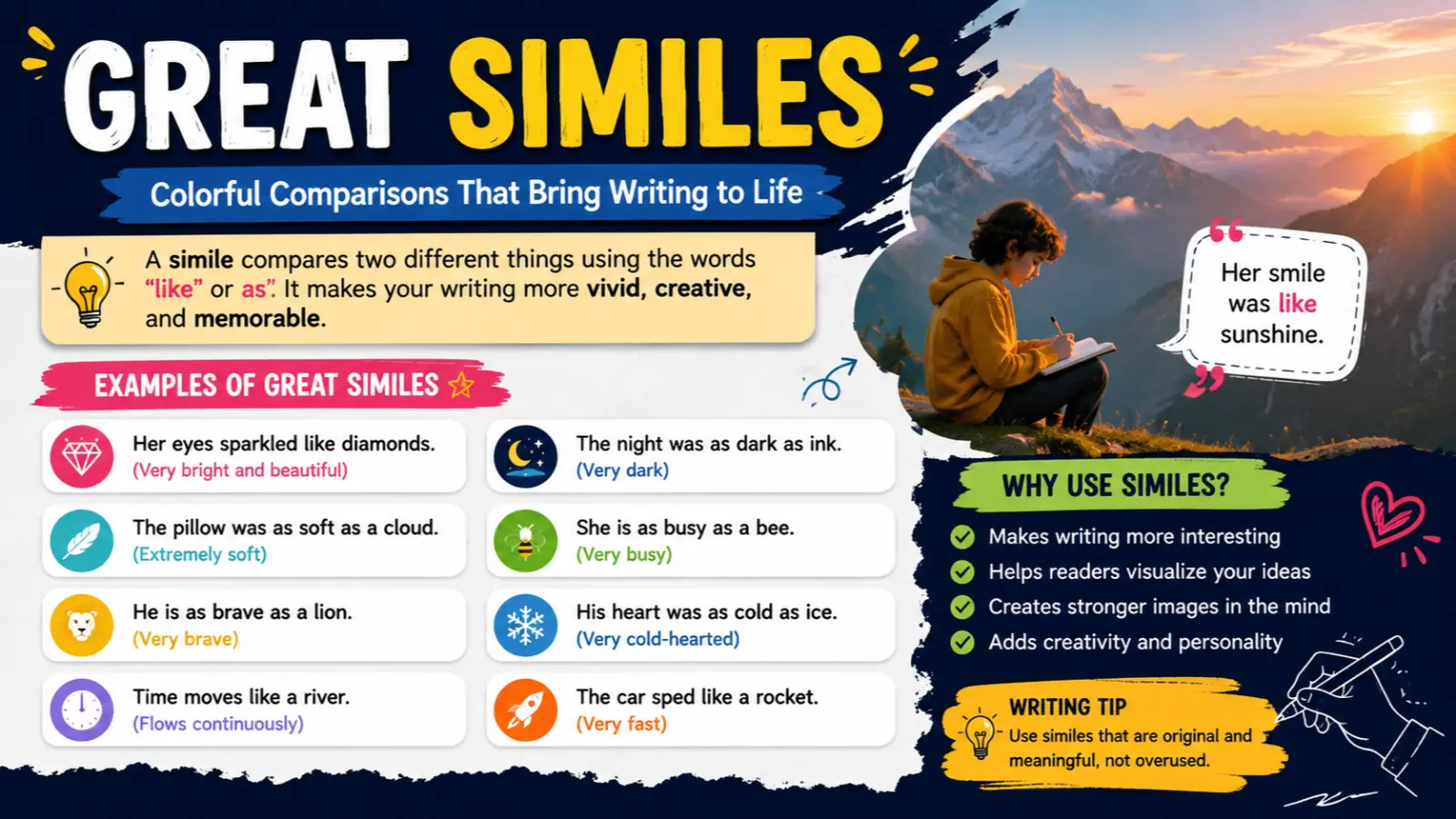
Great similes do more than compare two things—they help readers see, hear, and feel an idea in a memorable way. Whether you’re writing a story, poem, speech, essay, or even a social media caption, a well-crafted simile can transform ordinary writing into something readers remember. In this guide, you’ll discover original great similes, learn why they work, avoid common mistakes, and practice creating your own comparisons with confidence.
What Is a Great Simile?
A simile is a figure of speech that compares two different things using words like “like” or “as.”
A great simile goes one step further. Instead of using a familiar comparison, it creates a fresh image that feels surprising while still making perfect sense.
For example:
- Her hope floated like a lantern above stormy waves.
The comparison creates both a visual picture and an emotional feeling.
Why Great Similes Matter
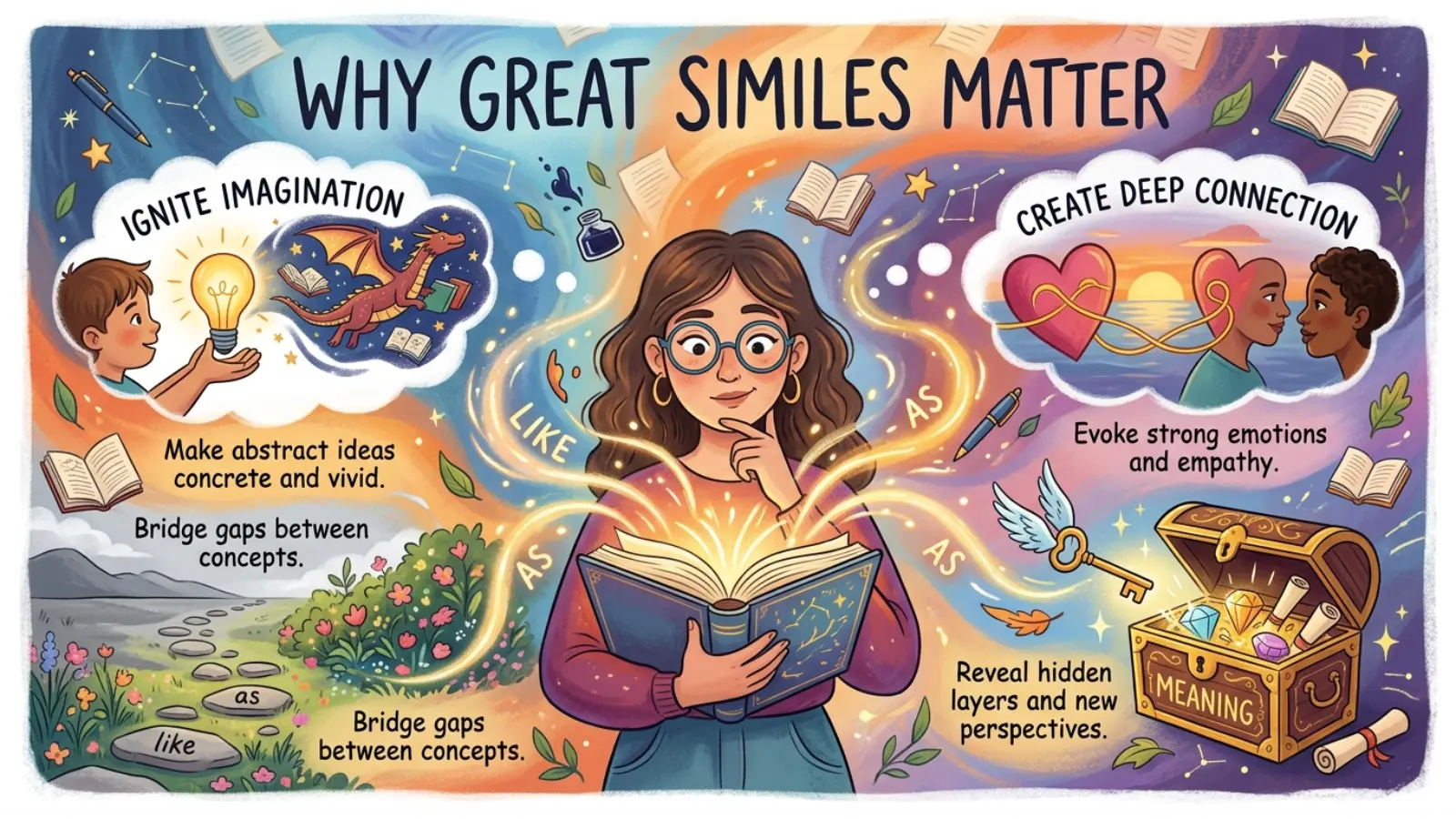
Strong similes help readers:
- Picture scenes more clearly
- Understand emotions faster
- Remember descriptions longer
- Connect with characters
- Add personality to writing
Professional writers often use similes to make ordinary moments unforgettable.
25 Original Great Similes with Meanings and Examples
1. As steady as a lighthouse during a storm
Meaning: Extremely dependable.
Examples
- My grandfather stayed as steady as a lighthouse during a storm.
- She remained calm through every challenge.
Best for: Leadership, trust, resilience.
Writing Tip: Use when describing someone others rely on.
2. Like sunlight slipping through old curtains
Meaning: Gentle hope appearing quietly.
Examples
- Happiness arrived like sunlight slipping through old curtains.
- Her smile brightened the room without saying a word.
Works well in: Emotional stories and poetry.
3. As curious as a child discovering hidden doors
Meaning: Deeply interested and eager to learn.
Examples
- He explored every museum as curious as a child discovering hidden doors.
- The young scientist questioned everything.
4. Like rain washing dust from forgotten windows
Meaning: Bringing clarity after confusion.
Examples
- Her advice was like rain washing dust from forgotten windows.
- The explanation finally made sense.
5. As patient as a mountain waiting for seasons
Meaning: Calm over long periods.
Examples
- My teacher remained as patient as a mountain waiting for seasons.
- Success rewarded his persistence.
6. Like music echoing across a quiet valley
Meaning: Beautiful and lasting.
Examples
- Her laughter spread like music echoing across a quiet valley.
- Good news lifted everyone’s mood.
7. As bright as fresh snow beneath morning sunlight
Meaning: Brilliant and cheerful.
Examples
- His imagination was as bright as fresh snow beneath morning sunlight.
- The classroom felt alive with ideas.
8. Like a compass finding true north
Meaning: Naturally guiding others.
Examples
- Her honesty worked like a compass finding true north.
- He always knew the right thing to do.
9. As gentle as leaves landing on a lake
Meaning: Soft and peaceful.
Examples
- Her voice was as gentle as leaves landing on a lake.
- The baby’s breathing became calm.
10. Like stars appearing after heavy clouds
Meaning: Hope after hardship.
Examples
- Better days arrived like stars appearing after heavy clouds.
- The team finally celebrated victory.
11. As fearless as an eagle above cliffs
Meaning: Brave under pressure.
Examples
- She entered the competition as fearless as an eagle above cliffs.
- The firefighter never hesitated.
12. Like fresh paint on an old wall
Meaning: Giving something new life.
Examples
- The renovation felt like fresh paint on an old wall.
- His encouragement renewed my confidence.
13. As focused as an artist finishing the final brushstroke
Meaning: Completely concentrated.
Examples
- She studied as focused as an artist finishing the final brushstroke.
- Nothing distracted him.
14. Like ripples spreading across still water
Meaning: Small actions creating bigger effects.
Examples
- One kind word spread like ripples across still water.
- Good leadership influenced the whole team.
15. As light as a feather carried by summer air
Meaning: Effortless or carefree.
Examples
- She danced as light as a feather carried by summer air.
- His mood improved instantly.
16. Like a seed pushing through stone
Meaning: Determination against difficulty.
Examples
- Her dream grew like a seed pushing through stone.
- Success came slowly but surely.
17. As warm as a fire on a winter evening
Meaning: Friendly and comforting.
Examples
- His welcome felt as warm as a fire on a winter evening.
- The neighbors treated everyone kindly.
18. Like a river finding its path
Meaning: Naturally progressing.
Examples
- His career developed like a river finding its path.
- Life slowly settled into place.
19. As sharp as morning frost
Meaning: Very alert or intelligent.
Examples
- Her observations were as sharp as morning frost.
- He noticed every small detail.
20. Like a kite dancing with the wind
Meaning: Joyful freedom.
Examples
- The children laughed like kites dancing with the wind.
- She embraced every opportunity.
21. As calm as moonlight on a quiet beach
Meaning: Deep peace.
Examples
- He stayed as calm as moonlight on a quiet beach.
- Meditation eased her worries.
22. Like roots holding a giant tree
Meaning: Strong support.
Examples
- Friendship held them together like roots holding a giant tree.
- Family gave her strength.
23. As fresh as the first breeze after rain
Meaning: Renewed and refreshing.
Examples
- His ideas felt as fresh as the first breeze after rain.
- The redesign energized the brand.
24. Like an open window on a spring morning
Meaning: Full of possibilities.
Examples
- Graduation felt like an open window on a spring morning.
- Every new project excited her.
25. As resilient as wildflowers growing between stones
Meaning: Strong despite hardship.
Examples
- She remained as resilient as wildflowers growing between stones.
- The community rebuilt after the storm.
What Makes a Simile Memorable?
Great similes usually have three qualities:
They Create a Clear Picture
Readers should instantly imagine the comparison.
They Match the Emotion
A joyful scene deserves uplifting imagery, while a serious moment benefits from calmer comparisons.
They Feel Natural
If readers stop to figure out what a simile means, it may be too complicated.
How Professional Writers Create Strong Similes
Instead of choosing the first comparison that comes to mind, experienced writers often ask:
- What does this emotion feel like?
- What object behaves the same way?
- What image would surprise readers without confusing them?
This approach leads to more original descriptions.
Related Literary Devices
Metaphor
A metaphor says one thing is another instead of using “like” or “as.”
- Simile: Her smile was like sunrise.
- Metaphor: Her smile was sunrise.
Imagery
Imagery appeals to the senses. Similes often strengthen imagery by making scenes easier to picture.
Hyperbole
Hyperbole exaggerates for emphasis.
Example:
- He ran as fast as lightning.
The comparison intentionally stretches reality.
Personification
Personification gives human qualities to non-human things.
Example:
- The wind whispered through the trees.
It can work beautifully alongside similes.
Symbolism
Symbols represent deeper meanings. A simile can compare something to a symbolic object, such as a bridge representing hope or connection.
How to Create Your Own Great Similes
Follow these simple steps.
Step 1
Choose the feeling or quality you want to describe.
Example:
- Courage
- Joy
- Loneliness
- Excitement
Step 2
Think of something that naturally shares that quality.
Step 3
Connect them using like or as.
Step 4
Read it aloud.
If it sounds forced, simplify it.
Creative Practice Exercises
Exercise 1
Describe happiness without using sunshine.
Exercise 2
Write three similes about friendship using objects found in nature.
Exercise 3
Rewrite a boring sentence.
Original:
“The room was quiet.”
Improved:
“The room was as quiet as snow settling over a sleeping forest.”
Exercise 4
Take one emotion and create five different similes using different settings such as the ocean, city, mountains, garden, and night sky.
Common Mistakes to Avoid
Using Overused Comparisons
Phrases like “busy as a bee” or “cold as ice” are familiar but often lack originality. Look for fresh, believable alternatives.
Mixing Images
Avoid combining unrelated pictures.
Confusing:
- Her voice was like thunder floating on feathers.
Keep your imagery consistent.
Forcing the Comparison
Every simile should make sense naturally. If readers need an explanation, revise it.
Confusing Similes with Metaphors
Remember:
- Similes use like or as.
- Metaphors compare directly without those words.
Adding Too Many Similes
One vivid comparison often has more impact than several crowded together.
Frequently Asked Questions
What makes a simile great?
A great simile creates a fresh, clear comparison that strengthens meaning without distracting the reader.
Should similes always use “like” or “as”?
Yes. Those words are the defining feature of a simile.
Can I invent my own similes?
Absolutely. Original similes often make writing more engaging than familiar expressions.
Are similes useful outside creative writing?
Yes. They improve speeches, blogs, essays, presentations, and everyday conversations by making ideas easier to understand.
How many similes should I use in one piece of writing?
Use only as many as improve the writing. Quality matters more than quantity.
What’s the difference between a cliché and an effective simile?
A cliché is a comparison readers have seen countless times. An effective simile offers a fresh perspective while remaining clear and meaningful.
Conclusion
Great similes don’t depend on complicated language—they depend on thoughtful observation. The best comparisons reveal something familiar in an unexpected way, helping readers connect with your ideas through vivid images and genuine emotion. As you write, challenge yourself to notice the world more carefully. A drifting leaf, a winding river, or a glowing lantern can become the inspiration for your next memorable simile. The more you practice creating original comparisons, the more naturally your writing will capture readers’ attention and leave a lasting impression.
I am Helena Frost, a writer captivated by the beauty of language and the art of comparison. Through my words, I explore the world by turning ordinary moments into vivid similes and reflections. I enjoy crafting phrases that spark imagination, evoke emotion, and linger in the mind. My writing celebrates the subtle connections between people, nature, and the stories we live. For me, every sentence is an opportunity to reveal the extraordinary in the everyday.