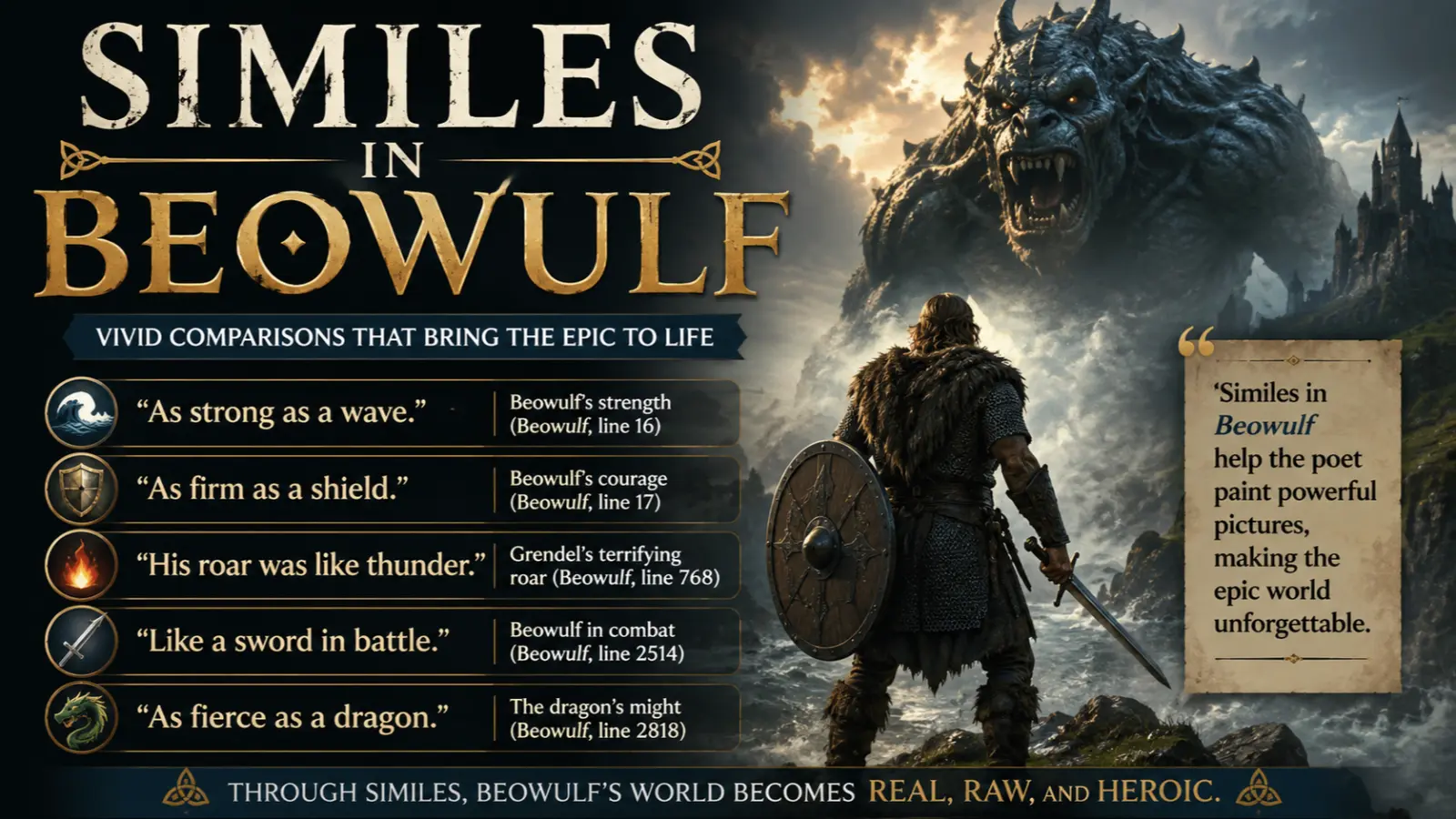
Beowulf is one of the oldest surviving works of English literature. Although it relies more heavily on metaphors, kennings, and vivid imagery than on frequent similes, the few comparisons inspired by its style help readers picture heroic battles, dangerous monsters, and unforgettable characters. A simile compares two unlike things using “like” or “as.” In epic poetry, similes slow the action just enough to create memorable images, deepen emotion, and help readers visualize dramatic scenes. This guide explores how similes fit the world of Beowulf, provides original examples inspired by the poem’s themes, and offers practical advice for writing your own epic comparisons.
Quick Answer
Similes in Beowulf are less common than metaphors and kennings, but they serve an important purpose by making heroic actions, emotions, and settings easier to imagine. Writers inspired by Beowulf often use similes to compare warriors, monsters, storms, swords, and courage to familiar images that strengthen the story’s emotional impact.
Why Similes Matter in an Epic Like Beowulf
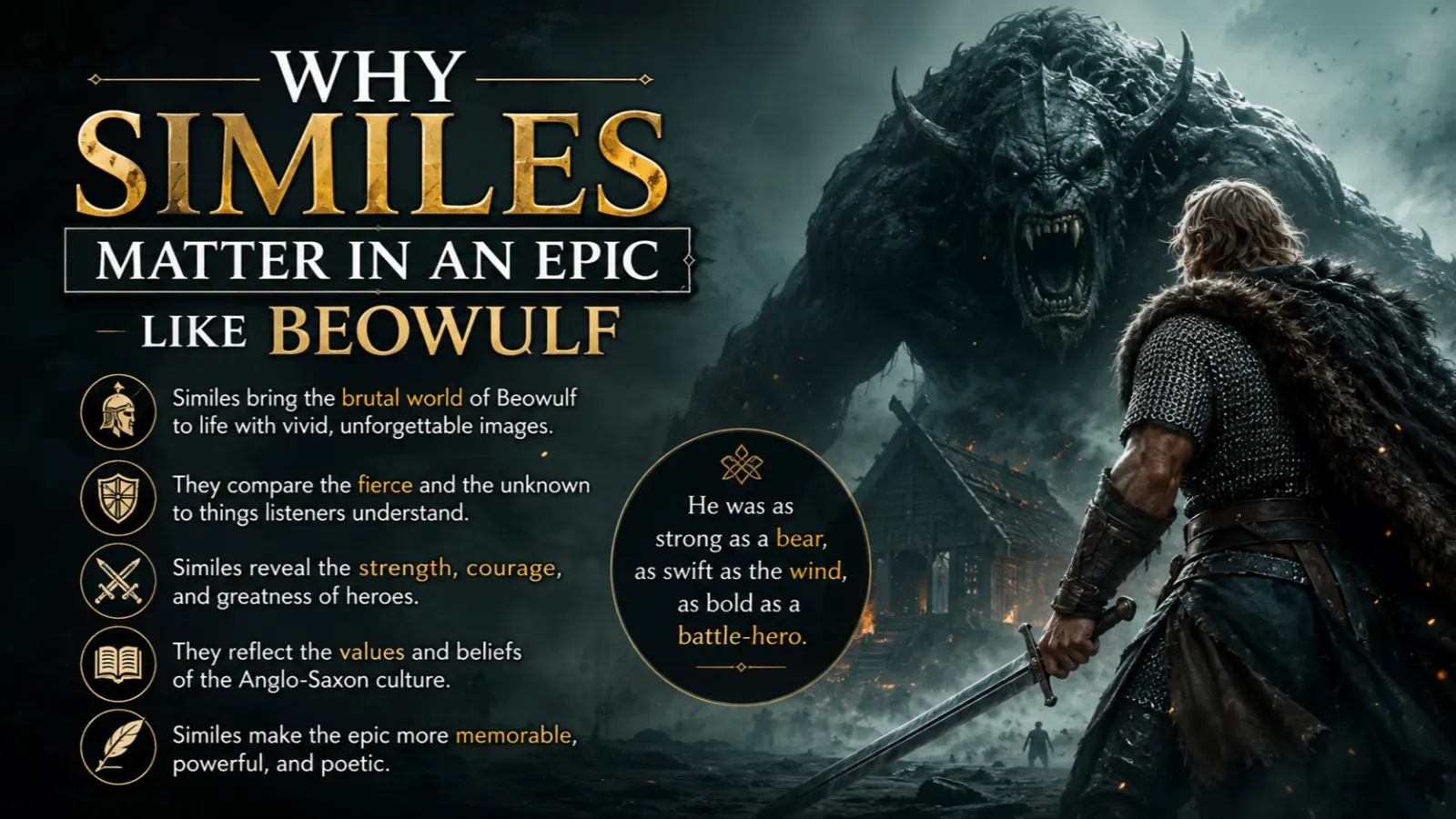
Epic poems tell stories on a grand scale. Their heroes face impossible challenges, their enemies symbolize fear itself, and every battle carries lasting consequences.
A well-crafted simile can:
- Make action scenes easier to picture.
- Add emotional depth without slowing the story too much.
- Highlight bravery, danger, or loss.
- Connect unfamiliar settings with everyday experiences.
- Help readers remember important moments.
Unlike ordinary descriptions, similes invite readers to imagine the scene for themselves.
Original Similes Inspired by Beowulf
1. Brave as a mountain standing against the storm
Meaning: Unshakable courage despite danger.
Examples
- The warrior stood as brave as a mountain standing against the storm.
- She remained as brave as a mountain while defending her family.
Effect
Creates confidence and strength.
Best Use
Heroes facing overwhelming odds.
Writing Tip
Compare courage to something naturally stable.
2. His sword flashed like frozen lightning
Meaning: Extremely bright and powerful.
Examples
- His sword flashed like frozen lightning beneath the moon.
- The blade gleamed like frozen lightning before the attack.
Writing Purpose
Adds dramatic visual imagery.
3. The monster moved like a shadow escaping dawn
Meaning: Silent and difficult to catch.
Examples
- The creature slipped like a shadow escaping dawn.
- The enemy vanished like a shadow before anyone reacted.
Best Context
Suspense and horror.
4. Courage spread through the hall like sunrise across snow
Meaning: Hope quickly replaced fear.
Examples
- Courage spread through the hall like sunrise across snow.
- His speech filled every heart like sunrise across snow.
Emotional Effect
Hope and renewal.
5. The waves crashed like angry giants
Meaning: Violent, overwhelming seas.
Examples
- The ship fought waves crashing like angry giants.
- The coast echoed as waves roared like angry giants.
Storytelling Use
Sea voyages and storms.
6. His voice rolled like distant thunder
Meaning: Deep and commanding.
Examples
- The king’s voice rolled like distant thunder.
- His warning echoed like distant thunder.
Writing Tip
Excellent for leaders and warriors.
7. Fear clung like cold iron
Meaning: Fear felt heavy and impossible to ignore.
Examples
- Fear clung like cold iron before the battle.
- The villagers carried fear like cold iron.
8. The shield stood like an ancient oak
Meaning: Strong and dependable.
Examples
- His shield stood like an ancient oak.
- The defenders held their line like ancient oaks.
9. Hope flickered like a lone candle in winter
Meaning: Small but persistent hope.
Examples
- Hope flickered like a lone candle in winter.
- The survivors protected hope like a tiny flame.
10. The dragon’s breath burned like a blazing furnace
Meaning: Intense heat.
Examples
- The dragon breathed fire like a blazing furnace.
- Heat poured across the valley like a furnace door opening.
11. The warrior charged like a hunting wolf
Meaning: Fast, fearless, and determined.
Examples
- He charged like a hunting wolf.
- The soldiers advanced like wolves chasing prey.
12. Silence settled like falling ash
Meaning: Heavy silence after destruction.
Examples
- Silence settled like falling ash after the battle.
- The village became quiet like falling ash.
13. Honor shone like polished gold
Meaning: Noble reputation.
Examples
- His honor shone like polished gold.
- Their loyalty gleamed like polished gold.
14. The castle rose like a cliff above the sea
Meaning: Impressive and secure.
Examples
- The fortress stood like a cliff above the sea.
- The walls rose like towering cliffs.
15. Grief spread like winter fog
Meaning: Sadness slowly covered everyone.
Examples
- Grief spread like winter fog after the king’s death.
- Sorrow drifted through the hall like winter fog.
16. The spear flew like a falcon diving
Meaning: Fast and accurate.
Examples
- His spear flew like a falcon diving.
- The weapon struck like a hunting bird.
17. Wisdom rested like calm water
Meaning: Quiet intelligence.
Examples
- Wisdom rested within the old king like calm water.
- Her advice flowed like calm water.
18. Victory echoed like bells across the hills
Meaning: Triumph reached everyone.
Examples
- Victory echoed like bells across the hills.
- News of success spread like ringing bells.
19. The battlefield glowed like embers before dawn
Meaning: A haunting scene after combat.
Examples
- The battlefield glowed like embers before dawn.
- Smoke lingered like glowing embers.
20. Loyalty held the warriors together like woven rope
Meaning: Strong unity.
Examples
- Loyalty held the warriors together like woven rope.
- Their friendship bound them like braided rope.
What Makes an Epic Simile Effective?
Epic similes succeed because they do more than decorate a sentence. They strengthen the mood, reveal character, and support the story.
Professional writers often ask:
- Does this comparison fit the setting?
- Does it create a fresh image?
- Does it strengthen the emotion?
- Would removing it make the passage weaker?
If the answer is yes, the simile is doing meaningful work.
Similes Compared with Other Literary Devices in Beowulf
Metaphor
A metaphor states one thing is another.
Example
“The warrior was a shield for his people.”
Metaphors are more common in Beowulf than similes.
Kennings
One of Beowulf‘s signature devices is the kenning—a compound expression that replaces a familiar noun.
Examples include phrases such as “whale-road” for the sea and “battle-sweat” for blood. These imaginative substitutions add richness to the poem’s language.
Imagery
Imagery appeals to the senses through descriptive language.
A simile often strengthens imagery by giving readers a vivid comparison.
Personification
Personification gives human qualities to nonhuman things.
Example:
“The wind whispered across the cliffs.”
Hyperbole
Epic poetry frequently exaggerates events for dramatic effect.
Example:
“The roar shook the entire kingdom.”
Symbolism
Objects often carry deeper meaning.
A dragon may symbolize greed, while treasure can symbolize both reward and temptation.
How to Create Your Own Epic Similes
Follow these steps when writing in an epic style.
Step 1: Identify the main idea.
Is your character brave, frightened, wise, or powerful?
Step 2: Find a striking comparison.
Choose something from nature, history, animals, or weather.
Step 3: Use “like” or “as.”
Keep the wording simple.
Step 4: Match the mood.
Dark scenes deserve darker comparisons.
Step 5: Read it aloud.
An effective simile sounds natural rather than forced.
Creative Practice
Try these exercises.
Exercise 1
Write three similes describing a heroic warrior.
Exercise 2
Describe a dragon without mentioning fire.
Exercise 3
Compare a storm to an emotion.
Exercise 4
Rewrite a plain sentence using one memorable simile.
Original:
“The king was brave.”
Possible revision:
“The king stood as fearless as a cliff facing endless waves.”
Common Mistakes to Avoid
Using overused comparisons
Readers have seen phrases like “busy as a bee” countless times. Aim for fresh imagery.
Mixing unrelated images
Avoid combining comparisons that clash.
Weak Example
“He fought like a lion while floating like a feather.”
The images suggest opposite qualities.
Confusing metaphors and similes
Remember:
- Similes use like or as.
- Metaphors make direct comparisons.
Adding unnecessary similes
Not every sentence needs one. Too many comparisons can distract from the action.
Choosing comparisons that don’t fit the setting
A medieval epic should generally use imagery that feels appropriate to its world unless you’re intentionally creating a modern adaptation.
Frequently Asked Questions
Did Beowulf use many similes?
No. Beowulf relies much more on metaphors, kennings, and vivid imagery than on frequent similes.
Why are similes useful in epic poetry?
They help readers visualize action, understand emotions, and appreciate the scale of heroic events.
What literary device is most famous in Beowulf?
Kennings are widely recognized as one of the poem’s defining literary features.
Can students create their own Beowulf-style similes?
Absolutely. Original comparisons inspired by the poem’s themes are an excellent way to practice descriptive writing.
What’s the difference between a kenning and a simile?
A kenning replaces a noun with a descriptive compound phrase, while a simile compares two things using like or as.
Should every battle scene include similes?
No. Use them where they make the image stronger or more memorable. Too many can reduce their impact.
Conclusion
Although similes appear less often in Beowulf than other literary devices, they remain a powerful way to enrich epic storytelling. Thoughtful comparisons can transform a simple battle into an unforgettable scene, reveal a hero’s character, or deepen the emotional weight of a moment.The best similes don’t simply compare—they illuminate. Study the atmosphere of Beowulf, observe how great writers create vivid imagery, and then experiment with your own original comparisons. With practice, you’ll create descriptions that feel both imaginative and timeless.
I am Helena Frost, a writer captivated by the beauty of language and the art of comparison. Through my words, I explore the world by turning ordinary moments into vivid similes and reflections. I enjoy crafting phrases that spark imagination, evoke emotion, and linger in the mind. My writing celebrates the subtle connections between people, nature, and the stories we live. For me, every sentence is an opportunity to reveal the extraordinary in the everyday.