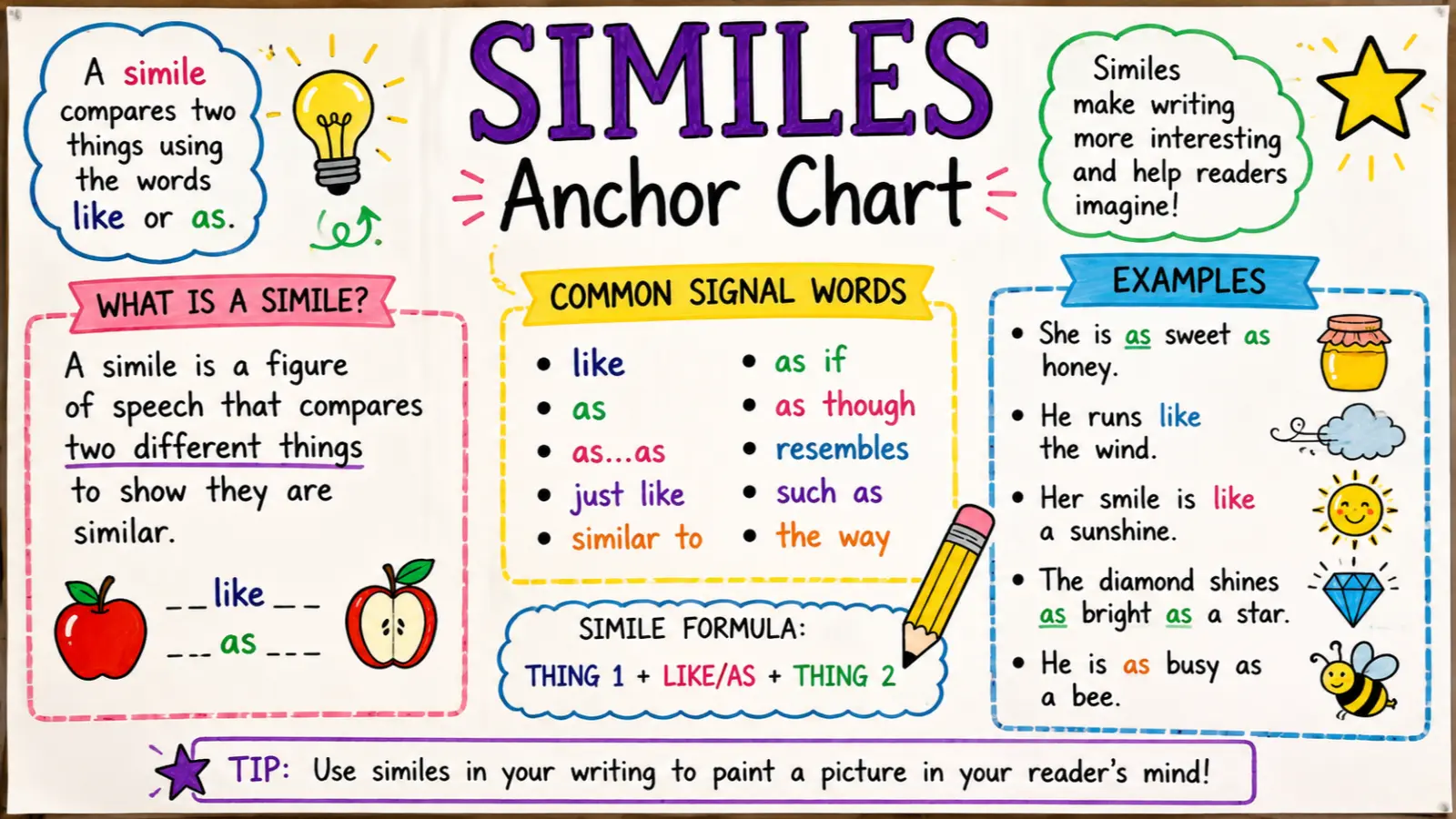
A simile is a comparison that uses the words like or as to help readers picture an idea more clearly. Instead of saying something is simply “fast” or “happy,” a simile creates a vivid image that makes writing more memorable. Teachers often use a similes anchor chart to introduce this literary device because it gives students a visual reference they can return to while reading and writing. Whether you’re teaching elementary students, homeschooling, or improving your own creative writing, an anchor chart makes learning easier and more engaging. This guide explains how a similes anchor chart works, offers fresh examples, and shows you how to create your own meaningful comparisons.
What Is a Similes Anchor Chart?
A similes anchor chart is a classroom poster or reference page that explains what a simile is, how it works, and how to write one correctly.
A strong anchor chart usually includes:
- A simple definition
- Signal words like like and as
- Original examples
- Tips for writing effective similes
- Common mistakes to avoid
Unlike a vocabulary list, an anchor chart encourages students to think creatively instead of memorizing comparisons.
Why Teachers Use Similes Anchor Charts
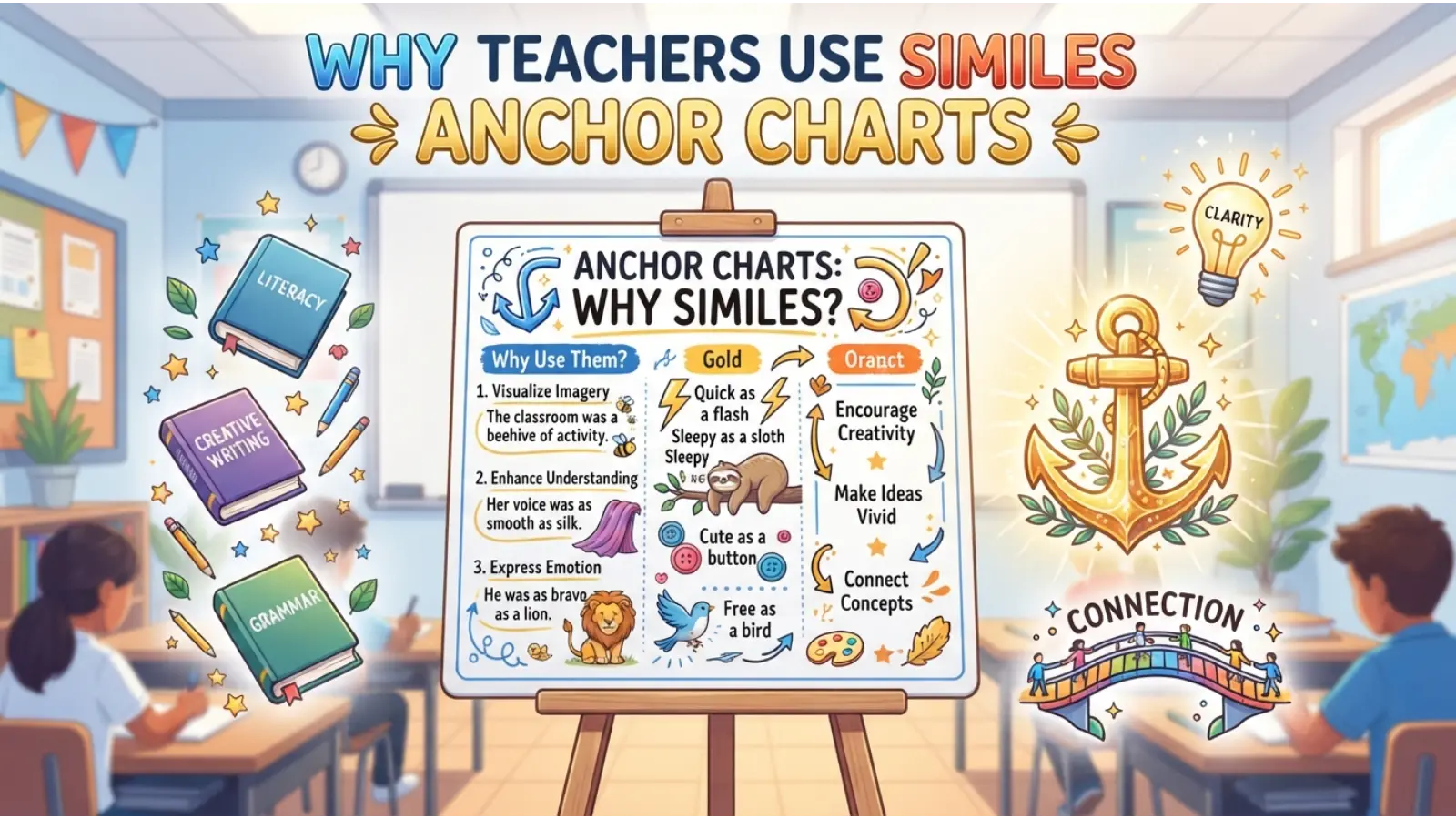
Students often understand a concept better when they can see examples alongside clear explanations.
A similes anchor chart helps learners:
- Recognize similes while reading
- Improve descriptive writing
- Expand vocabulary
- Develop creative thinking
- Build confidence during writing activities
Because the chart stays visible in the classroom, students naturally begin using stronger comparisons in their own work.
How a Good Simile Works
Every effective simile compares two different things that share one noticeable quality.
Formula
Subject + like/as + comparison
Example:
The lantern glowed like a friendly star.
The comparison focuses on brightness, making the description easier to imagine.
A successful simile should feel surprising without becoming confusing.
Original Similes for Your Anchor Chart
1. As patient as a tree waiting for spring
Meaning
Someone remains calm while waiting.
Writing purpose
Perfect for character descriptions.
Sentence
The grandmother was as patient as a tree waiting for spring.
Writing tip
Compare actions rather than appearances whenever possible.
2. Like chalk dust dancing in sunlight
Meaning
Tiny objects moving gently.
Story example
The fairy floated through the room like chalk dust dancing in sunlight.
3. As curious as a squirrel near a picnic
Meaning
Very interested in discovering something.
Conversation
“You’ve been as curious as a squirrel near a picnic all morning.”
4. Like fresh footprints in snow
Meaning
Something easy to notice.
Writing purpose
Great for mystery stories.
5. As steady as an old lighthouse
Meaning
Reliable during difficult situations.
Formal example
Her leadership remained as steady as an old lighthouse.
6. Like a notebook filling with dreams
Meaning
Ideas growing over time.
Poetry
My heart opened like a notebook filling with dreams.
7. As quiet as unopened letters
Meaning
Complete silence with hidden possibilities.
8. Like rain polishing every leaf
Meaning
Something making everything feel refreshed.
9. As hopeful as sunrise after fog
Meaning
Optimistic despite challenges.
10. Like a kite finding the wind
Meaning
Finally succeeding.
11. As gentle as warm tea on cold hands
Meaning
Comforting and kind.
12. Like pebbles skipping across a lake
Meaning
Quick, light movement.
13. As bright as a window at dawn
Meaning
Cheerful and welcoming.
14. Like a compass finding north
Meaning
Knowing exactly what to do.
15. As calm as moonlight on water
Meaning
Peaceful emotions.
16. Like an empty canvas waiting for color
Meaning
Full of possibilities.
17. As brave as the first bird to sing
Meaning
Showing courage before others.
18. Like autumn leaves sharing secrets
Meaning
Soft whispering sounds.
19. As determined as roots breaking stone
Meaning
Quiet but unstoppable persistence.
20. Like a candle refusing the wind
Meaning
Remaining strong during hardship.
21. As cheerful as wildflowers after rain
Meaning
Joy returning after difficult times.
22. Like stars stitched across velvet
Meaning
Beautiful nighttime imagery.
23. As thoughtful as an artist choosing colors
Meaning
Carefully considering every decision.
24. Like echoes inside a mountain valley
Meaning
Words or memories lasting a long time.
Why These Similes Feel Fresh
Many classroom examples rely on comparisons that students have heard repeatedly. Fresh similes capture attention because they combine familiar experiences in unexpected ways.
Instead of comparing someone to a lion every time they are brave, think about situations that naturally demonstrate courage. Originality comes from observing everyday life closely.
Professional writers often ask themselves one question:
“What image would help my reader see this feeling instantly?”
That approach usually produces stronger comparisons than copying familiar expressions.
Build Your Own Similes Step by Step
Creating original similes becomes easier with practice.
Step 1: Choose a quality
Examples include:
- Happy
- Cold
- Loud
- Gentle
- Confident
Step 2: Think of something that naturally shows that quality
For “gentle,” you might think of:
- Falling snow
- Soft feathers
- Calm water
- Warm sunlight
Step 3: Make the comparison
Instead of writing:
She was gentle.
Write:
She was as gentle as warm sunlight through a window.
Step 4: Read it aloud
If it sounds awkward or forced, simplify it.
The best similes feel effortless.
Classroom Activities Using a Similes Anchor Chart
Simile Match
Students match adjectives with possible comparisons.
Finish the Simile
Provide the beginning:
- As quiet as…
- Like a…
Students invent their own endings.
Picture Writing
Show an image and challenge students to write three original similes inspired by it.
Simile Hunt
Ask students to find similes in books they are already reading and explain why each one works.
Common Mistakes Students Make
Using overused comparisons
Examples like “busy as a bee” or “cold as ice” are familiar but rarely surprise readers.
Look for fresh observations instead.
Mixing unrelated images
Example:
She floated like a cloud and roared like thunder in the same sentence.
Unless both ideas work together, mixed imagery can confuse readers.
Forgetting “like” or “as”
Without these words, the sentence may become a metaphor instead of a simile.
Knowing the difference helps students choose the right literary device.
Comparing things with no shared quality
Every comparison should highlight one clear characteristic.
If readers cannot identify the connection, the simile loses its impact.
Adding too many similes
Strong writing uses similes strategically.
A few memorable comparisons are more effective than filling every paragraph with them.
Similes and Other Literary Devices
Simile vs. Metaphor
A simile compares using like or as.
A metaphor says one thing is another.
Both create imagery, but they achieve it differently.
Simile and Imagery
Imagery appeals to the senses.
A simile often strengthens imagery by helping readers picture, hear, feel, taste, or smell an experience more clearly.
Simile and Personification
Personification gives human qualities to non-human things.
A sentence can include both devices, but each serves a different purpose.
Simile and Hyperbole
Hyperbole exaggerates for emphasis.
A simile compares.
Sometimes writers combine them carefully, but balance is important.
Practice Exercises
Exercise 1
Rewrite these adjectives using original similes:
- Bright
- Nervous
- Quiet
- Fast
- Proud
Exercise 2
Describe a rainy afternoon using three different similes.
Try focusing on sound, movement, and mood.
Exercise 3
Choose one object from your classroom.
Write five different similes describing it from different perspectives.
Frequently Asked Questions
What is a similes anchor chart?
A similes anchor chart is a visual classroom reference that explains what similes are, shows how they work, and provides examples students can use while reading and writing.
What should be included on a similes anchor chart?
Include a simple definition, the words like and as, several original examples, writing tips, and reminders about common mistakes.
Are similes suitable for all grade levels?
Yes. Younger students can begin with simple comparisons, while older students can create more imaginative and detailed similes.
How many examples should an anchor chart have?
Six to ten carefully chosen examples are usually enough for classroom reference. Additional examples can be added as students learn.
How do students write better similes?
Encourage them to observe everyday life, focus on one shared quality, and avoid relying on common comparisons they have heard many times.
Can similes improve creative writing?
Absolutely. Similes make descriptions clearer, strengthen imagery, and help readers connect emotionally with characters and scenes.
Conclusion
A well-designed similes anchor chart does more than define a literary device—it encourages students to think creatively, notice details, and express ideas with confidence. The strongest similes come from careful observation rather than memorization, which is why originality matters so much. As you practice, look beyond familiar comparisons and ask yourself what image best captures the feeling, action, or idea you want to express. Over time, you’ll build a collection of vivid, memorable similes that make your writing more engaging and uniquely your own.
I am Helena Frost, a writer captivated by the beauty of language and the art of comparison. Through my words, I explore the world by turning ordinary moments into vivid similes and reflections. I enjoy crafting phrases that spark imagination, evoke emotion, and linger in the mind. My writing celebrates the subtle connections between people, nature, and the stories we live. For me, every sentence is an opportunity to reveal the extraordinary in the everyday.