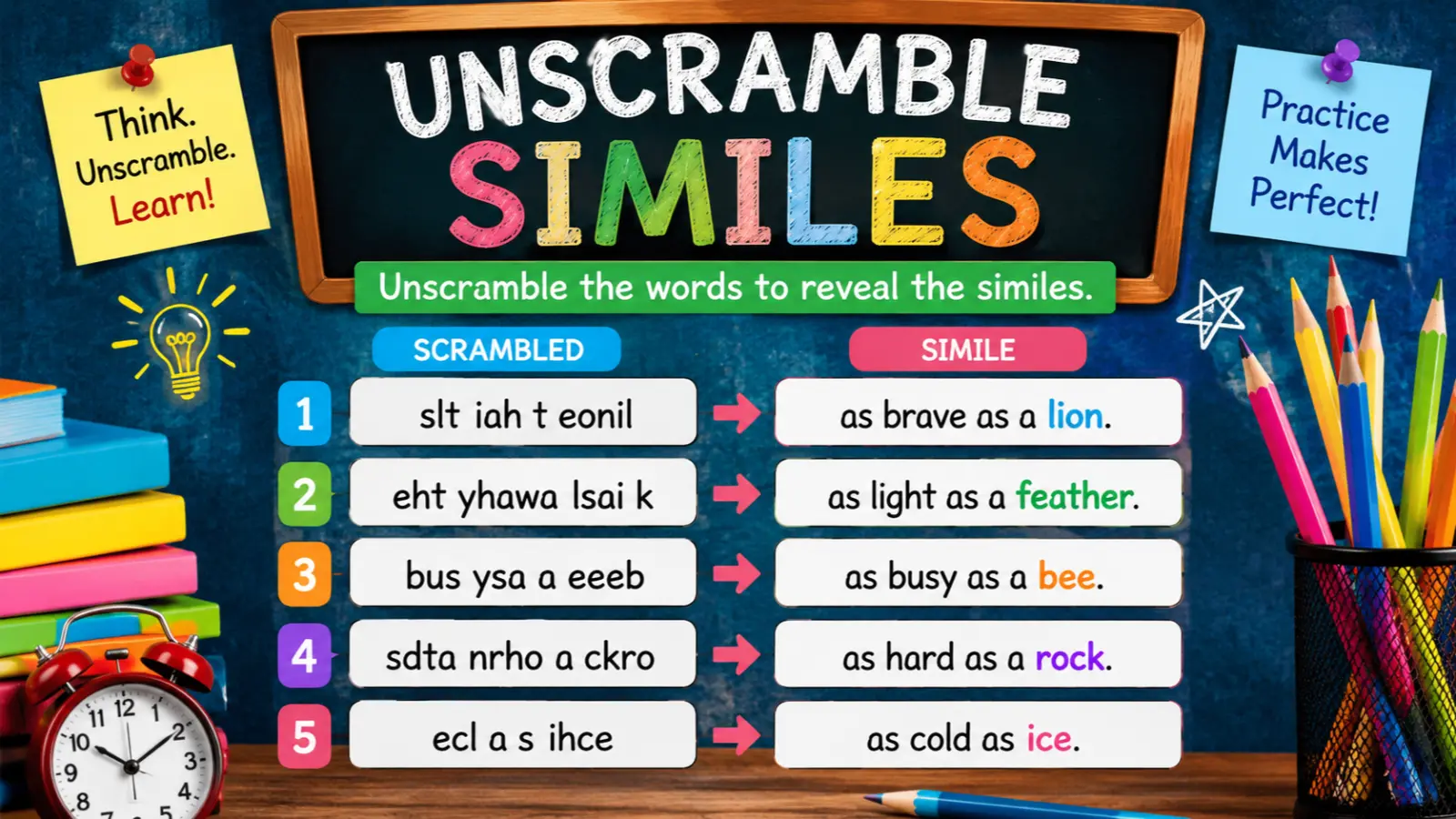
Similes are one of the easiest ways to make writing colorful and memorable. They compare two different things using words such as like or as, helping readers picture ideas more clearly. Whether you’re a student, teacher, parent, or writer, learning through unscramble similes is an enjoyable way to strengthen vocabulary and creative thinking. Unlike simple memorization, unscrambling similes encourages you to recognize patterns, understand meaning, and create vivid comparisons of your own. In this guide, you’ll learn how unscramble similes work, practice with original examples, and discover techniques for writing stronger descriptions.
Quick Answer
An unscramble simile is a learning activity where the words in a simile are mixed up, and the reader rearranges them into a meaningful comparison using like or as. These exercises improve language skills, reading comprehension, and creative writing while making learning more interactive.
Why Unscramble Similes Are Effective Learning Tools
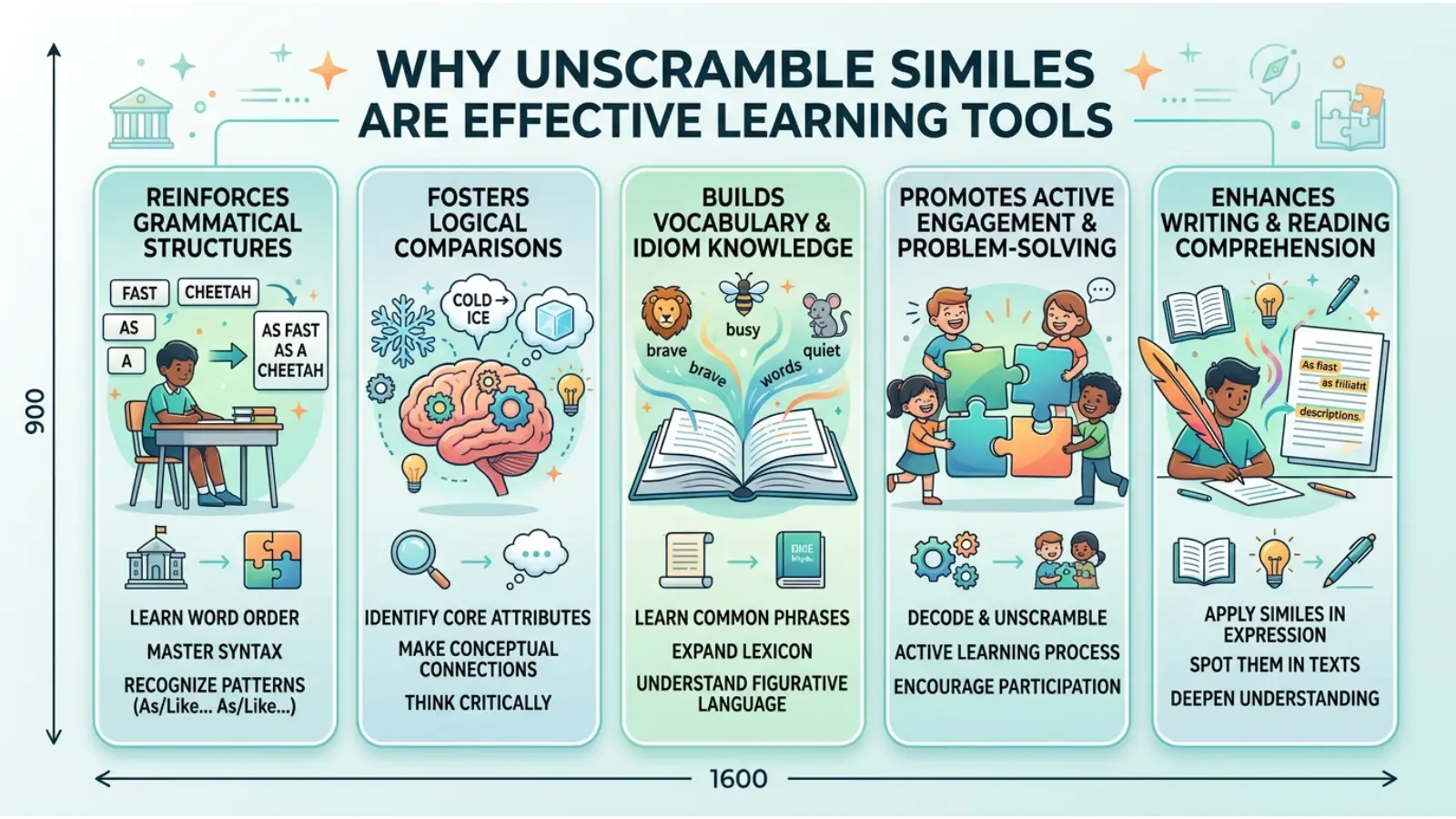
Unscrambling a sentence requires more than finding the correct order. It encourages readers to think about grammar, imagery, and meaning all at once.
These activities help learners:
- Recognize sentence structure.
- Understand how similes create imagery.
- Build stronger vocabulary.
- Improve creative writing.
- Practice reading comprehension.
Because each completed simile paints a mental picture, students often remember them longer than ordinary vocabulary exercises.
How an Unscramble Simile Works
A scrambled sentence contains all the correct words but in the wrong order.
Example:
Scrambled
as | bright | lantern | a | as
Answer
As bright as a lantern.
The learner must identify the comparison and place the words into a natural sentence.
25 Original Unscramble Similes
1. As Quiet as Morning Snow
Scrambled
snow | quiet | as | morning | as
Answer
As quiet as morning snow.
Meaning
Describes complete silence.
Example Sentences
- The library was as quiet as morning snow.
- She entered as quiet as morning snow.
Writing Tip
Use when describing peaceful settings.
2. Like Leaves Dancing in Autumn
Scrambled
autumn | leaves | dancing | like | in
Answer
Like leaves dancing in autumn.
Meaning
Shows graceful movement.
Examples
- Her dress floated like leaves dancing in autumn.
- The ribbons moved like leaves dancing in autumn.
3. As Steady as an Old Lighthouse
Scrambled
old | lighthouse | steady | an | as | as
Answer
As steady as an old lighthouse.
Meaning
Shows reliability and confidence.
4. Like a River Finding the Sea
Scrambled
sea | finding | river | the | like | a
Answer
Like a river finding the sea.
Meaning
Represents a natural journey or purpose.
5. As Soft as Cloud Shadows
Scrambled
cloud | shadows | as | soft | as
Answer
As soft as cloud shadows.
Meaning
Describes gentle movement or touch.
6. Like Fresh Rain on Warm Stone
Scrambled
warm | fresh | rain | stone | like | on
Answer
Like fresh rain on warm stone.
Meaning
Creates a refreshing image.
7. As Curious as a New Explorer
Scrambled
curious | explorer | new | as | a | as
Answer
As curious as a new explorer.
Meaning
Shows excitement to discover.
8. Like Stars Waking at Dusk
Scrambled
stars | dusk | waking | like | at
Answer
Like stars waking at dusk.
Meaning
Describes something slowly appearing.
9. As Brave as the First Climber
Scrambled
first | climber | brave | the | as | as
Answer
As brave as the first climber.
Meaning
Represents courage.
10. Like Fresh Paint on Canvas
Scrambled
paint | fresh | canvas | on | like
Answer
Like fresh paint on canvas.
Meaning
Suggests creativity and possibility.
11. As Smooth as Glass Water
Scrambled
glass | smooth | water | as | as
Answer
As smooth as glass water.
Meaning
Describes calmness.
12. Like a Kite Finding Wind
Scrambled
wind | kite | finding | like | a
Answer
Like a kite finding wind.
Meaning
Shows sudden success.
13. As Gentle as Falling Petals
Scrambled
falling | petals | gentle | as | as
Answer
As gentle as falling petals.
14. Like Fireflies Across the Field
Scrambled
fireflies | across | like | field | the
Answer
Like fireflies across the field.
15. As Calm as Hidden Water
Scrambled
hidden | calm | water | as | as
Answer
As calm as hidden water.
16. Like Sunrise Through Mist
Scrambled
mist | through | sunrise | like
Answer
Like sunrise through mist.
17. As Light as Floating Seeds
Scrambled
floating | seeds | light | as | as
Answer
As light as floating seeds.
18. Like Music in the Breeze
Scrambled
music | breeze | like | the | in
Answer
Like music in the breeze.
19. As Bright as Fresh Copper
Scrambled
fresh | copper | bright | as | as
Answer
As bright as fresh copper.
20. Like Waves Greeting Shore
Scrambled
waves | greeting | shore | like
Answer
Like waves greeting shore.
21. As Patient as Growing Trees
Scrambled
trees | growing | patient | as | as
Answer
As patient as growing trees.
22. Like Moonlight on Glass
Scrambled
glass | moonlight | like | on
Answer
Like moonlight on glass.
23. As Fresh as Spring Air
Scrambled
spring | air | fresh | as | as
Answer
As fresh as spring air.
24. Like a Puzzle Coming Together
Scrambled
coming | puzzle | together | like | a
Answer
Like a puzzle coming together.
25. As Clear as Mountain Dawn
Scrambled
mountain | dawn | clear | as | as
Answer
As clear as mountain dawn.
Meaning
Describes excellent clarity.
Story Example
“The solution became as clear as mountain dawn after one careful look.”
Tips for Creating Better Similes
Strong similes don’t depend on unusual words. They rely on fresh observations.
Try these techniques:
- Compare things people can easily imagine.
- Appeal to the senses.
- Match the emotion of the scene.
- Keep comparisons believable.
- Read your simile aloud to check if it sounds natural.
Professional writers often notice ordinary details that others overlook. A simple observation can become a memorable comparison.
Why Some Similes Feel More Memorable
The best similes create an instant picture.
Instead of choosing random objects, ask yourself:
- What does this feel like?
- What does it remind me of?
- Which image creates the strongest emotion?
The clearer the mental image, the stronger the simile.
Related Literary Devices
Metaphor
A metaphor compares two things without using like or as.
- Simile: As calm as hidden water.
- Metaphor: She was hidden water.
Imagery
Imagery uses descriptive language to engage the senses. Similes often strengthen imagery by giving readers a vivid comparison.
Personification
Personification gives human qualities to non-human things.
Example:
“The wind whispered through the trees.”
Hyperbole
Hyperbole uses exaggeration for emphasis, while similes focus on comparison.
Symbolism
A symbol represents a deeper meaning. Similes may include symbols, but their primary purpose is comparison.
Create Your Own Unscramble Similes
Practice this simple process.
Step 1
Choose a feeling or object.
Example:
- happy
- cold
- excited
- peaceful
Step 2
Think of something that shares the same quality.
Example:
- sunrise
- feathers
- waterfall
- lantern
Step 3
Write a comparison using like or as.
Example:
As hopeful as the first sunrise after a storm.
Creative Exercise
- Write five original similes.
- Scramble the words.
- Exchange them with a friend or classmate.
- Unscramble each other’s similes.
- Discuss which comparisons create the strongest images.
This exercise develops creativity, grammar, and critical thinking at the same time.
Common Mistakes to Avoid
Using Overused Comparisons
Avoid relying on familiar expressions whenever possible. Fresh images are more memorable.
Mixing Images
Keep one clear comparison instead of combining unrelated ideas.
Forgetting Like or As
A simile needs like or as to make the comparison clear.
Comparing Unrelated Ideas
The comparison should make sense to readers and support the description.
Making Similes Too Long
A concise comparison is often stronger than one filled with unnecessary words.
Frequently Asked Questions
What is an unscramble simile?
It is an activity where mixed-up words are rearranged to form a correct simile using like or as.
Why are unscramble similes useful?
They improve grammar, vocabulary, reading comprehension, and creative writing skills.
Are unscramble similes good for children?
Yes. They make learning figurative language interactive and enjoyable for elementary, middle, and even high school students.
Can teachers use unscramble similes in class?
Absolutely. They work well as warm-up activities, homework, group games, and literacy centers.
How do I create my own unscramble similes?
Write an original simile first, then mix the words and challenge someone to rearrange them correctly.
What’s the difference between a simile and a metaphor?
A simile uses like or as, while a metaphor makes a direct comparison without those words.
Can unscramble similes improve creative writing?
Yes. They help writers notice descriptive language, practice imagery, and develop more imaginative comparisons.
Conclusion
Unscramble similes transform a simple language lesson into an engaging creative exercise. By rebuilding comparisons word by word, readers strengthen grammar, expand vocabulary, and learn how effective imagery works in real writing. As you practice, don’t just solve scrambled similes—create your own. The more original comparisons you invent, the more vivid, memorable, and expressive your writing will become.
I am Helena Frost, a writer captivated by the beauty of language and the art of comparison. Through my words, I explore the world by turning ordinary moments into vivid similes and reflections. I enjoy crafting phrases that spark imagination, evoke emotion, and linger in the mind. My writing celebrates the subtle connections between people, nature, and the stories we live. For me, every sentence is an opportunity to reveal the extraordinary in the everyday.