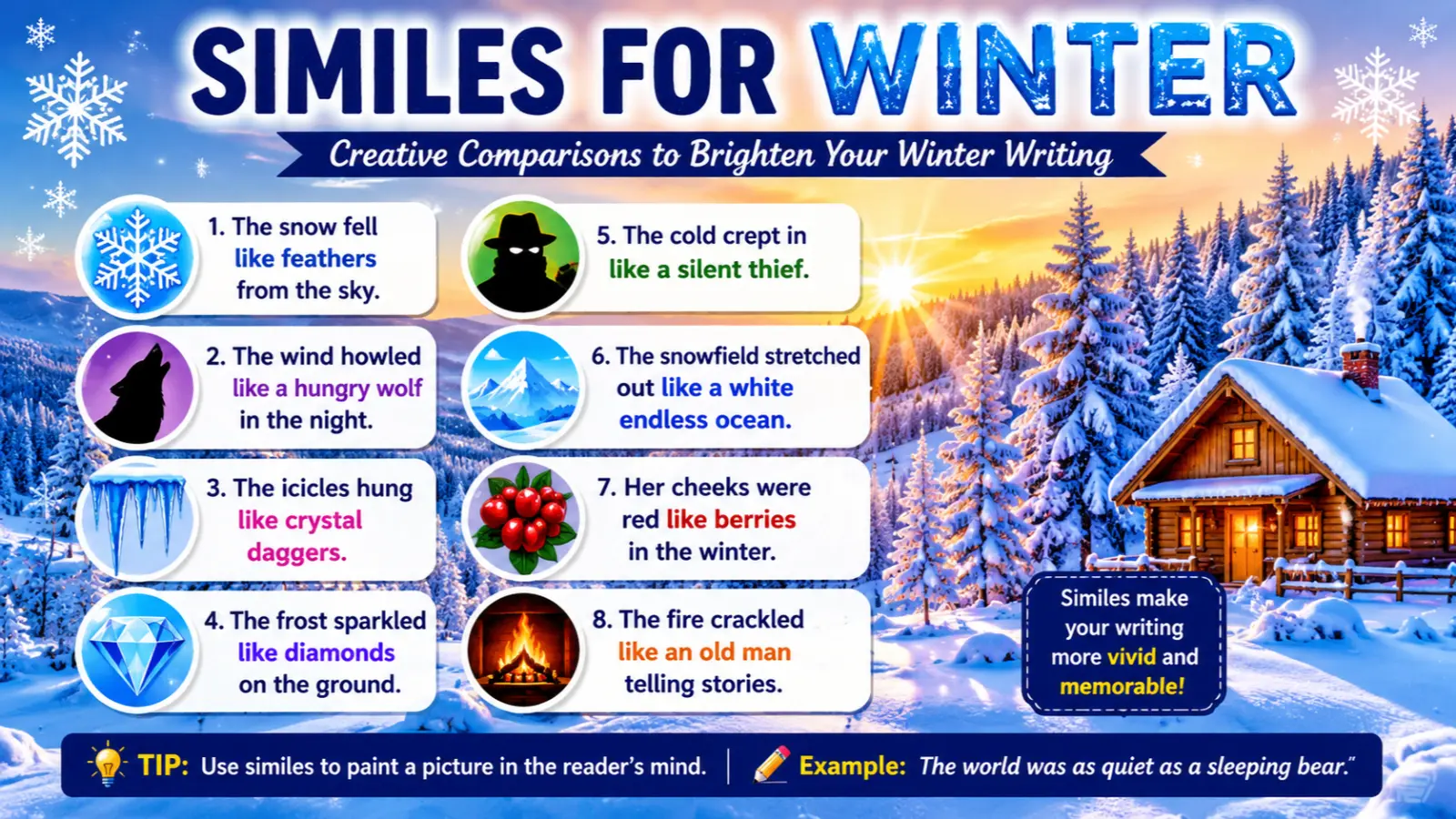
Winter has a unique personality. It can feel peaceful, harsh, magical, lonely, or full of celebration—all within the same season. One of the best ways to capture those changing moods is through similes. A simile compares one thing to another using “like” or “as.” Instead of saying the air was cold, you can say the air was as sharp as broken crystal. The comparison helps readers experience the scene instead of simply reading about it. Whether you’re writing a story, poem, journal entry, speech, or school assignment, this guide will help you create richer descriptions with original similes for winter that feel fresh rather than overused.
What Is a Winter Simile?
A winter simile is a comparison that uses like or as to describe winter weather, landscapes, emotions, or experiences.
Example:
The frozen lake was as smooth as polished glass.
Rather than stating a fact, the simile paints a clear picture readers can imagine.
Why Writers Love Winter Similes
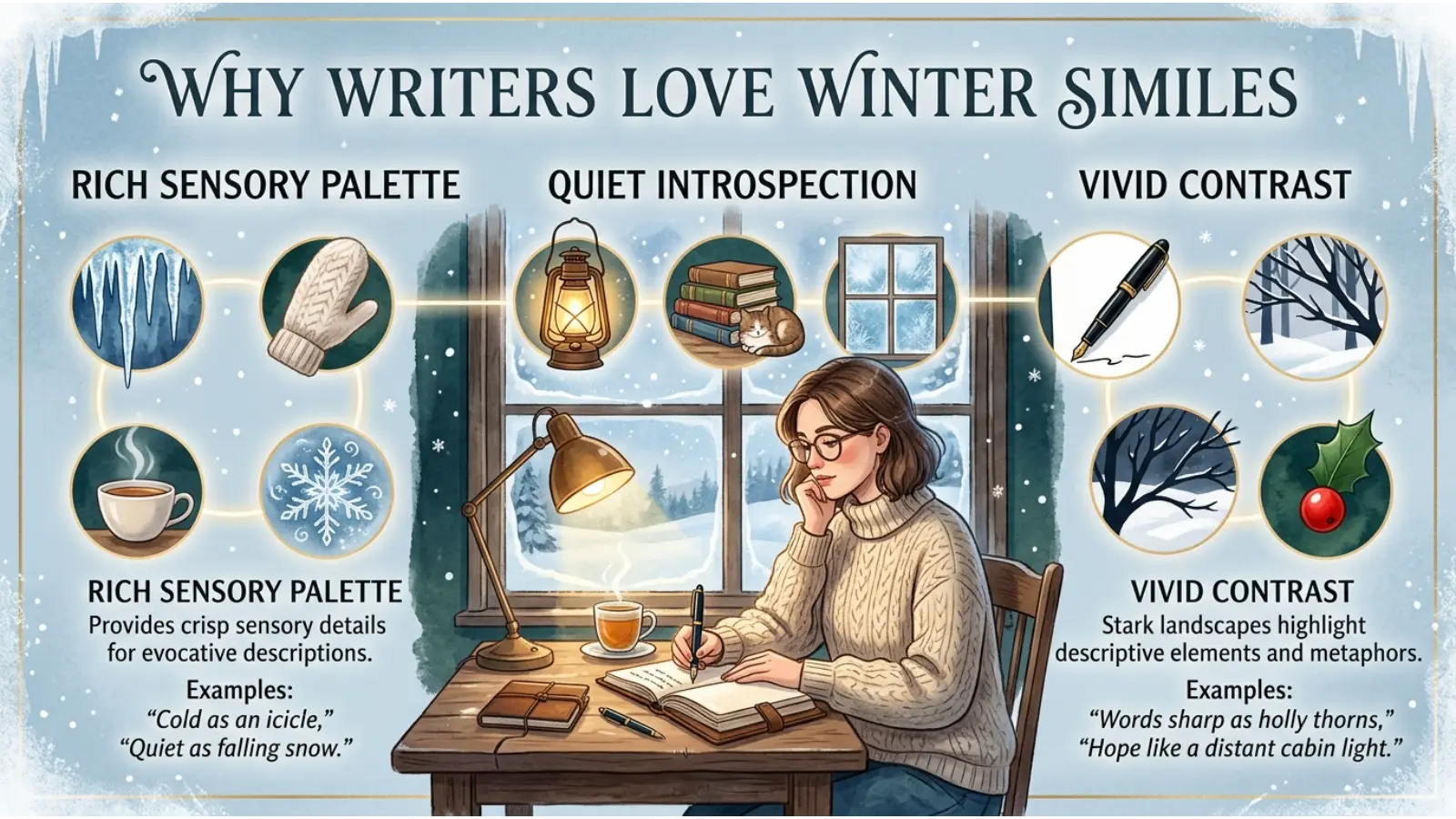
Winter naturally creates strong imagery.
A well-crafted simile can help readers feel:
- Quiet snowfall
- Bitter cold
- Cozy evenings
- Frozen landscapes
- Holiday excitement
- Winter loneliness
- Fresh beginnings
Great similes engage the senses and make ordinary descriptions unforgettable.
25 Original Similes for Winter
1. As quiet as snow covering forgotten footsteps
Meaning: Complete silence.
Examples
- The village became as quiet as snow covering forgotten footsteps.
- The classroom felt as quiet as snow covering forgotten footsteps before the exam.
Works best for: Peaceful settings, reflective writing, poetry.
Writing Tip: Pair this with sound imagery to increase emotional depth.
2. Like silver dust scattered across the earth
Meaning: Fresh snowfall sparkling in sunlight.
Examples
- The hills looked like silver dust scattered across the earth.
- Frost covered the garden like silver dust.
Best Context: Nature writing.
3. As sharp as frozen crystal
Meaning: Extremely cold air.
Examples
- The wind was as sharp as frozen crystal.
- Every breath felt as sharp as frozen crystal.
Storytelling: Builds tension in outdoor scenes.
4. Like a sleeping giant wrapped in white
Meaning: Snow-covered mountains or forests.
Examples
- The mountain rested like a sleeping giant wrapped in white.
- The valley appeared like a sleeping giant beneath fresh snow.
5. As bright as morning frost
Meaning: Brilliant and sparkling.
Examples
- Her smile was as bright as morning frost.
- The windows shimmered as bright as morning frost.
6. Like pages waiting for a story
Meaning: Fresh snow untouched by footprints.
Examples
- The field stretched like pages waiting for a story.
- The backyard looked like pages waiting for a story.
Writing Purpose: Inspires imagination.
7. As gentle as drifting feathers
Meaning: Soft snowfall.
Examples
- Snow fell as gentle as drifting feathers.
- The flakes floated as gentle as drifting feathers.
8. Like a blanket stitched from clouds
Meaning: Thick snow covering everything.
Examples
- Snow settled like a blanket stitched from clouds.
- The rooftops wore a blanket stitched from clouds.
9. As patient as an icicle
Meaning: Slow, still, and unmoving.
Examples
- Winter waited as patient as an icicle.
- He stood as patient as an icicle.
10. Like whispered secrets in the wind
Meaning: Soft winter breeze.
Examples
- The breeze sounded like whispered secrets.
- Pine trees swayed like whispered secrets.
11. As pale as moonlit snow
Meaning: Very white or colorless.
Examples
- Her scarf was as pale as moonlit snow.
- The clouds looked as pale as moonlit snow.
12. Like stars resting on branches
Meaning: Frost sparkling on trees.
Examples
- Frost glittered like stars resting on branches.
- Every tree looked decorated by tiny stars.
13. As still as a frozen pond
Meaning: Perfectly motionless.
Examples
- The morning remained as still as a frozen pond.
- The room became as still as a frozen pond.
14. Like glass breathing in the cold
Meaning: Frosted windows.
Examples
- The windows looked like glass breathing in the cold.
- Ice patterns spread like glass breathing in the cold.
15. As crisp as a fresh apple
Meaning: Clean, refreshing winter air.
Examples
- The morning felt as crisp as a fresh apple.
- The breeze tasted as crisp as a fresh apple.
16. Like candles glowing inside ice
Meaning: Warm lights during winter nights.
Examples
- The cottages glowed like candles inside ice.
- The streetlights looked like candles inside ice.
17. As lonely as a single pine on a snowy hill
Meaning: Isolation.
Examples
- The cabin stood as lonely as a single pine.
- She felt as lonely as a single pine.
18. Like tiny dancers falling from the sky
Meaning: Snowflakes.
Examples
- Snowflakes twirled like tiny dancers.
- Winter arrived with tiny dancers falling from the sky.
19. As calm as a frozen sunrise
Meaning: Deep peace.
Examples
- The lake remained as calm as a frozen sunrise.
- His voice stayed as calm as a frozen sunrise.
20. Like crystal lace across the windows
Meaning: Frost patterns.
Examples
- Frost spread like crystal lace.
- Every window wore crystal lace.
21. As cold as forgotten stone
Meaning: Deep, penetrating cold.
Examples
- The bench was as cold as forgotten stone.
- His gloves felt as cold as forgotten stone.
22. Like white paint brushed across the hills
Meaning: Snow-covered landscape.
Examples
- The hills looked like white paint brushed across the earth.
- Winter painted the valley with white strokes.
23. As sparkling as frozen diamonds
Meaning: Glittering snow.
Examples
- The snow sparkled as frozen diamonds.
- The path glittered as frozen diamonds.
24. Like a silent orchestra
Meaning: A peaceful winter landscape full of visual beauty.
Examples
- The forest stood like a silent orchestra.
- The valley resembled a silent orchestra waiting to perform.
25. As hopeful as the first snowfall
Meaning: New beginnings.
Examples
- She smiled as hopeful as the first snowfall.
- The new year felt as hopeful as the first snowfall.
Best Context: Inspirational writing.
How to Make Winter Similes Feel Original
Instead of comparing winter only to ice or snow, think about the emotions and experiences it creates.
Ask yourself:
- What does winter sound like?
- What colors dominate the scene?
- How does the air feel?
- What memories does it bring?
- Which objects share the same mood?
The strongest similes connect physical details with emotional meaning.
For example, compare snowfall to pages waiting for stories instead of simply calling it white. Readers remember unexpected but believable comparisons.
Related Literary Devices That Strengthen Winter Writing
Metaphor
A metaphor makes a direct comparison without using like or as.
Simile: The forest was like a sleeping giant.
Metaphor: The forest was a sleeping giant.
Imagery
Imagery appeals to the senses.
Example:
The icy wind stung my cheeks while snowflakes melted quietly on my scarf.
Personification
Give winter human qualities.
Example:
Winter wrapped the village in silence.
Hyperbole
Use exaggeration for dramatic effect.
Example:
The cold could freeze a heartbeat.
Symbolism
Winter often symbolizes:
- Rest
- Reflection
- Endings
- Hope
- Renewal
- Solitude
Understanding symbolism helps create more meaningful descriptions.
Create Your Own Winter Similes
You don’t need to wait for inspiration. Build your own comparisons with a simple process.
Step 1: Choose a winter detail.
Examples:
- Snow
- Ice
- Wind
- Frost
- Bare trees
- Fireplace
Step 2: Notice its strongest quality.
Ask:
- Is it silent?
- Bright?
- Cold?
- Gentle?
- Heavy?
- Lonely?
Step 3: Compare it with something unexpected but believable.
Instead of writing:
Cold as ice.
Try:
Cold as a key forgotten outside overnight.
The second comparison feels more specific and memorable.
Creative Practice Exercises
Exercise 1
Describe a snowy forest using three different similes.
Exercise 2
Write one simile for each emotion:
- Joy
- Fear
- Peace
- Loneliness
using winter imagery.
Exercise 3
Look outside or imagine a winter scene. Write five observations using all five senses before turning two of them into similes.
Common Mistakes When Writing Winter Similes
Using Overused Comparisons
Readers have seen phrases like as cold as ice countless times. Look for more distinctive comparisons.
Mixing Imagery
Avoid combining unrelated images.
Weak: The snow was like fire floating underwater.
Choose comparisons that create a consistent picture.
Confusing Similes with Metaphors
A simile uses like or as.
A metaphor does not.
Knowing the difference improves clarity.
Forcing Comparisons
Every comparison should make sense.
If readers must stop to figure it out, simplify the image.
Forgetting the Emotion
The best similes reveal more than appearance. They also express mood, atmosphere, or character.
Frequently Asked Questions
What is a good simile for winter?
A good winter simile creates a fresh image while matching the mood of the scene. For example, The snow lay like pages waiting for a story.
Why are similes useful in winter writing?
They help readers picture the landscape, feel the weather, and connect emotionally with the setting.
Can winter similes be used in poetry?
Yes. Winter imagery naturally supports poetry because it combines visual beauty with emotion and symbolism.
What makes a winter simile original?
Original similes avoid predictable comparisons and focus on specific details, emotions, or sensory experiences.
Should children use simple winter similes?
Absolutely. Clear, easy comparisons are often the most effective for young writers and readers.
How can I avoid cliché winter similes?
Observe real winter scenes, focus on unique details, and compare them to familiar objects or experiences that share the same qualities.
Conclusion
Winter offers endless inspiration for creative writing, from sparkling frost and silent forests to icy winds and cozy firesides. Original similes help transform these familiar scenes into vivid experiences that readers can see and feel. As you write, pay attention to the small details that make winter unique, experiment with unexpected comparisons, and revise your work until each simile feels natural. With practice, you’ll create descriptions that are memorable, expressive, and entirely your own.
I am Helena Frost, a writer captivated by the beauty of language and the art of comparison. Through my words, I explore the world by turning ordinary moments into vivid similes and reflections. I enjoy crafting phrases that spark imagination, evoke emotion, and linger in the mind. My writing celebrates the subtle connections between people, nature, and the stories we live. For me, every sentence is an opportunity to reveal the extraordinary in the everyday.