Describing something as “slow” may seem simple, but the right simile can transform an ordinary sentence into one readers remember. Whether you’re writing a story, poem, essay, speech, or conversation, a creative comparison helps readers picture movement, emotion, and atmosphere more clearly. A simile compares two different things using the words like or as. Instead of simply saying someone walked slowly, you can compare that movement to something familiar, making the description more engaging. In this guide, you’ll discover original similes for slow, learn why they work, see them used in different contexts, and pick up practical writing techniques to strengthen your own descriptions.
Quick Answer
A simile for slow compares slow movement, progress, or change to something naturally unhurried using like or as. For example:
- As slow as a candle melting.
- Like a sleepy river winding through a valley.
- As slow as frost spreading across glass.
These comparisons create stronger mental images than simply saying something is slow.
Why Use Similes for Slow?
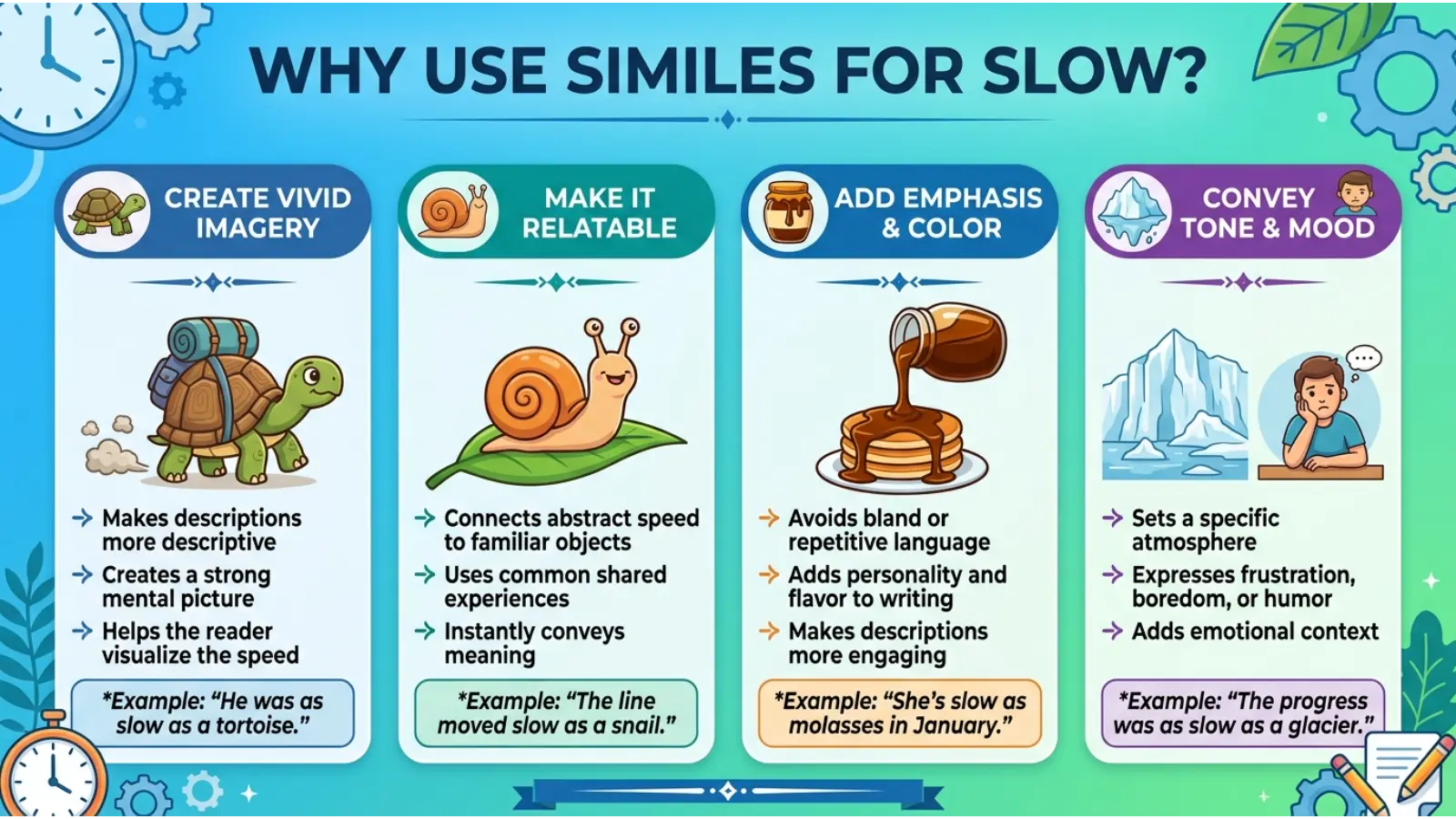
The word slow can describe many different situations.
- A person walking
- Time passing
- Traffic moving
- Learning something
- A growing plant
- A conversation
- Healing after illness
- A computer loading
- A quiet afternoon
Different situations call for different imagery. The best similes help readers feel how slow something is instead of merely being told.
35 Original Similes for Slow
1. As slow as a candle melting
Meaning: Very gradual and peaceful.
Examples
- The evening passed as slow as a candle melting.
- Recovery felt as slow as a candle melting.
Writing Tip: Excellent for calm or reflective scenes.
2. Like a sleepy river winding through a valley
Meaning: Gentle, continuous movement.
Examples
- The parade moved like a sleepy river winding through a valley.
- His thoughts drifted like a sleepy river.
Best Context: Nature writing.
3. As slow as frost spreading across glass
Meaning: Nearly invisible progress.
Examples
- Winter arrived as slow as frost spreading across glass.
- Trust returned as slow as frost forming overnight.
4. Like a turtle searching for shade
Meaning: Purposeful but very slow.
Examples
- He crossed the field like a turtle searching for shade.
- The hikers climbed like turtles seeking shelter.
5. As slow as dust settling after a storm
Meaning: Calm returning gradually.
Examples
- The room grew quiet as slow as dust settling.
- Peace returned as slow as dust after chaos.
6. Like autumn leaves drifting to earth
Meaning: Soft, graceful slowness.
Examples
- Her dance flowed like autumn leaves drifting down.
- The paper floated like an autumn leaf.
7. As slow as moss growing on stone
Meaning: Extremely gradual.
Examples
- Change came as slow as moss growing on stone.
- His confidence grew that slowly.
8. Like clouds crossing a windless sky
Meaning: Barely noticeable movement.
Examples
- The afternoon passed like clouds crossing a windless sky.
- The boat drifted that slowly.
9. As slow as morning fog lifting
Meaning: Slow but inevitable.
Examples
- Understanding arrived as slow as morning fog lifting.
- The sadness faded the same way.
10. Like an old clock losing seconds
Meaning: Consistently slow.
Examples
- The meeting crawled like an old clock losing seconds.
- Production slowed like an aging clock.
11. As slow as honey on cold bread
Meaning: Thick, reluctant movement.
Examples
- The paint spread as slow as honey on cold bread.
- The syrup poured that slowly.
12. Like roots reaching through soil
Meaning: Quiet and patient growth.
Examples
- Their friendship developed like roots beneath the earth.
- His skills improved that way.
13. As slow as the first snowflake falling
Meaning: Gentle beginning.
Examples
- Silence arrived as slow as the first snowflake.
- Night settled that softly.
14. Like an old book opening carefully
Meaning: Deliberate pace.
Examples
- She shared her story like an old book opening.
- Memories unfolded slowly.
15. As slow as paint drying in winter
Meaning: Frustratingly slow.
Examples
- The download felt as slow as paint drying in winter.
- Waiting became unbearable.
16. Like a snail tracing a garden path
Meaning: Extremely slow but steady.
Examples
- The child wandered like a snail tracing a garden path.
- The line moved that slowly.
17. As slow as a seed waking underground
Meaning: Hidden progress.
Examples
- Hope returned as slow as a seed waking underground.
- Ideas developed quietly.
18. Like smoke curling into still air
Meaning: Slow and graceful.
Examples
- Her voice floated like smoke.
- The melody drifted softly.
19. As slow as dawn coloring the horizon
Meaning: Beautiful gradual change.
Examples
- The city awakened as slow as dawn.
- Confidence brightened little by little.
20. Like an elderly cat stretching after sleep
Meaning: Relaxed movement.
Examples
- He rose like an elderly cat after a nap.
- The dog moved the same way.
21. As slow as ice melting in winter shade
Meaning: Almost motionless.
Examples
- Progress felt painfully slow.
- The afternoon dragged endlessly.
22. Like a feather floating through still air
Meaning: Light and peaceful.
Examples
- The letter fell like a feather.
- The balloon drifted gently.
23. As slow as ivy climbing a wall
Meaning: Steady long-term growth.
Examples
- Success came as slow as ivy climbing brick.
- Experience accumulated gradually.
24. Like an old train climbing a mountain
Meaning: Slow because of effort.
Examples
- The team advanced like an old train uphill.
- The project moved that way.
25. As slow as stars fading at sunrise
Meaning: Quiet transition.
Examples
- Night disappeared as slow as stars fading.
- Fear slowly vanished.
26. Like rainwater finding its way downhill
Meaning: Natural but unhurried.
Examples
- The crowd dispersed like rainwater.
- Ideas spread gradually.
27. As slow as a lantern swinging in calm air
Meaning: Gentle rhythm.
Examples
- The porch light moved slowly.
- His breathing steadied.
28. Like an artist adding careful brushstrokes
Meaning: Deliberate precision.
Examples
- She solved the puzzle patiently.
- The sculpture took shape slowly.
29. As slow as a mountain casting its shadow
Meaning: Massive and gradual.
Examples
- Evening arrived as slow as a mountain’s shadow.
- Winter approached quietly.
30. Like ripples reaching a distant shore
Meaning: Slow spread.
Examples
- The news traveled gradually.
- Laughter spread through the room.
31. As slow as a flower opening before sunrise
Meaning: Gentle transformation.
Examples
- Her smile appeared slowly.
- Spring arrived little by little.
32. Like an old tree bending in the breeze
Meaning: Slow, natural movement.
Examples
- He nodded thoughtfully.
- The branches swayed lazily.
33. As slow as silence filling an empty hall
Meaning: Gradual stillness.
Examples
- Calm returned after the applause.
- The excitement faded.
34. Like a patient fisherman waiting for dawn
Meaning: Slow with purpose.
Examples
- He worked patiently.
- She waited without rushing.
35. As slow as moonlight crossing a quiet lake
Meaning: Peaceful and elegant slowness.
Examples
- The night unfolded as slow as moonlight crossing a quiet lake.
- Her memories returned gently.
What Makes a Good Simile for Slow?
Strong similes do more than compare speed. They create emotion and imagery.
Ask yourself:
- Does the comparison feel believable?
- Can readers picture it?
- Does it match the mood?
- Is it fresh instead of overused?
Professional writers often choose comparisons from nature, daily life, or familiar experiences because readers instantly recognize them.
Related Literary Devices
Metaphor
A metaphor says something is another thing instead of using like or as.
- Simile: The river moved like a sleepy snake.
- Metaphor: The river was a sleepy snake.
Imagery
Imagery appeals to the senses.
Instead of only describing slow movement, include sounds, textures, or colors.
Example:
The wagon rolled as slow as frost spreading across glass while the wheels whispered over the dirt road.
Personification
Give human qualities to non-human objects.
Example:
The sunset stretched its tired arms across the hills.
Hyperbole
Sometimes exaggeration makes slow movement humorous.
Example:
The queue moved so slowly it seemed to age before my eyes.
Symbolism
Slow movement can symbolize:
- Patience
- Wisdom
- Healing
- Reflection
- Careful growth
- Endurance
How to Create Your Own Similes for Slow
Follow this simple process.
Step 1
Think about what is slow.
Step 2
Look around nature or everyday life.
Step 3
Choose something readers recognize.
Step 4
Compare the feeling, not just the speed.
Step 5
Read it aloud.
If it sounds natural, you’ve probably found a good simile.
Creative Exercise
Write one sentence describing each of these using a new simile:
- A rainy afternoon
- A sleepy puppy
- An old bicycle
- A classroom before the bell
- A plant growing by the window
Avoid using comparisons you’ve heard before. Focus on creating fresh, believable imagery.
Common Mistakes
Using Overused Comparisons
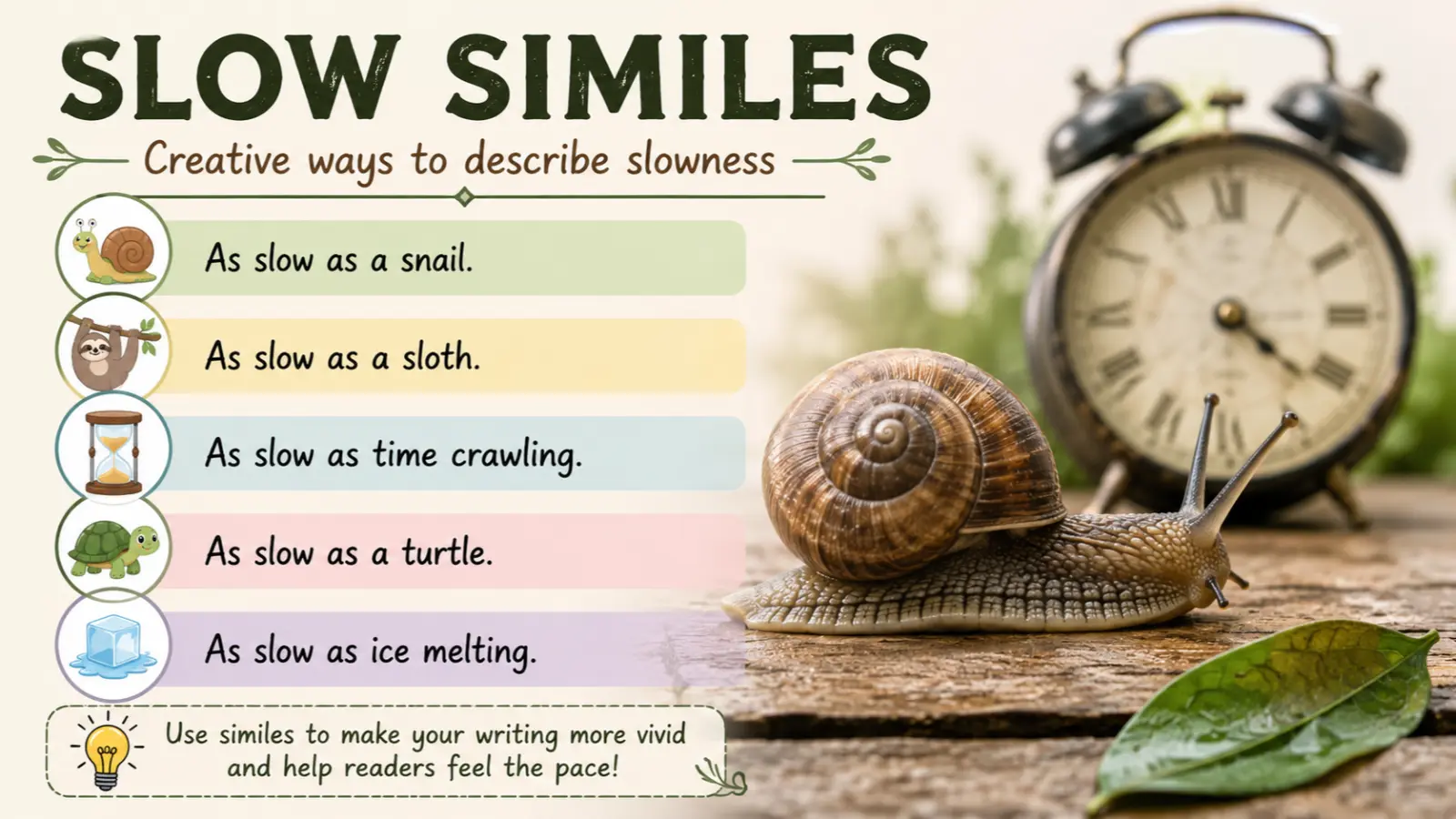
Expressions like “as slow as a snail” are familiar but may not stand out. Look for more original images.
Mixing Imagery
Avoid combining unrelated pictures.
Weak: As slow as honey flying through the wind.
Choose comparisons that make logical sense.
Confusing Metaphors with Similes
Remember:
- Similes use like or as.
- Metaphors do not.
Forcing Comparisons
If the reader has to stop and figure out the meaning, the simile may be too complicated.
Ignoring the Mood
A funny comparison doesn’t belong in a serious emotional scene. Match your imagery to the tone of your writing.
Frequently Asked Questions
What is a simple simile for slow?
“As slow as a candle melting” is simple, visual, and easy to understand.
Can similes describe emotions as well as movement?
Yes. Slow can describe healing, learning, growing, waiting, or changing emotions.
Are similes better than adjectives?
Not always. Use similes when you want readers to imagine a scene rather than simply receive information.
How many similes should I use in a story?
Use them sparingly. Well-placed similes have more impact than frequent comparisons.
Can children use similes for slow?
Absolutely. Nature-based comparisons such as leaves falling or clouds drifting are easy for young writers to understand.
What makes a simile memorable?
A memorable simile combines originality, clarity, and an image readers can instantly picture.
Should every slow description include a simile?
No. Mix similes with direct description to keep your writing natural and varied.
Conclusion
The best similes for slow help readers experience time, movement, and emotion instead of simply reading about them. By choosing fresh comparisons inspired by nature, everyday life, and careful observation, you can make your writing more vivid and memorable. Use these examples as inspiration rather than formulas. Experiment with your own comparisons, pay attention to the mood of each scene, and don’t be afraid to revise until the image feels just right. Over time, creating original similes will become one of the most rewarding parts of your writing process.
I am Helena Frost, a writer captivated by the beauty of language and the art of comparison. Through my words, I explore the world by turning ordinary moments into vivid similes and reflections. I enjoy crafting phrases that spark imagination, evoke emotion, and linger in the mind. My writing celebrates the subtle connections between people, nature, and the stories we live. For me, every sentence is an opportunity to reveal the extraordinary in the everyday.