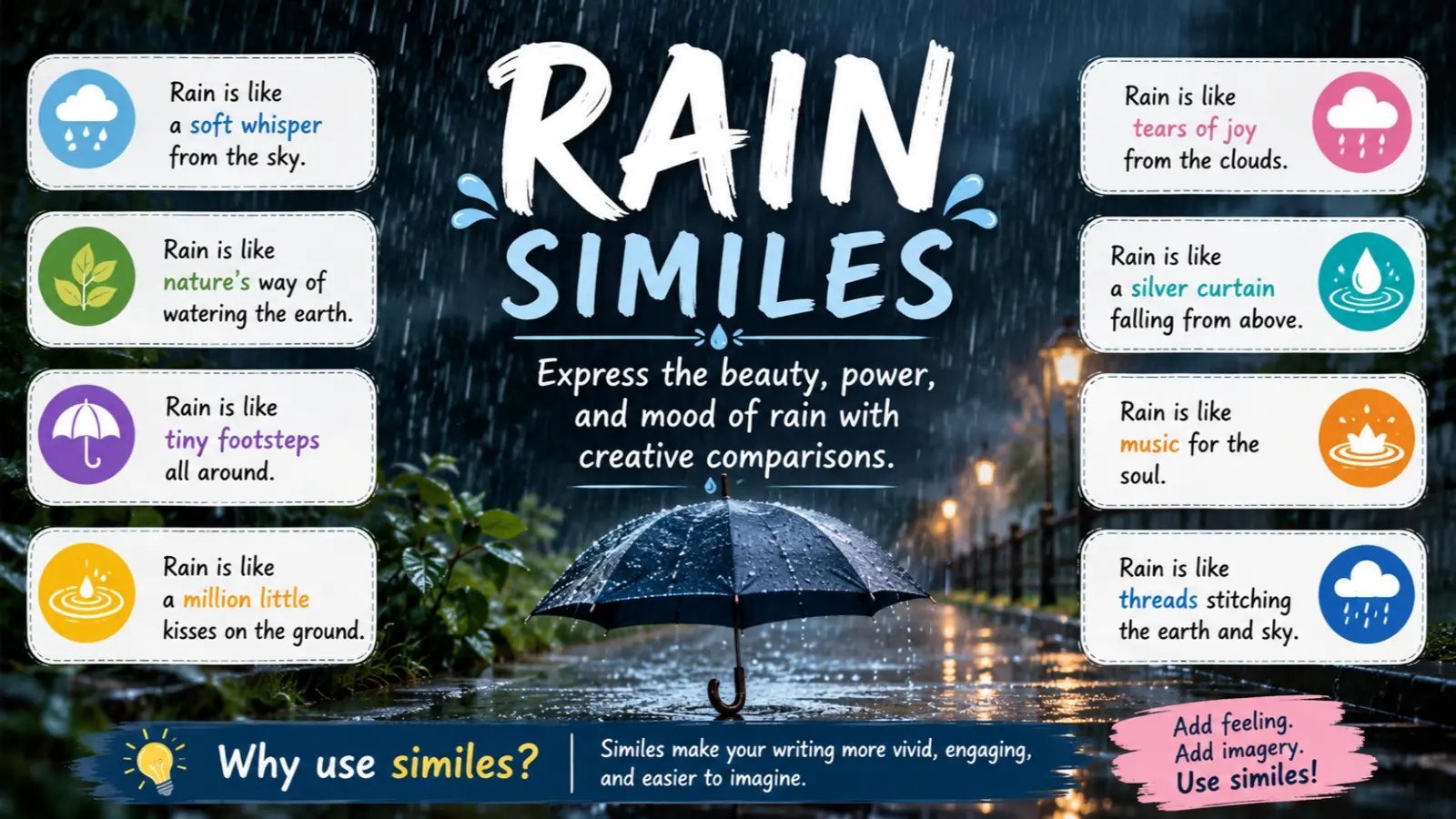
Rain is one of the most powerful images a writer can use. It can symbolize hope, sadness, peace, mystery, or renewal depending on how it is described. One simple comparison can completely change the mood of a sentence. A simile compares two different things using “like” or “as”. Strong similes help readers picture a scene instead of simply reading about it. Whether you’re writing a story, poem, essay, or conversation, these rain similes will help you create richer descriptions and stronger imagery.
What Are Rain Similes?
Rain similes compare rain—or something related to rain—to another object, action, or experience using like or as.
Instead of saying:
The rain was heavy.
You could write:
The rain fell like handfuls of tiny pearls tossed from the clouds.
The second sentence paints a much clearer picture and creates a stronger emotional response.
Why Writers Love Using Rain Similes
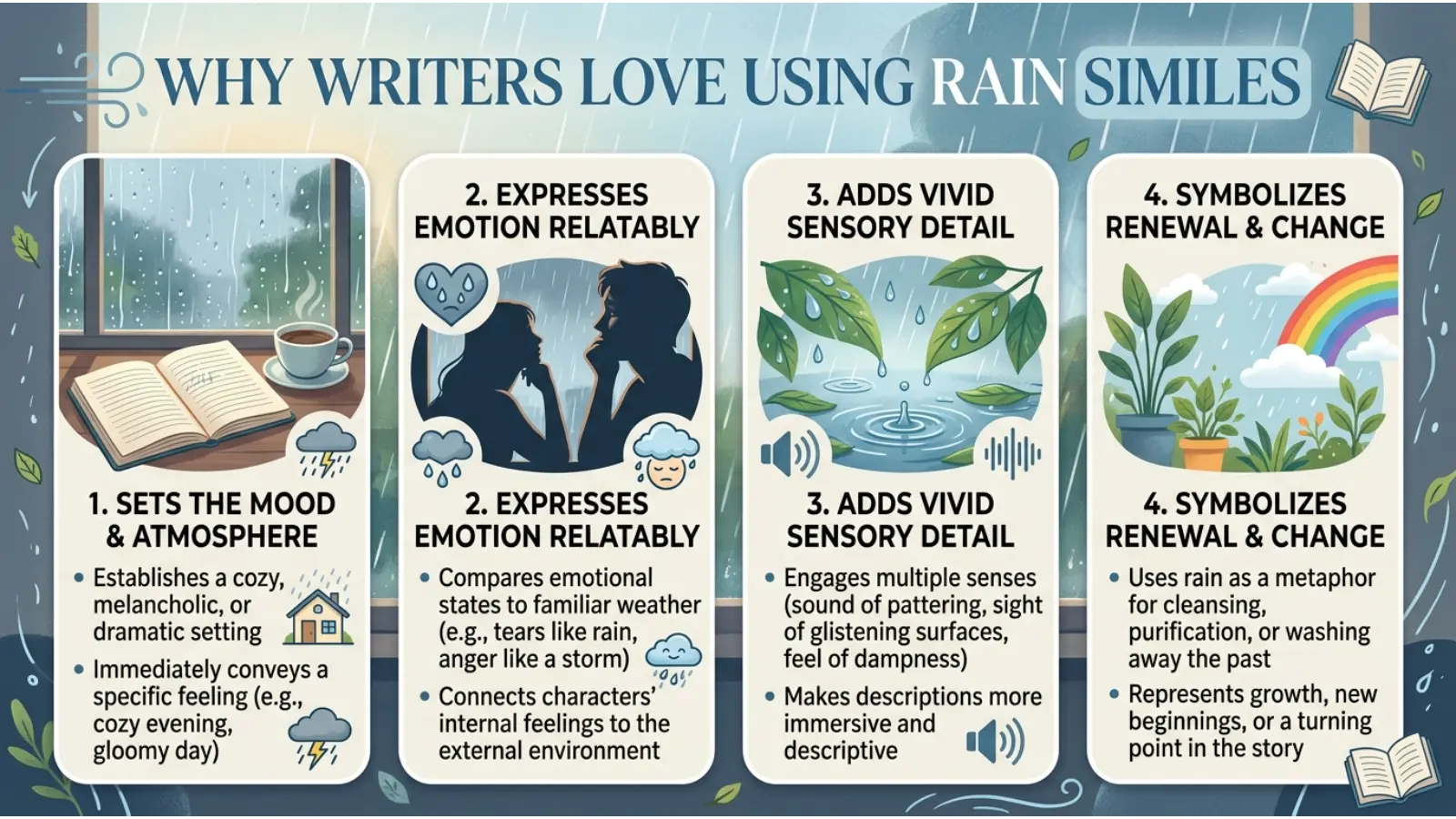
Rain naturally creates atmosphere.
It can represent:
- Fresh beginnings
- Loneliness
- Romance
- Tension
- Calmness
- Power
- Nostalgia
- Mystery
A carefully chosen simile helps readers experience those emotions without directly stating them.
30 Original Rain Similes with Meanings and Examples
1. Rain fell like silver threads stitching the sky to the earth.
Meaning: Gentle, continuous rainfall.
Examples
- Rain fell like silver threads stitching the sky to the earth all afternoon.
- The hills disappeared behind rain that looked like silver stitches.
Best for: Peaceful nature writing.
Writing Tip: Great for scenic descriptions.
2. Rain danced like children celebrating summer.
Meaning: Playful, lively rain.
Examples
- Raindrops danced like children celebrating summer.
- The puddles sparkled as the rain danced around them.
Effect: Joyful and energetic.
3. Rain whispered like an old friend sharing secrets.
Meaning: Very soft rainfall.
Examples
- Rain whispered against the window throughout the evening.
- The forest listened while the rain whispered among the leaves.
Best Context: Cozy scenes.
4. Rain crashed like thousands of tiny drums.
Meaning: Loud, heavy rain.
Examples
- Rain crashed on the roof like thousands of tiny drums.
- Everyone paused as the storm beat overhead.
Writing Purpose: Build suspense.
5. Rain drifted like floating feathers.
Meaning: Extremely light rain.
Examples
- Rain drifted across the garden like floating feathers.
- Barely anyone noticed the gentle shower.
6. Rain sparkled like scattered diamonds.
Meaning: Beautiful rain in sunlight.
Examples
- Morning rain sparkled like scattered diamonds.
- Every leaf shimmered beneath the light.
Best for: Nature descriptions.
7. Rain wrapped the town like a soft blanket.
Meaning: Rain creating a calm atmosphere.
Examples
- Evening rain wrapped the town like a soft blanket.
- The streets became quiet beneath its cover.
8. Rain rushed like eager runners.
Meaning: Fast-moving rainfall.
Examples
- Rain rushed across the road like eager runners.
- The gutters filled within minutes.
9. Rain shimmered like tiny stars falling from the clouds.
Meaning: Beautiful sparkling rain.
Examples
- Rain shimmered in the sunset.
- Every drop caught the golden light.
10. Rain rolled across the roof like marbles.
Meaning: Distinct raindrop sounds.
Examples
- Rain rolled across the roof like marbles.
- The sound echoed through the cabin.
11. Rain spread like watercolor paint.
Meaning: Rain slowly covering everything.
Examples
- Rain spread across the valley like watercolor paint.
- Colors softened beneath the gray sky.
12. Rain fell like quiet applause.
Meaning: Soft rhythmic rainfall.
Examples
- Rain sounded like quiet applause outside.
- The audience hardly noticed the weather.
13. Rain drifted like forgotten memories.
Meaning: Gentle and emotional rain.
Examples
- Rain drifted through the empty streets.
- It reminded her of childhood afternoons.
14. Rain burst like scattered beads.
Meaning: Sudden heavy shower.
Examples
- Rain burst from the clouds without warning.
- The sidewalks were soaked instantly.
15. Rain poured like an overflowing fountain.
Meaning: Extremely heavy rain.
Examples
- Rain poured over the city.
- Cars slowed as visibility disappeared.
16. Rain glimmered like polished glass.
Meaning: Bright reflective rain.
Examples
- Rain glimmered across the pavement.
- Streetlights reflected beautifully.
17. Rain drifted like sleepy butterflies.
Meaning: Slow, peaceful rain.
Examples
- Rain drifted through the trees.
- The afternoon felt wonderfully calm.
18. Rain echoed like distant applause.
Meaning: Gentle repeating rain sounds.
Examples
- Rain echoed through the valley.
- Every rooftop answered softly.
19. Rain raced like wild horses.
Meaning: Powerful storm.
Examples
- Rain raced over the hills.
- The storm arrived quickly.
20. Rain clung like morning mist.
Meaning: Fine rain.
Examples
- Rain clung to every branch.
- The air stayed cool for hours.
21. Rain shimmered like liquid crystal.
Meaning: Crystal-clear rainfall.
Examples
- The waterfall sparkled as rain shimmered around it.
- Every droplet reflected light.
22. Rain floated like tiny lanterns.
Meaning: Beautiful illuminated rain.
Examples
- Rain floated through the evening light.
- It looked magical beneath the streetlamps.
23. Rain tumbled like rolling pearls.
Meaning: Heavy round raindrops.
Examples
- Large drops tumbled onto the leaves.
- The garden glittered afterward.
24. Rain gathered like curious travelers.
Meaning: Clouds building before rain.
Examples
- Rain gathered above the mountains.
- Everyone hurried indoors.
25. Rain flowed like gentle music.
Meaning: Relaxing rainfall.
Examples
- Rain flowed through the forest.
- The sound made reading even more enjoyable.
26. Rain stretched like transparent curtains.
Meaning: Continuous rain.
Examples
- Transparent sheets of rain covered the fields.
- The distant hills disappeared.
27. Rain bounced like playful marbles.
Meaning: Raindrops hitting hard surfaces.
Examples
- Rain bounced from the sidewalk.
- Tiny splashes covered the street.
28. Rain shimmered like melted silver.
Meaning: Elegant rainfall.
Examples
- The river reflected rain like melted silver.
- The entire landscape glowed.
29. Rain drifted like soft music through the trees.
Meaning: Quiet woodland rain.
Examples
- Rain drifted through the pines.
- Birds continued singing.
30. Rain arrived like a long-awaited guest.
Meaning: Welcome rainfall after dry weather.
Examples
- Farmers smiled as rain arrived like a long-awaited guest.
- The fields quickly came back to life.
Best Context: Hope and renewal.
How to Write Better Rain Similes
The strongest similes don’t simply describe rain—they create an experience.
Focus on the Senses
Ask yourself:
- What does the rain sound like?
- What does it look like?
- How does it feel?
- What mood does it create?
The more senses you include, the more vivid your writing becomes.
Compare Rain to Unexpected Things
Instead of comparing rain to something obvious, think about objects with similar movement, sound, or texture.
For example:
- Flowing ribbons
- Floating feathers
- Glass beads
- Quiet applause
- Soft music
Fresh comparisons make readers pause and imagine the scene.
Match the Mood
Your simile should support the emotion of the scene.
For a peaceful moment, use gentle imagery.
For an intense storm, choose comparisons that feel powerful and energetic.
Related Literary Devices
Metaphor
A metaphor compares without using like or as.
Simile: The rain fell like silver threads.
Metaphor: The rain was silver threads stitching the sky.
Imagery
Imagery appeals to the senses through descriptive language. Rain similes naturally strengthen visual, auditory, and tactile imagery.
Personification
Personification gives human qualities to rain.
Example:
The rain knocked politely on the window.
Hyperbole
Hyperbole exaggerates for emphasis.
Example:
The rain poured enough water to fill an ocean.
Symbolism
Rain often symbolizes:
- Growth
- Cleansing
- New beginnings
- Reflection
- Change
- Hope
The meaning depends on the context of your writing.
How to Create Your Own Rain Similes
Follow this simple process:
Step 1: Observe the Rain
Notice its speed, sound, shape, and movement.
Step 2: Choose One Quality
Focus on a single characteristic, such as softness or intensity.
Step 3: Find a Similar Image
Think of an object or experience that shares that quality.
Step 4: Connect with “Like” or “As”
Example:
Rain drifted like feathers across the meadow.
Creative Exercise
Write five rain similes using these ideas:
- Music
- Animals
- Light
- Fabric
- Precious stones
Then rewrite each one to make it more surprising while keeping it believable.
Common Mistakes When Writing Rain Similes
Using Overused Comparisons
Phrases like “rain like tears” have been used so often that they may no longer feel fresh. Look for original images instead.
Mixing Imagery
Avoid combining unrelated comparisons in the same sentence, as they can confuse readers.
Forgetting the Mood
A cheerful simile rarely fits a tragic scene. Always match your comparison to the emotion you want readers to feel.
Confusing Similes with Metaphors
Remember, similes use like or as. Metaphors make a direct comparison without those words.
Adding Too Many Similes
One strong comparison usually creates a greater impact than several crowded into a single paragraph.
Frequently Asked Questions
What is a rain simile?
A rain simile compares rain to something else using the words like or as to create a clearer image or emotion.
Why are rain similes useful in writing?
They make descriptions more vivid, help readers visualize scenes, and strengthen emotional impact.
Can rain similes be used in poetry?
Yes. Poetry often relies on similes to create rhythm, imagery, and emotional depth.
What’s the difference between a rain simile and a rain metaphor?
A simile uses like or as, while a metaphor states the comparison directly.
How can I avoid cliché rain similes?
Observe real rain closely, focus on a specific quality, and compare it with something unexpected but believable.
Are rain similes suitable for children?
Absolutely. Simple, imaginative similes help young writers build creativity and improve descriptive skills.
Can rain similes express different emotions?
Yes. The same rain can suggest joy, sadness, peace, fear, hope, or renewal depending on the comparison and context.
Conclusion
Rain offers endless inspiration for creative writing because it changes mood, setting, and emotion with just a few drops. Instead of relying on familiar comparisons, experiment with fresh imagery that reflects what you truly observe. The most memorable rain similes are not the most complicated—they are the ones that feel vivid, natural, and perfectly suited to the moment. Keep practicing, revise your comparisons, and you’ll soon develop a style that is uniquely your own.

I am Helena Frost, a writer captivated by the beauty of language and the art of comparison. Through my words, I explore the world by turning ordinary moments into vivid similes and reflections. I enjoy crafting phrases that spark imagination, evoke emotion, and linger in the mind. My writing celebrates the subtle connections between people, nature, and the stories we live. For me, every sentence is an opportunity to reveal the extraordinary in the everyday.