Silence can be comforting, mysterious, peaceful, or even unsettling. Simply saying something was “quiet” rarely captures those subtle emotions. That’s where quiet similes become valuable. A well-crafted simile helps readers hear the silence, feel the atmosphere, and imagine the scene more clearly. A simile compares one thing to another using “like” or “as.” Writers use similes in stories, poems, speeches, classroom assignments, and everyday conversation to create stronger imagery. In this guide, you’ll discover fresh and original quiet similes, learn why they work, and see practical examples that can improve your own writing.
Quick Answer
Quiet similes compare silence or stillness to something familiar using “like” or “as.” They make descriptions more vivid by helping readers imagine the mood, emotion, or atmosphere. For example, instead of saying “The room was quiet,” you might write, “The room was as quiet as snowfall settling over an empty field.”
Why Quiet Similes Make Writing Stronger
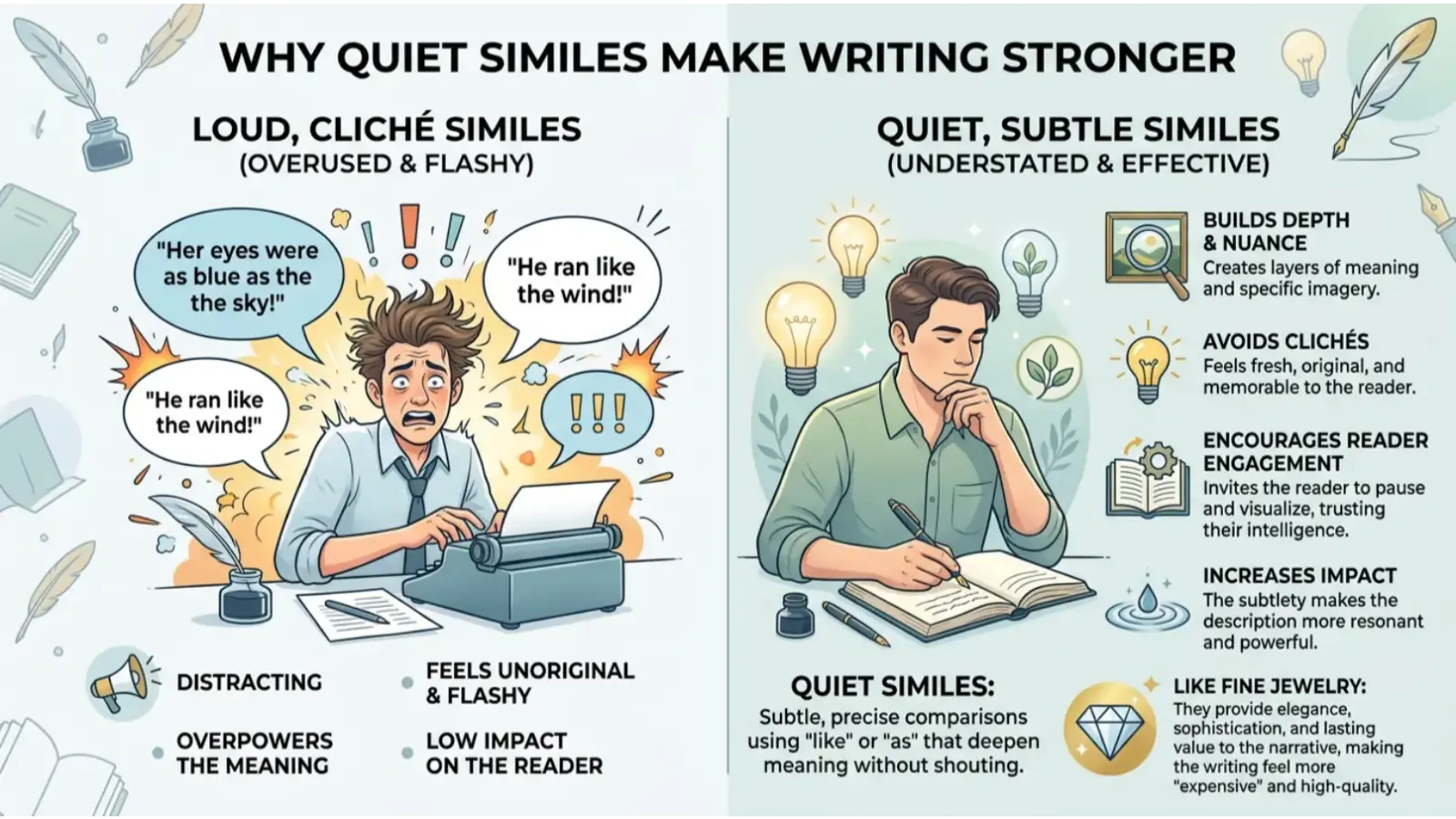
Quiet is more than the absence of sound. It can suggest peace, tension, loneliness, respect, wonder, or anticipation.
A thoughtful simile gives silence a personality. Instead of telling readers a place is quiet, it allows them to experience that quiet for themselves.
Professional writers often choose comparisons that match the emotion of the scene rather than simply describing volume.
1. As quiet as snow settling over an empty field
Meaning
Describes deep, peaceful silence that feels gentle rather than lonely.
Example Sentences
- The village became as quiet as snow settling over an empty field after sunset.
- Everyone listened, as quiet as snow settling over an empty field, while the old storyteller spoke.
Emotional Effect
Creates calm, comfort, and tranquility.
Writing Purpose
Perfect for peaceful landscapes, winter scenes, or reflective moments.
Storytelling Example
The cabin rested as quiet as snow settling over an empty field, untouched by the noise of the outside world.
Writing Tip
Nature often provides stronger imagery than everyday objects because readers can picture it more easily.
2. Like a feather drifting through still air
Meaning
Suggests delicate, effortless quiet.
Example Sentences
- Her footsteps faded like a feather drifting through still air.
- The library felt like a feather drifting through still air during the afternoon.
Best Context
Libraries, peaceful homes, meditation, gentle scenes.
Conversation Example
“It became like a feather drifting through still air once everyone left.”
Why It Works
The comparison emphasizes softness instead of complete silence.
3. As quiet as moonlight touching a lake
Meaning
Describes beautiful, peaceful silence.
Example Sentences
- The campsite became as quiet as moonlight touching a lake.
- The garden rested as quiet as moonlight touching a lake before dawn.
Poetry Example
The night stretched as quiet as moonlight touching a sleeping lake, holding every secret close.
Emotional Effect
Peaceful, dreamy, reflective.
4. Like pages waiting to be turned
Meaning
A silence filled with anticipation.
Example Sentences
- The classroom became like pages waiting to be turned before the teacher announced the results.
- The audience sat like pages waiting to be turned as the curtain slowly rose.
Writing Purpose
Excellent for suspense and expectation.
Formal Example
The meeting room remained like pages waiting to be turned, with every participant awaiting the final decision.
5. As quiet as a candle before dawn
Meaning
Gentle silence with a feeling of hope.
Example Sentences
- The house remained as quiet as a candle before dawn.
- Her voice faded until the room felt as quiet as a candle before dawn.
Emotional Effect
Warm, peaceful, hopeful.
Writing Tip
Pair quiet similes with light imagery to create emotional balance.
6. Like a painting that forgot to move
Meaning
Complete stillness where nothing seems alive.
Example Sentences
- The valley looked like a painting that forgot to move.
- The empty hallway stood like a painting that forgot to move.
Storytelling Example
For several moments, the castle remained like a painting that forgot to move, frozen in silence.
Best Context
Fantasy, mystery, abandoned places.
7. As quiet as morning mist over the hills
Meaning
Soft, natural silence at sunrise.
Example Sentences
- The countryside was as quiet as morning mist over the hills.
- We walked as quiet as morning mist over the hills.
Emotional Effect
Fresh, peaceful, calming.
Writing Advice
Landscape similes work especially well in descriptive essays and travel writing.
8. Like an unopened letter on a table
Meaning
Silence carrying curiosity or unanswered questions.
Example Sentences
- The room felt like an unopened letter on a table after the argument.
- His expression remained like an unopened letter on a table, hiding every emotion.
Writing Purpose
Creates subtle suspense without sounding dramatic.
9. As quiet as stars fading at sunrise
Meaning
A peaceful silence that slowly disappears.
Example Sentences
- The neighborhood became as quiet as stars fading at sunrise.
- Her worries drifted away, as quiet as stars fading at sunrise.
Poetry Example
Hope arrived as quiet as stars fading beneath the morning sky.
Emotional Effect
Gentle transition and calm reflection.
10. Like a secret resting beneath clear water
Meaning
A silence hiding thoughts or emotions beneath the surface.
Example Sentences
- His smile remained like a secret resting beneath clear water.
- The conversation ended like a secret resting beneath clear water.
Storytelling Example
The ancient temple stood like a secret resting beneath clear water, waiting for someone brave enough to uncover its history.
Writing Tip
Quiet does not always mean peaceful. Comparisons that hint at hidden emotion create richer, more memorable writing.
11. As quiet as a seed beneath fresh soil
Meaning
Describes a silence full of hidden potential and quiet growth.
Example Sentences
- The classroom became as quiet as a seed beneath fresh soil during the science experiment.
- She waited as quiet as a seed beneath fresh soil, preparing for her opportunity.
Emotional Effect
Hopeful, patient, and full of possibility.
Storytelling Example
The young inventor sat as quiet as a seed beneath fresh soil, letting a brilliant idea take root.
Writing Tip
A simile becomes more memorable when it suggests what might happen next, not just what is happening now.
12. Like a shoreline after the tide has gone
Meaning
A calm silence that follows activity or excitement.
Example Sentences
- The playground was like a shoreline after the tide has gone once the children left.
- The stadium felt like a shoreline after the tide has gone after the final whistle.
Best Context
Scenes that transition from busy to peaceful.
Why It Works
Readers naturally connect the retreating tide with fading noise.
13. As quiet as dew resting on new leaves
Meaning
Gentle, refreshing silence found in nature.
Example Sentences
- The garden remained as quiet as dew resting on new leaves.
- We enjoyed breakfast as quiet as dew resting on new leaves.
Poetry Example
Morning arrived as quiet as dew resting on the first leaves of spring.
Emotional Effect
Fresh, peaceful, and hopeful.
14. Like a lantern glowing in an empty barn
Meaning
A lonely silence with a small sense of warmth.
Example Sentences
- The farmhouse stood like a lantern glowing in an empty barn.
- His office felt like a lantern glowing in an empty barn after everyone had gone home.
Writing Purpose
Ideal for emotional scenes that mix comfort with isolation.
15. As quiet as clouds drifting beyond the mountains
Meaning
A wide, natural silence that feels endless.
Example Sentences
- The valley became as quiet as clouds drifting beyond the mountains.
- The hikers paused, as quiet as clouds drifting beyond the mountains.
Emotional Effect
Peace, freedom, and reflection.
Writing Tip
Large natural images help readers imagine space as well as silence.
16. Like a watch with no ticking
Meaning
An unusual silence that feels slightly unsettling.
Example Sentences
- The old house became like a watch with no ticking.
- The office felt like a watch with no ticking during the power outage.
Best Context
Mystery, suspense, and abandoned settings.
Why It Works
Readers expect a watch to tick. Removing that familiar sound creates tension.
17. As quiet as an untouched sketchbook
Meaning
Silence waiting for creativity to begin.
Example Sentences
- The art room stayed as quiet as an untouched sketchbook before class.
- Her imagination paused as quiet as an untouched sketchbook.
Writing Purpose
Excellent for creative writing, education, and artistic themes.
18. Like a path covered with fresh pine needles
Meaning
Soft, muted silence where even footsteps disappear.
Example Sentences
- The forest trail felt like a path covered with fresh pine needles.
- We walked like a path covered with fresh pine needles, careful not to disturb the wildlife.
Emotional Effect
Natural, peaceful, and immersive.
Storytelling Example
The travelers moved through the woods like a path covered with fresh pine needles, leaving almost no trace behind.
19. As quiet as the last glow of sunset
Meaning
A gentle silence marking the close of the day.
Example Sentences
- The beach grew as quiet as the last glow of sunset.
- Their conversation ended as quiet as the last glow of sunset.
Poetry Example
Evening settled as quiet as the last glow of sunset, wrapping the world in gentle stillness.
Best Context
Reflective endings, peaceful conclusions, emotional farewells.
20. Like a window holding the first light of morning
Meaning
A calm silence filled with quiet expectation and optimism.
Example Sentences
- The cottage felt like a window holding the first light of morning.
- She smiled like a window holding the first light of morning, saying nothing.
Emotional Effect
Optimistic, calm, and inspiring.
Writing Tip
The strongest similes often combine emotion with a clear visual image.
Writing Insights: Make Quiet Similes Feel Alive
Match the Simile to the Mood
Not every kind of silence feels the same. Ask yourself what the quiet represents before choosing a comparison.
- Peaceful silence → Nature, light, gentle weather
- Lonely silence → Empty buildings, abandoned roads
- Suspenseful silence → Unmoving objects, paused clocks
- Respectful silence → Still crowds, bowed heads
- Hopeful silence → Dawn, seeds, growing things
The comparison should support the emotion, not simply describe the absence of sound.
Replace Generic Comparisons with Specific Images
Weak writing often relies on broad descriptions.
Instead of:
The room was very quiet.
Try:
The room was as quiet as dew resting on new leaves.
Specific imagery helps readers picture the scene instead of merely understanding it.
Avoid Overused Quiet Similes
Some classic comparisons are effective, but repeating them can make writing feel predictable.
Examples of familiar comparisons include:
- As quiet as a mouse
- Silent as the grave
- Quiet as the night
Challenge yourself to create comparisons inspired by places, seasons, memories, or everyday experiences.
Build Similes from Real Observation
Professional writers often begin with careful observation.
Ask yourself:
- What places have you visited that felt completely silent?
- What natural moments seemed almost soundless?
- Which everyday objects suggest stillness?
Personal experiences usually produce fresher similes than copying familiar expressions.
Let the Scene Do the Work
A simile should strengthen your description, not replace it.
Instead of filling every paragraph with comparisons, use one well-placed simile at an important emotional moment. Readers remember quality more than quantity.
Related Literary Devices
Metaphor
A metaphor makes a direct comparison without using like or as.
- Simile: The forest was as quiet as dew resting on new leaves.
- Metaphor: The forest was a blanket of silence.
Both create imagery, but similes leave more room for interpretation.
Imagery
Imagery appeals to the senses. Quiet similes often combine sound with visual details such as moonlight, mist, water, forests, or dawn, making descriptions richer and more immersive.
Personification
Giving human qualities to non-human things can deepen a quiet scene.
Example:
The silence waited patiently outside the cabin.
Combining personification with a simile can create especially vivid descriptions.
Hyperbole
Hyperbole exaggerates for effect.
Example:
The room was so quiet that even a falling leaf sounded loud.
Use exaggeration sparingly so it remains believable.
Symbolism
Quiet often symbolizes reflection, peace, mystery, respect, or change. Choosing the right comparison helps reinforce these deeper meanings without explaining them directly.
Create Your Own Quiet Similes
Original similes often come from observation rather than imagination alone. Instead of searching for unusual comparisons, pay attention to ordinary moments that naturally feel quiet. A still park at sunrise, a sleeping pet, or a hallway after everyone has gone home can inspire stronger writing than a familiar cliché.
Step 1: Decide What Kind of Quiet You Mean
Silence isn’t always the same. Think about the feeling you want readers to experience.
- Peaceful quiet
- Lonely quiet
- Nervous quiet
- Respectful quiet
- Magical quiet
- Hopeful quiet
Once you know the emotion, choosing the right comparison becomes much easier.
Step 2: Look for a Clear Image
Choose something readers can easily picture.
Examples:
- Morning fog
- A calm lake
- Fresh snowfall
- A sleeping village
- A single candle
- An unopened book
- Falling leaves
- A deserted trail
Concrete images are more memorable than abstract ideas.
Step 3: Connect the Feeling
Ask yourself:
What makes this object feel quiet?
For example:
- Snow softens sound.
- Mist hides movement.
- A sleeping house feels still.
- Calm water reflects without disturbance.
The answer becomes the heart of your simile.
Step 4: Write the Comparison
Use like or as.
Examples:
- As quiet as morning mist over a river.
- Like a leaf floating across still water.
- As quiet as the first star before night fully arrives.
Then read it aloud. If it sounds natural in conversation, it’s likely to work well in your writing.
Creative Writing Exercises
Exercise 1: Rewrite the Sentence
Replace the plain description with a vivid quiet simile.
Sentence:
The classroom was quiet.
Try writing three different versions:
- One peaceful
- One suspenseful
- One emotional
Exercise 2: Nature Challenge
Write five quiet similes inspired by:
- Forests
- Mountains
- Rivers
- Winter
- Sunrise
Avoid using comparisons you’ve heard before.
Exercise 3: Character Emotions
Describe someone who is:
- Nervous
- Happy
- Heartbroken
- Curious
Use a quiet simile that reflects each emotion without directly naming it.
Exercise 4: Story Starter
Complete this opening with your own original simile:
The old house stood as quiet as _____________.
Try to create an image readers haven’t seen before.
Common Mistakes When Writing Quiet Similes
Using Overused Comparisons
Phrases like “as quiet as a mouse” are widely understood, but they rarely surprise readers. Fresh imagery makes your writing stand out.
Mixing Unrelated Images
Keep your comparisons consistent.
Weak example:
The room was as quiet as snow but burned like thunder.
The images don’t work together and confuse the reader.
Forcing the Comparison
A simile should feel natural.
Instead of choosing unusual objects just to sound creative, choose comparisons that genuinely match the scene and emotion.
Confusing Similes with Metaphors
Remember the difference:
Simile
The room was as quiet as fresh snow.
Metaphor
The room was fresh snow.
Both are useful, but they are different literary devices.
Adding Too Many Similes
One vivid comparison often creates a stronger impression than several packed into the same paragraph. Give your best simile room to shine.
Frequently Asked Questions
What is a quiet simile?
A quiet simile compares silence or stillness to another image using like or as. It helps readers imagine both the sound and the mood of a scene.
Why do writers use quiet similes?
They create stronger imagery, add emotion, and make descriptions more memorable than simply saying something is “quiet.”
What makes a good quiet simile?
A good quiet simile is original, easy to picture, and matches the emotion of the scene. It should feel natural rather than forced.
Can quiet similes be used in poetry?
Yes. Poetry often relies on similes to create mood, rhythm, and vivid imagery. Quiet similes are especially effective in reflective and nature-themed poems.
Are quiet similes suitable for children?
Absolutely. Simple comparisons based on nature or everyday experiences help young writers understand descriptive language while encouraging creativity.
What’s the difference between a quiet simile and a metaphor?
A simile uses like or as to compare two things. A metaphor makes the comparison directly without those words.
How can I make my own quiet similes more original?
Observe real places, think about the emotion you want to express, and compare that feeling to something readers can clearly imagine. Personal observations often produce the most memorable similes.
Conclusion
Quiet is never just the absence of noise—it can express peace, mystery, anticipation, respect, or quiet joy. The right simile transforms a simple description into an experience that readers can see, feel, and remember.As you practice, focus on meaningful comparisons instead of familiar ones. Observe the world around you, experiment with fresh imagery, and let each simile support the mood of your writing. Over time, you’ll develop a unique descriptive style that feels natural, engaging, and distinctly your own.

I am Helena Frost, a writer captivated by the beauty of language and the art of comparison. Through my words, I explore the world by turning ordinary moments into vivid similes and reflections. I enjoy crafting phrases that spark imagination, evoke emotion, and linger in the mind. My writing celebrates the subtle connections between people, nature, and the stories we live. For me, every sentence is an opportunity to reveal the extraordinary in the everyday.