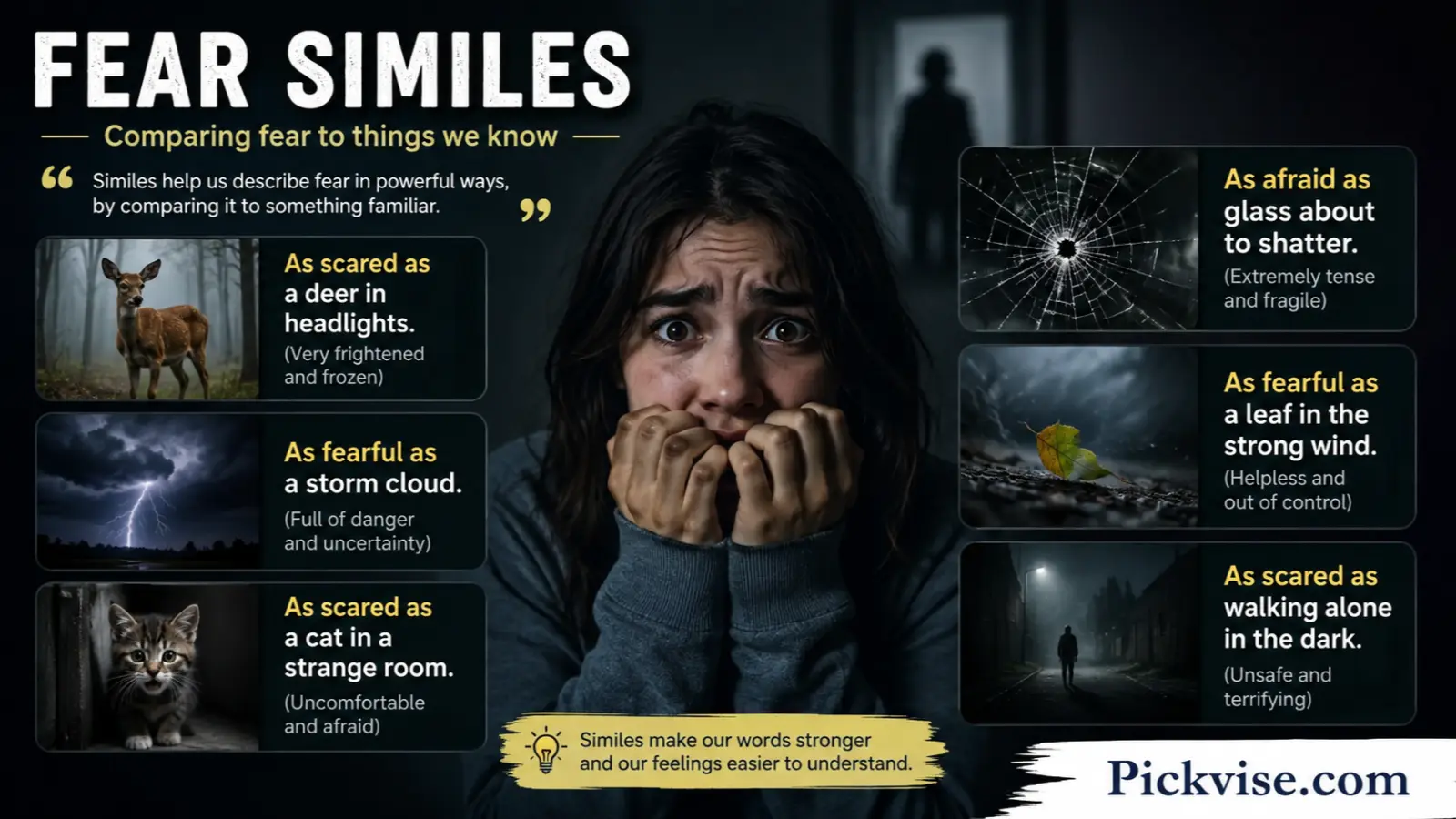
A Fear Similes compares two different things using words such as “like” or “as.” Writers use similes to turn an abstract feeling into something readers can see, hear, or almost experience.
Fear is especially well suited to comparison. Instead of simply writing “She was scared,” a writer can compare fear to a physical sensation, a sudden movement, a strange sound, or an unsettling place.
For example:
Fear wrapped around him like cold fog around an empty street.
The comparison gives fear a shape and atmosphere. It also leaves room for the reader to imagine the scene.
These fear similes can help with fiction, poetry, personal writing, dialogue, descriptions, and creative writing exercises. The goal is not simply to make fear sound dramatic. A strong simile should reveal something about the character, situation, or emotional intensity.
Quick Answer: What Are Some Good Fear Similes?
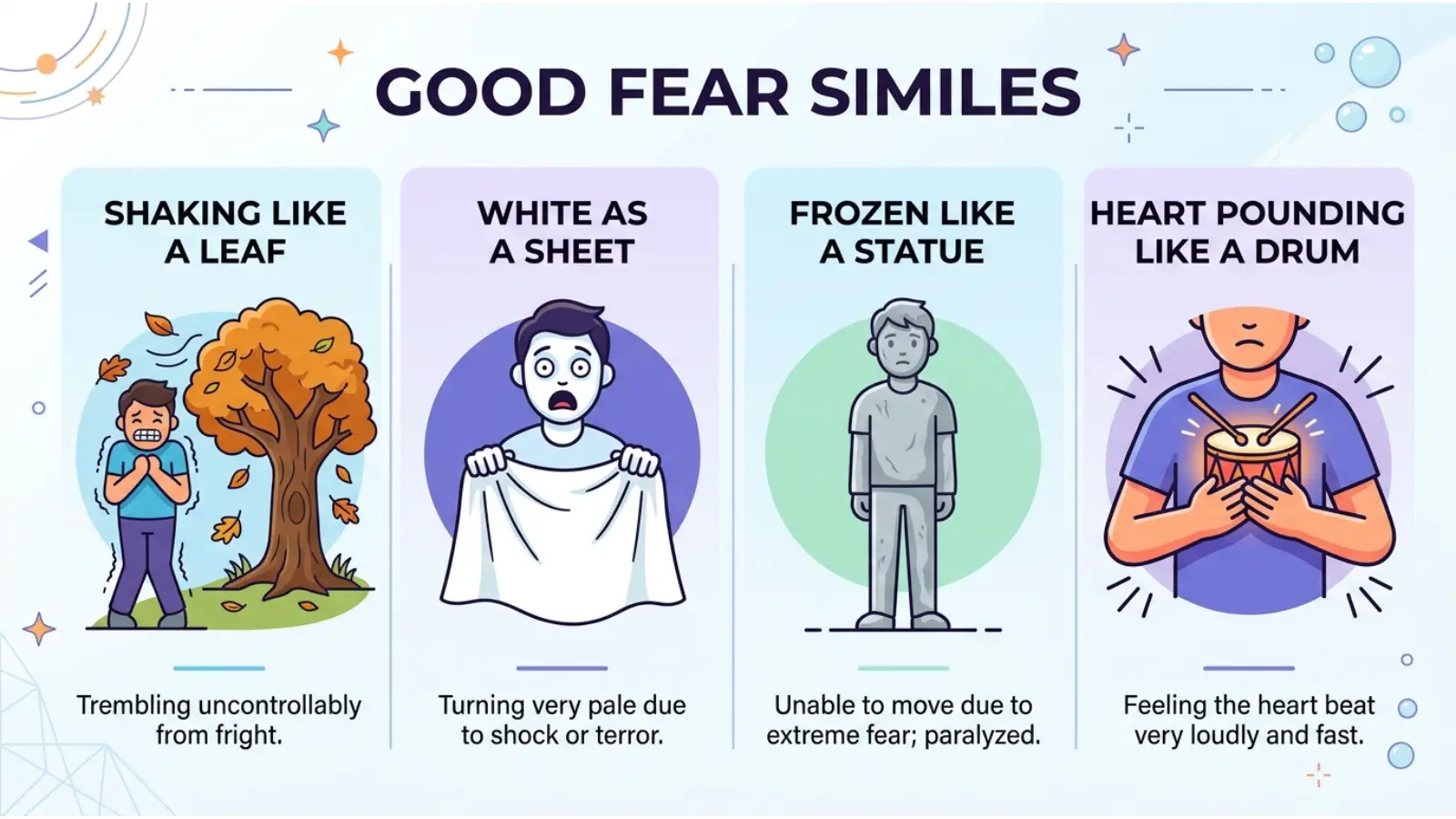
Good fear similes compare fear with sensations or images that communicate tension clearly. Examples include:
- Fear moved through her like an unexpected winter wind.
- His thoughts scattered like birds startled from a rooftop.
- The warning sounded like a door creaking in an empty house.
- Her courage felt as thin as paper in the rain.
- Panic spread through the room like a shadow at sunset.
- His heartbeat knocked like impatient fingers against glass.
The best choice depends on the kind of fear you want to create: sudden, quiet, mysterious, overwhelming, or uncertain.
30 Original Fear Similes for Creative Writing
1. Fear moved through him like an unexpected winter wind.
Meaning: Fear arrives suddenly and changes his emotional state.
This works well because wind is invisible but immediately noticeable. The comparison suggests that fear can be felt before it is fully understood.
Example:
Fear moved through him like an unexpected winter wind when he heard footsteps behind the door.
Best context: Suspense and unexpected danger.
Writing tip: Use weather-based comparisons when you want fear to affect the atmosphere as well as the character.
2. Her heartbeat knocked like impatient fingers against glass.
This simile turns a racing heartbeat into a physical sound.
Example:
Her heartbeat knocked like impatient fingers against glass as she waited for the answer.
The image creates nervous anticipation without directly saying that she was terrified.
Best context: Waiting, uncertainty, exams, interviews, or suspenseful scenes.
3. His thoughts scattered like birds startled from a rooftop.
Fear does not always make someone physically run. Sometimes it destroys their ability to think clearly.
Example:
His thoughts scattered like birds startled from a rooftop when the lights suddenly went out.
Writing purpose: Showing confusion and panic rather than simply naming the emotion.
4. Panic spread through the room like ink dropped into clear water.
This comparison emphasizes how quickly fear can affect several people.
Example:
Panic spread through the room like ink dropped into clear water, darkening every conversation.
The image works because ink gradually changes an otherwise calm space.
Best context: Crowds, emergencies, rumors, and group reactions.
5. Her courage felt as thin as paper in the rain.
Here, courage is presented as fragile.
Example:
Her courage felt as thin as paper in the rain when she reached for the unfamiliar door.
This is useful when a character wants to be brave but feels close to giving in to fear.
6. The hallway stretched before him like a question with no answer.
Not all fear comes from obvious danger. Uncertainty can be frightening too.
Example:
The hallway stretched before him like a question with no answer.
The comparison creates mystery without explaining exactly what the character fears.
Best context: Suspense, mystery, psychological fiction.
7. Her voice trembled like a candle flame in a draft.
A candle flame is small and easily disturbed, making it a useful image for an uncertain voice.
Example:
Her voice trembled like a candle flame in a draft as she called his name.
Writing tip: Small physical images can make emotional descriptions more believable.
8. Fear sat on his shoulders like a soaked winter coat.
This makes fear feel heavy and uncomfortable.
Example:
Fear sat on his shoulders like a soaked winter coat, slowing every step.
The simile works particularly well for prolonged anxiety rather than a sudden scare.
9. The silence felt like a locked room.
This comparison creates a sense of confinement.
Example:
After the announcement, the silence felt like a locked room.
Best context: Emotional tension, family drama, serious conversations, and suspense.
10. Her stomach twisted like a rope pulled too tight.
The comparison connects fear with a familiar physical sensation.
Example:
Her stomach twisted like a rope pulled too tight as the footsteps came closer.
This is especially useful when writing from a character’s physical perspective.
11. His confidence vanished like footprints beneath fresh snow.
This simile suggests that confidence disappears quickly and completely.
Example:
His confidence vanished like footprints beneath fresh snow when the unexpected question reached him.
Writing purpose: Showing a sudden loss of certainty.
12. The strange noise hovered like a question nobody wanted to ask.
This comparison creates uncertainty rather than direct terror.
Example:
The strange noise hovered like a question nobody wanted to ask.
It fits scenes where characters suspect something is wrong but do not yet know what it is.
13. Her fear tightened around her like a seat belt pulled too hard.
This image makes fear feel restrictive.
Example:
Her fear tightened around her like a seat belt pulled too hard, making every breath feel deliberate.
Best context: Claustrophobic or high-pressure situations.
14. His hands shook like leaves caught in restless air.
The image focuses on visible physical fear.
Example:
His hands shook like leaves caught in restless air as he held the fragile envelope.
Writing tip: Physical reactions often communicate fear more effectively than repeatedly using words such as scared or terrified.
15. The darkness gathered around them like an unfinished story.
This simile gives darkness a mysterious quality.
Example:
The darkness gathered around them like an unfinished story, hiding what might come next.
It works because an unfinished story creates curiosity and uncertainty.
16. Her breathing became as uneven as footsteps on broken stairs.
This comparison connects breathing with an unstable rhythm.
Example:
Her breathing became as uneven as footsteps on broken stairs when she realized she was alone.
Best context: Suspenseful scenes where the character’s body reveals their fear.
17. The warning struck him like a sudden crack of thunder.
This describes the emotional impact of unexpected information.
Example:
The warning struck him like a sudden crack of thunder.
The simile works best when fear begins with shocking news.
18. His doubt crawled through his mind like a slow-moving shadow.
This is better suited to quiet, developing fear.
Example:
Doubt crawled through his mind like a slow-moving shadow, growing longer with every unanswered message.
Writing purpose: Showing fear that develops gradually rather than arriving all at once.
19. Her courage flickered like a porch light during a storm.
The comparison suggests courage that repeatedly weakens and returns.
Example:
Her courage flickered like a porch light during a storm, but she kept walking.
This can create a more nuanced character because fear and bravery exist together.
20. The approaching footsteps sounded like a clock counting backward.
This simile creates suspense because every sound seems to move the character closer to a consequence.
Example:
The approaching footsteps sounded like a clock counting backward.
Best context: Mystery, thriller, and suspense writing.
21. His fear clung to him like wet clothes after a storm.
This conveys lingering fear.
Example:
Even after the danger passed, his fear clung to him like wet clothes after a storm.
Unlike a comparison involving a sudden shock, this one suggests that fear remains after the event.
22. The unfamiliar room felt like a maze built without an exit.
This works for characters who feel trapped or uncertain.
Example:
The unfamiliar room felt like a maze built without an exit.
Writing tip: Comparisons involving physical spaces can make psychological fear easier for readers to visualize.
23. Her thoughts raced like trains leaving a crowded station.
This simile shows an overloaded mind.
Example:
Her thoughts raced like trains leaving a crowded station, each one carrying another possible disaster.
The comparison is particularly useful for anxious overthinking.
24. His fear was as sharp as a splinter beneath the skin.
This presents fear as a persistent irritation rather than an explosive emotion.
Example:
His fear was as sharp as a splinter beneath the skin, impossible to ignore.
Best context: Subtle psychological tension.
25. The unexpected message landed like a stone in still water.
This focuses on the disturbance created by frightening information.
Example:
The unexpected message landed like a stone in still water, disturbing the calm of the entire afternoon.
The image is useful when fear interrupts an otherwise peaceful scene.
26. Her words came out like coins slipping through nervous fingers.
This gives nervous speech a physical quality.
Example:
Her words came out like coins slipping through nervous fingers.
Best context: Dialogue and emotionally difficult conversations.
27. The fear between them hung like smoke that refused to clear.
This simile works when characters share an unspoken concern.
Example:
The fear between them hung like smoke that refused to clear.
It can create tension without requiring anyone to explain what they are thinking.
28. His resolve cracked like ice beneath a sudden weight.
This comparison shows a character losing confidence under pressure.
Example:
His resolve cracked like ice beneath a sudden weight when he heard the alarm.
Writing purpose: Showing the exact moment bravery gives way to fear.
29. The possibility followed her like a shadow that had learned her name.
This creates a more unusual form of psychological suspense.
Example:
The possibility followed her like a shadow that had learned her name.
The image suggests that fear has become personal and difficult to escape.
30. Fear waited inside him like a storm behind a closed window.
This is useful for restrained characters who hide their emotions.
Example:
Fear waited inside him like a storm behind a closed window, visible only in the tension of his hands.
Best context: Characters who appear calm while experiencing intense internal conflict.
How to Make Fear Similes More Powerful
A strong simile does more than replace the word fear. It gives the reader information about how the fear behaves.
Ask yourself:
- Is the fear sudden or gradual?
- Is it loud or silent?
- Does it make the character freeze, run, hesitate, or overthink?
- Does the character understand the danger?
- Is the fear physical, emotional, or both?
- Does the scene need mystery, urgency, sadness, or tension?
Compare these two sentences:
He was very afraid.
and:
His confidence vanished like footprints beneath fresh snow.
The first sentence tells the reader what happened. The second creates an image that lets the reader interpret the emotional change.
Match the Comparison to the Emotion
Different comparisons produce different forms of fear.
For sudden fear: use images involving shocks, crashes, flashes, or abrupt movement.
For quiet fear: use darkness, silence, distance, shadows, or stillness.
A panic: use scattered objects, rushing water, crowded movement, or broken rhythms.
A lingering fear: use stains, smoke, wet clothing, shadows, or persistent sounds.
The comparison should serve the emotional moment instead of competing with it.
How Professional Writers Avoid Cliché Fear Comparisons
Many fear descriptions become predictable because writers reach automatically for familiar images.
For example, comparisons involving a racing heart, cold sweat, or a deer in headlights can communicate fear, but frequent use makes them less surprising.
You do not need to avoid familiar imagery completely. Instead, ask what is specific to your character and scene.
A musician might experience fear as an instrument suddenly going out of tune. A student might compare uncertainty to a test question they cannot decipher. A sailor might understand fear through changing tides.
The more closely the comparison connects to the character’s world, the more authentic it tends to feel.
A Simple Formula for Creating Your Own Fear Similes
Try this five-step method.
1. Name the exact type of fear
Don’t stop at fear. Decide whether the character feels dread, nervousness, panic, uncertainty, embarrassment, or anticipation.
2. Identify a physical reaction
Maybe the character’s hands shake, thoughts race, breathing changes, or movement slows.
3. Find an unexpected but believable image
Look around the scene. What object, sound, movement, or natural event resembles that reaction?
4. Connect the two with “like” or “as”
For example:
nervous thoughts + crowded traffic =
Her thoughts moved like traffic trapped at a broken signal.
5. Remove anything unnecessary
A simile becomes stronger when the comparison is clear and precise. If the reader has to decode it for too long, simplify it.
Creative Exercises to Practice Fear Similes
Exercise 1: Describe Fear Without Using “Scared”
Write five sentences about a frightened character without using:
- scared
- afraid
- fear
- terrified
- nervous
Use physical reactions and comparisons instead.
Exercise 2: Change the Mood
Take one fear simile and rewrite it three ways:
- mysterious
- humorous
- deeply serious
This teaches you how word choice changes emotional tone.
Exercise 3: Build From the Setting
Choose a location such as a classroom, forest, hospital, airport, or empty house.
Now create three comparisons using objects found in that environment.
This produces more original imagery because the simile grows naturally from the setting.
Exercise 4: Make Fear Personal
Choose a character’s hobby or profession. Imagine how that person might understand fear through something familiar.
A chef, photographer, athlete, mechanic, or musician will notice different details in the world. Those details can become the foundation for distinctive similes.
Simile vs. Metaphor: What’s the Difference?
A simile makes a direct comparison using words such as like or as.
Fear moved through him like winter wind.
A metaphor makes the comparison more directly.
Fear was a winter wind moving through him.
Both can create vivid imagery, but they produce slightly different effects.
Similes often give readers a little more distance because the writer signals that one thing resembles another. Metaphors can feel more immediate and absolute.
Other Literary Devices That Work With Fear
Imagery
Imagery uses descriptive language that appeals to the senses. Fear similes become stronger when they connect with sounds, textures, temperatures, movement, or visual details.
Personification
You can give fear human behavior:
Fear waited patiently outside the door.
This makes an abstract emotion feel like an active presence.
Hyperbole
Exaggeration can communicate the intensity of emotion, especially in humorous or dramatic writing. Use it deliberately so the exaggeration fits the voice.
Symbolism
An object can represent fear throughout a story. A flickering light, locked door, or unanswered phone may become meaningful through repetition.
Common Mistakes When Writing Fear Similes
Using too many comparisons
A paragraph filled with similes can become distracting. One precise comparison may be more effective than five average ones.
Mixing unrelated imagery
Avoid jumping from weather to machinery to animals to food in the same sentence unless the unusual combination is intentional.
Forcing the comparison
If a simile feels difficult to explain, it may not belong in the sentence.
Confusing a simile with a metaphor
Remember: a simile usually signals comparison with like or as. A metaphor states the comparison more directly.
Describing instead of revealing
A comparison should add information. If “he was scared” and the simile communicate exactly the same thing without adding atmosphere or character, the simile may not be doing enough work.
Choosing drama over precision
The biggest-sounding comparison is not automatically the strongest. Quiet fear can be more powerful when described through a small, specific detail.
Frequently Asked Questions About Fear Similes
What is a good simile for fear?
A good fear simile makes an abstract emotion concrete. For example, “Fear sat on his shoulders like a soaked winter coat” suggests that the emotion feels heavy and difficult to escape.
How do you describe fear in a creative way?
Focus on what fear does to the body, thoughts, surroundings, and behavior. Then compare that effect with a specific image that matches the scene.
What is a simile for being scared?
One example is: “Her voice trembled like a candle flame in a draft.” It communicates fear through a physical detail rather than simply naming the emotion.
How can I avoid cliché similes about fear?
Start with the character and setting instead of searching for a generic comparison. A character’s surroundings, memories, interests, and physical reactions can all provide fresher imagery.
Can similes make a scary story better?
Yes, when they support the story’s atmosphere. A carefully chosen simile can increase suspense, reveal character, and make an emotional moment easier to visualize.
Are fear similes useful in poetry?
Absolutely. Poetry often depends on compressed imagery, and a strong simile can communicate an emotional experience in very few words.
Should every sentence in a scary story contain a simile?
No. Too many comparisons can weaken the impact of all of them. Use similes where they add a new image, emotional layer, or insight.
Conclusion
The strongest fear similes do not simply make fear sound frightening. They show what that fear feels like to a particular person in a particular moment. When you write your own comparisons, begin with the emotion, observe its physical or psychological effect, and then search the character’s world for an image that captures it. The most memorable comparison is often not the loudest one. It is the one that feels precise, unexpected, and true to the scene. Experiment with different images, read your sentences aloud, and keep the comparisons that make the emotion clearer rather than merely more dramatic. With practice, similes can turn simple descriptions into moments readers can genuinely picture and feel.

I am Helena Frost, a writer captivated by the beauty of language and the art of comparison. Through my words, I explore the world by turning ordinary moments into vivid similes and reflections. I enjoy crafting phrases that spark imagination, evoke emotion, and linger in the mind. My writing celebrates the subtle connections between people, nature, and the stories we live. For me, every sentence is an opportunity to reveal the extraordinary in the everyday.