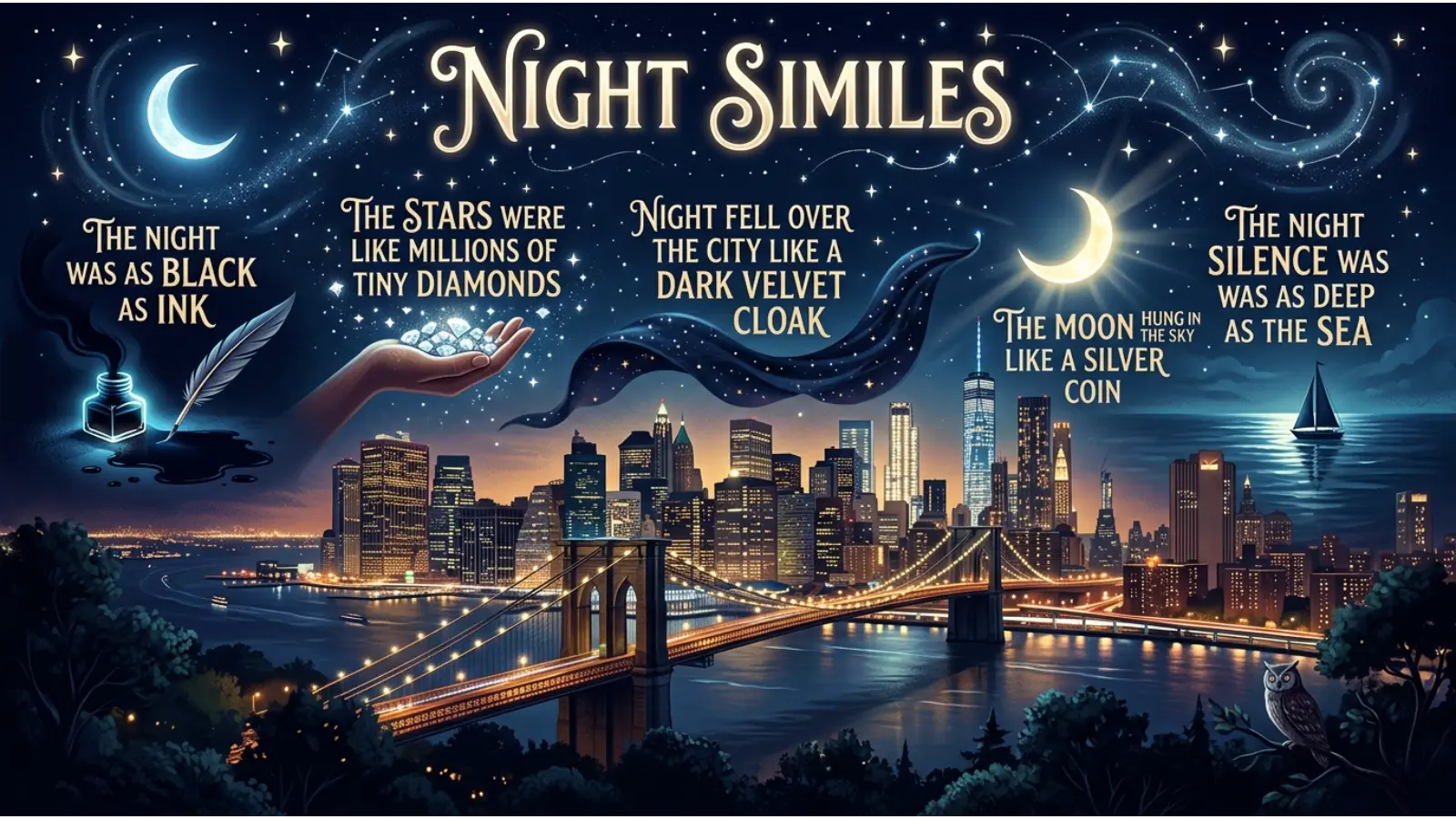
Night Similes has a special quality that daylight cannot reproduce. It can feel peaceful, mysterious, lonely, exciting, comforting, or even unsettling. A well-chosen comparison can turn a simple sentence about darkness into an image readers can almost see.
A simile compares two different things using words such as “like” or “as.” For example, instead of saying “The night was dark,” a writer might say, “The night stretched across the town like a curtain of ink.”
That small change gives the reader something to imagine.
These night similes are useful for creative writing, poetry, storytelling, school assignments, descriptive passages, and everyday writing. Along with examples, you’ll find explanations of why particular comparisons work and how to create your own.
What Is a Simile for Night?
A simile for night compares nighttime, darkness, stars, moonlight, or the atmosphere of evening with something familiar. It usually uses like or as to create a clear mental image.
For example:
The night was like a deep blue ocean without a shore.
The comparison makes the darkness feel vast and endless.
Night similes can describe different moods. A calm night might be compared with a quiet blanket, while a frightening night could resemble a locked room or a watchful creature.
30 Creative Night Similes
1. The night was like a curtain of deep blue velvet.
This comparison gives the night a rich, soft, almost luxurious quality.
Example: The night was like a curtain of deep blue velvet, slowly covering the fading daylight.
Best for: Poetry, romantic descriptions, and peaceful scenes.
2. The sky was scattered with stars like silver grains across black sand.
Instead of simply saying that the stars were bright, this image focuses on their arrangement.
Example: Stars glittered like silver grains across black sand above the quiet village.
Writing tip: Comparisons become stronger when they describe both appearance and placement.
3. Darkness crept over the fields like spilled ink.
The image suggests darkness spreading gradually.
Example: Darkness crept over the fields like spilled ink, swallowing the last patches of sunlight.
Effect: This works especially well when a scene is becoming mysterious or tense.
4. The moon hung in the sky like a pale lantern.
This is a simple, accessible comparison that works well for young writers.
Example: The moon hung like a pale lantern above the sleeping houses.
Best for: Children’s stories, descriptive writing, and gentle nighttime scenes.
5. The night wrapped around the town like a heavy cloak.
Here, night becomes something that surrounds and covers.
Example: The night wrapped around the town like a heavy cloak, muting every distant sound.
Effect: The comparison can create a feeling of isolation or mystery.
6. The stars shone like tiny windows in an endless ceiling.
This comparison makes the sky seem enormous.
Example: The stars shone like tiny windows in an endless ceiling.
Writing purpose: Use it when you want readers to notice the scale of the night sky.
7. The quiet night was as still as an abandoned library.
Instead of comparing silence with another outdoor scene, this uses a familiar indoor place.
Example: The quiet night was as still as an abandoned library.
Effect: It emphasizes silence and stillness rather than darkness.
8. Moonlight spilled across the road like melted silver.
The word spilled makes the light feel active.
Example: Moonlight spilled across the road like melted silver.
Best for: Poetry and visually rich storytelling.
9. The city glittered at night like a field of fireflies.
This comparison transforms artificial lights into something natural.
Example: From the hill, the city glittered like a field of fireflies.
Writing tip: A distant viewpoint can make this comparison especially effective.
10. The night air felt cool like water from a mountain spring.
This simile focuses on physical sensation.
Example: The night air felt cool like water from a mountain spring.
Effect: Sensory similes help readers experience a scene rather than simply observe it.
11. The moon was as bright as a lamp left burning in an empty room.
This comparison combines brightness with loneliness.
Example: The moon was as bright as a lamp left burning in an empty room.
Best for: Melancholy or reflective scenes.
12. Shadows stretched across the walls like long fingers.
This creates movement and a slightly unsettling mood.
Example: Shadows stretched across the walls like long fingers as the candle flickered.
Effect: The comparison is useful in suspense and mystery writing.
13. The stars looked like scattered sparks from a distant fire.
The stars become tiny points of energy.
Example: Above the mountains, the stars looked like scattered sparks from a distant fire.
Best for: Adventure stories and dramatic landscapes.
14. The moonlight rested on the lake like a thin sheet of glass.
This emphasizes the smooth appearance of reflected light.
Example: Moonlight rested on the lake like a thin sheet of glass.
Writing purpose: Use this type of comparison for calm water and quiet scenes.
15. Night arrived like a guest who knew the house well.
This person-centered comparison gives nighttime a personality.
Example: Night arrived like a guest who knew the house well, quietly settling into every corner.
Effect: Person-like comparisons can make abstract ideas feel familiar.
16. The darkness was as thick as smoke.
A familiar physical substance makes an abstract quality easier to imagine.
Example: The darkness was as thick as smoke around the narrow alley.
Best for: Suspenseful or atmospheric writing.
17. The village slept like a child after a long day.
This comparison creates a gentle, peaceful mood.
Example: Beneath the moon, the village slept like a child after a long day.
Effect: It gives the setting a sense of innocence and rest.
18. The midnight sky looked like a painting washed in indigo.
This simile emphasizes color and visual composition.
Example: The midnight sky looked like a painting washed in indigo.
Best for: Poetry and artistic descriptions.
19. The stars blinked like distant signals across the darkness.
The stars become small points communicating across a huge distance.
Example: The stars blinked like distant signals across the darkness.
Writing tip: Choose comparisons that suggest an action when you want a static scene to feel alive.
20. The road disappeared into the night like a ribbon sinking into water.
This creates a strong sense of distance.
Example: The road disappeared into the night like a ribbon sinking into water.
Best for: Travel scenes, mysteries, and endings.
21. The moon floated above the rooftops like a white balloon.
This creates a lighter, more playful image.
Example: The moon floated above the rooftops like a white balloon.
Best for: Children’s writing and simple descriptive passages.
22. The evening faded like a photograph losing its color.
This comparison focuses on the transition from day to night.
Example: Evening faded like a photograph losing its color.
Effect: It creates a nostalgic or reflective feeling.
23. The night sounded like a room waiting for someone to speak.
This unusual comparison focuses on expectation rather than appearance.
Example: The night sounded like a room waiting for someone to speak.
Best for: Emotional fiction and introspective poetry.
24. The wind moved through the trees like a whisper passing between friends.
This gives the natural scene a quiet human quality.
Example: The wind moved through the trees like a whisper passing between friends.
Effect: It makes the night feel intimate rather than frightening.
25. The dark clouds gathered like curtains before a stage performance.
The comparison creates anticipation.
Example: Dark clouds gathered like curtains before a stage performance.
Best for: Storm scenes and moments before an important event.
26. The lonely street was as quiet as a clock after midnight.
This emphasizes unusual silence.
Example: The lonely street was as quiet as a clock after midnight.
Writing purpose: Use unexpected comparisons to avoid ordinary descriptions.
27. The stars were like tiny reminders that the darkness was not empty.
This comparison is more emotional than visual.
Example: The stars were like tiny reminders that the darkness was not empty.
Effect: It can suggest hope, companionship, or comfort.
28. The forest at night was like a book with half its pages missing.
Readers know something is hidden, but they cannot see everything.
Example: The forest at night was like a book with half its pages missing.
Best for: Mystery, fantasy, and suspense.
29. Dawn waited beyond the darkness like a door just out of sight.
This comparison turns night into a temporary stage before morning.
Example: Dawn waited beyond the darkness like a door just out of sight.
Effect: It creates anticipation and hope.
30. The peaceful night settled over the neighborhood like dust after a storm.
This gives the ending of the day a feeling of quiet resolution.
Example: The peaceful night settled over the neighborhood like dust after a storm.
Best for: Reflective endings and calm scenes.
How to Choose the Right Night Simile
Not every night needs the same kind of comparison. The best simile depends on the feeling you want your reader to experience.
For peace, try images involving blankets, still water, soft fabric, or quiet rooms.
For mystery, consider hidden doors, unfinished books, veils, distant signals, or unfamiliar roads.
A fear, darker images can work: thick smoke, long shadows, empty buildings, or things moving unseen.
For hope, compare stars or moonlight with small lights, windows, signals, or distant beacons.
The key question is not simply, “What looks like night?” Ask instead:
“What should the reader feel when they experience this night?”
That question usually leads to a stronger comparison.
Why These Night Similes Work
A good simile does more than decorate a sentence. It transfers qualities from one image to another.
Consider:
The night was dark.
The sentence gives information, but very little atmosphere.
Now consider:
The night wrapped around the town like a heavy cloak.
The second sentence suggests darkness, enclosure, quietness, and perhaps isolation.
The comparison adds several layers without requiring a long explanation.
Use Concrete Images
Night is an abstract concept, so concrete objects can make it easier to imagine.
Compare darkness with:
- ink
- fabric
- smoke
- water
- a curtain
- a cloak
- a room
- a road
The reader already understands these physical things, so the comparison gives the abstract idea shape.
Match the Image to the Mood
A soft comparison can make night comforting:
The darkness settled like a warm blanket.
A harsher image changes the mood:
The darkness closed around the street like a locked gate.
Both describe darkness, but they create completely different emotional responses.
Night Similes for Poetry
Poetry often benefits from compact images that suggest more than they directly explain.
For example:
Moonlight lay on the river like a quiet promise.
The comparison does not merely describe light. It introduces an emotional idea.
When writing poetry, try combining a nighttime image with an emotion:
Night + object + feeling
For example:
The stars were like small pieces of courage scattered across the sky.
This technique allows a physical scene to carry an emotional meaning.
Night Similes for Stories
In fiction, avoid filling every sentence with comparisons. One strong simile can be more effective than several weak ones.
Instead of:
The night was like ink, the moon was like a lamp, the stars were like diamonds, and the wind was like a whisper.
Choose the image that matters most to the scene.
For example:
The road vanished into the darkness like a ribbon sinking into deep water.
That single comparison can establish uncertainty without overwhelming the paragraph.
How to Create Your Own Night Similes
Creating an original simile is easier when you work through a few deliberate steps.
1. Decide What Part of Night You Are Describing
You might focus on:
- darkness
- moonlight
- stars
- silence
- cold air
- shadows
- clouds
- evening
- midnight
- the transition into dawn
2. Choose a Specific Quality
Ask what you want to communicate.
Is the night:
- quiet?
- enormous?
- mysterious?
- lonely?
- peaceful?
- frightening?
- beautiful?
- comforting?
3. Brainstorm Unexpected Objects
If the night is quiet, don’t immediately choose a sleeping baby or a silent room. Think more widely.
A quiet night could resemble:
- an empty theater
- a closed museum
- a paused song
- a forgotten hallway
- a snow-covered field
4. Connect the Two Ideas
Now create the comparison using like or as.
The night was as quiet as an empty theater after the audience had gone.
The unusual image makes the sentence more memorable.
5. Remove Anything That Does Not Help
A simile should have a purpose. If removing it makes the writing clearer and stronger, it may not be necessary.
A Simple Exercise for Better Night Writing
Try this three-line exercise:
Line 1: Describe the night plainly.
The night was quiet.
Line 2: Identify the quality.
Quiet enough to feel almost empty.
Line 3: Find a surprising comparison.
The night was as quiet as a theater waiting for its first audience.
Now repeat the exercise with darkness, moonlight, stars, wind, and dawn.
The goal isn’t to create the fanciest sentence. The goal is to find an image that feels precise.
Common Mistakes When Writing Night Similes
Using Too Many Clichés
Some comparisons appear so frequently that they no longer create a strong image.
Familiar comparisons aren’t automatically wrong, but original writing often becomes more memorable when the image is specific.
Instead of reaching for the first comparison that comes to mind, ask:
“What would this scene look like in my own imagination?”
Mixing Unrelated Images
A sentence can become confusing when it combines several unrelated comparisons.
For example, if darkness is described as both a blanket and a rushing river in the same sentence, the reader may struggle to understand the intended image.
Choose one dominant picture.
Forcing a Simile Into Every Sentence
Not every sentence needs figurative language.
Strong descriptive writing usually combines straightforward statements with occasional vivid comparisons. This gives the strongest images room to stand out.
Choosing an Image That Does Not Match the Mood
A playful comparison may weaken a frightening scene.
Likewise, an extremely dark comparison may make a peaceful bedtime scene feel unnecessarily threatening.
Always consider the emotional context.
Confusing Similes With Metaphors
A simile normally makes a comparison using words such as like or as:
The night was like a curtain.
A metaphor makes the comparison directly:
The night was a curtain.
Both can create imagery, but they use different structures.
Night Similes vs. Other Literary Devices
Night descriptions can use several forms of figurative language.
Simile:
The moon looked like a silver coin.
Metaphor:
The moon was a silver coin.
Personification:
The night whispered through the trees.
Imagery:
Cold air drifted through the open window while pale moonlight covered the floor.
Hyperbole:
The darkness seemed to stretch forever.
These devices can work together, but each produces a slightly different effect.
Frequently Asked Questions
What is a good simile for night?
A strong night simile depends on the mood. For a peaceful scene, you might write, “The night settled over the town like a soft cloak.” For mystery, try an image involving hidden paths, curtains, or unfinished books.
What are some similes for a dark night?
You can compare darkness with ink, smoke, a closed room, a heavy curtain, or deep water. The best choice depends on whether you want the darkness to feel peaceful, mysterious, or threatening.
How do you describe night creatively?
Use sensory details and compare nighttime with familiar objects. Think about what the night looks, sounds, feels, and even seems to mean emotionally.
What is a simile for a starry night?
A starry night could be compared with “silver grains scattered across black sand” or “tiny windows opening across an endless ceiling.” Choose an image that matches your scene.
What is a simile for moonlight?
Moonlight can be compared with melted silver, a pale lantern, glass, a thin ribbon, or another image that captures its brightness and movement.
Can night similes be used in poems?
Yes. Night is especially suitable for poetic comparisons because it naturally involves strong visual and emotional imagery. Keep poetic similes focused rather than overcrowding each line.
How do I make my night similes original?
Start with the specific feeling you want to create, then brainstorm less obvious objects connected with that feeling. Specific sensory details and unexpected but believable comparisons usually produce fresher similes.
Conclusion
The best night similes do more than tell readers that it is dark. They give darkness a texture, movement, mood, or emotional meaning. When you write your own, start with the scene rather than the phrase “like.” Decide what you want readers to feel, identify the strongest quality, and then search for an image that expresses it clearly. A quiet street, a star-filled sky, a lonely road, and a moonlit lake can all exist under the same night sky—but each can tell a completely different story. That is the real power of a good simile: one comparison can make an ordinary description feel unforgettable.
I am Helena Frost, a writer captivated by the beauty of language and the art of comparison. Through my words, I explore the world by turning ordinary moments into vivid similes and reflections. I enjoy crafting phrases that spark imagination, evoke emotion, and linger in the mind. My writing celebrates the subtle connections between people, nature, and the stories we live. For me, every sentence is an opportunity to reveal the extraordinary in the everyday.