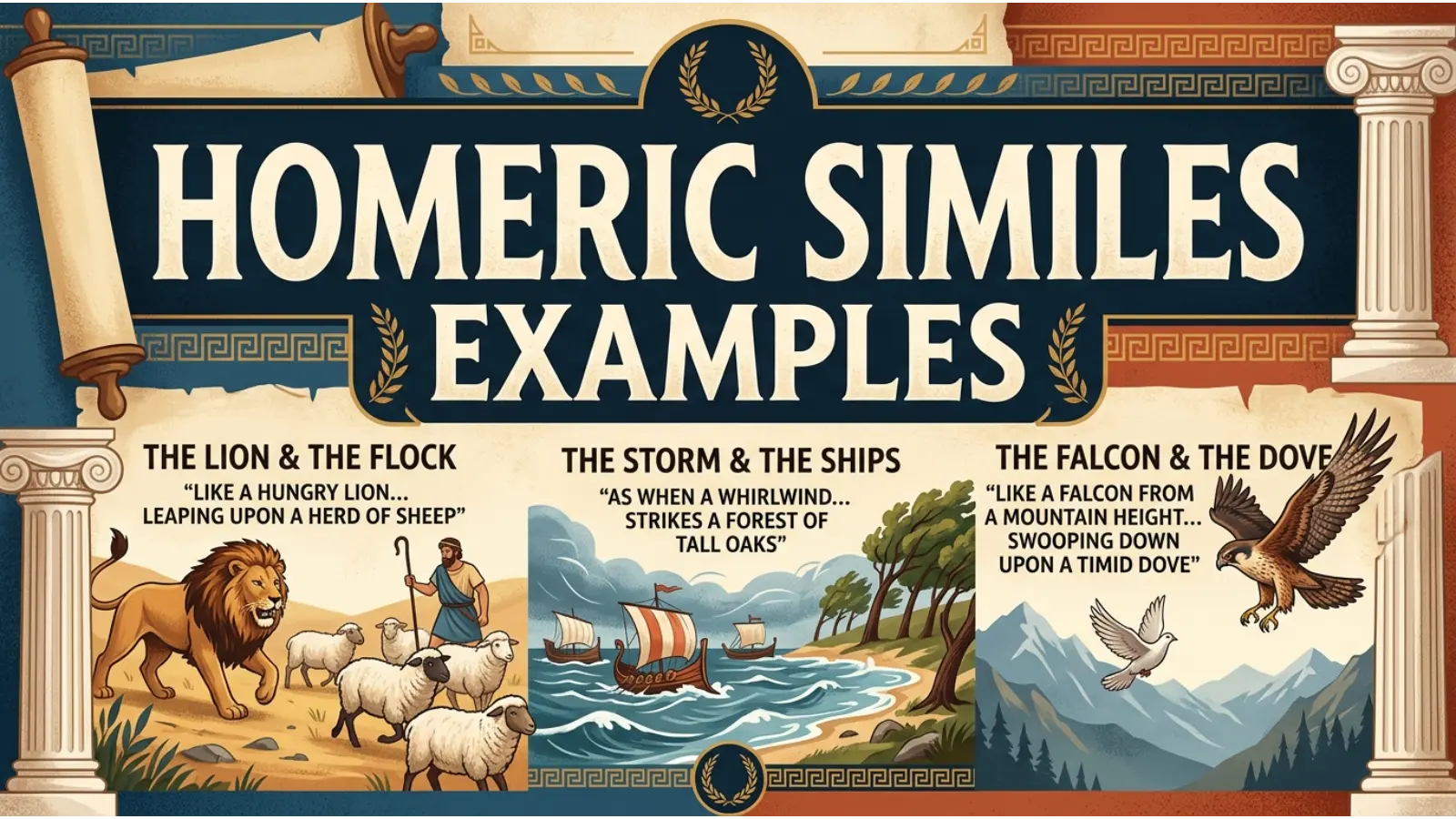
A Homeric Similes Examples is an extended comparison that explains a person, action, emotion, or scene by comparing it with something familiar from everyday life or nature. These comparisons are especially associated with Homer’s Iliad and Odyssey, where a brief battlefield action can suddenly expand into an image of lions, storms, fires, farmers, rivers, or wild animals.
Unlike a short simile such as “the warrior was like a lion,” a Homeric simile often develops over several lines. The comparison may describe what the animal does, how the weather behaves, or what people experience before returning to the original scene.
That extra detail gives Homeric similes their distinctive power. They slow the action for a moment, make an unfamiliar world easier to imagine, and add emotional or symbolic meaning.
This guide explores Homeric similes examples, explains why they work, and shows how modern writers can use the same technique without copying ancient poetry.
What Is a Homeric Simile?
A Homeric Similes Examples is an extended simile, sometimes called an epic simile, that develops a comparison beyond a single phrase.
For example, instead of writing:
The warrior fought like a lion.
A Homeric-style comparison might develop the idea:
The warrior moved like a lion defending its young, circling the threat, watching for an opening, then suddenly rushing forward when the danger came too close.
The comparison creates a miniature scene of its own.
The key features are:
- A clear comparison
- A vivid image
- Several details connected to that image
- A return to the original subject
- A strong emotional or dramatic effect
Homer frequently draws his comparisons from ordinary experiences. That is one reason they remain memorable: even when the main story concerns gods and heroes, the imagery can involve things people recognize from farming, hunting, weather, animals, fire, or family life.
Why Homeric Similes Are So Effective
A powerful extended simile does more than decorate a sentence.
It can change the reader’s perspective.
A warrior may be described as a storm, a predator, a tree, or a wave. Each comparison emphasizes something different. A storm suggests force. A predator suggests instinct. A tree may suggest endurance. A wave suggests movement and unstoppable energy.
Homeric similes also create pauses inside fast-moving scenes. A battle can be chaotic, but the comparison gives the reader a moment to observe the action from a different angle.
For modern writers, this is an important lesson:
Don’t compare something merely because the comparison sounds beautiful. Compare it to reveal something.
25 Homeric Similes Examples and What They Teach Writers
The following examples are original modern paraphrases of Homeric-style imagery, not quotations from a particular translation. They capture common epic comparison patterns while avoiding reproduction of copyrighted translations.
1. A Warrior Like a Lion Protecting Its Cubs
Simile:
The warrior stood over his fallen companion like a lion guarding its young, refusing to retreat while danger gathered around him.
Meaning:
The comparison emphasizes courage, loyalty, and protective instinct.
Why it works:
A lion defending its young gives the reader an immediate picture of fierce determination.
Example sentence:
He guarded the wounded soldiers like a lion protecting its cubs.
Writing tip:
When writing about courage, choose an image that shows why the person is brave rather than simply calling the person brave.
2. Warriors Like Swarming Bees
Simile:
The soldiers poured through the narrow gate like a disturbed hive suddenly sending thousands of bees into the air.
Meaning:
The image suggests movement, noise, confusion, and overwhelming numbers.
Example sentence:
The crowd rushed toward the stadium entrance like bees leaving a shaken hive.
Best context:
Use this type of comparison for crowds, armies, groups, or sudden activity.
Writing lesson:
A strong comparison can communicate several qualities at once.
3. An Army Like a Dark Storm
Simile:
The army advanced across the plain like a storm cloud spreading over the fields before thunder.
Meaning:
The army appears threatening and powerful.
Emotional effect:
The image creates tension because the reader expects something destructive to follow.
Writing tip:
Weather makes an effective comparison when you want to create anticipation.
4. A Warrior Like a Mountain Lion
Simile:
He moved among the opposing soldiers like a mountain lion slipping through tall grass, quiet until the instant it attacked.
Meaning:
The warrior is stealthy, patient, and dangerous.
Why it works:
The comparison focuses on movement rather than appearance.
Example sentence:
The goalkeeper watched the ball like a predator waiting for the right moment.
Writing lesson:
Compare an action with another action whenever possible.
5. Fire Spreading Through Dry Grass
Simile:
The excitement traveled through the ranks like fire running through dry grass beneath a hot wind.
Meaning:
The emotion spreads quickly and becomes difficult to stop.
Best context:
This works for excitement, anger, panic, rumors, or enthusiasm.
Writing tip:
A simile becomes stronger when the comparison has a natural cause-and-effect relationship.
6. A Hero Like a Rising Tree
Simile:
He stood among the frightened soldiers like a young tree rising above flattened grass after a storm.
Meaning:
The hero represents strength, recovery, and hope.
Emotional effect:
The image feels reassuring rather than threatening.
Writing lesson:
Not every epic comparison needs violence. Nature can express resilience just as effectively.
7. Soldiers Like Waves on a Shore
Simile:
The fighters surged forward like waves repeatedly striking a rocky shore.
Meaning:
The image emphasizes repeated movement and persistence.
Example sentence:
The fans moved toward the entrance like waves rolling toward a beach.
Writing tip:
Water imagery works particularly well for movement, repetition, and unstoppable force.
8. A Spear Like Lightning
Simile:
The spear flashed toward its target like a sudden streak of lightning across a dark sky.
Meaning:
The comparison emphasizes speed and brightness.
Why it works:
Lightning is instantly recognizable as sudden and powerful.
Modern adaptation:
The cyclist shot around the corner like lightning.
9. A Warrior Like a Falcon
Simile:
He descended upon the enemy like a falcon dropping toward prey from a great height.
Meaning:
The warrior appears swift, focused, and precise.
Writing tip:
Animal comparisons are especially effective when the animal’s behavior matches the character’s behavior.
10. A Crowd Like a River
Simile:
The people streamed through the streets like a river released from a broken dam.
Meaning:
The comparison shows both direction and force.
Example sentence:
Students poured from the school gates like a river suddenly freed from its banks.
Writing lesson:
Think about what your subject does, not just what it resembles.
11. A Cry Like Thunder
Simile:
His shout rolled across the field like thunder traveling between distant mountains.
Meaning:
The voice sounds powerful and far-reaching.
Emotional effect:
It makes the speaker seem commanding.
Best context:
Speeches, battles, celebrations, protests, and dramatic scenes.
12. A Warrior Like a Wolf in Winter
Simile:
He prowled through the darkness like a hungry wolf crossing a frozen valley.
Meaning:
The comparison creates loneliness, danger, and determination.
Writing tip:
Seasonal details can add emotional meaning to an animal simile.
13. Dust Like Smoke
Simile:
Dust rose behind the marching soldiers like smoke climbing from a distant fire.
Meaning:
The image emphasizes the scale and movement of the army.
Why it works:
The reader can visualize the dust before seeing the soldiers themselves.
Writing lesson:
A simile can establish setting as well as describe a character.
14. A Fighter Like a Boar
Simile:
The fighter charged through the crowd like a wild boar bursting from the undergrowth.
Meaning:
The character appears aggressive, sudden, and difficult to stop.
Example sentence:
The player drove toward the basket like a boar breaking through thick brush.
Best context:
Fast-paced action scenes.
15. Grief Like a Winter Wind
Simile:
Grief moved through the household like a winter wind slipping beneath every closed door.
Meaning:
The emotion is portrayed as unavoidable and penetrating.
Emotional effect:
The comparison creates a quiet, heavy mood.
Writing lesson:
Abstract emotions become easier to understand when connected to physical sensations.
16. Hope Like Morning Light
Simile:
Hope returned to the exhausted soldiers like morning light slowly appearing beyond the hills.
Meaning:
Hope arrives gradually after darkness.
Why it works:
The movement from darkness to light naturally supports the emotional change.
Writing tip:
When describing hope, recovery, or relief, look for images of gradual change.
17. Anger Like a Rising Flame
Simile:
His anger grew like a flame feeding on every dry branch placed before it.
Meaning:
Small frustrations continue to increase the emotion.
Example sentence:
Her irritation grew like a fire fed by one complaint after another.
Writing lesson:
An extended simile can explain how an emotion develops instead of merely naming it.
18. A Leader Like a Shepherd
Simile:
The commander moved among his soldiers like a shepherd walking through a scattered flock, gathering the frightened and directing the lost.
Meaning:
The leader is presented as responsible and protective.
Why it works:
The comparison focuses on leadership rather than physical appearance.
Best context:
Stories about responsibility, teamwork, and guidance.
19. A City Like an Anthill
Simile:
The city stirred at sunrise like an enormous anthill suddenly exposed to sunlight.
Meaning:
People move quickly in many directions, creating organized activity.
Example sentence:
The marketplace became like an anthill after the first delivery trucks arrived.
Writing tip:
Small creatures can provide surprisingly effective images for large human communities.
20. Ships Like Birds on the Sea
Simile:
The ships crossed the blue water like dark birds gliding toward a distant horizon.
Meaning:
The comparison emphasizes graceful movement and distance.
Emotional effect:
It creates a calmer image than the battlefield comparisons.
Writing lesson:
Epic writing benefits from contrast. Not every comparison should be violent or intense.
21. Rain Like a Curtain
Simile:
Rain fell across the battlefield like a heavy curtain hiding one side from the other.
Meaning:
The rain blocks vision and creates uncertainty.
Best context:
Storm scenes, suspense, travel, and dramatic transitions.
Writing tip:
Ask what the natural element does to the scene.
22. A Runner Like a Deer
Simile:
The messenger raced across the plain like a deer startled from a quiet forest.
Meaning:
The comparison communicates speed and sudden movement.
Example sentence:
She ran toward the finish line like a deer startled by a sudden sound.
Writing lesson:
Choose an animal whose characteristic movement matches your subject.
23. The Battlefield Like a Harvest Field
Simile:
The warriors moved across the field like harvesters working through a field of grain, advancing row by row.
Meaning:
The comparison emphasizes repeated movement and organized action.
Why it works:
A familiar agricultural scene makes a complicated scene easier to visualize.
Writing tip:
One of the most useful Homeric techniques is explaining an unfamiliar event through a familiar activity.
24. A Hero Like a Great Oak
Simile:
The old hero remained among the younger fighters like a great oak standing after the surrounding trees had fallen.
Meaning:
The hero represents endurance, age, and stability.
Emotional effect:
The comparison gives the character dignity.
Writing lesson:
Objects from nature can represent character qualities without directly stating them.
25. Panic Like Birds Scattering
Simile:
The soldiers scattered in panic like a flock of birds startled from a field.
Meaning:
The image shows sudden fear and disorder.
Example sentence:
The crowd scattered like birds when the unexpected noise echoed across the square.
Writing tip:
For fear, movement-based comparisons are often stronger than simply saying “they were scared.”
What Makes These Similes “Homeric”?
Not every simile involving an animal or natural object is automatically a Homeric simile.
The important difference is development.
A short simile might say:
The warrior was like a lion.
A Homeric-style simile develops the comparison:
The warrior was like a lion guarding its young, circling the danger, testing the distance, and waiting until the threat came close enough to meet.
The second version creates a small scene.
This is why Homeric similes are sometimes described as epic similes or extended similes.
They can:
- interrupt the action briefly
- create a vivid picture
- reveal character
- establish atmosphere
- explain unfamiliar situations
- increase emotional intensity
- connect human behavior with nature
- make a scene easier to remember
Homeric Similes vs. Ordinary Similes
A regular simile is usually compact.
Ordinary simile:
Her voice was like music.
Extended or Homeric-style simile:
Her voice moved through the quiet room like music drifting from a distant house, soft at first and then clearer as everyone stopped talking.
The second comparison gives the reader more information.
The goal isn’t simply to make the sentence longer. The additional details should earn their place.
If the comparison adds no new meaning, it is probably unnecessary.
How Homeric Similes Create Strong Imagery
One reason these comparisons remain useful to writers is that they turn abstract ideas into visible scenes.
Consider the difference:
The character was lonely.
Now compare it with:
He stood alone in the empty station like the last tree left standing after a forest fire.
The second sentence doesn’t merely tell the reader that the character is lonely. It creates a picture.
Good similes often answer one or more of these questions:
- What does the subject look like?
- How does it move?
- What does it sound like?
- What does it feel like?
- What effect does it have on others?
- What familiar situation behaves in a similar way?
The strongest comparison usually has a specific point of connection.
How to Write Your Own Homeric Similes
You don’t need to write an epic poem to use this technique.
Start with something you want readers to understand more clearly.
Step 1: Identify the subject
Choose a person, action, emotion, object, or setting.
For example:
Subject: A nervous student before an important presentation.
Step 2: Identify the quality
Ask what you want to emphasize.
Perhaps the student is:
- restless
- uncertain
- alert
- quiet
- overwhelmed
Step 3: Search for a familiar image
Think about nature, animals, weather, work, sports, or everyday life.
For nervousness, you might choose:
- a bird trapped indoors
- leaves shaking in wind
- water before a storm
- a runner waiting for the starting signal
Step 4: Develop the comparison
Don’t stop after “like.”
Add one or two details that belong naturally to the image.
For example:
The student waited beside the classroom door like a bird perched inside an unfamiliar room, turning toward every sound and watching for the moment when the door would open.
Step 5: Return to the original subject
The comparison should lead the reader back to the actual scene.
That final connection makes the simile feel purposeful instead of decorative.
How to Avoid Clichés in Similes
Some comparisons have become so familiar that they no longer create a strong image.
Examples include phrases such as:
- as busy as a bee
- as cold as ice
- as brave as a lion
- as white as snow
- as fast as lightning
These aren’t grammatically wrong. The problem is that readers may process them without stopping to imagine anything.
Instead, make the comparison more specific.
Instead of:
He was as busy as a bee.
Try:
He moved between the three tables like a bee returning to different flowers, never staying still for more than a few seconds.
The second version gives the reader a scene.
Specificity is one of the easiest ways to make a familiar comparison feel fresh.
Common Mistakes When Writing Homeric Similes
Using Too Many Details
An extended simile should develop an image, not bury the reader beneath unrelated descriptions.
Choose details that strengthen the main comparison.
Mixing Different Images
Avoid beginning with one image and suddenly switching to another.
For example:
The warrior moved like a storm, roaring like a lion and swimming like a fish.
The imagery competes with itself.
Choose one dominant comparison and develop it.
Explaining the Simile Too Much
If the image is clear, let readers experience it.
You don’t always need to write:
This shows that the character was extremely brave.
The image may already communicate that.
Choosing an Unrelated Comparison
A creative comparison isn’t automatically a good comparison.
The two things should share a meaningful quality.
Making Every Simile Dramatic
Epic poetry often uses intense imagery, but modern writing benefits from variety.
A quiet comparison can sometimes be more powerful than an enormous one.
Related Literary Devices
Simile
A simile directly compares two different things, commonly using like or as.
The clouds moved like ships.
Metaphor
A metaphor makes a direct comparison without using “like” or “as.”
The clouds were ships crossing the sky.
Personification
Personification gives human qualities to nonhuman things.
The wind whispered through the trees.
Hyperbole
Hyperbole uses deliberate exaggeration for emphasis.
The entire world seemed to hear his shout.
Imagery
Imagery uses descriptive language to create sensory experiences.
Homeric similes often combine simile with strong imagery.
Symbolism
Symbolism allows an object, animal, place, or event to represent a larger idea.
For example, a rising sun might suggest hope or renewal depending on the context.
A Simple Formula for Creating an Extended Simile
A useful starting structure is:
Subject + comparison + shared quality + supporting details + return to subject
For example:
The goalkeeper watched the approaching ball like a hawk watching movement below, remaining perfectly still until the final instant, when he suddenly lunged forward.
The comparison works because the goalkeeper and hawk share a clear quality: focused observation followed by sudden action.
Don’t treat this as a formula you must follow every time. Use it as a way to understand how extended comparisons grow naturally.
Creative Exercises for Writers
Exercise 1: Turn a Short Simile Into an Extended One
Start with:
The runner was like a deer.
Now add two details about the deer’s movement.
Exercise 2: Describe an Emotion Without Naming It
Choose one:
- excitement
- fear
- jealousy
- relief
- loneliness
- determination
Write a simile without using the name of the emotion.
Exercise 3: Compare a Modern Scene to Nature
Describe:
- a crowded subway
- a basketball game
- a school hallway
- a busy market
- an airport
- a thunderstorm
Give the scene an unexpected natural comparison.
Exercise 4: Use an Everyday Activity
Homer often made powerful scenes understandable through familiar activities.
Compare a modern event with:
- cooking
- farming
- gardening
- fishing
- building
- cleaning
- traveling
This exercise helps prevent your writing from becoming too abstract.
Frequently Asked Questions
What is a Homeric simile?
A Homeric simile is an extended comparison associated especially with Homeric epic poetry. It develops an image over several details instead of making only a brief comparison.
Why are Homeric similes also called epic similes?
They are called epic similes because they are particularly characteristic of epic poetry and often expand into detailed scenes that support the larger story.
Where are Homeric similes found?
They are especially famous in Homer’s Iliad and Odyssey, where extended comparisons appear throughout descriptions of battles, characters, nature, travel, and emotional experiences.
What is the difference between a simile and a Homeric simile?
A normal simile can be very short, such as “the warrior was like a lion.” A Homeric simile expands the comparison with additional action, setting, or sensory details.
Why did Homer use so many similes?
Extended comparisons helped make dramatic scenes vivid, provided pauses within fast action, connected heroic events to familiar experiences, and added emotional or thematic depth.
Are Homeric similes only about battles?
No. Although many famous examples occur in battle scenes, Homeric-style comparisons can involve animals, farming, weather, travel, family life, nature, and ordinary human activities.
Can modern writers use Homeric similes?
Absolutely. Writers can use extended comparisons in novels, short stories, poetry, essays, speeches, and creative nonfiction. The key is to make the comparison meaningful rather than simply decorative.
What is the easiest way to create a Homeric simile?
Start with one quality you want to emphasize. Find a familiar image that shares that quality, develop the image with a few specific details, and then connect it back to your original subject.
Conclusion
The lasting lesson of Homeric similes examples is not simply that epic poetry contains beautiful comparisons. It is that a well-chosen comparison can change how readers understand a scene. A warrior can become a lion. An army can become a storm. A crowd can become a river. Grief can become a winter wind. Hope can become morning light. The best comparisons, however, do more than make writing sound poetic. They reveal movement, emotion, character, atmosphere, or meaning. When creating your own extended similes, begin with the quality you want readers to notice. Then find an image that naturally expresses it. Develop that image just enough to make the reader see it, feel it, or hear it. That is the real strength of the Homeric simile: one comparison can open an entire scene inside the reader’s imagination.
I am Helena Frost, a writer captivated by the beauty of language and the art of comparison. Through my words, I explore the world by turning ordinary moments into vivid similes and reflections. I enjoy crafting phrases that spark imagination, evoke emotion, and linger in the mind. My writing celebrates the subtle connections between people, nature, and the stories we live. For me, every sentence is an opportunity to reveal the extraordinary in the everyday.