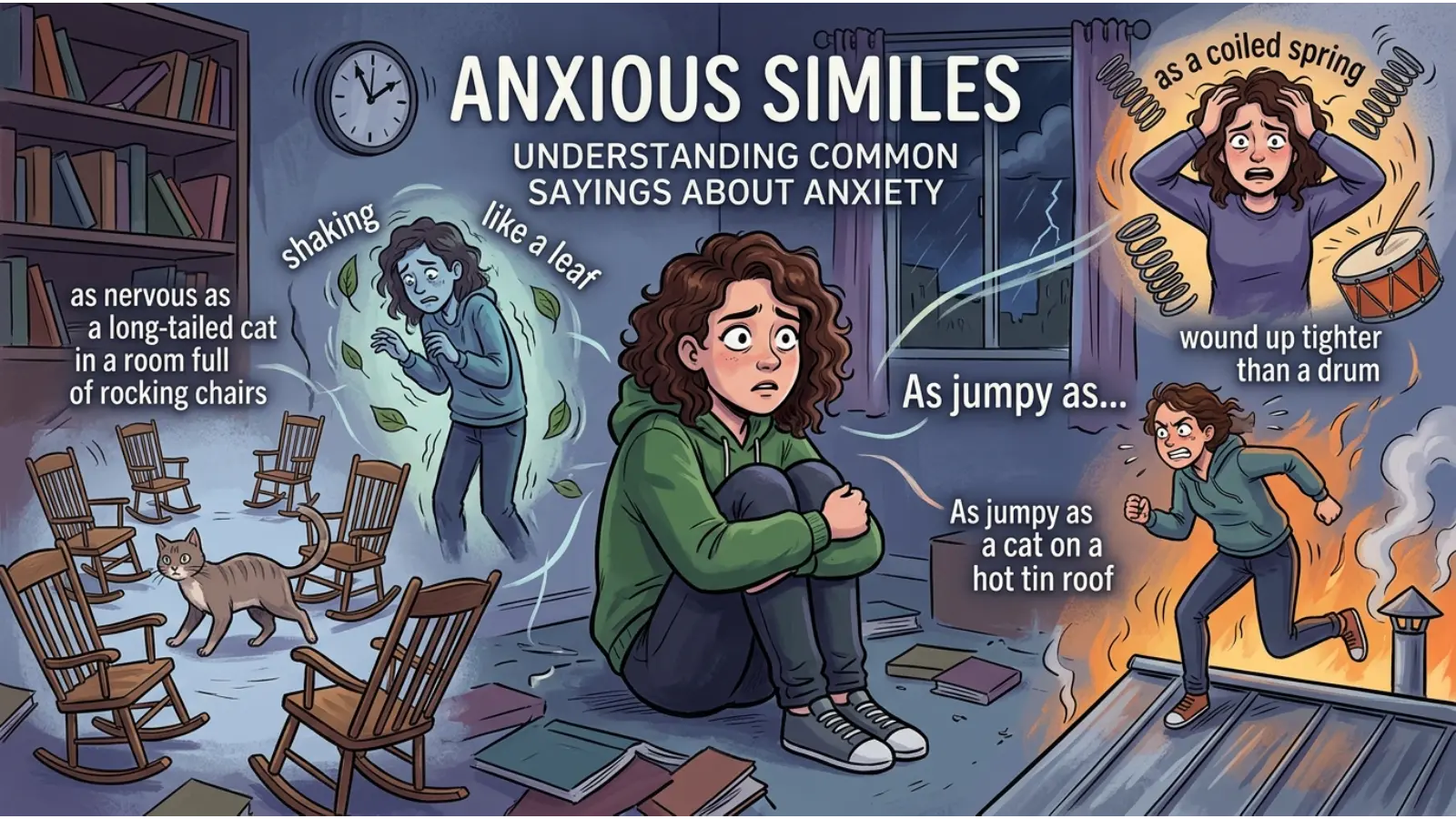
Anxious Similes can be difficult to describe because it is often invisible. A character may look calm while their thoughts race, their attention narrows, or every small uncertainty feels unusually important. This is where a strong simile can help.
A simile compares two different things using words such as like or as. Instead of simply writing, “She was anxious,” you can create a clearer picture: “Her thoughts moved like birds startled from a quiet roof.”
The best anxious similes do more than say that someone is nervous. They show what anxiety feels like, whether it is restless, quiet, sudden, overwhelming, or barely noticeable. Writers can use them in stories, poems, personal writing, dialogue, essays, and character descriptions.
Below are original comparisons designed to give you ideas while also showing how imagery can make emotional writing stronger.
What Are Anxious Similes?
An anxious simile compares anxiety or nervousness with something familiar and usually uses like or as.
For example:
“His thoughts scattered like papers caught in a sudden breeze.”
The comparison works because scattered papers suggest disorder and difficulty concentrating. The reader does not just learn that the character is anxious; they get an image of what that anxiety is doing to the character’s thoughts.
An anxious simile can describe:
- racing thoughts
- nervous anticipation
- uncertainty
- restlessness
- fear of making a mistake
- social nervousness
- tension before an important event
- difficulty concentrating
- quiet uneasiness
Quick Answer: What Are Some Good Anxious Similes?
Some original examples include:
- Her thoughts buzzed like a room full of trapped flies.
- His confidence shook like a loose window in a storm.
- The uncertainty followed her like a shadow that had learned her name.
- His mind jumped like a radio searching for a clear station.
- Her nerves fluttered like curtains beneath an open window.
- The waiting stretched like a hallway with no visible door.
- His worries gathered like clouds over a small town.
- Her attention slipped like ice beneath an unsteady foot.
Each comparison highlights a different shade of anxiety.
30 Original Anxious Similes for Writing
1. Her thoughts buzzed like a room full of trapped flies.
This simile presents anxiety as persistent mental noise. The buzzing suggests thoughts that are difficult to silence.
Example:
Her thoughts buzzed like a room full of trapped flies while she waited for the phone to ring.
Best for: stories, character descriptions, and reflective writing.
Writing tip: Use an image associated with repetitive movement or sound when you want anxiety to feel mentally exhausting.
2. His confidence shook like a loose window in a storm.
A loose window suggests instability. The character may appear confident on the surface, but uncertainty is making that confidence tremble.
Example:
He smiled at the audience, but his confidence shook like a loose window in a storm.
This works especially well for public speaking, competitions, interviews, or performances.
3. Her nerves fluttered like curtains beneath an open window.
Unlike darker comparisons, this one describes nervousness through delicate movement.
Example:
Her nerves fluttered like curtains beneath an open window as she approached the microphone.
The image is useful when anxiety is noticeable but not overwhelming.
4. His mind jumped like a radio searching for a clear station.
This comparison captures rapidly changing thoughts.
Example:
His mind jumped like a radio searching for a clear station, moving from one possible problem to another.
The simile is especially useful when describing distraction and overthinking.
5. The uncertainty followed her like a shadow that had learned her name.
This gives uncertainty a persistent presence without simply calling it frightening.
Example:
The uncertainty followed her like a shadow that had learned her name.
The unusual detail makes the comparison more memorable.
6. His worries gathered like clouds over a small town.
The image suggests anxiety gradually building rather than appearing all at once.
Example:
His worries gathered like clouds over a small town, darkening what had started as an ordinary afternoon.
This is effective for gradual tension in storytelling.
7. The waiting stretched like a hallway with no visible door.
This focuses on the experience of anticipation.
Example:
The waiting stretched like a hallway with no visible door.
It works particularly well when a character does not know when uncertainty will end.
8. Her attention slipped like ice beneath an unsteady foot.
This simile describes difficulty maintaining concentration.
Example:
Her attention slipped like ice beneath an unsteady foot whenever she tried to read the instructions.
The physical image makes an invisible mental experience easier to imagine.
9. His questions multiplied like ripples after a stone hits water.
One worry can create another, then another.
Example:
His questions multiplied like ripples after a stone hits water.
This is a useful comparison for overthinking.
10. Her patience trembled like a candle flame near an open door.
The flame suggests something fragile and easily disturbed.
Example:
Her patience trembled like a candle flame near an open door.
Use it when anxiety is making someone increasingly restless.
11. His thoughts tangled like headphones left in a pocket.
This is a familiar modern image for confused thinking.
Example:
By midnight, his thoughts were tangled like headphones left in a pocket.
The comparison gives the reader an immediate sense of mental frustration.
12. Her uncertainty hovered like a question mark above the room.
This turns uncertainty into something almost visible.
Example:
Her uncertainty hovered like a question mark above the room while everyone waited for an answer.
It fits scenes involving silence, decisions, or unanswered questions.
13. His heartbeat seemed like a drummer practicing behind a thin wall.
The comparison suggests an awareness of physical nervousness without relying on a cliché.
Example:
His heartbeat seemed like a drummer practicing behind a thin wall as the announcement approached.
The image connects bodily sensation with sound.
14. Her thoughts darted like sparrows startled from a garden.
The sudden movement of sparrows represents scattered thoughts.
Example:
Her thoughts darted like sparrows startled from a garden when she realized she had forgotten the appointment.
This is useful for sudden anxiety.
15. His words came out like coins shaken from a nearly empty pocket.
This simile suggests hesitancy and difficulty speaking.
Example:
His words came out like coins shaken from a nearly empty pocket.
It can work well in dialogue scenes where a character struggles to express themselves.
16. The tension sat between them like an unopened letter.
An unopened letter contains information, but its contents remain unknown.
Example:
The tension sat between them like an unopened letter neither wanted to read.
This works particularly well in relationship or conversation scenes.
17. Her confidence felt like a bridge carrying more weight than it was built for.
The image suggests pressure placed on someone who is trying to remain composed.
Example:
Her confidence felt like a bridge carrying more weight than it was built for.
Use it when expectations are creating pressure.
18. His thoughts circled like moths around a porch light.
The repeated movement suggests returning to the same concern.
Example:
His thoughts circled like moths around a porch light, always returning to the same possibility.
This is especially useful for repetitive worry.
19. Her calmness was as thin as paper in the rain.
This describes a fragile appearance of calm.
Example:
Her calmness was as thin as paper in the rain, though she kept telling everyone she was fine.
The comparison works because wet paper quickly loses its strength.
20. His worry crept through the afternoon like a draft beneath a door.
This represents anxiety that arrives gradually.
Example:
His worry crept through the afternoon like a draft beneath a door.
It is a strong choice when the emotion starts quietly.
21. Her thoughts clicked like a lock being tested again and again.
The repeated clicking suggests checking and rechecking.
Example:
Her thoughts clicked like a lock being tested again and again.
This can describe a character repeatedly questioning whether something is safe, correct, or finished.
22. His attention bounced like a ball in an empty stairwell.
The echoing movement creates a sense of uncontrolled distraction.
Example:
His attention bounced like a ball in an empty stairwell while he tried to finish the assignment.
This is a good option for informal or student-focused writing.
23. The possibility hung over him like a kite caught in power lines.
This image suggests something suspended and difficult to resolve.
Example:
The possibility hung over him like a kite caught in power lines.
It works best when a particular possibility keeps occupying a character’s thoughts.
24. Her questions lined up like strangers waiting outside a locked office.
This comparison emphasizes uncertainty and lack of answers.
Example:
Her questions lined up like strangers waiting outside a locked office.
It is useful when a character wants information but cannot get it yet.
25. His courage flickered like a porch light with a loose connection.
The flickering light represents confidence that repeatedly appears and disappears.
Example:
His courage flickered like a porch light with a loose connection before he stepped onto the stage.
This gives nervousness a visual rhythm.
26. Her worry moved through her like static through an old speaker.
Static is irritating, unpredictable, and difficult to ignore.
Example:
Her worry moved through her like static through an old speaker.
The simile works especially well for internal uneasiness.
27. His thoughts crowded together like passengers at a closing train door.
The comparison creates pressure and urgency.
Example:
His thoughts crowded together like passengers at a closing train door.
This is useful when many concerns arrive simultaneously.
28. The silence felt like a room holding its breath.
This describes anxious anticipation rather than anxiety itself.
Example:
The silence felt like a room holding its breath as the results were revealed.
It is particularly effective in suspenseful scenes.
29. Her decision wavered like a compass near a magnet.
A compass normally points toward direction, but interference can make it unreliable.
Example:
Her decision wavered like a compass near a magnet.
This is a strong comparison for uncertainty about what choice to make.
30. His worry waited at the edge of every thought like a bird on a telephone wire.
The bird is present but not necessarily moving, creating a feeling of constant watchfulness.
Example:
His worry waited at the edge of every thought like a bird on a telephone wire.
This works well when anxiety is persistent but relatively quiet.
How to Choose the Right Anxious Simile
Not every anxious feeling should sound frantic. Anxiety can be loud, quiet, physical, mental, sudden, or gradual.
Start by deciding what kind of anxiety you want the reader to experience.
For racing thoughts
Choose images involving movement:
- scattered birds
- spinning objects
- radio signals
- tangled wires
- rushing water
For example:
Her thoughts moved like birds startled from a rooftop.
For uncertainty
Use images involving unanswered questions, unfinished journeys, or unstable direction.
His uncertainty was like a road disappearing into fog.
For nervous anticipation
Use waiting-related imagery:
The minutes stood like passengers waiting for a delayed train.
For fragile confidence
Choose objects that can easily shake, bend, flicker, or break.
Her confidence flickered like a porch light in heavy wind.
The goal is not to find the most dramatic comparison. The goal is to find the comparison that matches the exact emotion.
Why These Similes Work
A good anxious simile creates a connection between an abstract emotion and a concrete experience.
Anxiety itself cannot be photographed. But a shaking window can. A crowded hallway can. A flickering light can. A tangled pair of headphones can.
That concrete image gives the reader something to visualize.
There is another advantage: different comparisons create different emotional effects.
Compare these:
His thoughts raced like birds startled from a garden.
and:
His worry crept through the afternoon like a draft beneath a door.
The first feels sudden and energetic. The second feels quiet and gradual.
That distinction matters in creative writing.
How to Make Anxious Similes More Vivid
Give the comparison a specific detail
Weak:
She was anxious like an animal.
More vivid:
Her thoughts scattered like sparrows startled from a quiet garden.
The second version gives the reader movement, setting, and sound.
Match the image to the character
A teenager, detective, athlete, scientist, and poet may not describe anxiety in the same way.
A musician might notice rhythm.
A gardener might notice weather or plants.
A mechanic might notice machines.
A traveler might notice roads, stations, or maps.
The strongest similes often feel as though they belong to the person experiencing the emotion.
Use one strong image instead of several weak ones
A sentence does not become better simply because it contains more comparisons.
For example, stacking several unrelated images can make the prose confusing:
His mind was like a storm, a broken clock, a racing train, and a tangled rope.
Choose one image that best represents the intended feeling.
Anxious Similes in Different Types of Writing
In fiction
Similes can reveal a character’s inner state without directly explaining it.
Instead of:
Maya was nervous about entering the room.
Try:
Maya’s confidence shook like a loose window in a storm as her hand reached for the door.
The comparison works with the physical action.
In poetry
Poetry gives you more freedom to compress emotion into an image.
Worry waited
like a bird on a wire,
watching every thought.
The comparison becomes part of the poem’s atmosphere.
In dialogue
Characters do not always speak in polished literary language. A natural conversational simile should fit the speaker.
“My brain feels like a radio stuck between stations.”
That sounds more conversational than an elaborate poetic comparison.
In essays
Use similes carefully. A vivid comparison can clarify an idea, but academic writing usually benefits from precision over decoration.
For example:
Uncertainty can feel like standing at a crossroads without a map.
This can make an abstract discussion more accessible without overwhelming the point.
How to Create Your Own Anxious Similes
You do not need to memorize lists of comparisons. You can create better ones yourself.
Step 1: Name the exact feeling
Do not stop at “anxiety.”
Ask:
- Is the character restless?
- Are they waiting?
- Are they overthinking?
- Are they afraid of making a mistake?
- Are they uncertain?
- Are they trying to appear calm?
Step 2: Find a physical experience
Think of something that behaves in a similar way.
For example:
Overthinking → tangled headphones
Waiting → a delayed train
Fragile confidence → flickering light
Sudden nervousness → startled birds
Step 3: Add a surprising detail
Instead of:
Her thoughts were like birds.
Try:
Her thoughts scattered like sparrows startled from a quiet garden.
The extra detail creates a scene.
Step 4: Test the emotional effect
Ask yourself:
Does this comparison make the emotion clearer?
If removing the simile changes nothing, it may not be doing enough work.
Step 5: Read it aloud
A good simile should fit naturally into the sentence. If the comparison sounds forced, simplify it.
Creative Exercises for Writing Anxious Similes
Exercise 1: Complete the comparison
Finish these sentences with your own imagery:
- My thoughts moved like ______.
- Her nervousness sounded like ______.
- His uncertainty felt like ______.
- The waiting stretched like ______.
- Their silence was like ______.
Try to avoid the first comparison that comes to mind.
Exercise 2: Change the intensity
Write three versions of the same emotion:
Mild anxiety:
Her worry was like a small draft beneath the door.
Moderate anxiety:
Create an image involving stronger movement.
Intense anxiety:
Create an image involving rapid, overwhelming change.
This teaches you how imagery can control emotional intensity.
Exercise 3: Write from character perspective
Choose a character with a specific interest.
Then create an anxious simile using something familiar to that character.
For example, a musician might compare nervousness to an instrument that will not stay in tune.
The result can feel more personal than a generic comparison.
Anxious Similes vs. Metaphors
A simile makes a comparison using words such as like or as.
His thoughts were like tangled wires.
A metaphor makes the comparison directly.
His thoughts were tangled wires.
Both can create strong imagery, but the grammatical structure differs.
Similes are often useful when you want to make an unfamiliar feeling easier to visualize. Metaphors can feel more direct and forceful.
Simile, Imagery, and Hyperbole: What’s the Difference?
These devices can overlap, but they perform different jobs.
Simile: compares two things.
Her thoughts fluttered like loose pages.
Imagery: uses descriptive language to create sensory experience.
Loose pages scraped across the pavement in the wind.
Hyperbole: deliberately exaggerates.
He had a million questions.
When describing anxiety, a simile can work especially well because it connects an invisible emotion to something readers can see, hear, or imagine.
Common Mistakes When Writing Anxious Similes
Relying on clichés
Expressions such as “nervous as a cat” may communicate the basic idea, but familiar comparisons often lack freshness.
Try asking:
What would this particular character notice?
That question can lead you toward more original imagery.
Mixing unrelated images
Avoid jumping between weather, machines, animals, oceans, and buildings in the same sentence unless there is a deliberate reason.
A consistent image usually feels cleaner.
Making the comparison too complicated
A simile should help the reader, not make them stop to decode it.
If the comparison needs a paragraph of explanation, consider simplifying it.
Using a simile that does not match the emotion
A comparison involving gentle movement may not communicate panic or intense tension.
Always check the emotional temperature of the image.
Explaining the simile too much
If the image is clear, let it breathe.
Instead of explaining every possible meaning, trust the reader to make the connection.
Frequently Asked Questions
What is a good simile for being anxious?
A good anxious simile compares nervousness to a concrete experience, such as scattered birds, a flickering light, tangled wires, or a radio searching for a signal. The best choice depends on the type of anxiety you want to show.
How do you describe anxiety in a creative way?
Use sensory details and comparisons that show what anxiety does to thoughts, attention, behavior, or the surrounding atmosphere. For example, you might compare uncertainty to a hallway with no visible door.
What are similes for nervousness?
Examples include comparisons involving fluttering curtains, flickering lights, unstable bridges, startled birds, and radio signals. Choose an image that matches the specific kind of nervousness.
How can I avoid cliché similes?
Start with the character rather than a list of familiar expressions. Think about the objects, places, sounds, or experiences that person knows well, then build a comparison around one of them.
Can anxious similes be used in poetry?
Yes. Similes are particularly useful in poetry because they can turn an abstract emotion into a compact visual or sensory image.
Are anxious similes useful in storytelling?
Yes. They can reveal a character’s internal state while keeping the scene active. A well-placed comparison can show nervousness without repeatedly stating that a character is anxious.
What is the difference between an anxious simile and an anxious metaphor?
An anxious simile usually uses like or as to make the comparison, while a metaphor makes the comparison directly. Both can communicate emotion through imagery.
Conclusion
The strongest anxious similes do not simply replace the word anxious. They reveal how anxiety behaves. It might buzz, flicker, circle, tremble, gather, crowd, hover, or creep. Finding that behavior gives you a path toward stronger imagery. When creating your own comparison, start with the exact emotion, choose something physical that behaves similarly, and add one specific detail. Then read the sentence aloud and remove anything that feels forced. A fresh simile does not need to be complicated. Sometimes the simplest unexpected image gives a reader the clearest understanding of what a character is feeling.
I am Helena Frost, a writer captivated by the beauty of language and the art of comparison. Through my words, I explore the world by turning ordinary moments into vivid similes and reflections. I enjoy crafting phrases that spark imagination, evoke emotion, and linger in the mind. My writing celebrates the subtle connections between people, nature, and the stories we live. For me, every sentence is an opportunity to reveal the extraordinary in the everyday.