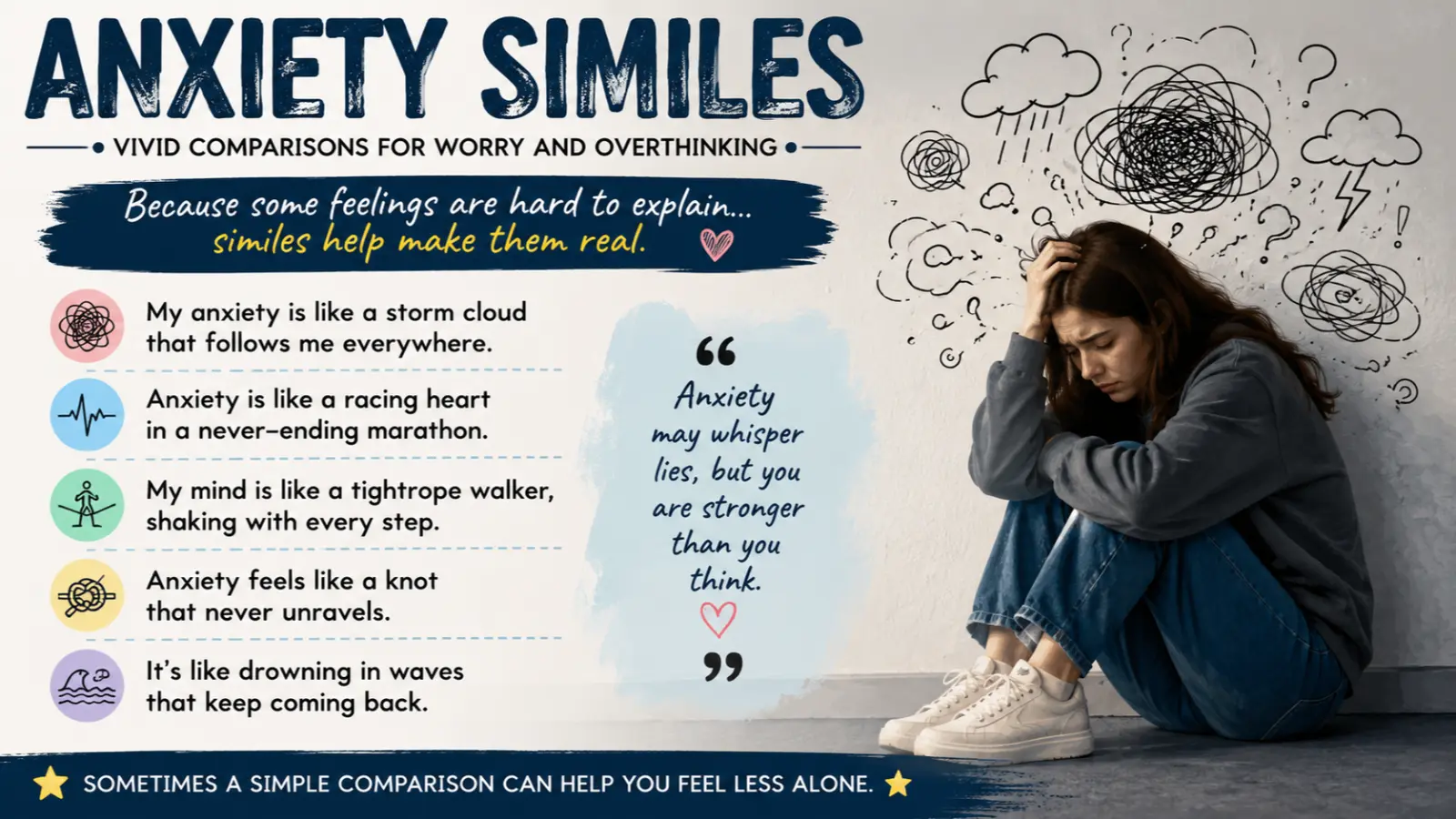
Anxiety Similes can be difficult to describe because it is often invisible. A person may look completely calm while their thoughts feel crowded, restless, or uncertain. A well-chosen simile gives that hidden feeling a concrete image readers can understand.
A simile compares two different things using words such as like or as. For example, saying “Her thoughts raced like birds startled from a tree” turns an abstract feeling into something readers can picture.
These anxiety similes can help with creative writing, poetry, storytelling, journaling, school assignments, and everyday descriptions. The goal is not simply to collect comparisons, but to understand why they work and how to create your own.
What Is an Anxiety Simile?
An anxiety simile is a comparison that uses familiar imagery to communicate feelings such as worry, nervousness, uncertainty, tension, or uneasiness.
Instead of writing:
He felt anxious.
You might write:
His thoughts fluttered like loose papers caught in a sudden wind.
The second version gives the reader movement and imagery. It suggests that the character cannot easily control or organize what is happening in their mind.
Quick Answer: What Are Good Similes for Anxiety?
Good anxiety similes compare anxious feelings with restless, uncertain, trapped, noisy, or unpredictable experiences. Examples include:
- His thoughts scattered like leaves in a sudden gust.
- Her nerves hummed like a phone vibrating on a wooden table.
- Worry followed him like a shadow that arrived before sunset.
- My mind spun like a compass near a magnet.
- His uncertainty hung like fog over an unfamiliar road.
The strongest comparison depends on the kind of anxiety you want to communicate.
30 Original Anxiety Similes
1. “Her thoughts scattered like leaves in a sudden gust.”
Meaning: Her thoughts became difficult to organize.
Emotional effect: This creates a feeling of mental disorder and loss of control.
Example:
She tried to focus on the conversation, but her thoughts scattered like leaves in a sudden gust.
Writing purpose: Use it when a character is overwhelmed by many thoughts at once.
Best context: Fiction, personal writing, and reflective poetry.
Writing tip: Notice how the image contains movement. Active imagery often makes an emotion feel more immediate.
2. “His nerves hummed like a phone vibrating on a wooden table.”
Meaning: He felt restless and unable to relax.
Emotional effect: The comparison creates a subtle but persistent sense of tension.
Example:
Before the announcement, his nerves hummed like a phone vibrating on a wooden table.
Best context: Contemporary fiction and everyday storytelling.
Why it works: The reader can almost hear and feel the repeated vibration.
3. “Worry followed her like a shadow that arrived before sunset.”
Meaning: Her worry seemed to appear even before anything bad happened.
Emotional effect: It suggests anticipation and persistent uneasiness.
Example:
Even on quiet mornings, worry followed her like a shadow that arrived before sunset.
Writing tip: An unusual detail can make a familiar idea feel fresh.
4. “His mind spun like a compass near a magnet.”
Meaning: He could not settle on a clear direction or decision.
Emotional effect: This creates confusion and uncertainty.
Example:
With three choices in front of him, his mind spun like a compass near a magnet.
Best context: Stories about difficult decisions.
Adaptation: Replace compass with another object that loses reliability when disturbed.
5. “Her uncertainty hung like fog over an unfamiliar road.”
Meaning: She could not clearly see what lay ahead.
Emotional effect: The image creates mystery, hesitation, and vulnerability.
Example:
The future hung before her like fog over an unfamiliar road.
Writing purpose: Particularly useful when anxiety comes from uncertainty about the future.
6. “His questions multiplied like raindrops racing down a window.”
Meaning: One concern quickly led to another.
Emotional effect: The comparison suggests a steady flow of thoughts.
Example:
As the deadline approached, his questions multiplied like raindrops racing down a window.
Writing tip: Use a visual process rather than simply naming the emotion.
7. “Her confidence trembled like a candle near an open window.”
Meaning: Her confidence felt fragile.
Emotional effect: The reader senses that a small disturbance could make her lose confidence.
Example:
Before stepping onto the stage, her confidence trembled like a candle near an open window.
Best context: Performance, public speaking, competition, or social situations.
8. “The unanswered message sat in his mind like a pebble in a shoe.”
Meaning: The unanswered message remained a small but persistent source of discomfort.
Emotional effect: It communicates irritation without making the anxiety sound overwhelming.
Example:
The unanswered message sat in his mind like a pebble in a shoe throughout the afternoon.
Writing purpose: Good for mild anxiety or everyday worry.
9. “Her thoughts buzzed like a room full of fluorescent lights.”
Meaning: Her mind felt noisy and difficult to quiet.
Emotional effect: The image creates mental fatigue.
Best context: Describing prolonged overthinking.
Writing tip: Sensory details—sound, light, texture, temperature—can make abstract emotions easier to imagine.
10. “His patience stretched like a rubber band pulled too far.”
Meaning: He was approaching the limit of what he could comfortably handle.
Emotional effect: It creates tension and anticipation.
Example:
Waiting for the result, his patience stretched like a rubber band pulled too far.
Best context: Waiting scenes and moments of suspense.
11. “Her stomach felt like a washing machine with one shoe inside.”
Meaning: She felt physically unsettled and emotionally restless.
Emotional effect: This gives anxiety a slightly humorous, energetic quality.
Best context: Informal storytelling and humorous writing.
Writing tip: Not every anxiety simile needs to be dark. A playful comparison can reveal personality.
12. “His worries crowded together like people rushing through a narrow doorway.”
Meaning: Too many worries seemed to arrive at once.
Emotional effect: The image communicates pressure and mental overcrowding.
Example:
At bedtime, his worries crowded together like people rushing through a narrow doorway.
Best context: Fiction and reflective writing.
13. “Her calm felt as fragile as thin ice beneath a winter boot.”
Meaning: She appeared calm, but that calm could disappear quickly.
Emotional effect: It creates suspense and vulnerability.
Writing purpose: Useful when showing the difference between outward appearance and inner emotion.
14. “His thoughts darted like sparrows startled from a fence.”
Meaning: His thoughts moved rapidly from one concern to another.
Emotional effect: The reader gets a quick, restless image.
Best context: Fast-paced scenes and internal monologue.
Why it works: The verb darted adds energy to the comparison.
15. “The possibility of failure hovered like a balloon he could not release.”
Meaning: The fear of failure remained present and difficult to escape.
Emotional effect: It suggests emotional pressure without describing it as constant panic.
Example:
During the interview, the possibility of failure hovered like a balloon he could not release.
Writing tip: Objects that should normally be easy to control can become powerful symbols of emotional difficulty.
16. “Her concentration flickered like a hallway light with a loose connection.”
Meaning: She could focus briefly but kept losing concentration.
Emotional effect: It creates instability.
Best context: Studying, working, writing, or trying to complete an important task.
17. “His doubts gathered like clouds at the edge of the afternoon.”
Meaning: Doubts gradually became more noticeable.
Emotional effect: The comparison creates a sense that tension is building.
Writing purpose: Excellent for gradual emotional development.
Adaptation: You can change the weather image depending on the mood of the scene.
18. “Her heartbeat felt like a drummer practicing behind a thin wall.”
Meaning: She was very aware of her heartbeat because she felt nervous.
Emotional effect: The comparison creates sound and physical tension.
Best context: Moments immediately before an important event.
19. “His uncertainty was like standing in a hallway with every door closed.”
Meaning: He could not see which choice or direction was right.
Emotional effect: It creates a sense of limitation and indecision.
Best context: Character development and difficult choices.
Writing tip: Spatial imagery is useful when describing emotional states because it gives the reader a physical environment to imagine.
20. “Her worries flickered like too many tabs open on a computer.”
Meaning: She was thinking about many things at once.
Emotional effect: This is a modern, relatable image of mental overload.
Best context: Contemporary writing and casual conversation.
Example:
By midnight, her worries flickered like too many tabs open on a computer.
21. “His confidence shrank like a drawing erased one corner at a time.”
Meaning: His confidence gradually disappeared.
Emotional effect: It communicates a slow emotional change.
Writing purpose: Use this when anxiety develops gradually rather than suddenly.
22. “Her fear waited like a question mark at the end of every thought.”
Meaning: Almost every thought seemed to lead to uncertainty.
Emotional effect: It emphasizes doubt.
Best context: Poetry and introspective prose.
Why it works: The punctuation mark becomes a visual representation of uncertainty.
23. “His mind was as restless as a kite tugging against its string.”
Meaning: He wanted mental freedom but could not settle down.
Emotional effect: The image combines movement with restraint.
Best context: Creative writing and poetry.
24. “The deadline loomed like a train heard before it appeared.”
Meaning: An approaching deadline created growing tension.
Emotional effect: It creates anticipation without directly stating that the character is anxious.
Writing tip: Sometimes the strongest anxiety imagery focuses on the thing causing the worry rather than the feeling itself.
25. “Her nervousness crept like cold air beneath a closed door.”
Meaning: Anxiety slowly entered her thoughts despite her attempt to remain calm.
Emotional effect: The image feels quiet and gradual.
Best context: Subtle emotional scenes.
26. “His thoughts tangled like earphones left in a pocket.”
Meaning: His ideas became confusing and difficult to separate.
Emotional effect: This creates a familiar image of frustration.
Example:
The more he tried to solve the problem, the more his thoughts tangled like earphones left in a pocket.
Best context: Everyday writing and school assignments.
27. “Her worry hovered like a moth around an unlit lamp.”
Meaning: Her attention kept returning to something even though she could not resolve it.
Emotional effect: This creates a quiet, slightly mysterious atmosphere.
Best context: Literary fiction and poetry.
28. “His anticipation buzzed like an elevator stuck between floors.”
Meaning: He felt suspended between waiting and knowing.
Emotional effect: The comparison creates tension and uncertainty.
Best context: Waiting for news, results, decisions, or important conversations.
29. “Her thoughts pressed together like books packed too tightly on a shelf.”
Meaning: She had too many thoughts competing for attention.
Emotional effect: The image suggests pressure and mental crowding.
Writing purpose: Useful when anxiety feels heavy rather than energetic.
30. “His uneasiness lingered like the echo of a door closing somewhere upstairs.”
Meaning: The feeling remained even after the immediate event had passed.
Emotional effect: It creates a quiet, lingering mood.
Best context: Reflective prose, mystery, and atmospheric storytelling.
How to Choose the Right Anxiety Simile
Not every anxious feeling has the same shape. Before choosing a comparison, ask what the emotion actually feels like.
For racing thoughts
Use images involving movement:
- birds taking flight
- scattered papers
- spinning objects
- rushing water
- flickering lights
These comparisons make the reader feel speed and disorder.
For uncertainty
Choose images involving limited visibility or direction:
- fog
- closed doors
- unfamiliar roads
- unreliable maps
- changing signs
These work particularly well when a character does not know what will happen next.
For physical nervousness
Use sensory comparisons:
- vibration
- buzzing
- trembling
- pressure
- unstable objects
These help readers connect an emotional state to a physical sensation.
For lingering worry
Choose images that remain present:
- shadows
- echoes
- background noise
- distant clouds
- objects that cannot be ignored
This makes the emotion feel persistent without repeatedly using the word anxiety.
How to Make Anxiety Similes More Vivid
A strong simile does more than replace one adjective with another. It gives the reader a small experience.
Compare:
She was very nervous.
with:
Her concentration flickered like a hallway light with a loose connection.
The second sentence gives the reader something visual. It also suggests that her focus is unstable.
A useful formula is:
emotion + specific action + unexpected but believable image
For example:
His doubts gathered like clouds at the edge of the afternoon.
The comparison works because gathered suggests gradual change, while the clouds suggest something approaching.
Avoid Clichés When Writing About Anxiety
Some comparisons have been used so often that they may lose their impact. Familiar expressions are not automatically wrong, but fresh imagery often makes writing more memorable.
Instead of automatically reaching for the first comparison that comes to mind, ask:
What does this feeling actually resemble in this particular scene?
If the character is waiting for an important email, technology may provide a natural image. If the character is walking through an unfamiliar place, fog or a confusing road might fit better.
The setting should influence the simile.
How Professional Writers Build Better Comparisons
Strong imagery usually comes from observation.
Imagine a character waiting outside an interview room. Instead of simply deciding that they are “very anxious,” notice what happens around them:
- a clock keeps ticking
- a pen moves between their fingers
- a door opens and closes
- footsteps approach and disappear
- their prepared answers suddenly seem difficult to remember
Those details can inspire stronger comparisons.
For example:
The ticking clock sounded like a tiny metronome measuring the space between confidence and doubt.
The simile grows from the scene rather than being added randomly.
Anxiety Similes vs. Metaphors
A simile makes a comparison using words such as like or as.
Her thoughts scattered like leaves in a gust.
A metaphor makes the comparison directly.
Her thoughts were scattered leaves.
Both can create imagery. The difference is mainly in how directly the comparison is presented.
Similes can be especially useful when you want to show a particular quality of an emotion without completely identifying the emotion with another object.
Related Literary Devices
Imagery
Imagery uses descriptive language that helps readers experience a scene through the senses. Anxiety similes often rely heavily on visual, auditory, or physical imagery.
Personification
Personification gives human qualities to nonhuman things.
The deadline waited impatiently at the edge of his thoughts.
This can work alongside a simile to make an abstract emotion feel active.
Hyperbole
Hyperbole deliberately exaggerates something for effect. It can express how intense an emotion feels, but it should be used carefully.
Symbolism
A repeated object or image can represent a larger idea. Fog, locked doors, or unfinished paths can symbolize uncertainty in a story.
Alliteration
Alliteration repeats beginning consonant sounds. It can add rhythm to emotional writing, especially poetry.
How to Create Your Own Anxiety Similes
You do not need a huge vocabulary to create an original comparison. Start with the feeling and work outward.
Step 1: Name the exact feeling
Is it nervousness, uncertainty, anticipation, embarrassment, pressure, or overthinking?
Specific emotions produce more precise imagery.
Step 2: Notice what the body or mind is doing
Maybe your character is:
- tapping a foot
- rereading a message
- forgetting a prepared sentence
- watching the clock
- changing their mind repeatedly
Step 3: Find an object that behaves similarly
If thoughts keep returning, think of something that repeatedly comes back.
A concentration keeps disappearing, find something that flickers or fades.
If worry builds slowly, consider something that gathers.
Step 4: Add “like” or “as”
Turn the observation into a comparison.
Her attention disappeared like a radio signal moving out of range.
Step 5: Test the image
Ask three questions:
- Can the reader picture it?
- Does it match the emotion?
- Does it add something that the plain sentence does not?
If the answer is yes, the simile is probably doing useful work.
A Quick Exercise for Writers
Take this plain sentence:
I was nervous before the presentation.
Now create three versions.
Visual:
My confidence flickered like a hallway light.
Auditory:
My thoughts buzzed like a crowded waiting room.
Physical:
My nerves pulled tight like a knot in a shoelace.
The exercise teaches an important lesson: the same emotion can produce very different imagery.
Common Mistakes When Writing Anxiety Similes
Using the same comparison repeatedly
If every anxious character has a racing heart or stormy thoughts, your writing may begin to sound predictable.
Look for details unique to the character and scene.
Mixing unrelated images
Avoid jumping from a storm to a machine to a forest in one sentence unless the unusual combination is intentional.
A focused image is usually easier to understand.
Forcing a simile into every sentence
Not every line needs figurative language. Too many comparisons can make prose feel crowded.
Use a simile when it adds clarity, emotion, rhythm, or atmosphere.
Making the comparison too complicated
A simile should usually be understandable without an explanation paragraph.
If the reader has to solve the comparison before understanding the emotion, simplify it.
Confusing a simile with a metaphor
Remember the basic distinction:
Simile: “His thoughts moved like scattered birds.”
Metaphor: “His thoughts were scattered birds.”
Both are useful, but they create slightly different effects.
Describing anxiety without showing its source
Sometimes the strongest writing shows what caused the feeling.
Instead of:
She was anxious.
Try:
The unopened email sat on her screen, bright and silent.
The scene itself can communicate the emotion.
Frequently Asked Questions About Anxiety Similes
What is a good simile for anxiety?
A good anxiety simile clearly connects the emotion to a familiar image. For example, “Her thoughts scattered like leaves in a sudden gust” works well for mental restlessness.
What is a simile for feeling nervous?
You could write, “His nerves hummed like a phone vibrating on a wooden table.” The comparison suggests a persistent, uncomfortable sense of tension.
How do you describe anxiety in creative writing?
Use specific sensory details, actions, thoughts, and comparisons rather than repeatedly naming the emotion. Show how the character behaves and what they notice.
What is a simile for overthinking?
“Her worries flickered like too many tabs open on a computer” is useful for describing a mind occupied by several competing thoughts.
Can anxiety similes be funny?
Yes. Humor can reveal character and make an anxious situation feel more relatable. For example, comparing an unsettled stomach to a washing machine with one shoe inside creates a playful effect.
Are similes useful in poetry?
Absolutely. Similes can compress a complicated emotion into a memorable image while also adding rhythm and atmosphere.
What is the difference between a simile and a metaphor?
A simile usually uses like or as to make a comparison, while a metaphor makes the comparison directly.
How can I make my anxiety similes original?
Start with the specific situation instead of searching for a generic comparison. Observe what the character sees, hears, touches, remembers, or fears, then compare that experience with something that behaves similarly.
Conclusion
The best anxiety similes do not simply make writing sound more poetic. They help readers feel and visualize an emotion that cannot be seen directly. A nervous character might have thoughts that scatter, confidence that flickers, doubts that gather, or uncertainty that hangs like fog. Each comparison gives anxiety a different shape, and that choice can reveal something about the character and the scene. When creating your own similes, start with observation. Identify the exact emotion, notice how it behaves, and then search for an image with the same quality. Keep the comparison clear, specific, and connected to the situation. A fresh simile does not need complicated language. Sometimes the most memorable image is an ordinary object behaving in an unexpectedly perfect way.
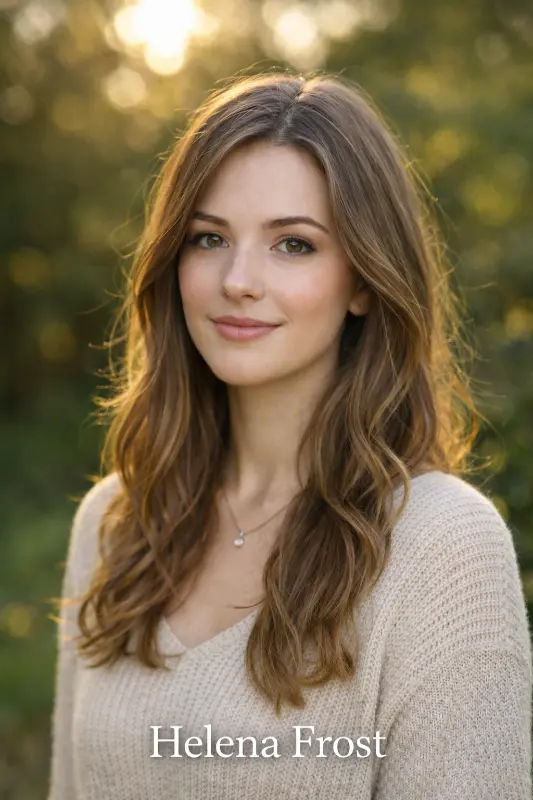
I am Helena Frost, a writer captivated by the beauty of language and the art of comparison. Through my words, I explore the world by turning ordinary moments into vivid similes and reflections. I enjoy crafting phrases that spark imagination, evoke emotion, and linger in the mind. My writing celebrates the subtle connections between people, nature, and the stories we live. For me, every sentence is an opportunity to reveal the extraordinary in the everyday.