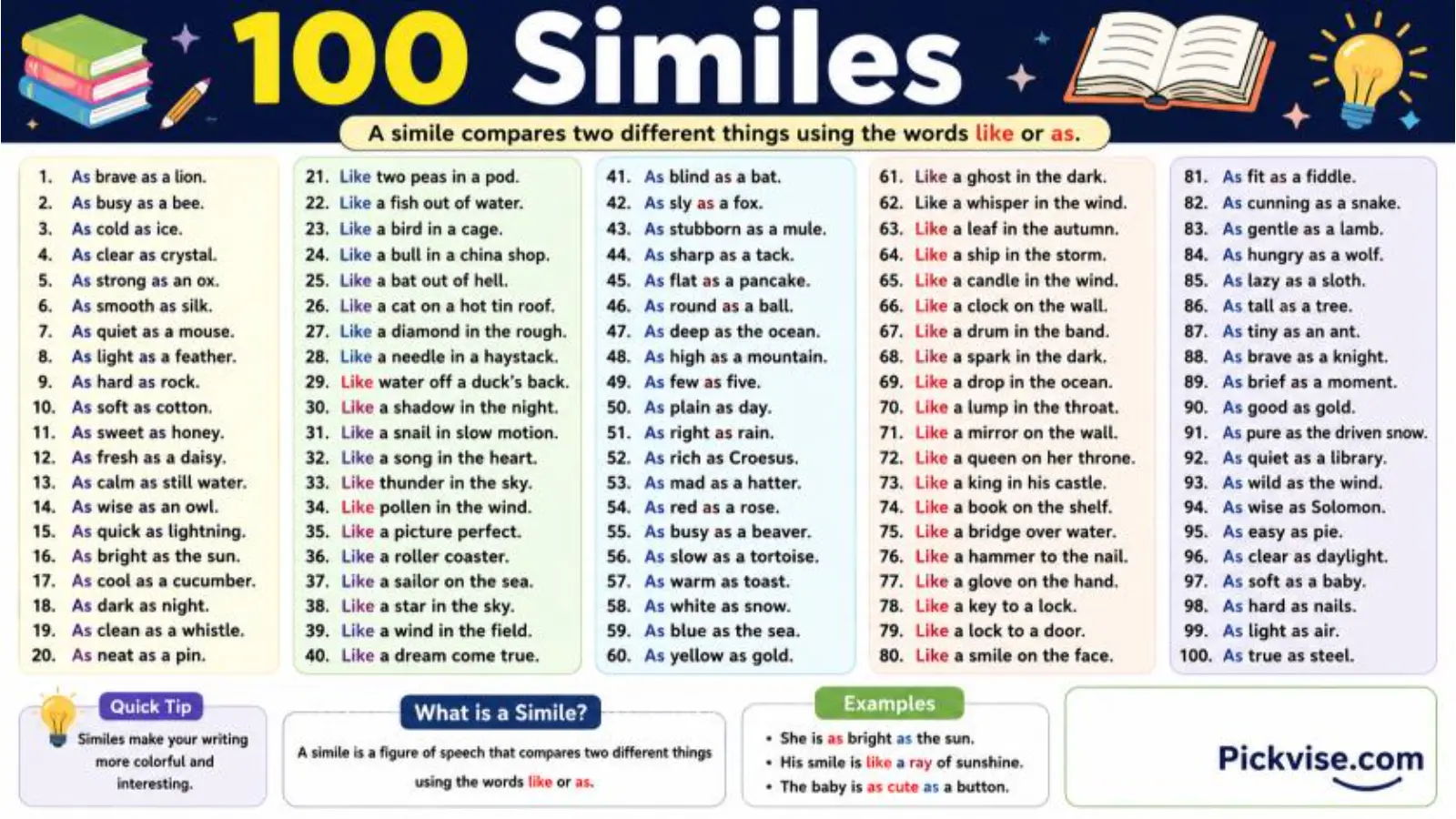
100 Similes make writing easier to picture and harder to forget. Instead of simply saying that someone is happy, angry, lonely, or excited, a simile connects that feeling to something readers already understand.
A 100 Similes usually compares two different things using words such as like or as. For example, “Her happiness spread like sunlight through an open window” gives the reader more than the word happy can.
You can find 100 Similes in poems, songs, novels, speeches, conversations, advertisements, school assignments, and everyday storytelling. This collection of 100 similes covers emotions, relationships, nature, music, and common situations while showing how to use comparisons naturally.
The 100 Similes goal is not simply to memorize clever phrases. It is to learn how comparisons work so you can create stronger ones yourself.
What Is a Simile?
A 100 Similes is a figure of speech that compares two unlike things, usually with like or as.
For example:
“The 100 Similes child’s laughter was like bells in a quiet hallway.”
The 100 Similes laughter is not literally a bell. The comparison suggests that it was bright, clear, and noticeable.
A useful 100 Similes has three parts:
- Subject: what you are describing
- Comparison: what you compare it with
- Connection: the quality both share
The strongest 100 Similes do not compare things randomly. They reveal a specific quality.
100 Original Similes to Strengthen Your Writing
Similes for Happiness
1. Her happiness was like sunlight spilling across a kitchen floor.
This comparison makes happiness feel warm, natural, and expansive. It works particularly well in personal narratives and descriptions of peaceful moments.
Example: After hearing the good news, her happiness was like sunlight spilling across a kitchen floor.
2. He grinned as brightly as a window catching the morning sun.
The image turns a simple 100 Similes into something visibly radiant.
Best for: character descriptions and storytelling.
3. Their excitement bubbled like water over a bright summer stone.
This suggests 100 Similes energetic happiness that is difficult to contain.
4. His good mood floated like a paper kite above the noisy crowd.
The simile shows happiness remaining light despite an unpleasant environment.
5. She felt as cheerful as a garden after its first spring rain.
This comparison connects happiness with renewal and freshness.
6. The children’s laughter bounced like rubber balls around the room.
The physical movement makes the sound feel lively and contagious.
7. His relief opened like a window in a stuffy room.
This is especially effective when happiness follows worry or tension.
8. Her smile was like a small lamp left glowing in the dark.
Instead of making happiness huge and dramatic, this comparison presents it as comforting.
9. The victory felt as sweet as fruit picked at exactly the right moment.
This works well when describing earned satisfaction.
10. Joy moved through the family like music traveling from one room to another.
The comparison emphasizes how happiness can spread from one person to another.
Similes for Friendship
11. Their friendship was like a well-worn path through a familiar forest.
It suggests trust built through repeated experiences.
12. She was as dependable as a lighthouse on a foggy night.
The comparison emphasizes reliability rather than constant attention.
13. Their conversations flowed like a river that never needed directions.
This works when two friends can talk naturally without forcing conversation.
14. His friendship was like a sturdy bridge between difficult days.
The image suggests support during challenging times.
15. They laughed together like children discovering the same secret.
This gives the friendship a playful quality.
16. Her advice was as steady as footsteps on a familiar staircase.
The comparison suggests consistency and trust.
17. Their memories clung together like photographs in an old album.
This works especially well for reflective writing.
18. A true friend can be like a window opened in a crowded room.
The image suggests relief, honesty, and emotional space.
19. Their bond grew like ivy along an old brick wall.
This emphasizes gradual growth over time.
20. He stood beside his friend like an umbrella beneath sudden rain.
The comparison makes support concrete and easy to visualize.
Similes for Rain
21. Rain tapped against the roof like impatient fingers.
The sound becomes almost human.
22. The rain fell as softly as feathers landing on a blanket.
This is useful for calm, gentle scenes.
23. Rain swept across the street like silver threads pulled through the air.
The image focuses on movement and appearance.
24. The storm arrived like a drumbeat growing louder in the distance.
This comparison builds anticipation.
25. Raindrops gathered on the window like tiny beads on glass.
It creates a close-up visual image.
26. The pavement shone like polished stone after the shower.
This emphasizes the transformation caused by rain.
27. Rain rushed down the gutters like children racing downhill.
The comparison gives the water speed and personality.
28. The drizzle hung over the town like a thin gray curtain.
This works particularly well for gloomy atmosphere.
29. The rain whispered against the leaves like a secret being repeated.
The sound becomes quiet and mysterious.
30. Heavy rain struck the fields like thousands of tiny thrown pebbles.
The comparison communicates force without simply saying “the rain was heavy.”
Similes for Love
31. Her affection grew like a vine finding sunlight through a narrow window.
This suggests love developing gradually despite limitations.
32. Their connection felt as natural as two rivers joining downstream.
The comparison emphasizes ease and unity.
33. His care was like a blanket on a cold evening.
This presents love as comfort rather than drama.
34. Their memories glowed like lanterns along a long road.
This works well in reflective or nostalgic writing.
35. Her voice was as comforting as rain heard from inside a warm house.
The contrast between outside and inside creates emotional warmth.
36. Their trust was like a bridge built one careful stone at a time.
This shows that strong relationships develop through repeated actions.
37. His kindness arrived like spring after a difficult winter.
The comparison gives kindness a sense of renewal.
38. Their affection rested between them like a quiet song.
This works when the feeling is subtle rather than dramatic.
39. Her presence was like a familiar page in a favorite book.
The comparison suggests comfort and familiarity.
40. Their love endured like a tree holding its branches through changing seasons.
This is useful when writing about lasting relationships.
Similes for Anger
41. His anger rose like a storm building beyond the hills.
The comparison shows anger developing before it becomes obvious.
42. Her words snapped like dry twigs beneath a heavy boot.
This makes the dialogue feel sharp and sudden.
43. He was as tense as a wire pulled too tightly.
The image suggests pressure that could quickly become overwhelming.
44. Her frustration simmered like a pot left too long on the stove.
This is useful for controlled or slowly developing anger.
45. His temper flashed like lightning behind a dark cloud.
The comparison communicates sudden intensity.
46. The argument spread through the room like smoke under a closed door.
This suggests that tension affects everyone nearby.
47. His irritation buzzed like an insect trapped inside a glass.
The image communicates persistent annoyance.
48. She carried her anger like a heavy coat she could not take off.
This focuses on the emotional burden rather than an outburst.
49. His voice struck the room like a slammed door.
This works particularly well in dialogue.
50. Her patience cracked like ice beneath an unexpected step.
The comparison shows a sudden breaking point.
Similes in Music
Music naturally creates comparisons because sound can suggest movement, texture, color, distance, and emotion.
51. The melody moved like a bird gliding over still water.
This gives the music a smooth, graceful quality.
52. The bass sounded as deep as thunder beneath the floor.
The comparison emphasizes physical impact.
53. Her voice floated like mist over a quiet lake.
This works for soft, atmospheric singing.
54. The drums arrived like footsteps approaching from a distant street.
The image creates anticipation.
55. The chorus rose like a crowd lifting a single voice.
This is useful for music that becomes larger and more powerful.
56. The violin cried like a lonely train disappearing into the night.
The comparison gives the instrument a melancholy emotional quality.
57. The rhythm jumped like sparks from a campfire.
This creates a lively, energetic image.
58. The piano notes fell like raindrops on an empty window.
The comparison suits delicate or reflective music.
59. The final chord hung in the air like a question without an answer.
This is effective when music ends with uncertainty or tension.
60. The song unfolded like a road revealing new scenery around every bend.
The comparison focuses on progression and discovery.
Common Similes for Everyday Writing
Common similes are useful because readers understand them immediately. They can be effective when clarity matters more than originality.
61. The room was as quiet as a library after closing.
The comparison establishes silence quickly.
62. He ran like a startled deer.
This gives the reader an immediate sense of speed and nervousness.
63. She was as busy as a bee in a flower garden.
This communicates energetic activity.
64. The baby slept like a stone after the long journey.
The comparison emphasizes deep, undisturbed sleep.
65. His hands were as cold as winter glass.
This makes an ordinary physical detail more vivid.
66. The old chair creaked like a wooden boat in rough water.
The sound becomes more memorable through a familiar image.
67. The classroom became as lively as a market at noon.
This works well for scenes where energy suddenly increases.
68. The road stretched like a ribbon across the valley.
The comparison helps readers visualize shape and distance.
69. Her explanation was as clear as a clean window.
This is useful for describing understandable speech or writing.
70. The child was as curious as a cat exploring a new room.
The comparison reinforces playful curiosity.
Funny Similes
Humor often comes from an unexpected comparison. A funny simile works best when the image is surprising but still understandable.
71. He stared at the homework like a detective who had misplaced the entire case.
The humor comes from exaggerating ordinary confusion.
72. My alarm clock sounded like an angry robot demanding rent.
This turns a familiar morning annoyance into an absurd image.
73. She walked into the meeting as confidently as a penguin entering a dance contest.
The mismatch creates the joke.
74. His hair stood up like grass after a very confused lawn mower.
The unusual image makes the description playful.
75. The toddler attacked the birthday cake like a tiny excavator with a deadline.
This works because the comparison is energetic and exaggerated.
76. My backpack was as organized as a drawer after an earthquake.
The image humorously describes complete disorder.
77. He searched for his glasses like a pirate hunting for buried treasure, even though they were on his head.
The contrast between effort and reality creates the joke.
78. The puppy followed me like a tiny detective with no concept of privacy.
This gives the animal a humorous personality.
79. His excuse was as believable as a fish claiming it had never seen water.
The absurdity makes the judgment memorable.
80. She guarded the last cookie like a dragon protecting a very disappointing treasure.
This turns an ordinary situation into a miniature fantasy.
Similes for Nature and Description
81. The morning sky opened like a curtain pulled across a bright stage.
This gives sunrise a sense of gradual revelation.
82. The mountains stood like quiet guardians beyond the town.
The comparison creates scale and strength.
83. The wind moved through the grass like invisible hands brushing velvet.
The image makes something unseen easier to imagine.
84. The moon looked like a pale coin above the rooftops.
This is simple and visually immediate.
85. The leaves spun through the air like pages torn from a green book.
The comparison captures both movement and color.
86. The river curved through the valley like a silver thread.
This emphasizes shape and brightness.
87. The clouds gathered like travelers meeting at a crossroads.
The person-like comparison adds anticipation.
88. The desert stretched as wide as an unfinished story.
This combines physical space with an abstract idea.
89. The stars scattered across the sky like grains of sugar on dark cloth.
The contrast between tiny bright points and darkness creates a clear visual.
90. The forest breathed like a sleeping animal beneath the moonlight.
This gives the setting a mysterious, living atmosphere.
Similes for People and Character
91. She listened as carefully as a photographer waiting for the perfect light.
The comparison suggests patience and attention.
92. He moved through the crowd like a compass needle searching for north.
This works for someone uncertain or purposeful.
93. Her confidence stood as firmly as a tree rooted in deep soil.
The image suggests stability rather than arrogance.
94. He was as restless as a bird inside an open cage.
This communicates a strong desire to move or escape.
95. She spoke with the calmness of water flowing beneath thin ice.
The surface appears controlled while hidden tension remains underneath.
96. His curiosity burned like a small flame protected from the wind.
The comparison suggests persistent interest.
97. She entered the room like a new color added to a familiar painting.
This is useful when someone changes the atmosphere around them.
98. He carried his disappointment like a stone hidden in his pocket.
The image suggests an emotional weight that others may not notice.
99. Her ideas arrived like birds landing one after another on a quiet wire.
This works beautifully for creative-writing descriptions.
100. He faced the unfamiliar future like a traveler studying a map with half the roads missing.
The comparison captures uncertainty without making the character powerless.
Why Some Similes Feel Stronger Than Others
A simile becomes memorable when the comparison reveals something specific.
Compare:
“She was happy like a flower.”
with:
“Her happiness opened like a window in a dark room.”
The first comparison is broad. The second gives happiness a recognizable effect: it creates light and space.
When writing your own similes, ask what exactly am I trying to show?
Is the character’s happiness:
- energetic?
- peaceful?
- surprising?
- contagious?
- temporary?
- comforting?
Once you identify the precise quality, finding a comparison becomes much easier.
How to Make a Simile More Vivid
Strong writers usually begin with observation rather than trying to sound poetic.
Instead of writing:
“The rain was beautiful.”
Look at what the rain actually does.
Does it:
- blur streetlights?
- drum on metal roofs?
- collect in footprints?
- make the pavement shine?
- bend flowers toward the ground?
You can then build the comparison around the observed detail.
For example:
“Rain blurred the streetlights like wet paint dragged across glass.”
The image works because it is based on a visible effect.
How to Avoid Cliché Similes
Some comparisons are so familiar that readers barely notice them.
Expressions such as “busy as a bee” or “cold as ice” are not grammatically wrong. They are simply less surprising because readers have encountered them many times.
Use familiar similes when you want quick clarity. Choose a fresh comparison when the moment deserves stronger imagery.
A useful test is:
Could a reader picture the comparison immediately, and does it tell them something new?
If the answer is yes, the simile is probably doing useful work.
Simile vs. Metaphor: What’s the Difference?
A simile makes an explicit comparison:
“The classroom was like a marketplace.”
A metaphor makes the comparison directly:
“The classroom was a marketplace.”
Both can create imagery, but they produce slightly different effects.
Similes can feel exploratory because they invite the reader to notice a relationship between two things. Metaphors can sound more direct and forceful.
Neither device is automatically better. Choose the one that matches the voice of your writing.
Simile, Imagery, Personification, and Hyperbole
Similes often work alongside other literary devices.
Imagery appeals to the senses:
“The rain smelled like wet earth and leaves.”
Personification gives human qualities to something nonhuman:
“The wind argued with the shutters.”
Hyperbole deliberately exaggerates:
“I waited a thousand years for the bus.”
A sentence can combine devices, but be careful not to overload it. One precise image is often stronger than several competing ones.
How to Create Your Own Similes
Try this five-step process.
1. Choose the subject
Start with something ordinary: a person’s voice, a storm, a smile, a crowded room, or a difficult decision.
2. Identify its strongest quality
Ask what you actually want readers to notice.
For example, a voice might be:
- rough
- gentle
- distant
- energetic
- trembling
3. Search your memory
Think about objects, places, animals, weather, sounds, food, sports, machines, or ordinary experiences that share that quality.
4. Make the comparison specific
Instead of:
“His voice was like an animal.”
Try identifying the particular sound:
“His voice scraped like a chair dragged across a wooden floor.”
5. Read it aloud
A good simile should fit the sentence naturally. If the comparison sounds more noticeable than the idea itself, simplify it.
Three Creative Exercises for Better Similes
Exercise 1: The Five-Sense Challenge
Choose one object and describe it using sight, sound, touch, smell, and movement.
Then create one simile from the strongest detail.
Exercise 2: Replace the First Comparison
Write a sentence using your first instinct.
Then reject that comparison and create three alternatives.
The third or fourth idea is often more interesting because you have moved beyond the obvious association.
Exercise 3: Give an Emotion a Physical Form
Choose an emotion such as fear, excitement, embarrassment, hope, or anger.
Ask:
If this emotion were an object, weather pattern, animal, sound, or landscape, what would it resemble?
For example:
“Nervousness fluttered inside him like a trapped moth.”
The emotion becomes something readers can visualize.
Common Mistakes When Writing Similes
Using a comparison that says nothing new
A simile should add information. If removing it leaves the sentence equally vivid, it may not be necessary.
Mixing images
Avoid combining unrelated comparisons:
“Her anger was a stormy volcano racing like a train.”
The images compete with each other.
Choose one dominant image instead.
Making the comparison too complicated
A simile should not require a paragraph of explanation. If readers need to decode it, simplify the comparison.
Choosing an image that does not fit the emotion
A peaceful scene and a violent comparison may create an unintended effect. Always consider the emotional association of your comparison.
Using too many similes
Even excellent similes lose power when every sentence contains one.
Let plain sentences surround your strongest images.
Confusing similes and metaphors
If you write “He was a lion,” you are using a metaphor. If you write “He was like a lion,” you are using a simile.
Frequently Asked Questions About Similes
What are 10 examples of similes?
Examples include:
- “Her smile was like a small lamp in the dark.”
- “The rain tapped like impatient fingers.”
- “His anger rose like a storm.”
- “Their friendship was like a sturdy bridge.”
- “The melody moved like a bird over water.”
- “The road stretched like a ribbon.”
- “She was as calm as still water.”
- “His ideas arrived like birds on a wire.”
- “The classroom became as lively as a market.”
- “The moon looked like a pale coin.”
What are common similes?
Common similes include familiar comparisons such as as busy as a bee, as cold as ice, and as quiet as a mouse. They are useful for quick communication, although fresh comparisons can make creative writing more distinctive.
What are some similes for happiness?
You can describe happiness as sunlight, laughter, music, spring rain, an open window, or a kite in the wind. The best choice depends on the kind of happiness you want to show.
What are good similes for friendship?
Friendship can be compared with a bridge, lighthouse, familiar path, sturdy shelter, or growing plant. These images emphasize qualities such as trust, reliability, familiarity, and growth.
What are similes for rain?
Rain can be compared with fingers tapping on a roof, silver threads, falling beads, a curtain, racing children, or whispered secrets. Choose an image based on the rain’s speed, sound, mood, and intensity.
What are some similes for love?
Love can be compared with warmth, a growing vine, joined rivers, a familiar book, a quiet song, or a tree surviving changing seasons. These comparisons can communicate comfort, growth, connection, or endurance.
How do I write a powerful simile?
First decide exactly what quality you want to communicate. Then find an unusual but believable object or experience that shares that quality. Keep the comparison clear, specific, and appropriate to the mood.
Can similes be used in academic writing?
Yes, but they should be used selectively. Similes can clarify abstract ideas or make explanations more accessible, but formal writing usually benefits from precise language rather than decorative comparisons.
Conclusion
The best similes do more than make sentences sound pretty. They help readers see, hear, feel, and understand an idea. Use familiar similes when you need quick clarity. Reach for original comparisons when you want a scene, emotion, or character to stay in the reader’s mind. Most importantly, do not treat these 100 similes as phrases to memorize. Use them as examples of a larger skill: noticing relationships between ordinary things. A puddle can become a mirror. A voice can become a distant instrument. Friendship can become a bridge. Anger can become pressure beneath a lid.Once you start looking for those connections, everyday observations become raw material for better writing.
I am Helena Frost, a writer captivated by the beauty of language and the art of comparison. Through my words, I explore the world by turning ordinary moments into vivid similes and reflections. I enjoy crafting phrases that spark imagination, evoke emotion, and linger in the mind. My writing celebrates the subtle connections between people, nature, and the stories we live. For me, every sentence is an opportunity to reveal the extraordinary in the everyday.