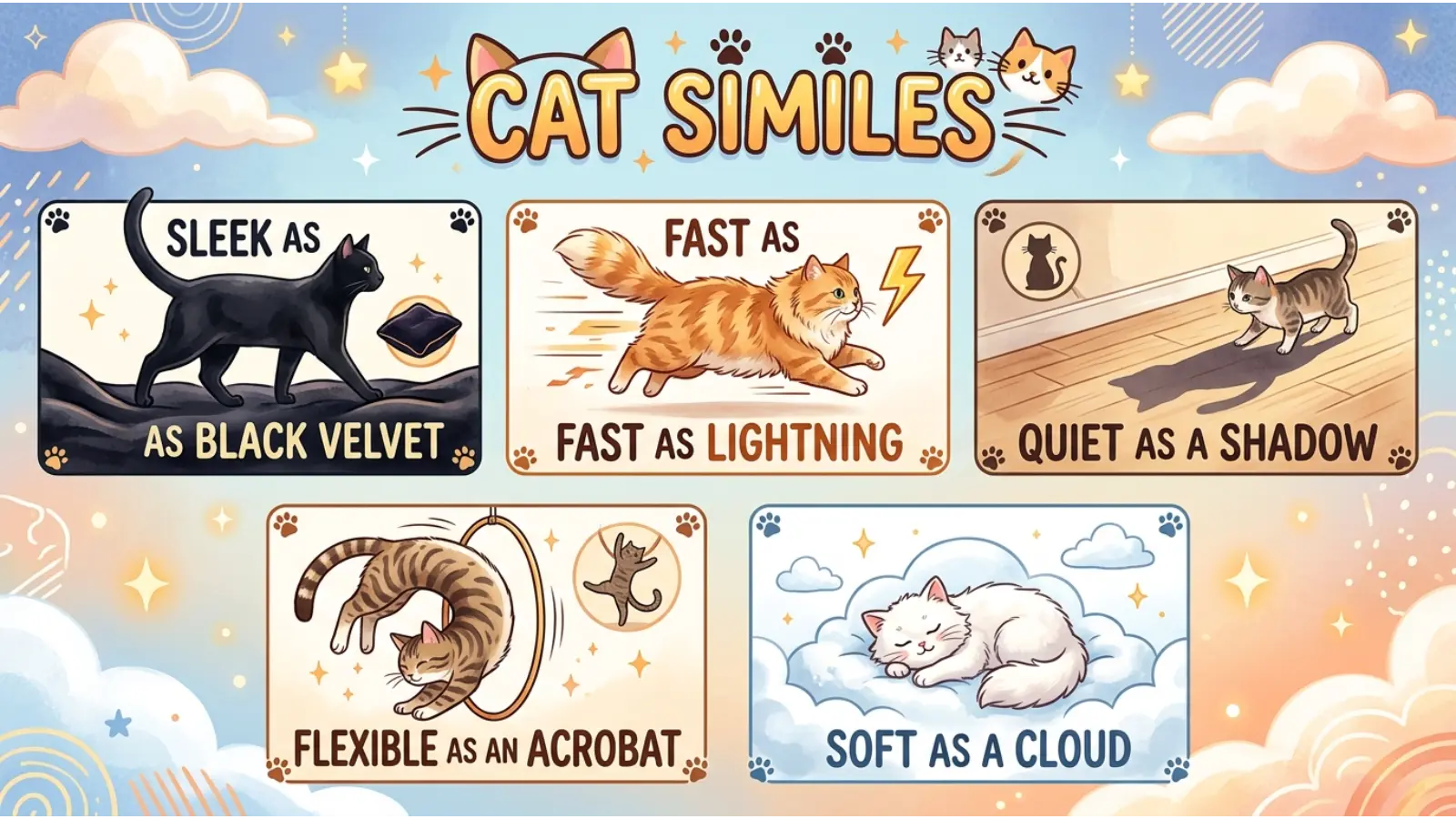
Cat Similes are naturally expressive animals. A quick flick of the tail, a sudden leap, or a quiet stare can communicate more than several sentences of plain description. That is why cat similes are useful for writers who want their descriptions to feel sharper and more imaginative.
A simile compares two different things using words such as like or as. Instead of simply writing, “The cat moved quietly,” you can create a stronger picture by comparing its movement to something familiar.
Good similes do more than decorate a sentence. They help readers see movement, sense mood, understand personality, and remember a scene. You can use them in stories, poems, school assignments, character descriptions, creative writing, captions, and everyday conversation.
This collection offers original cat similes, explains what makes them effective, and shows how to build your own comparisons without relying on tired expressions.
What Is a Cat Simile?
A cat simile is a direct comparison between a cat and another person, animal, object, force, or experience, usually using like or as.
For example:
The kitten darted across the room like a spark escaping a fire.
The comparison gives the reader an immediate sense of speed and sudden movement.
A useful cat simile should add something meaningful. If removing the comparison makes the sentence exactly as effective, the simile probably is not doing enough work.
Cat Similes: 30 Original Examples for Creative Writing
1. The cat moved like a shadow slipping beneath a door.
Meaning: The cat moved quietly and almost unnoticed.
This works because a shadow suggests both silence and smooth movement. It is especially useful when describing a curious cat exploring a dark or quiet room.
Example:
The cat moved like a shadow slipping beneath a door, disappearing before anyone noticed.
Writing tip: Use this comparison for stealth rather than ordinary walking.
2. Her eyes were like two lanterns watching the hallway.
Meaning: The cat’s eyes appeared bright, alert, and observant.
The lantern comparison creates a mysterious atmosphere while emphasizing the cat’s attention.
Example:
At midnight, her eyes were like two lanterns watching the hallway.
This fits particularly well in mystery, fantasy, or nighttime scenes.
3. The kitten bounced like a rubber ball with a mind of its own.
Meaning: The kitten moved energetically and unpredictably.
The phrase gives the animal a playful personality rather than merely saying that it was energetic.
Example:
The kitten bounced like a rubber ball with a mind of its own whenever the toy mouse appeared.
4. His tail curled like a question mark.
Meaning: The cat’s tail formed a curved shape that suggested curiosity.
This is a compact visual simile. It works because the reader can picture both shapes immediately.
Example:
His tail curled like a question mark as he studied the strange box.
5. The old cat stretched like a ribbon slowly pulled across a table.
Meaning: The cat stretched in a long, smooth movement.
This comparison emphasizes length and gradual motion.
Writing tip: Shape-based comparisons are particularly effective when you want readers to visualize an animal’s posture.
6. The kitten’s paws landed as softly as falling leaves.
Meaning: The kitten walked or jumped with very little noise.
Falling leaves create a gentle image without making the cat seem supernatural.
Example:
The kitten’s paws landed as softly as falling leaves on the wooden floor.
7. The cat watched the bird like a patient chess player studying the board.
Meaning: The cat was focused, strategic, and waiting for the right opportunity.
The comparison adds personality. Instead of simply calling the cat “patient,” it shows patience through behavior.
Best context: Character-driven stories.
8. Her fur shimmered like sunlight caught on water.
Meaning: The cat’s coat looked bright and reflective.
This is useful when describing a cat in natural light.
Example:
Her silver fur shimmered like sunlight caught on water beside the window.
9. The frightened kitten trembled like a leaf in a sudden storm.
Meaning: The kitten was extremely nervous or afraid.
The storm creates a stronger emotional setting than a simple statement such as “the kitten was scared.”
Writing tip: Match the intensity of the comparison to the emotion. A frightened kitten needs an image that communicates vulnerability.
10. The cat sprang like a folded spring suddenly released.
Meaning: The cat jumped with explosive speed.
The comparison highlights stored energy followed by sudden movement.
Example:
The cat sprang like a folded spring suddenly released and landed on the chair.
11. He sat like a small king guarding his quiet kingdom.
Meaning: The cat appeared confident, comfortable, and in control of its surroundings.
This comparison is humorous because it gives an ordinary household cat royal authority.
12. The kitten chased the string like a tiny storm with paws.
Meaning: The kitten moved rapidly and chaotically while playing.
The unusual image makes the sentence lively and playful.
Best context: Children’s stories, humorous descriptions, and playful captions.
13. Her purr sounded like rain tapping gently against a window.
Meaning: The purr was soft, steady, and calming.
This is a sound-based simile. Sound comparisons can make writing more immersive because they appeal directly to the reader’s imagination.
14. The cat slipped through the furniture like water finding a narrow crack.
Meaning: The cat moved easily through a tight space.
Water is an effective comparison because it suggests flexibility and continuous movement.
15. His ears stood like two little sails catching the wind.
Meaning: The cat’s ears were upright and alert.
The image gives the animal an attentive, almost adventurous quality.
16. The sleepy kitten curled up like a comma at the end of a sentence.
Meaning: The kitten folded into a small curved shape while resting.
This comparison works particularly well in literary writing because it connects the cat’s physical form to writing itself.
Example:
After an exhausting afternoon, the kitten curled up like a comma at the end of a sentence.
17. Her whiskers spread like fine threads around a tiny face.
Meaning: The whiskers appeared delicate and widely arranged.
The comparison focuses on detail rather than dramatic action, making it useful for descriptive passages.
18. The cat prowled through the garden like a detective searching for clues.
Meaning: The cat moved carefully while investigating its surroundings.
This simile gives the animal a curious personality and can make a simple garden scene more entertaining.
19. His claws flashed like tiny silver needles.
Meaning: The claws looked sharp and bright.
The comparison creates a slightly tense mood without requiring a long explanation.
Best context: Suspenseful or action-oriented scenes.
20. The kitten’s meow was as thin as a distant whistle.
Meaning: The kitten’s voice sounded faint or high.
This is a good example of using a simile to describe sound rather than appearance.
21. The cat froze like a statue caught in the middle of a thought.
Meaning: The cat suddenly became completely still.
The unusual second half makes the comparison more imaginative than simply saying “like a statue.”
22. She raced across the carpet like a tiny comet.
Meaning: The cat moved extremely quickly.
A comet suggests speed, energy, and a bright streak of movement.
Example:
The kitten raced across the carpet like a tiny comet chasing the red toy.
23. His whiskers quivered like grass beneath a passing breeze.
Meaning: The cat’s whiskers moved slightly and delicately.
This comparison is best for quiet observational writing.
24. The cat stared at me like an old librarian who had caught me making noise.
Meaning: The cat’s expression seemed serious, judgmental, or disapproving.
The humor comes from giving the cat a distinctly human reaction.
Best context: Funny stories and casual writing.
25. The orange kitten curled beside the heater like a warm loaf fresh from the oven.
Meaning: The kitten looked cozy, compact, and comfortable.
The food comparison creates warmth and friendliness without simply saying the kitten was “cute.”
26. Her tail flicked like a metronome keeping time with her impatience.
Meaning: The cat repeatedly moved her tail while becoming annoyed.
This comparison combines movement with emotion, making it stronger than a purely visual description.
27. The cat disappeared like a coin beneath a magician’s hand.
Meaning: The cat vanished from sight suddenly.
This works well when a cat ducks behind furniture, jumps around a corner, or escapes a room.
28. The kitten attacked the paper bag like a knight challenging a castle.
Meaning: The kitten played aggressively and enthusiastically with the bag.
The dramatic contrast between a tiny kitten and a heroic knight makes the sentence humorous.
29. His purr rolled through the room like a low summer breeze.
Meaning: The purring sound was gentle, continuous, and soothing.
This comparison creates a relaxed atmosphere.
30. The cat sat by the window like a quiet traveler waiting for the world to move.
Meaning: The cat appeared calm, thoughtful, and observant.
This works especially well in reflective prose because the comparison gives an ordinary moment emotional depth.
How to Choose the Right Cat Simile
The strongest comparison depends on what you want the reader to notice.
If you want to show speed, compare the cat with something fast or suddenly released. If you want to show quietness, choose something that moves gently. For playfulness, use an unexpected comparison that creates energy or humor.
Consider this progression:
Weak:
The cat was fast.
Better:
The cat ran like a flash.
More specific:
The cat shot across the hallway like a spark bouncing from a live wire.
The final version gives the reader a more precise sense of sudden, energetic movement.
Use the Five Senses to Make Similes Stronger
Many beginner writers rely almost entirely on visual comparisons. You can make your descriptions richer by using other senses.
Sight
Her fur gleamed like frost under morning light.
Sound
His purr hummed like a distant engine.
Touch
The kitten’s fur felt like a soft brush against my hand.
Movement
She darted through the doorway like a ribbon caught in the wind.
Atmosphere
The cat watched the empty street like a guard at a silent gate.
The goal is not to use all five senses in every description. Choose the sense that matters most to the scene.
Why Some Cat Similes Feel More Memorable
A memorable simile usually contains a connection the reader can understand but does not expect.
For instance, “the cat was quiet like a quiet animal” provides almost no new information. The comparison simply repeats the original idea.
By contrast:
The cat moved like a shadow slipping beneath a door.
The reader receives information about speed, silence, direction, and atmosphere at once.
That is the real power of a good simile: it compresses several descriptive details into one image.
How to Avoid Cliché Cat Similes
Some comparisons are so familiar that they no longer create a strong image.
Common phrases can still have a place, especially in casual writing, but original writing becomes more interesting when you search for a fresher connection.
Instead of immediately writing:
The cat was as quiet as a mouse.
Try asking:
- What else moves quietly?
- What object has a similar shape?
- What sound resembles the cat?
- What human behavior matches its personality?
- What unexpected image would fit this particular scene?
You might arrive at:
The cat moved like a shadow slipping beneath a door.
The comparison feels more specific because it was built from the cat’s actual behavior.
Don’t Make Every Simile Dramatic
A common mistake is assuming that every sentence needs an impressive comparison.
It does not.
If every line contains a dazzling image, the writing can become exhausting. Strong prose gives important images room to stand out.
Compare:
The cat leaped like a comet, landed like thunder, stared like a king, and curled like a storm cloud.
The sentence is overloaded.
A cleaner version might be:
The cat leaped across the room like a tiny comet. A moment later, it settled beside the window and watched the rain.
One strong comparison can be more effective than four competing ones.
Cat Similes for Different Writing Situations
For a Children’s Story
Use playful, easy-to-picture comparisons.
The kitten bounced like a rubber ball with a mind of its own.
Children can understand the image immediately, and the comparison adds movement to the story.
For Poetry
Choose comparisons that carry mood as well as appearance.
The cat sat by the window like a quiet traveler waiting for the world to move.
Poetry benefits from images that leave emotional space for the reader.
For a Mystery Story
Use darker or more uncertain comparisons.
The cat’s eyes glowed like two lanterns watching the hallway.
The image can help establish suspense without directly announcing that something feels mysterious.
For Humor
Give the cat an exaggerated human role.
The cat stared at me like an old librarian who had caught me making noise.
Human comparisons can make animal behavior instantly funny.
For School Writing
Choose clear, relevant comparisons rather than overly complicated ones.
The kitten’s paws landed as softly as falling leaves.
The image is easy to understand while still demonstrating descriptive writing.
Cat Similes and Other Literary Devices
Similes are closely related to several other forms of figurative language, but they are not interchangeable.
Simile vs. Metaphor
A simile makes an explicit comparison:
The cat moved like a shadow.
A metaphor makes the comparison more directly:
The cat was a shadow slipping through the room.
Both can create imagery, but the grammatical structure is different.
Simile vs. Personification
Personification gives human qualities to something nonhuman:
The cat complained about the empty food bowl.
The cat is not literally complaining in the human sense. The sentence gives its behavior a human interpretation.
A simile might instead say:
The cat stared at the empty bowl like a disappointed customer.
These devices can work together.
Simile and Imagery
Imagery is broader than simile. It involves language that helps readers imagine sensory experiences.
A simile is one tool for creating imagery.
Her purr sounded like rain tapping against a window.
The simile contributes auditory imagery by helping the reader imagine the sound.
How to Create Your Own Cat Similes
You do not need to wait for inspiration. You can build an effective simile deliberately.
Step 1: Observe the Cat
Start with an exact behavior.
Is the cat:
- creeping?
- stretching?
- staring?
- sleeping?
- playing?
- hiding?
- jumping?
- purring?
Specific observation gives you better raw material.
Step 2: Identify the Main Quality
Decide what you want the reader to feel.
Maybe the cat is:
quiet, curious, impatient, playful, graceful, nervous, energetic, mysterious, or comfortable.
Step 3: Brainstorm Unexpected Matches
If the cat is curious, do not stop at “like a detective.”
Think about objects, people, weather, sounds, or movements that suggest curiosity.
Step 4: Test the Comparison
Ask yourself:
Does this comparison add information?
If the answer is no, replace it.
Step 5: Read It Aloud
A simile may look clever on the page but sound awkward in a sentence. Reading aloud helps you notice unnatural wording and unnecessary complexity.
A Quick Exercise for Better Similes
Choose one cat behavior and write three comparisons.
For example:
Behavior: The cat is waiting.
- Like a guard outside a silent gate.
- Like a traveler watching the station clock.
- Like a musician waiting for the first note.
Now ask which comparison best matches your scene.
There is no single correct answer. The strongest choice depends on the mood and context.
Common Mistakes Writers Make With Similes
Using a Comparison That Says Nothing New
The cat was soft like something soft.
The comparison provides no useful image.
Mixing Two Images
The cat moved like lightning, sailing through the room like a boat.
The sentence combines unrelated images without a clear reason.
Choose one dominant comparison.
Forcing a Simile Into Every Sentence
Figurative language is most effective when it has a purpose. Plain description can create contrast and make your strongest images more noticeable.
Choosing a Comparison That Does Not Fit the Emotion
A playful scene probably does not need an extremely threatening image unless you deliberately want to change the mood.
Explaining the Simile Too Much
Once the image works, let it work.
Instead of:
The cat moved like a shadow, which means it was very quiet and difficult to see.
In creative writing, this is often enough:
The cat moved like a shadow beneath the table.
Trust the reader to understand a clear image.
Frequently Asked Questions About Cat Similes
What is an example of a cat simile?
An example is: “The kitten raced across the floor like a tiny comet.” It compares the kitten’s fast movement with a comet to create a vivid image.
What are some good similes for cats?
Useful cat similes can compare cats with shadows, leaves, ribbons, lanterns, springs, travelers, detectives, or other things that match their movement, appearance, or personality.
How do you describe a cat using a simile?
First identify the cat’s most noticeable quality, such as speed, softness, curiosity, or quietness. Then compare that quality with something readers can easily imagine.
Can cat similes be used in poems?
Yes. Similes are especially useful in poetry because a short comparison can communicate appearance, emotion, movement, and atmosphere in very few words.
What is the difference between a cat simile and a cat metaphor?
A simile usually uses like or as, such as “The cat moved like a shadow.” A metaphor makes the comparison directly, such as “The cat was a shadow.”
How can I make a cat simile more creative?
Start with the cat’s actual behavior and look beyond obvious comparisons. Try comparing its movement, sound, shape, or personality with an unexpected but believable image.
Are funny cat similes good for creative writing?
They can be. Humor often comes from comparing an ordinary cat with an exaggerated human role, such as a strict teacher, impatient customer, detective, or royal ruler.
Conclusion
The best cat similes do not simply make a sentence prettier. They help readers see, hear, and feel what is happening. Start with observation. Identify the quality you want to emphasize, find an unexpected comparison, and make sure the image fits the mood. Sometimes a quiet comparison is enough; other times a surprising image can become the memorable detail in an entire scene. Experiment with your own comparisons. A cat stretching beside a window, chasing a toy, watching a bird, or sleeping in a sunbeam can become much more than a simple description when you find the right image.

I am Helena Frost, a writer captivated by the beauty of language and the art of comparison. Through my words, I explore the world by turning ordinary moments into vivid similes and reflections. I enjoy crafting phrases that spark imagination, evoke emotion, and linger in the mind. My writing celebrates the subtle connections between people, nature, and the stories we live. For me, every sentence is an opportunity to reveal the extraordinary in the everyday.