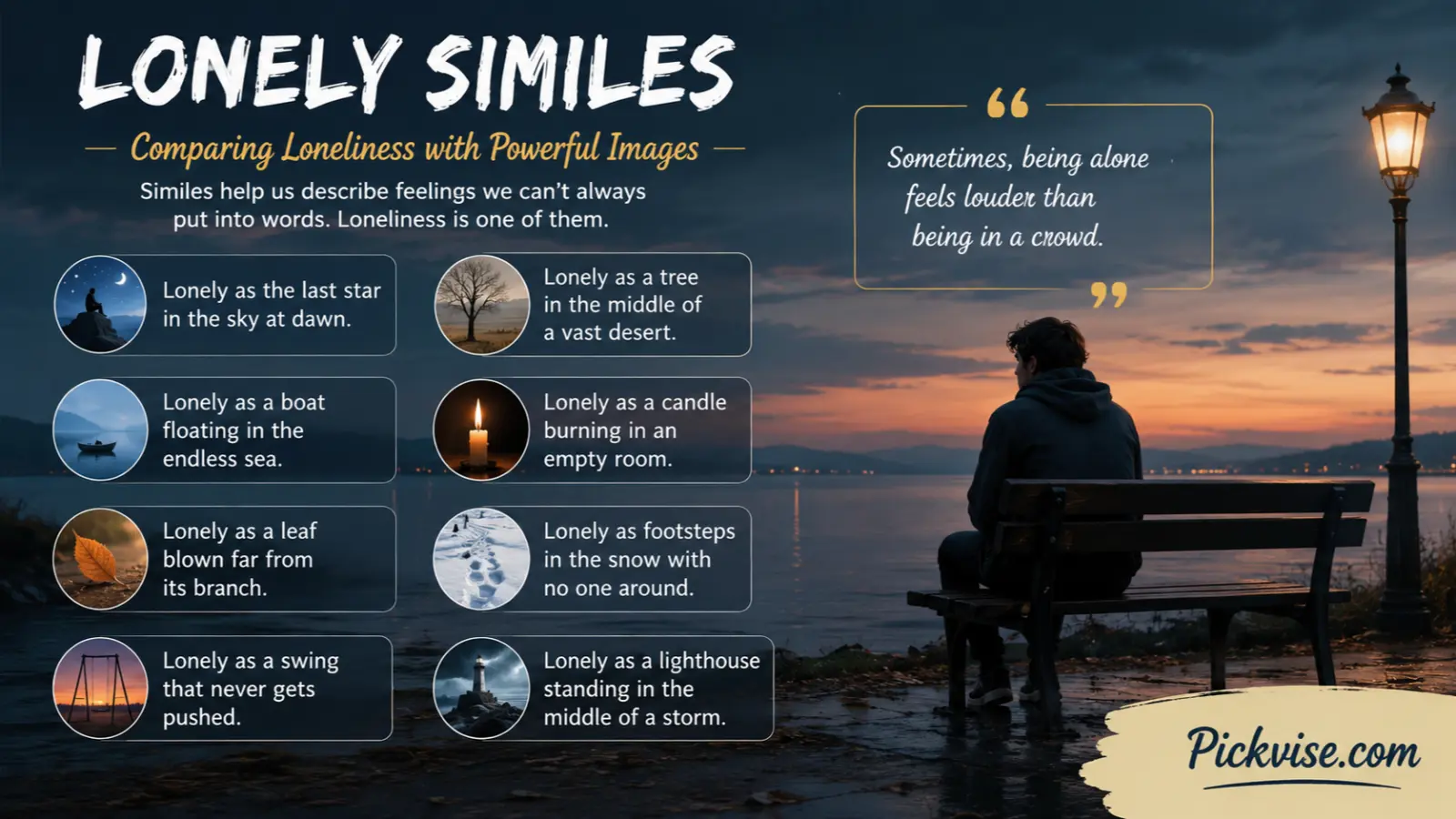
Lonely Similes can be difficult to describe because it is often invisible. A person may be surrounded by people and still feel completely alone. This is where a strong simile can help. By comparing loneliness to something readers can see, hear, or feel, writers can turn an abstract emotion into a vivid image.
A Lonely Similes compares two different things using words such as like or as. For example, instead of simply saying, “She felt lonely,” a writer might say, “She felt like a single window glowing in an empty building.”
This article explores lonely similes that can help with poems, stories, songs, personal writing, descriptions, and everyday conversation. Each comparison is original and designed to show not only what loneliness feels like, but also how writers can use imagery more effectively.
What Are Lonely Similes?
Lonely similes are comparisons that describe loneliness, isolation, emotional distance, silence, or the Lonely Similes feeling of being disconnected from others.
For example:
He stood alone like a lighthouse waiting for a ship that never appeared.
The comparison makes loneliness easier to imagine. Instead of naming the emotion directly, it gives the reader a scene.
Quick Answer
A lonely simile compares loneliness to something familiar using like or as. Examples include “alone like a forgotten streetlight” and “as quiet as a room after everyone has left.”
30 Original Similes About Loneliness
1. Lonely Like a Forgotten Streetlight
Simile: He felt lonely like a forgotten streetlight glowing over an empty road.
Meaning: The comparison suggests someone who continues existing and giving something to the world while receiving little attention in return.
Writing purpose: This works especially well for characters who feel overlooked rather than simply physically alone.
Example:
After everyone left, he felt lonely like a forgotten streetlight glowing over an empty road.
The streetlight creates a useful contrast: it is still shining, but there is nobody nearby to notice it.
2. Alone Like a Chair in an Empty Classroom
Simile: She sat alone like a chair left behind in an empty classroom.
This image suggests abandonment and stillness. It works well in school stories, reflective essays, and scenes involving separation.
Writing tip: Objects can make emotional descriptions stronger because readers can picture them immediately.
3. Quiet as a House After Goodbye
Simile: The house was as quiet as a place after the last goodbye.
This comparison focuses on the silence that follows separation.
Example:
When his family moved away, the house was as quiet as a place after the last goodbye.
The simile is useful when loneliness is expressed through surroundings rather than direct emotion.
4. Lonely Like a Boat Without a Shore
Simile: He felt lonely like a small boat drifting without a shore.
The boat represents uncertainty and emotional directionlessness.
Best context: This fits stories about change, separation, or feeling unsure about where one belongs.
5. As Empty as a Playground at Midnight
Simile: Her thoughts felt as empty as a playground at midnight.
A playground normally suggests movement and connection. Putting it at midnight creates a strong contrast.
Why it works: Good similes often become memorable when they place something familiar in an unexpected situation.
6. Like a Song Nobody Knows
Simile: He felt like a song nobody knew how to sing.
This comparison presents loneliness as the feeling of being unheard or misunderstood.
Poetry use: It can work particularly well in poems about identity, friendship, or emotional distance.
7. Like a Message Waiting for a Reply
Simile: Her loneliness felt like a message waiting for a reply that never came.
This is a modern comparison that fits contemporary stories and personal writing.
It captures not only being alone, but also expecting connection and not receiving it.
8. As Distant as a Star Behind Clouds
Simile: He felt as distant as a star hidden behind thick clouds.
The star remains present, but it cannot be easily seen.
Meaning: This can represent someone who wants connection but feels emotionally unreachable.
9. Lonely Like a Book on a Closed Shelf
Simile: She felt lonely like a book waiting on a shelf that nobody opened.
The book represents untold thoughts, experiences, or feelings.
Writing purpose: Use this when loneliness comes from feeling unseen or unheard.
10. Like Footprints Without a Traveler
Simile: His memories were like footprints without a traveler.
This image suggests traces of someone or something that is no longer present.
Why it works: It creates mystery as well as sadness, making it useful for fiction and poetry.
11. As Cold as an Unanswered Doorway
Simile: The silence felt as cold as an unanswered doorway.
The doorway suggests an opportunity for connection that never opens.
Best context: This works well when writing about rejection, distance, or waiting.
12. Like a Single Cloud in a Clear Sky
Simile: She felt like a single cloud drifting through a completely clear sky.
Unlike some lonely comparisons, this one does not necessarily suggest sadness. It can express feeling different or separate from everyone else.
Writing tip: Loneliness does not always have to be described as misery. Sometimes it feels peaceful, strange, or uncertain.
13. Alone Like a Candle in a Locked Room
Simile: He was alone like a candle burning inside a locked room.
The candle provides light, but the locked room prevents connection.
Emotional effect: This creates a feeling of isolation mixed with quiet strength.
14. Like a Train After the Station Closes
Simile: Her heart felt like a train arriving after the station had already closed.
This comparison captures loneliness caused by bad timing.
Storytelling use: It can describe missed opportunities, lost friendships, or relationships that changed.
15. As Quiet as Snow Before Footsteps
Simile: The room was as quiet as fresh snow before anyone walked through it.
This simile emphasizes silence without automatically making it frightening.
Best context: Use it for peaceful, reflective, or bittersweet scenes.
16. Like a Photograph Missing Everyone
Simile: The old room felt like a photograph with everyone carefully removed.
The comparison creates an unusual visual image.
Why it works: It transforms an ordinary empty room into evidence of absence.
17. Lonely Like a Window Facing an Empty Street
Simile: He felt lonely like a window facing an empty street.
A window normally connects an inside world with an outside world. Here, there is nothing to see.
Writing purpose: This is useful for scenes involving waiting, isolation, or homesicknes
18. Like a Bell in a Desert
Simile: Her voice felt like a bell ringing in a desert.
The sound exists, but there may be nobody nearby to answer it.
Meaning: This simile is particularly effective for loneliness caused by feeling unheard.
19. As Separate as Islands at Low Tide
Simile: They stood as separate as islands scattered across the same sea.
This can describe emotional distance between people who are physically close.
Important lesson: Loneliness can exist inside relationships, families, classrooms, and crowds—not only when someone is physically alone.
20. Like a Shadow Without a Person
Simile: He felt like a shadow without a person to follow.
The image suggests a loss of belonging or purpose.
Best context: Fiction, poetry, and reflective writing.
21. As Still as a Park Before Sunrise
Simile: The city park was as still as a place waiting for morning.
This creates a quieter, less dramatic form of loneliness.
Writing tip: Not every lonely simile needs words such as sad, empty, or broken. Let the image communicate the emotion.
22. Like a Key With No Door
Simile: She felt like a key with no door to open.
The key suggests usefulness and possibility, while the missing door creates disconnection.
Meaning: This works especially well when a character feels that they have something to offer but nowhere to belong.
23. Lonely Like a Star Lost in Daylight
Simile: He felt lonely like a star lost in daylight.
The star has not disappeared; it simply cannot be seen.
Emotional effect: This comparison suggests hiddenness rather than complete absence.
24. Like a Voice Trapped Behind Glass
Simile: His thoughts felt like a voice trapped behind glass.
The speaker can see the world but cannot fully reach it.
Best context: Use this for emotional isolation, communication problems, or characters who struggle to express themselves.
25. As Empty as a Swing That Never Moves
Simile: The backyard was as empty as a swing that never moves.
The swing normally suggests children, motion, and laughter. Its stillness creates the emotional contrast.
Why it works: Familiar objects can carry emotional associations without needing lengthy explanation.
26. Like a Road With No Travelers
Simile: Her evening stretched before her like a road with no travelers.
This suggests a long period of solitude.
Storytelling use: It is effective for transitions between scenes or descriptions of lonely journey
27. As Far Away as a Voice Across the Ocean
Simile: Even when they spoke, he felt she was as far away as a voice across the ocean.
This demonstrates an important type of loneliness: emotional distance despite communication.
28. Like a Garden Waiting for Spring
Simile: His lonely heart was like a garden waiting for spring.
This comparison leaves room for hope.
Writing lesson: A simile can describe the present emotion while quietly suggesting what may happen next.
29. Alone Like the Last Page of a Book
Simile: She felt alone like the last page of a book after the story had ended.
The image combines solitude with finality.
Best context: Use it for endings, departures, graduation scenes, or moments of major change.
30. Like a Light on in an Empty House
Simile: He felt like a light left on in an empty house.
The light suggests presence, while the empty house suggests the absence of companionship.
Writing purpose: This is useful when you want loneliness to feel quiet rather than dramatic.
How to Make Lonely Similes More Powerful
A strong simile does more than attach like or as to two nouns. It creates a meaningful relationship between the two images.
Compare:
He was lonely like a thing.
with:
He was lonely like a light left on in an empty house.
The second version works because the image contains emotional information. The light suggests presence, while the empty house suggests absence.
Choose Images That Already Carry Emotion
Certain places and objects naturally create associations.
An empty classroom can suggest abandonment.
A closed door can suggest separation.
A fading photograph can suggest memory.
A distant light can suggest hope or isolation.
Instead of explaining the emotion repeatedly, choose an image that does some of the work for you.
Use Contrast
Contrast is one of the easiest ways to strengthen imagery.
A playground is normally noisy, so an empty playground feels especially lonely.
A crowded city is normally full of people, so describing someone as lonely in a crowd creates tension.
A bright window can feel lonely when everything around it is dark.
The emotional effect comes from the difference between what readers expect and what they see.
Avoid Turning Every Simile Into a Sad Cliché
Words such as broken heart, empty soul, and darkness are familiar because writers use them frequently. Familiar language is not automatically bad, but predictable comparisons rarely make a description memorable.
Ask yourself:
Could another writer have written this exact comparison without knowing my story?
If the answer is yes, make the image more specific.
Instead of:
He was lonely like a lonely person.
Try:
He was lonely like a porch light shining after the house had gone quiet.
The second image gives the reader something concrete to imagine.
Lonely Similes for Different Types of Writing
For Poetry
Poetry often benefits from compact, sensory comparisons.
My thoughts drifted like paper boats after the rain.
The image leaves space for the reader to interpret the emotion.
For Fiction
Fictional characters need similes that fit their personality and surroundings.
A lonely sailor might compare loneliness to a distant harbor. A student might compare it to an empty classroom. A musician might compare it to an instrument nobody plays.
Writing tip: Let the character’s world influence the comparison.
For Personal Writing
Personal essays and journals can use similes to communicate emotions that are difficult to explain directly.
Instead of simply writing:
I felt left out.
You might write:
I felt like an extra chair at a table already full.
The image communicates the feeling without overexplaining it.
For Songs and Lyrics
Similes are common in music because they compress emotion into memorable imagery. A songwriter can compare distance to a road, silence to winter, or loneliness to an empty room.
The strongest musical comparisons usually fit the song’s existing imagery rather than introducing an unrelated picture.
How Professional Writers Build Better Similes
Writers often begin with the emotion and then search for an image that shares its qualities.
Try this process:
1. Name the emotion.
Loneliness.
2. Identify its quality.
Maybe the loneliness feels quiet, distant, invisible, unwanted, or temporary.
3. Brainstorm physical images.
An empty bus stop. A closed shop. A distant window. A single boat.
4. Find the strongest connection.
An empty bus stop suggests waiting and absence.
5. Add sensory detail.
Instead of “lonely like a bus stop,” try “lonely like a bus stop after the final bus has gone.”
This method creates comparisons based on meaning rather than randomness.
How to Create Your Own Lonely Similes
You can create original comparisons with a simple five-step exercise.
Step 1: Describe the Feeling Without Using Its Name
Write five words describing the emotion.
For loneliness, you might choose:
- distant
- quiet
- unseen
- waiting
- disconnected
Step 2: Turn Each Word Into an Image
What looks distant?
A mountain across a valley.
What looks quiet?
An empty theater.
What suggests waiting?
A train platform.
Step 3: Add a Specific Detail
Instead of:
Lonely like a train platform.
Try:
Lonely like a train platform after the final departure.
Step 4: Test the Comparison
Ask:
- Is the connection clear?
- Does the image create an emotion?
- Is it original?
- Does it fit the character or setting?
- Could I make it more specific?
Step 5: Remove Anything Unnecessary
A good simile should usually clarify or intensify the writing. If the comparison distracts from the sentence, replace it.
Creative Exercises for Writing Better Similes
Exercise 1: The Empty Place
Choose an empty place and describe it using three similes.
For example:
- an empty classroom
- a closed restaurant
- a quiet bus stop
Do not use the words lonely, sad, or alone.
Exercise 2: Change the Emotion
Take one image, such as a window, and create three comparisons:
- a hopeful simile
- a lonely simile
- an angry simile
This teaches you how context changes emotional meaning.
Exercise 3: Use Your Character’s World
Choose a character who is a:
- musician
- athlete
- student
- traveler
- gardener
Create a lonely simile using something that person would naturally know.
This produces more believable imagery than choosing random objects.
Related Literary Devices That Can Strengthen Lonely Writing
Metaphor
A metaphor makes a direct comparison without like or as.
Simile:
Her loneliness was like a locked room.
Metaphor:
Her loneliness was a locked room.
The metaphor is more direct, while the simile creates a little more distance between the emotion and image.
Imagery
Imagery uses sensory details to help readers experience a scene.
Instead of simply writing:
He was lonely.
You can show:
The refrigerator hummed in the silent kitchen while his phone remained dark on the table.
The scene itself communicates loneliness.
Personification
Personification gives human qualities to nonhuman things.
The empty hallway seemed to wait for footsteps.
This can work beautifully alongside a simile.
Symbolism
A repeated image can become a symbol.
A writer might repeatedly use windows to represent distance, doors to represent separation, or lights to represent connection.
The important thing is consistency. A symbol becomes stronger when its meaning develops naturally through the story.
Common Mistakes When Writing Lonely Similes
Using Overused Comparisons
If readers have encountered the same comparison hundreds of times, it may not create a strong impression.
Better approach: Start with your specific scene and character.
Mixing Images
Avoid combining unrelated comparisons:
Her loneliness was like a locked ocean of broken shadows.
The images compete rather than reinforce one another.
Choose one central picture and develop it.
Forcing a Simile Into Every Sentence
Not every sentence needs figurative language. Too many comparisons can make writing feel crowded.
Use a simile when it adds something that straightforward description cannot.
Confusing Similes With Metaphors
A simile generally uses a comparison marker such as like or as.
He was like a shadow.
A metaphor removes the comparison marker:
He was a shadow.
Both are useful, but they create different effects.
Choosing an Image That Does Not Match the Emotion
A comparison may sound beautiful but still be emotionally inaccurate.
For example, comparing loneliness to a celebration might confuse the reader unless the contrast is intentional.
Always ask what emotional qualities the two things genuinely share.
Frequently Asked Questions
What is a good simile for loneliness?
A strong lonely simile might be: “He felt like a light left on in an empty house.” It communicates presence, absence, and quiet isolation in one image.
How do you describe loneliness with a simile?
Start by identifying the type of loneliness you want to show. Is it caused by isolation, rejection, distance, loss, or feeling misunderstood? Then choose a physical image that shares those qualities.
What are some creative similes for being alone?
Examples include “alone like a boat without a shore,” “like a message waiting for a reply,” and “like a book waiting on a shelf that nobody opened.”
Can lonely similes be used in poetry?
Yes. Similes are particularly effective in poetry because they can turn an abstract emotion into a compact visual or sensory image.
What is the difference between a lonely simile and a metaphor?
A lonely simile makes a comparison using words such as like or as. A metaphor makes the comparison directly. For example, “She was like an empty room” is a simile, while “She was an empty room” is a metaphor.
How can I make my loneliness writing less cliché?
Use specific images from the character’s environment. Think about what loneliness looks, sounds, or feels like in that particular scene rather than relying on familiar phrases.
Can loneliness be described without using the word “lonely”?
Absolutely. In fact, showing loneliness through an empty chair, unanswered message, quiet room, distant window, or abandoned place can often be more powerful than naming the emotion.
Conclusion
The best lonely similes do not simply tell readers that someone feels alone. They give loneliness a shape, setting, sound, or movement that readers can recognize. When creating your own comparisons, start with the exact kind of loneliness you want to express. Then search for an image that shares its emotional qualities. A quiet room may suggest peaceful solitude, while an unanswered message may suggest rejection. The right image depends on the story.Use similes selectively, make them specific, and allow the surrounding scene to support them. When a comparison feels natural rather than forced, it can turn a simple sentence into an image readers remember.

I am Helena Frost, a writer captivated by the beauty of language and the art of comparison. Through my words, I explore the world by turning ordinary moments into vivid similes and reflections. I enjoy crafting phrases that spark imagination, evoke emotion, and linger in the mind. My writing celebrates the subtle connections between people, nature, and the stories we live. For me, every sentence is an opportunity to reveal the extraordinary in the everyday.