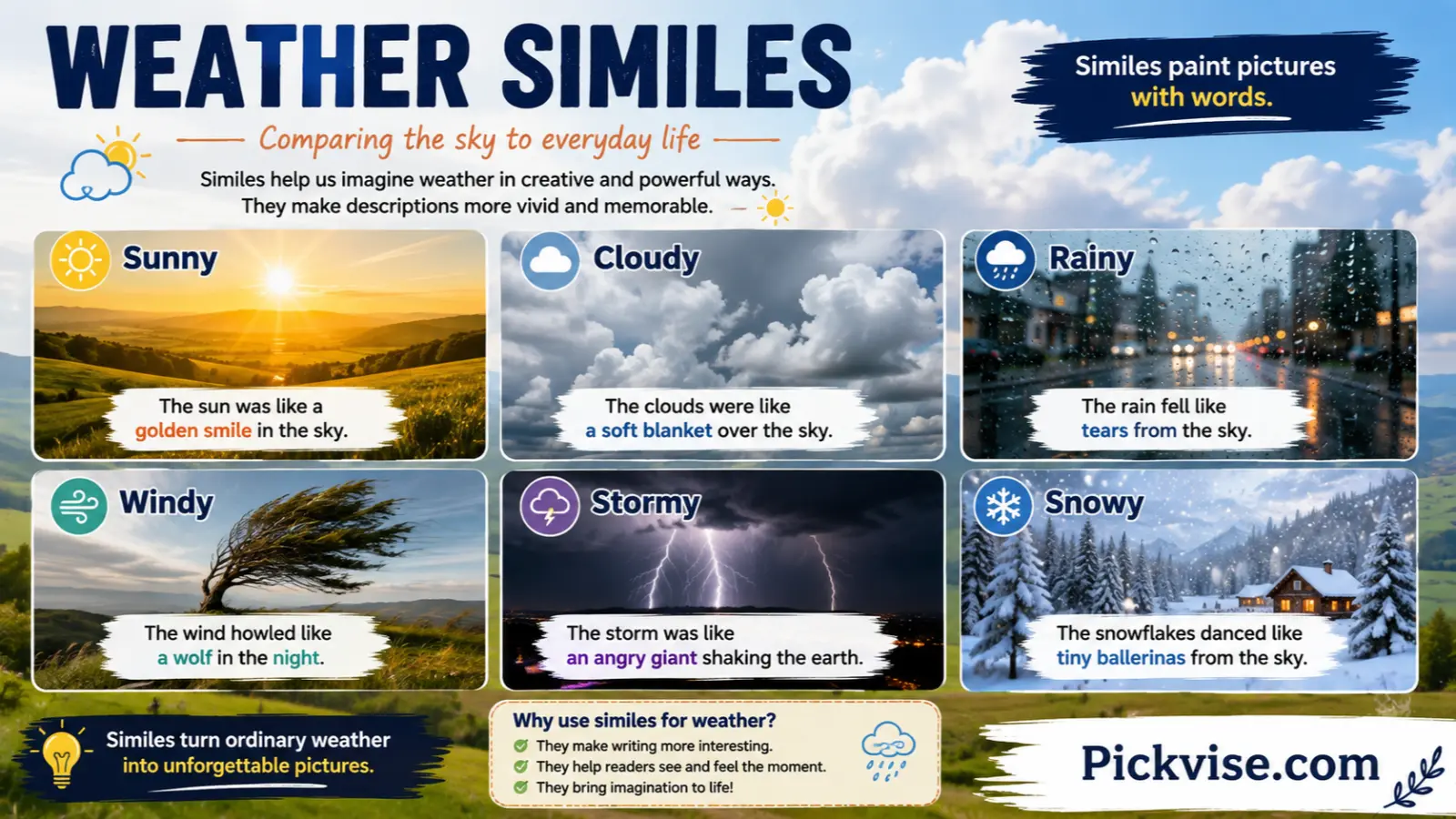
Weather Similes is one of the easiest subjects to describe and one of the easiest to describe badly. Saying that the rain was “heavy” tells readers what happened, but a carefully chosen simile can help them feel the scene.
A simile compares two different things using words such as like or as. In weather writing, it can turn a gray sky into a mood, make wind seem almost alive, or transform ordinary sunlight into something memorable.
Writers use weather similes in novels, poems, essays, speeches, songs, storytelling, and everyday conversation. The best comparisons do more than decorate a sentence—they reveal atmosphere, emotion, movement, or character.
This collection of weather similes focuses on original, adaptable comparisons and explains how to use them without making your writing sound forced.
What Are Weather Similes?
Weather similes are comparisons that describe weather by connecting it to another familiar image.
For example:
The rain fell like silver threads from the clouds.
The rain is not literally made of silver threads. The comparison helps readers imagine its thin, continuous appearance.
A strong weather simile usually gives the reader at least one useful detail: shape, sound, movement, temperature, color, intensity, or emotional atmosphere.
Quick Answer: What Are Some Good Weather Similes?
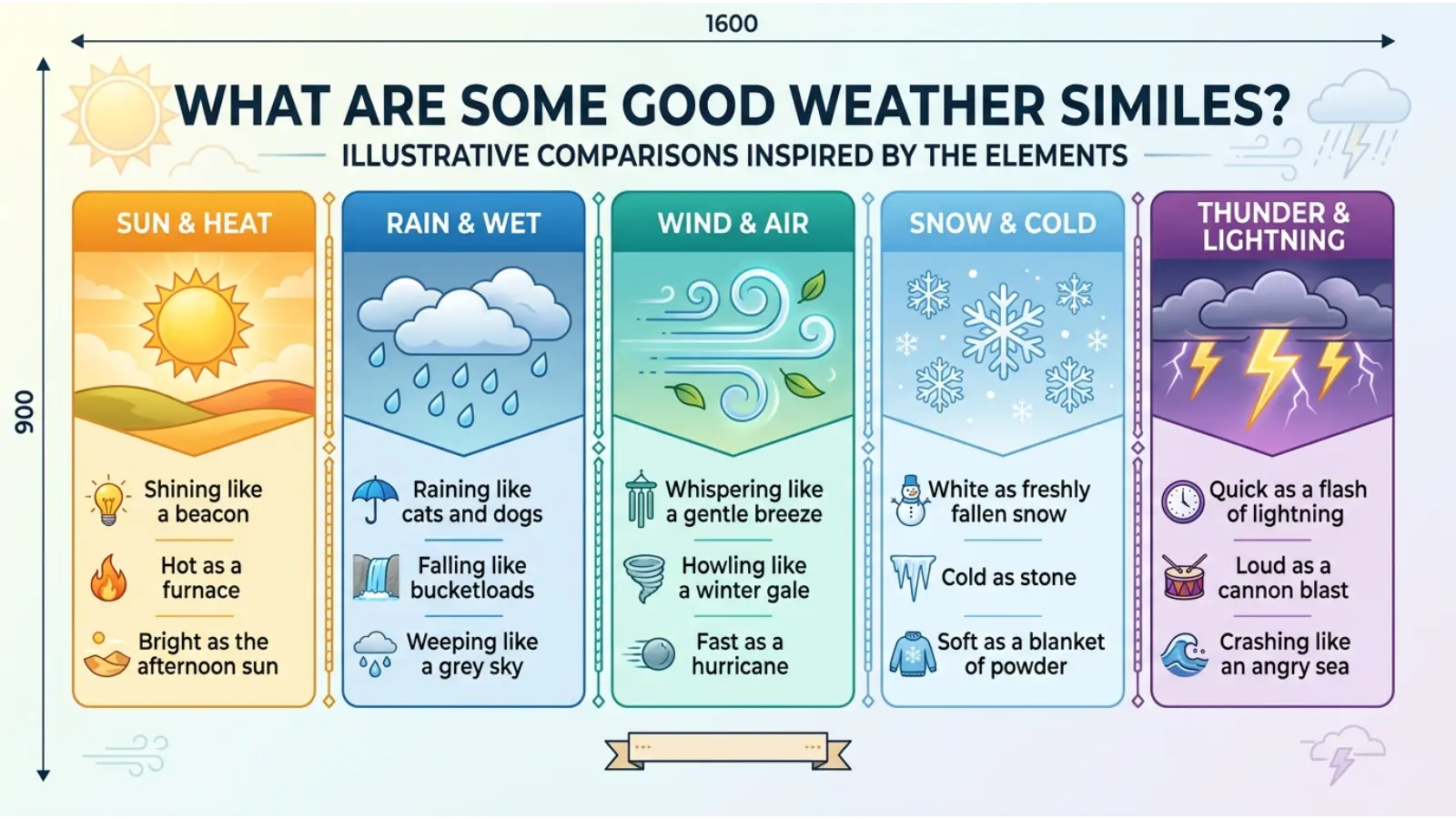
Here are a few original examples:
- The clouds gathered like quiet ships waiting beyond the horizon.
- The wind slipped through the trees like a secret being passed from branch to branch.
- The rain tapped the roof like impatient fingers.
- The sunlight spilled across the field like warm honey.
- The fog curled around the road like a pale ribbon.
- The thunder rolled like furniture being dragged across the sky.
- The snow covered the rooftops like soft white blankets.
- The storm moved toward the town like a dark curtain closing across a stage.
These comparisons work because they give ordinary weather a recognizable shape, sound, or movement.
Weather Similes for Rain
1. The Rain Fell Like Silver Threads
Meaning: The rain appears thin, continuous, and shining.
This simile works particularly well for gentle rainfall during daylight. The image of threads suggests that the drops seem connected as they fall.
Example:
The rain fell like silver threads beyond the kitchen window.
By afternoon, the rain hung like silver threads between the trees.
Writing tip: Use this comparison when you want rain to feel delicate rather than violent.
2. The Rain Drummed on the Roof Like Busy Fingers
Meaning: The comparison focuses on the rapid sound of raindrops.
Example:
Rain drummed on the roof like busy fingers while everyone sat quietly inside.
The image gives the weather a rhythm without literally saying that the rain was loud.
Best context: Stories, cozy scenes, children’s writing, and atmospheric descriptions.
3. The Rain Swept Across the Street Like a Gray Curtain
This comparison emphasizes how rainfall can obscure what lies beyond it.
Example:
The rain swept across the street like a gray curtain, hiding the buildings behind a watery blur.
Why it works: A curtain blocks vision, so the comparison immediately communicates reduced visibility.
4. The Rain Arrived Like an Uninvited Guest
This version gives rainfall a human quality.
Example:
The rain arrived like an uninvited guest just as the picnic began.
It works especially well when weather interrupts someone’s plans.
Writing purpose: Use it to connect weather with a character’s frustration, surprise, or disappointment.
Similes for Wind
5. The Wind Slipped Through the Trees Like a Whisper
The comparison makes the wind feel quiet and secretive.
Example:
The wind slipped through the trees like a whisper, barely disturbing the sleeping garden.
This is useful for peaceful nighttime scenes.
6. The Wind Pushed Against the Windows Like a Restless Crowd
Here, the wind becomes persistent and energetic.
Example:
The wind pushed against the windows like a restless crowd demanding to be heard.
Emotional effect: The comparison creates tension and makes the weather seem threatening.
7. The Wind Raced Across the Field Like a Child Late for Home
This gives the wind speed and personality.
Example:
The wind raced across the empty field like a child late for home.
The comparison works because it combines movement with emotion instead of merely saying “the wind was fast.”
8. The Cold Wind Bit Like Tiny Needles
This comparison focuses on physical sensation.
Example:
The cold wind bit like tiny needles whenever I stepped outside.
Writing tip: Comparisons involving touch can make weather descriptions much more immediate.
Similes for Clouds and the Sky
9. The Clouds Gathered Like Ships on a Distant Sea
The sky becomes a landscape.
Example:
Dark clouds gathered like ships on a distant sea above the mountains.
This simile works particularly well before a storm.
10. The Clouds Drifted Like Torn Pieces of Cotton
This comparison suggests soft, scattered clouds.
Example:
Small clouds drifted across the blue sky like torn pieces of cotton.
Best context: Peaceful daytime descriptions.
11. The Storm Clouds Hung Like a Heavy Ceiling
This simile communicates both appearance and pressure.
Example:
Storm clouds hung over the village like a heavy ceiling.
The comparison makes the sky feel unusually low and oppressive.
12. The Morning Sky Blushed Like a Painted Window
This comparison suits colorful sunrise scenes.
Example:
The morning sky blushed like a painted window as the sun climbed above the hills.
Writing tip: Color-based similes are especially effective when the color itself contributes to the mood.
Similes for Sunshine
13. Sunlight Spilled Across the Floor Like Warm Honey
This familiar physical image can make sunlight feel thick, golden, and comforting.
Example:
Sunlight spilled across the wooden floor like warm honey.
The word “spilled” also strengthens the image by suggesting movement.
14. The Sun Rose Like a Golden Lantern
Meaning: The comparison emphasizes brightness against a darker background.
Example:
The sun rose like a golden lantern above the quiet rooftops.
This works well in poems and reflective descriptions.
15. Sunbeams Stretched Through the Trees Like Golden Ribbons
This simile gives individual beams a visible shape.
Example:
Sunbeams stretched through the trees like golden ribbons.
Best context: Forests, gardens, parks, and peaceful outdoor scenes.
Similes for Storms
16. The Storm Rolled In Like a Dark Army
This comparison presents the storm as large, organized, and intimidating.
Example:
The storm rolled in like a dark army from beyond the hills.
Emotional effect: It creates anticipation and danger without needing graphic or dramatic details.
17. Thunder Rolled Like Furniture Across the Sky
The unusual comparison makes thunder feel physical and heavy.
Example:
Thunder rolled like furniture being dragged across the sky.
Why it works: Readers can recognize the rough, low sound even though thunder obviously is not furniture.
18. Lightning Flashed Like a Camera in the Clouds
This simile focuses on lightning’s sudden brightness.
Example:
Lightning flashed like a camera in the clouds, illuminating the landscape for an instant.
The comparison is particularly accessible in modern writing because readers understand the sudden burst of a camera flash.
19. The Storm Passed Like a Door Slamming Shut
This emphasizes suddenness and finality.
Example:
The storm passed like a door slamming shut, leaving the streets strangely quiet.
Writing purpose: Use this when you want the transition from chaos to calm to feel abrupt.
Similes for Snow and Ice
20. Snow Covered the Rooftops Like Soft Blankets
The comparison makes the landscape feel quiet and sheltered.
Example:
Fresh snow covered the rooftops like soft blankets.
21. Snowflakes Drifted Like Feathers
This focuses on slow, gentle movement.
Example:
Snowflakes drifted through the street like feathers carried on a slow breeze.
Best context: Calm winter scenes.
22. Frost Clung to the Window Like Tiny White Branches
This gives frost an intricate visual pattern.
Example:
Frost clung to the window like tiny white branches spreading across the glass.
Writing tip: Look closely at what weather actually resembles. Specific observation usually creates stronger imagery than exaggerated comparisons.
Similes for Fog and Mist
23. Fog Crawled Across the Road Like a Pale Blanket
The comparison communicates both movement and reduced visibility.
Example:
Fog crawled across the road like a pale blanket before sunrise.
24. Mist Curled Around the Hills Like Loose Ribbon
This creates a soft, flowing image.
Example:
Morning mist curled around the hills like loose ribbon.
Emotional effect: It can make a setting feel peaceful, mysterious, or dreamlike depending on the surrounding language.
25. Fog Wrapped the Harbor Like a Secret
This is less about physical shape and more about atmosphere.
Example:
Fog wrapped the harbor like a secret, hiding the boats beyond the shore.
Writing purpose: This type of simile is useful when weather helps create mystery.
Similes for Heat and Humidity
26. The Afternoon Heat Pressed Down Like a Heavy Hand
The comparison makes heat feel almost physical.
Example:
The afternoon heat pressed down like a heavy hand over the empty playground.
27. The Air Felt Like a Warm, Wet Towel
This is an intentionally sensory comparison.
Example:
The air felt like a warm, wet towel against my face.
Why it works: Readers can immediately understand unpleasant humidity through touch.
28. The Pavement Shimmered Like Glass
This focuses on the visual distortion caused by intense heat.
Example:
The pavement shimmered like glass beneath the afternoon sun.
Best context: Road scenes, summer descriptions, travel writing, and fiction.
How Weather Similes Can Create Emotion
Weather and emotion often appear together in writing, but writers should avoid assuming that every storm represents sadness or every sunny day represents happiness.
A more interesting approach is to let context determine the emotion.
Rain can feel comforting when someone is safe indoors. The same rain can feel frustrating when a character is trying to travel.
Likewise, sunlight can feel joyful, harsh, peaceful, or exhausting depending on the scene.
For example:
The rain tapped the roof like impatient fingers.
The same sound could be described differently:
Rain whispered against the roof like someone telling an old story.
The weather has not changed. The writer’s perspective has.
That is an important lesson in creative writing: imagery does not simply describe a scene; it reveals how the scene is being experienced.
How to Make Weather Similes More Vivid
A weak weather simile usually tells readers something they already know.
For example:
The wind was fast like a fast runner.
The comparison adds very little.
A stronger version might focus on a distinctive action:
The wind raced between the buildings like a messenger who had forgotten the road.
Now the comparison introduces movement, personality, and a small mystery.
When creating your own weather similes, ask:
- What does the weather look like?
- What does it sound like?
- What does it feel like?
- What does it remind me of?
- What emotion should the scene create?
- What unusual object or action shares that quality?
The last question often produces the freshest ideas.
Avoiding Cliché Weather Similes
Weather descriptions are especially vulnerable to clichés because writers have used the same comparisons for generations.
That does not mean familiar similes are always wrong. A common expression can be appropriate in casual writing or dialogue.
However, literary writing often becomes more memorable when the comparison reflects a specific observation.
Instead of immediately writing:
The clouds were like cotton.
Look at the clouds more carefully.
Are they:
- torn apart by wind?
- stacked above one another?
- glowing around the edges?
- stretched thin across the horizon?
- dark underneath but bright above?
Specific observation gives you more possibilities.
What Professional Writers Notice About Weather
Strong description often begins before the simile.
A skilled writer may notice that rain:
- changes the sound of a street,
- darkens wooden surfaces,
- reflects headlights,
- makes clothing heavier,
- blurs distant objects,
- changes the smell of the air.
Only after observing those details does the writer choose a comparison.
This prevents similes from becoming decorative phrases that could be removed without affecting the scene.
Weather Similes in Different Types of Writing
In Fiction
Use weather similes to establish setting and character perspective.
The wind scratched at the trees like an impatient visitor.
The comparison can create tension before anything else happens.
In Poetry
Poetry allows more compression and experimentation.
Moonlight rested on the snow like a quiet promise.
The simile can carry both visual imagery and emotional meaning.
In Conversation
Keep the comparison short and natural.
It was raining like the sky had forgotten to turn off the tap.
A conversational simile does not need to sound literary.
In Children’s Writing
Choose concrete images that children can easily picture.
The clouds floated like giant ships across the blue sky.
Simple comparisons can still create strong mental pictures.
Simile vs. Metaphor: What’s the Difference?
A simile makes a comparison using words such as “like” or “as.”
The fog moved like smoke.
A metaphor makes the comparison directly.
The fog was smoke.
Both can create imagery, but they produce slightly different effects.
The simile leaves a little distance between the two ideas. The metaphor makes the identification stronger and more immediate.
Other Literary Devices That Work With Weather
Weather descriptions become richer when similes work alongside other devices.
Imagery appeals to the senses:
Cold rain tickled the back of my neck.
Personification gives weather human qualities:
The clouds sulked above the town.
Hyperbole deliberately exaggerates:
The thunder shook the entire world.
Alliteration repeats beginning sounds:
The cold clouds crowded the coast.
Symbolism gives weather a deeper meaning. A storm might represent conflict in one story, while rain might represent renewal in another.
The key is moderation. Using every device in one sentence usually makes the writing feel crowded.
How to Create Your Own Weather Similes
Try this simple five-step process.
Step 1: Observe the Weather
Do not start with a comparison. First identify what you actually see, hear, smell, or feel.
Step 2: Choose One Dominant Quality
Maybe the rain is:
- delicate,
- relentless,
- noisy,
- cold,
- sparkling,
- inconvenient.
Choose one.
Step 3: Brainstorm Unrelated Images
If the rain is relentless, think about things that are relentless:
- tapping fingers,
- a ticking clock,
- waves,
- footsteps,
- an endless queue.
Step 4: Test the Comparison
Write several versions.
The rain fell like footsteps.
The rain struck the roof like hundreds of impatient footsteps.
The second gives readers more information.
Step 5: Remove Anything That Does Not Help
If the simile does not improve the sentence, delete it.
Good writing is not about adding the most imagery. It is about choosing the imagery that matters.
Three Creative Exercises for Better Similes
Exercise 1: Describe One Storm in Three Moods
Describe the same storm as:
- peaceful,
- frightening,
- exciting.
This teaches you how word choice changes the emotional meaning of imagery.
Exercise 2: Ban Familiar Comparisons
Write five weather similes without using:
- clouds like cotton,
- rain like tears,
- snow like diamonds,
- wind like a hurricane.
The goal is not to avoid every familiar phrase forever. It is to train yourself to look for new images.
Exercise 3: Start With a Sound
Choose a weather sound—rain, thunder, wind, hail, or snow underfoot.
Ask:
“What else makes a similar sound?”
Then turn your answer into a simile.
This exercise is particularly useful because sound-based imagery is often overlooked.
Common Mistakes When Writing Weather Similes
Using Too Many Similes
A paragraph packed with comparisons can become exhausting.
Choose the one or two images that make the greatest difference.
Mixing Images
Avoid combining unrelated comparisons:
The wind roared like a whispering river of knives.
The reader has to process too many ideas at once.
Forcing a Comparison
If a simile feels strange simply because it is unusual, originality has gone too far.
A fresh comparison should still make sense.
Explaining the Simile Too Much
If the image is clear, trust the reader.
Instead of:
The rain fell like silver threads, meaning that the drops looked thin and shiny.
The first sentence may be enough.
Choosing a Weak Comparison
The object you compare your weather to should contribute something meaningful.
“Rain fell like water” is technically a comparison, but it teaches the reader almost nothing.
Forgetting the Character’s Perspective
A farmer, child, traveler, poet, and scientist may experience the same weather differently.
Let the point of view influence the comparison.
Frequently Asked Questions About Weather Similes
What is a good simile for weather?
A good weather simile compares a weather condition with something readers can easily visualize while adding a useful quality such as movement, sound, texture, or emotion. For example, “The fog wrapped the harbor like a secret” creates both an image and a mood.
What is a simile for rain?
Examples include “The rain fell like silver threads” and “The rain drummed on the roof like busy fingers.” Choose the comparison according to whether you want the rain to feel gentle, noisy, persistent, or dramatic.
What is a simile for wind?
A wind simile might be “The wind raced across the field like a child late for home.” It emphasizes speed while giving the weather a lively personality.
What is a simile for a storm?
You could write, “The storm rolled in like a dark army.” This creates a strong image of a large, threatening storm approaching from a distance.
What is a simile for clouds?
For soft clouds, try “The clouds drifted like torn pieces of cotton.” For threatening clouds, a comparison such as “The storm clouds hung like a heavy ceiling” creates a darker mood.
How do I make a weather simile more creative?
Start by observing one specific quality of the weather instead of searching for a comparison immediately. Then connect that quality to an unexpected but believable object, action, sound, or experience.
Can weather similes show emotion?
Yes. A weather comparison can influence the mood of a scene without directly naming an emotion. The same rain can seem comforting, lonely, irritating, mysterious, or joyful depending on the surrounding language.
Should I use weather similes in academic writing?
Use them carefully. Similes are most natural in creative, descriptive, persuasive, and personal writing. Formal academic writing usually prioritizes precise information over decorative imagery.
Conclusion
The strongest weather similes do more than make a sentence prettier. They help readers see, hear, feel, and interpret the weather through a particular perspective. A good comparison might turn rain into a rhythm, wind into movement, fog into mystery, or sunlight into warmth. The important part is not how unusual the comparison sounds. It is whether the image gives readers something meaningful to imagine. Next time you describe the weather, pause before writing the first familiar comparison that comes to mind. Observe one small detail, connect it to something unexpected, and ask whether the resulting image makes the scene clearer or more emotional. That is where an ordinary weather description can become memorable writing.

I am Helena Frost, a writer captivated by the beauty of language and the art of comparison. Through my words, I explore the world by turning ordinary moments into vivid similes and reflections. I enjoy crafting phrases that spark imagination, evoke emotion, and linger in the mind. My writing celebrates the subtle connections between people, nature, and the stories we live. For me, every sentence is an opportunity to reveal the extraordinary in the everyday.